
"Rest in peace" is said about the person who died, and "sorry for your loss" is said to the family who are still here. The ways to say rest in peace in English change with the place: a card, a funeral, a message online, or a text to a friend. Some are religious and some are not, and the everyday forms come first.
Other Ways to Say Rest in Peace in Everyday English
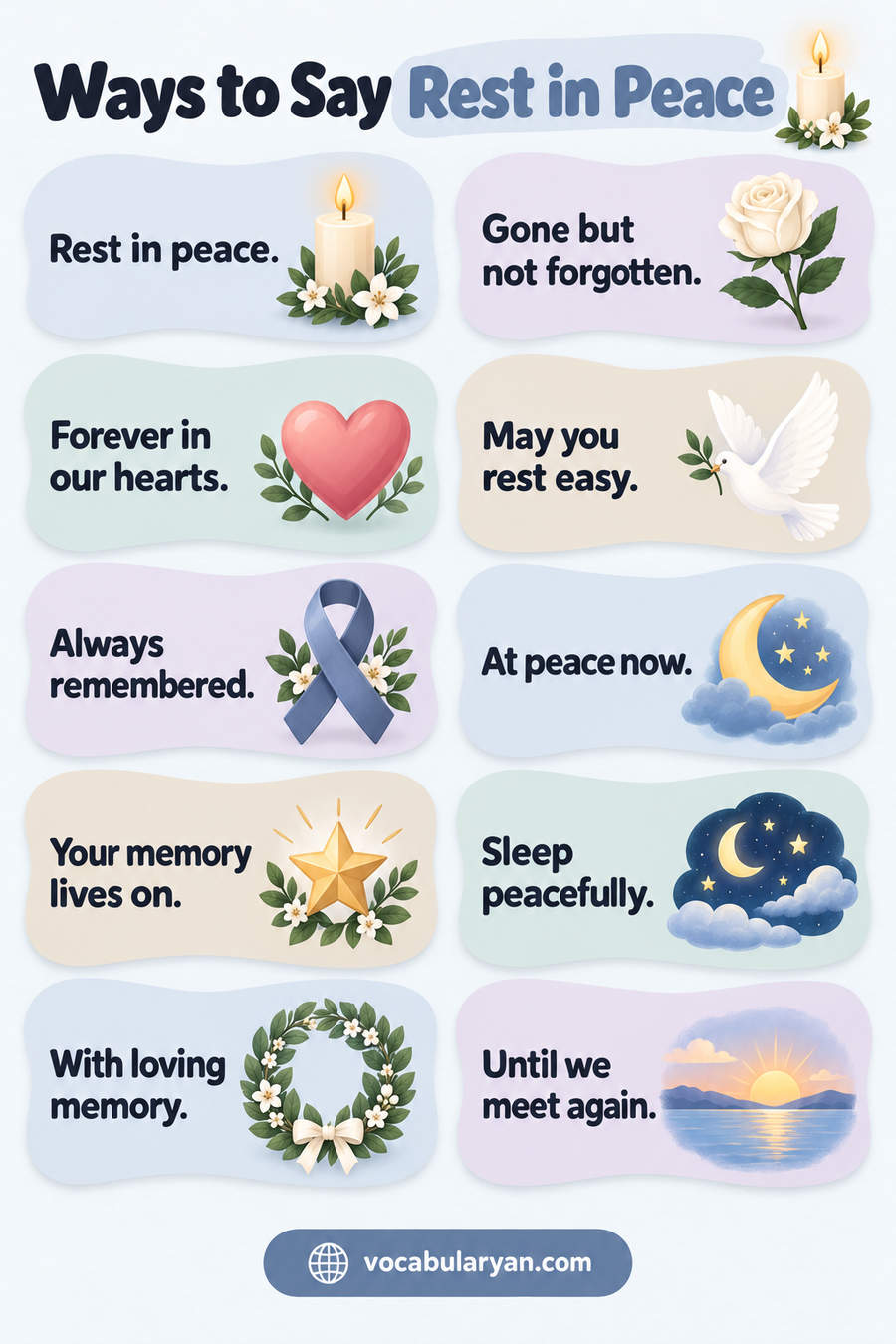
These six phrases fit almost any death, from a neighbour to a colleague’s parent, in speech and in writing.
Rest in peace: the standard wish for someone who has died, and it fits every level and every faith. It goes after the person’s name, or on its own line at the end of a message.
- Rest in peace, Mr Okafor, you taught half this town to drive.
- We lost our old headteacher last night. Rest in peace, sir.
- Rest in peace, Auntie Rose.
Rest easy: a warmer and more casual form of the same wish, common in messages between friends and family. It is not used in a formal notice.
- Rest easy, Dad, the garden is in good hands.
- Rest easy, Jamal, we’ll keep the band going.
- Such sad news about Pete. Rest easy, big man.
At peace now: the phrase for someone who was ill or in pain, because it means the pain has ended.
- Nan is at peace now, after two hard years.
- He’s at peace now, and that is what he wanted.
- She’s at peace now, surrounded by the people she loved right up to the end.
Gone but not forgotten: the line for a card, a gravestone, or an anniversary message, and it means the person is still remembered.
- Gone but not forgotten, our lovely Uncle Sam.
- Ten years today. Gone but not forgotten, Mum.
- The team wore black armbands for Coach Reyes, gone but not forgotten.
Forever in our hearts: a soft, warm line that fits a card or an online tribute from a whole family or a whole class.
- Forever in our hearts, Grandma Lin.
- Our little brother, forever in our hearts.
- She’s forever in our hearts, and her recipes are still on the kitchen wall.
Sleep well: a gentle wish that treats death as sleep, and it fits an older relative, a friend, or a pet.
- Sleep well, Grandad, you earned your rest.
- Sleep well, Aisha, the whole street will miss you.
- Goodnight and sleep well, old friend.
Write "rest in peace" when you are unsure, and keep "rest easy" for someone you knew well.
Ways to Say Rest in Peace on a Card or in a Funeral Book
A card or a funeral book line is short, written by hand, and read by the family, so it names the person warmly.
In loving memory: the most common first line on a card, a flower card, or a memorial page, and it goes before the name.
- In loving memory of Harold James Bell, 1941 to 2026.
- In loving memory of a wonderful teacher and friend.
- Flowers arrived with one line: in loving memory of Sofia.
Forever remembered: a short line for a funeral book or a plaque, and it means the memory will not fade.
- Uncle Tariq, forever remembered for his terrible jokes and his kind heart.
- Forever remembered by the Year 6 class of 2019.
- Our neighbour Ann, forever remembered.
Always in our thoughts: a line that fits an anniversary card or a bench plaque, and it is warm without being religious.
- Dad, always in our thoughts, especially on Sunday mornings.
- Always in our thoughts, from everyone at the clinic.
- Three years on and you’re always in our thoughts, Maria.
Until we meet again: a hopeful line that treats death as a parting, and it fits a faith card or a plain one.
- Goodbye for now, Grandad. Until we meet again.
- Until we meet again, my dear friend.
- She signed the funeral book with four words: until we meet again.
Gone too soon: the line for someone who died young or suddenly, and it fits a card, a tribute, or a sports shirt.
- Danny, gone too soon at twenty-two.
- Gone too soon, but never far from our thoughts.
- The whole village turned out for Lucy, gone too soon.
Write "in loving memory" on a card and "until we meet again" in a funeral book, and add the person’s name every time.
Ways to Say Rest in Peace When You Speak at a Funeral
Spoken lines at a funeral are said to the room, and each one closes a memory or a speech with warmth.
He’s at rest: a calm spoken line for a eulogy or a quiet word at the graveside, and it fits a long illness.
- After a hard year, he’s at rest, and we can be glad of that.
- She’s at rest now, next to Grandad, where she wanted to be.
- He’s at rest, and the garden he planted is in full flower.
A life well lived: the line that sums up a long and full life, and it fits the end of a speech about a grandparent.
- Ninety-two years, four children, and a café that fed the whole town: a life well lived.
- We are not here only to cry, we are here to celebrate a life well lived.
- Raise a glass to Frank, a life well lived.
We’ll miss you: a direct spoken goodbye said to the coffin or the photo, and it is the most natural close to a eulogy.
- We’ll miss you, Mum, every single day.
- We’ll miss you at the Sunday match, Coach.
- Goodbye, Leila. We’ll miss you more than we can say.
Farewell: the formal spoken goodbye, and it fits a minister, a colleague, or a friend closing a speech.
- Farewell, dear friend, and thank you for everything.
- We say farewell today to a man who never turned anyone away.
- Farewell, Professor Kaur, and rest in peace.
Close a funeral speech with "we’ll miss you" for family and "farewell" for a colleague.
Ways to Say Rest in Peace in a Social Post or Public Tribute
A tribute online is short, public, and read by strangers as well as friends, so the lines are warm and a little bigger than everyday speech.
Fly high: a casual tribute line for someone young or full of energy, and it is common under a photo.
- Fly high, Marcus, the pitch won’t be the same.
- Fly high, little sister.
- Heartbroken today. Fly high, Ellie.
Heaven gained an angel: a soft, popular tribute line, mostly for a child, a mother, or a very kind person.
- Heaven gained an angel last night. Rest in peace, Nana.
- Heaven gained an angel today, and we lost our best friend.
- Goodbye, sweet Amara. Heaven gained an angel.
Gone but never forgotten: the stronger form of "gone but not forgotten", and it fits an anniversary tribute online.
- One year today. Gone but never forgotten, Dad.
- Gone but never forgotten, our captain and our friend.
- Rest in peace, Auntie Bea, gone but never forgotten.
Your memory lives on: a line that speaks to the person directly and fits a public tribute from a school, a club, or a company.
- Your memory lives on in every student you taught, Mrs Diaz.
- Rest in peace, Sam. Your memory lives on in this club.
- Your memory lives on in the garden you planted at the hospice.
Forever young: the line for someone who died young, and it means the person will never grow old in memory.
- Forever young, Jay. Rest in peace.
- Twenty-one forever. Forever young, our girl.
- Forever young, and forever the loudest voice in the room.
Under a photo, write the person’s name, one line such as "fly high", and "rest in peace", and keep it to two lines.
Ways to Say Rest in Peace in a Text to a Friend
A text about a death is short and honest, and it goes to a friend who knew the person or who has just lost someone.
Rest easy, mate: a warm, casual line for a friend’s tribute in a group chat, and it fits British and Australian friends.
- Rest easy, mate, we’ll have a pint for you on Friday.
- Just heard about Dev. Rest easy, mate.
- Rest easy, mate, you were the best of us.
Can’t believe he’s gone: the line for shock, said in the first hours after the news, and it fits a text between friends.
- Can’t believe he’s gone. I only saw him last week.
- Can’t believe she’s gone, are you okay?
- I can’t believe he’s gone. Rest in peace, Tom.
She was one of the good ones: a casual line of praise for the person who died, and it fits a text to a friend who knew her.
- She was one of the good ones. Rest in peace, Mrs Hall.
- I’m gutted. He was one of the good ones.
- She was one of the good ones, and the whole office knew it.
I’m so sorry for your loss: the line to the friend, not about the dead person, and it is the one condolence to send to someone who has lost a relative. A whole page on ways to say sorry for your loss covers the rest of those phrases.
- I’m so sorry for your loss, Priya. Your grandad was a lovely man.
- I’m so sorry for your loss. Call me any time, day or night.
- I’m so sorry for your loss, I’m here if you need anything at all.
"Rest in peace" is said about the person who died, and it sounds cold as the only line to the friend who lost them.
- Rest in peace to your mum. ❌ (as the whole text to a friend)
The friend needs a line addressed to them, so the condolence comes first and the wish for the person second.
- I’m so sorry for your loss, Nadia. Rest in peace to your mum, she was wonderful. ✅
Text the friend "I’m so sorry for your loss" first, and add "rest in peace" for the person after it.
Formal Ways to Say Rest in Peace in an Email or Notice
A formal notice goes to a company, a school, or a newspaper, and each line is written in full with no contractions.
It is with great sadness that we announce: the standard opening of a death notice from a company, a club, or a family, and it goes before the name.
- It is with great sadness that we announce the death of our founder, Mr David Ross.
- It is with great sadness that we announce that Dr Helen Mbeki passed away on Tuesday.
- It is with great sadness that we announce the passing of our colleague and friend, Luis Ortega.
Passed away peacefully: the formal way to say "died", and it fits a notice, an obituary, or an email to staff.
- Margaret passed away peacefully at home on 3 June, aged 88.
- Our former chairman passed away peacefully in hospital, with his family beside him.
- She passed away peacefully after a short illness.
Will be greatly missed: the formal line that says the person was valued, and it closes a notice or an email.
- He will be greatly missed by colleagues, students, and friends.
- Anna will be greatly missed by everyone at the practice.
- A kind and patient teacher, she will be greatly missed.
In memoriam: the Latin title line for a formal tribute, a newspaper notice, or a plaque, and it goes before the name and the dates.
- In memoriam: Professor Alan Whitfield, 1950 to 2026.
- The journal opens with a page in memoriam for its late editor.
- In memoriam, Sergeant Kwame Boateng.
Our deepest condolences to the family: the formal line addressed to the relatives, and it closes a notice or an email from a company. It is a condolence, and the page on ways to say sorry for your loss covers its relatives.
- Our deepest condolences to the family at this sad time.
- We send our deepest condolences to the family and to all who knew her.
- Our deepest condolences to the family, friends, and former colleagues of Mr Ross.
The abbreviation "RIP" belongs to texts and online tributes, and it looks careless in a printed notice.
- RIP Mr David Ross, founder of Ross and Sons. ❌ (in a company notice)
A formal notice writes the phrase in full, with "may" for the wish.
- May he rest in peace. David Ross, founder of Ross and Sons. ✅
The wishes on this page run from a short text to a formal notice, and the table sorts them.
| Level | Phrases | Who it fits |
|---|---|---|
| Slang | RIP, fly high, rest easy mate | Friends in a text or a group chat |
| Casual | Rest easy, sleep well, gone too soon | Friends, family, tributes online |
| Neutral | Rest in peace, at peace now, gone but not forgotten | Anyone, on a card or in speech |
| Formal | May she rest in peace, in loving memory, passed away peacefully | Notices, emails, funeral speeches |
| Very formal | Eternal rest grant unto him, in memoriam | Church services, obituaries, plaques |
Write "it is with great sadness that we announce" to open a notice, "passed away peacefully" for the death, and "may he rest in peace" in full at the end.
Ways to Say Rest in Peace for a Public Figure
A tribute to a singer, an actor, or a politician is public, and it speaks about the person’s work as well as the death.
Rest in peace, legend: the most common online tribute for a musician, an athlete, or an actor, and it fits a fan who never met the person.
- Rest in peace, legend, your songs got me through school.
- Rest in peace, legend. Nobody will ever play like that again.
- Rest in peace, legend, thank you for thirty years of goals.
Thank you for the memories: a warm tribute that names what the person gave, and it fits a fan or a colleague.
- Thank you for the memories, and rest in peace.
- Thank you for the memories, Coach. That final in 2009 was the best night of my life.
- Rest in peace, and thank you for the memories.
End of an era: the line for a public figure whose career defined a period, and it goes with "rest in peace" in the same tribute.
- End of an era. Rest in peace, Sir Michael.
- The last of the great newsreaders has gone. End of an era.
- End of an era for British comedy. Rest in peace.
What a life: a short tribute for a long, full, public life, and it sounds admiring rather than sad.
- Ninety-six years, three Oscars, and a garden full of roses. What a life.
- What a life. Rest in peace, Madam President.
- What a life she had, and what a loss for all of us.
Write "rest in peace, legend" for a musician or an athlete, and "end of an era" for someone whose work shaped a whole period.
Ways to Say Rest in Peace for a Pet
A tribute to a pet is warm and personal, and it treats the animal as a member of the family.
Run free: the most common line for a dog or a horse, and it means the animal is free from age and illness.
- Run free, Max, the best dog a boy ever had.
- Run free, old girl, no more sore legs.
- She was fourteen and still chasing the ball last month. Run free, Bella.
Over the rainbow bridge: the phrase for the place pets go after death, and it fits a tribute online or a card from a vet.
- Our sweet Tabby went over the rainbow bridge this morning.
- Rest in peace, Rex, over the rainbow bridge at fourteen.
- He crossed over the rainbow bridge with his head in my lap.
Good boy, rest now: a tender goodbye to a dog, and it echoes the words the dog heard every day.
- Good boy, rest now, Buster. You did so well.
- Good girl, rest now, my Daisy.
- Good boy, rest now. Thank you for twelve years of walks.
Sleep well, little one: the line for a small pet, a cat, or a rabbit, and it fits a child’s card or a message to a friend.
- Sleep well, little one. The garden is quiet without you.
- Goodbye, Mochi. Sleep well, little one.
- Sleep well, little one, you were loved every day of your life.
Write "run free" for a dog and "sleep well, little one" for a cat or a small pet, and add the pet’s name.
Religious and Non-Religious Ways to Say Rest in Peace
Some wishes name God or heaven, and some do not, and the choice follows the faith of the person who died.
Religious Forms
May she rest in peace: the full form of the wish, from the Latin prayer, and it is said after the name of a dead person in Catholic and Anglican families.
- My grandmother, may she rest in peace, made this cake every Christmas.
- May he rest in peace and rise in glory.
- Father Tom, may he rest in peace, baptised every child in this parish.
God rest his soul: a spoken wish said at once after naming someone who has died, common in Britain, Ireland, and the American South.
- My father, God rest his soul, never missed a match.
- Old Mrs Kelly, God rest her soul, taught me to knit.
- God rest his soul, he was the kindest man on the street.
Eternal rest grant unto him: the first line of the Catholic prayer for the dead, and it fits a funeral card, a Mass card, or a formal notice.
- Eternal rest grant unto him, O Lord, and let perpetual light shine upon him.
- The card read: eternal rest grant unto her, O Lord.
- Eternal rest grant unto them, and rest in peace.
Rest in God’s care: a gentle Christian wish that fits a card or a spoken line to a family of faith.
- Rest in God’s care, dear Ruth.
- Grandad is resting in God’s care now.
- Rest in God’s care, and thank you for a lifetime of love.
May his memory be a blessing: the Jewish wish said after the name of someone who has died, and it fits a card, a message, or a formal tribute.
- Rabbi Cohen, may his memory be a blessing, led this community for forty years.
- May her memory be a blessing. She fed everyone who walked through her door.
- We remember Leah today, may her memory be a blessing.
To God we belong and to Him we return: the English form of the Muslim words said on hearing of a death, and it is said before any other line.
- To God we belong and to Him we return. Uncle Yusuf passed away this morning.
- To God we belong and to Him we return, and we ask for patience for the family.
- She heard the news and said quietly, "to God we belong and to Him we return".
Non-Religious Forms
At rest: the shortest neutral form, and it fits a plaque, a bench, or a quiet spoken line.
- Our dear friend Bill, at rest at last.
- At rest after a long and full life.
- She is at rest, and her books are still on every shelf in the house.
Sleep peacefully: a soft wish with no mention of God, and it fits a card or a tribute for a friend of any faith or none.
- Sleep peacefully, Grandma, and thank you for everything.
- Sleep peacefully, Ali, the fight is over.
- Goodnight, Dad. Sleep peacefully.
Never forgotten: two words that fit a wristband, a shirt, a tattoo, or a card, and they mean the memory stays.
- Jess, 1998 to 2026, never forgotten.
- Loved always, never forgotten.
- Never forgotten, our Sunday league captain.
Goodbye and thank you: a plain, warm farewell for a colleague, a teacher, or a neighbour, and it needs no faith at all.
- Goodbye and thank you, Mrs Adebayo. You changed my life at eleven.
- Goodbye and thank you, Doctor. Thirty years of care.
- Goodbye and thank you for the laughs, Ray.
Use "may she rest in peace" or "God rest his soul" with a family of faith, and "at rest" or "sleep peacefully" with anyone else.
Ways to Say Rest in Peace for Someone Who Suffered Before Dying
After a long illness, the wish names the end of pain, and it comforts the family who watched the illness.
No more pain: the plain line for someone who was ill or in pain for a long time, and it fits a text, a card, or a spoken word.
- No more pain, Dad. Rest now.
- She’s gone, and there is no more pain.
- No more pain, no more hospitals. Rest in peace, Grandma.
Free at last: the line for someone whose body had failed them, and it treats death as release.
- Free at last, after five years of fighting.
- Rest in peace, Uncle Ken, free at last.
- Free at last, and dancing again, I hope.
At peace at last: a stronger form of "at peace now", and it fits the end of a long illness or a hard life.
- Mum is at peace at last.
- At peace at last, after a long and brave fight.
- He’s at peace at last, and we are so grateful for the nurses who cared for him.
Her suffering is over: the line that names the illness directly, and it fits a family that has been caring for someone for months.
- Her suffering is over, and she went in her sleep.
- His suffering is over now, and he’s with Nan.
- We are sad, but her suffering is over, and that is a mercy.
Write "no more pain" in a text and "at peace at last" on a card, and keep both for a death after illness.
Short Ways to Say Rest in Peace
Short forms fit a text, a comment, a wristband, or a hashtag, and each one is two or three words at most.
RIP: the abbreviation of "rest in peace", said as three letters or as one word, "rip". It belongs to texts, comments, and captions, and it is wrong on a printed card, in a formal notice, or in a speech.
- RIP Mr Bell, best teacher ever.
- RIP Max, the goodest boy.
- Just seen the news about Chris. RIP mate.
R.I.P.: the same abbreviation with full stops, older and a little more formal, and it fits a gravestone or a cartoon tombstone.
- The stone read R.I.P. and nothing else.
- R.I.P. Nana Joan, 1938 to 2026.
- The children drew a small cross with R.I.P. on the pet’s grave.
At peace: two words for a text or a caption, and they fit a death after illness.
- Grandad’s gone. At peace.
- At peace now, after so long.
- She’s at peace, and we’re all together at the house.
Rest now: a tender two-word goodbye, spoken or texted, and it fits family and close friends.
- Rest now, Mum. We’ve got this.
- Rest now, Ben. You did enough.
- Goodnight, Dad. Rest now.
"RIP" in a formal card reads as a shortcut, and the family notices.
- RIP Margaret, with sympathy from all at Ross and Sons. ❌ (on a printed sympathy card)
A printed card takes the phrase in full, because the three letters look like a text message.
- Rest in peace, Margaret, with sympathy from all at Ross and Sons. ✅
Use "RIP" in a text or a comment, and write "rest in peace" in full anywhere the family will keep the card.
Regional Ways to Say Rest in Peace in English
English-speaking countries each keep a few death phrases of their own, and the right one sounds natural to a local family.
British Ways to Say Rest in Peace
God rest her: the short British and Irish form of "God rest her soul", said in the middle of a story about someone who has died.
- My nan, God rest her, kept a sweet jar by the door.
- Old Mr Price, God rest him, ran the paper shop for fifty years.
- God rest her, she never once missed a Sunday.
Bless him: a fond British word said after the name of someone who has died, warm rather than religious in everyday use.
- Grandad, bless him, still called it the wireless.
- She was ninety-four, bless her, and sharp to the end.
- Bless him, he’d have hated all this fuss.
Sleep well, mate: the British and Australian tribute for a male friend, and it fits a text, a pub tribute, or a football shirt.
- Sleep well, mate, we’ll save you a seat at the match.
- Sleep well, mate. Best man at my wedding and the best man I knew.
- Gutted. Sleep well, mate.
American Ways to Say Rest in Peace
Rest in power: an American tribute for someone who fought for a cause, from the Black American tradition, and it fits an activist, an artist, or a community leader.
- Rest in power, Reverend Hayes. The march goes on.
- Rest in power, sister. You spoke for all of us.
- The mural says rest in power above her name.
Rest in paradise: an American tribute, common in music and sports communities, and it fits a young person or a friend.
- Rest in paradise, Tay. Your verse stays on repeat.
- Rest in paradise, my brother.
- Rest in paradise, Coach D.
Sleep well, buddy: the American form of "sleep well, mate", said to a male friend or a dog.
- Sleep well, buddy. Saturday mornings won’t be the same.
- Sleep well, buddy, you were a great dog.
- Sleep well, buddy, we’ll take care of your mom.
Irish Ways to Say Rest in Peace
The Lord have mercy on him: the Irish spoken wish said at once after the name of a dead person, older and Catholic, and still common in the west of Ireland.
- My grandfather, the Lord have mercy on him, cut turf until he was eighty.
- Old Seamus, the Lord have mercy on him, knew every song in the parish.
- The Lord have mercy on her, she was a great woman for the cards.
Sorry for your trouble: the Irish condolence to the family, said at the wake and the funeral, and it is the Irish form of "sorry for your loss".
- Sorry for your trouble, Mary. He was a gentleman.
- Sorry for your trouble, the whole parish will miss her.
- Everyone at the wake said the same two words, "sorry for your trouble".
Use "God rest her" in Britain, "rest in power" or "rest in paradise" in America, and "the Lord have mercy on him" in Ireland, and use "rest in peace" everywhere else.
What Does the Family Say in Reply?
A wish for the dead person expects no reply, and a condolence to the family gets a short "thank you" and one warm line about the person.
Thank you, that means a lot: the standard reply to any condolence, in person or in a message, and it works at every level.
- Rest in peace, Mr Bell. Thank you, that means a lot to us.
- I’m so sorry for your loss. Thank you, that means a lot.
- She was one of the good ones. Thank you, that means a lot, she loved you too.
Thank you for coming: the reply at a funeral or a wake, said by the family at the door or by the coffin.
- Sorry for your trouble, Mary. Thank you for coming, Pat.
- Thank you for coming, it would have meant the world to him.
- Thank you for coming all this way, she talked about you so much.
He would have loved that: the reply to a tribute that names something about the person, and it keeps the memory alive for a moment.
- Rest easy, Coach, best man on the touchline. He would have loved that.
- Fly high, Ellie. She would have loved that, thank you.
- He would have loved that, he was so proud of the team.
Thank you for your kind words: the more formal reply, in an email, a card, or a notice from the family.
- Thank you for your kind words, they gave us great comfort this week.
- Thank you for your kind words and for the flowers.
- The family wishes to say thank you for your kind words and support.
We’re taking it one day at a time: the honest reply to "how are you all?" in the weeks after a death.
- How are you all doing? We’re taking it one day at a time.
- We’re taking it one day at a time, thanks for asking.
- We’re taking it one day at a time, and the house is very quiet.
Reply with "thank you, that means a lot", and add one line about the person if you have the strength for it.
More Everyday English Phrases
FAQs
The closest replacements are "rest easy", "at peace now", "sleep well", and "gone but not forgotten". "Rest easy" fits a friend, "at peace now" fits a death after illness, and "gone but not forgotten" fits a card or an anniversary. For a religious family, "may she rest in peace" or "God rest his soul" are the fullest forms.
The phrase goes after the person’s name, as in "rest in peace, Mr Bell", or on its own line at the end of a message. With "may" it goes after the name in the middle of a sentence, as in "my grandmother, may she rest in peace, made this cake every year". It is never used in the past tense, because it is a wish and not a report.
In a formal email or notice the phrase is written in full as "may he rest in peace". It comes after lines such as "it is with great sadness that we announce" and "passed away peacefully". "RIP" is never used in a professional message. For the family, the notice closes with "our deepest condolences to the family".
No, because "rest in peace" is said about the person who died, and the family needs a line addressed to them. Say "I’m so sorry for your loss" or "my deepest condolences" to the family first, and add "rest in peace" for the person after it. In Ireland the line to the family is "sorry for your trouble".
Yes, when the person or the family was not religious, or when the phrase feels too fixed for you. "At rest", "sleep peacefully", "never forgotten", and "goodbye and thank you" say the same thing with no mention of faith. Nobody at a funeral expects one set of words.
Yes, and it is the most common line on a memorial page, mostly with the person’s name and one more line such as "fly high" or "gone but never forgotten". "RIP" is fine in a comment or a caption. Keep a public tribute to two or three lines, because the family reads every one.
The phrase comes from the Latin prayer "requiescat in pace", which was carved on Christian graves and said at funerals for centuries. It is a wish that the dead person is free from pain and trouble. Over time it became the standard English farewell to the dead, for religious and non-religious families alike.
For a Christian family, "may she rest in peace", "God rest his soul", "eternal rest grant unto him", and "rest in God’s care" are the standard wishes. For a Jewish family the line is "may his memory be a blessing", and for a Muslim family the first words are "to God we belong and to Him we return". Each one is said after the person’s name.