
"See you later" promises a next meeting, and that promise is what separates it from "goodbye". Each of the ways to say see you later in English fixes the promise to a person or a time. "See you soon" fits a friend, "talk soon" fits a call, and "until next time" fits a client. The everyday forms fit almost everyone, so they come first.
Common Ways to Say See You Later in Everyday English
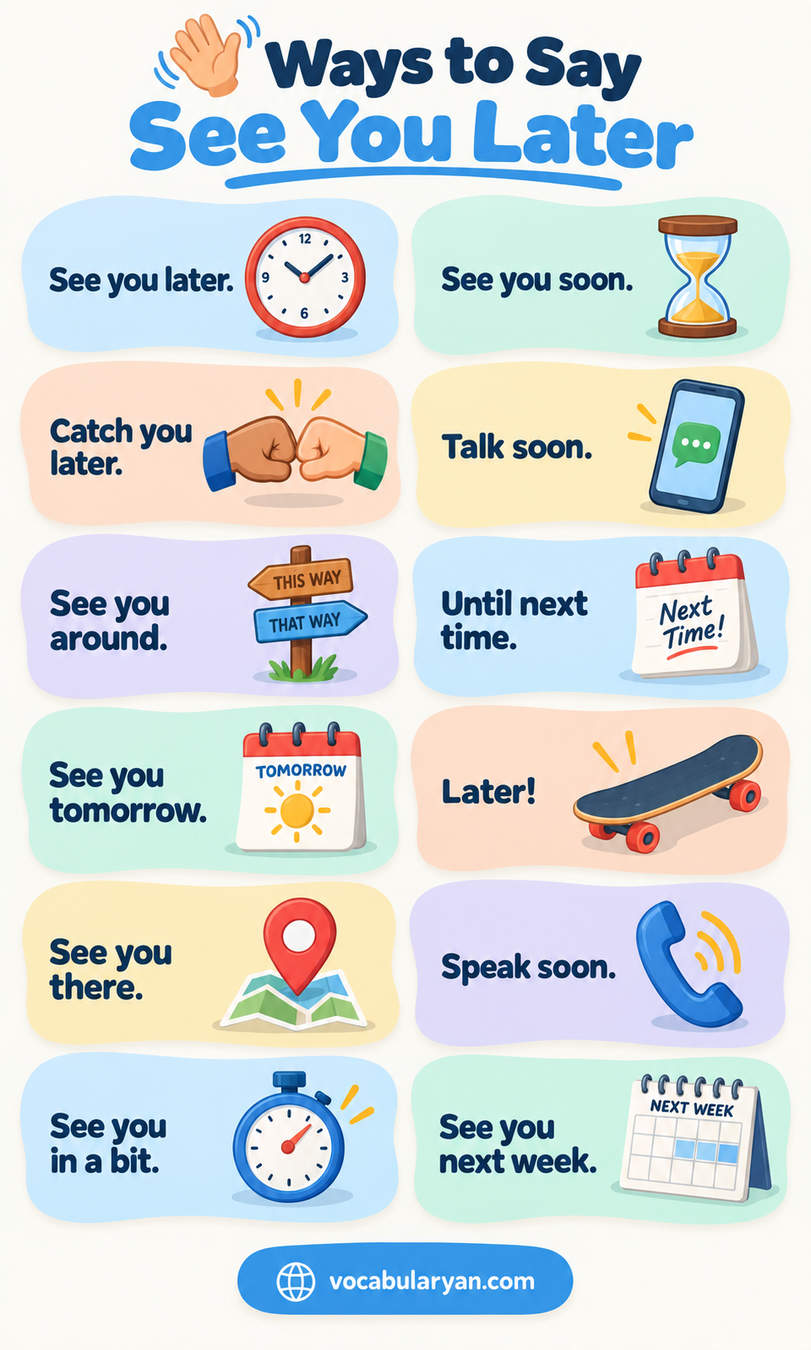
These eight farewells fit almost anyone, and each one promises that the two of you will meet or speak again.
See you: the shortest form, and it fits friends, family, and colleagues you meet every day. It sounds relaxed and never cold.
- See you, Priya, same time tomorrow?
- Right, I’m heading home, see you.
- See you, Dad, I’ll ring you when I land.
See you later: the full form, and it fits the same afternoon or a day next week, because "later" does not fix a time. Use it with anyone except a senior manager or a client.
- See you later, Marco, thanks for the coffee.
- I’m off to the gym now, see you later.
- See you later, everyone, drive safely.
See you soon: a warm promise of a meeting within days or weeks, and it fits a friend, a relative, or a colleague at another office.
- See you soon, Grandma, I’ll come on Sunday.
- Thanks for a lovely weekend, see you soon!
- See you soon, Ravi, good luck with the exam.
See you then: the farewell after you have agreed on a time. "Then" repeats that time without saying it again.
- Tuesday at ten? Perfect, see you then.
- See you then, Mrs Ali, the results will be ready.
- Okay, dinner at seven, see you then.
See you around: for someone you meet by chance rather than by plan, such as a neighbour or a classmate. It makes no promise of a date.
- Nice chatting, Sam, see you around.
- See you around, I’m in the library most afternoons.
- See you around, mate, say hi to your brother.
Talk to you later: the farewell for a call or a chat, and it fits anyone you speak to more than once a week. In American English it is the standard end to a friendly phone call.
- I’ve got to run, talk to you later.
- Talk to you later, Mum, my train’s here.
- Thanks for the update, talk to you later.
Catch you later: casual and friendly, and it fits friends and relaxed colleagues. To a customer it sounds too loose.
- Catch you later, Jess, enjoy the film.
- I’m heading out for lunch, catch you later.
- Catch you later, guys, thanks for the game.
Until next time: polite and a little formal, and it fits a customer, a host, or a friend you see a few times a year.
- Thank you for having us, until next time.
- Until next time, Mr Chen, safe travels.
- That was fun, until next time!
Say "see you later" when the next meeting has no date, and "see you then" once the date is fixed.
Casual Ways to Say See You Later to Friends
Casual farewells are for people who know you well, and each one is short, quick, and relaxed.
Later: one word, and the most common casual farewell between friends in American English. To a boss or a stranger it sounds rude.
- Later, Tom, text me when you get home.
- Okay, I’m done, later!
- Later, man, good game.
Laters: the British form of "later", said between friends and in texts. It sounds playful rather than rude.
- Laters, Dan, see you at practice.
- Right, that’s me, laters.
- Laters! Don’t forget my book.
See ya: "see you" spelled the way it sounds, and it fits texts and friends of any age.
- See ya, Lucy, thanks for the lift.
- See ya at the party on Saturday.
- See ya, I’ll bring the snacks.
Catch ya later: the loosest form of "catch you later", and it fits close friends and teammates.
- Catch ya later, Jay, good luck tonight.
- We’re leaving now, catch ya later!
- Catch ya later, I’ve got to pick up my sister.
Talk later: two words that end a chat or a call between friends, and they fit a text just as well.
- Got to go, talk later.
- Talk later, my food’s here.
- Okay, talk later, tell Ben I said hi.
See you in a bit: a promise to meet within the hour, and it fits partners, friends, and family in the same house or town.
- Just popping to the shop, see you in a bit.
- See you in a bit, I’m five minutes away.
- Save me a seat, see you in a bit.
See you in a while: softer than "in a bit", and the wait is longer, from an hour to a whole day.
- I’m going for a run, see you in a while.
- See you in a while, Mum, I’ll be at Leo’s.
- Okay, see you in a while, the meeting takes an hour.
See you when I see you: a relaxed farewell for a friend when neither of you knows the next date, and it sounds calm rather than sad.
- No plans yet, so see you when I see you.
- See you when I see you, Ana, have a great trip.
- We’ll sort it out later, see you when I see you.
Keep "later", "laters", and "catch ya later" for friends, and use "see you soon" with everyone else.
Formal Ways to Say See You Later at Work
Formal farewells fit a client, a manager, an interviewer, or a guest, and each one is a full sentence.
I look forward to seeing you again: the standard formal farewell for a client or a guest, said at the end of a meeting or a visit.
- I look forward to seeing you again, Ms Adams, thank you for your time.
- It was a pleasure, and I look forward to seeing you again in June.
- I look forward to seeing you again at the conference.
I look forward to our next meeting: a step more formal, and it fits a business partner or a committee. It names the meeting rather than the person.
- I look forward to our next meeting, Mr Petrov.
- Thank you all, I look forward to our next meeting on the third.
- I look forward to our next meeting, and I will send the notes today.
Until we meet again: very formal and a little old-fashioned, and it fits a speech, a farewell dinner, or a guest leaving for a long time.
- Until we meet again, my friends, thank you for a wonderful evening.
- Until we meet again, Professor Grant, safe journey home.
- The host raised his glass and said, "Until we meet again."
I’ll be in touch: a promise to call or write, and it fits an interviewer, a recruiter, or a colleague at the end of a meeting.
- Thank you for coming in, I’ll be in touch by Friday.
- I’ll be in touch once I have the figures.
- I’ll be in touch, Dr Okafor, about the next appointment.
See you at the meeting: neutral and polite, and it fits colleagues who share a calendar.
- See you at the meeting, Fatima, I’ll bring the slides.
- See you at the meeting at three, everyone.
- Thanks, Omar, see you at the meeting on Thursday.
I’ll see you then: the polite full form of "see you then", and the "I’ll" makes it fit a manager or a client after you fix a time.
- Nine o’clock on Monday, I’ll see you then, Mrs Novak.
- I’ll see you then, and thank you again for the invitation.
- Perfect, I’ll see you then.
Goodbye for now: polite and warm, and it fits a customer, a patient, or a guest when the next meeting is planned but not dated.
- Goodbye for now, Mr Lewis, the nurse will call you.
- Goodbye for now, and thank you for shopping with us.
- Goodbye for now, everyone, the course starts again in September.
The one farewell to avoid with a client is "catch you later", because it puts you on the level of a close friend.
- Catch you later, Ms Adams, thanks for the meeting. ❌
"Catch you later" belongs to friends, so with a client the farewell is a full formal sentence.
- I look forward to seeing you again, Ms Adams, thanks for the meeting. ✅
The next-meeting farewells sort into five levels, from slang to very formal.
| Level | Farewells | Who it fits |
|---|---|---|
| Slang | Later, laters, catch ya later, TTYL | Close friends your own age |
| Casual | See ya, catch you later, talk later, see you in a bit | Friends, family, relaxed colleagues |
| Neutral | See you, see you later, see you soon, see you then | Anyone you know by name |
| Formal | Until next time, I’ll be in touch, goodbye for now | Managers, clients, customers, older people |
| Very formal | I look forward to seeing you again, until we meet again | Guests of honour, interviews, speeches |
Use a full sentence with "I" for a client, and keep the two-word farewells for the people you see every day.
Ways to Say See You Later in an Email
An email farewell goes on the line before your name, and it names the next contact when there is one.
Speak soon: the warm sign-off between colleagues who talk by phone or video, and it is a British favourite.
- Thanks for the update, speak soon, Sara
- Speak soon, and let me know if Thursday works.
- I’ll send the draft tonight. Speak soon!
Talk soon: the American twin of "speak soon", and it fits colleagues and clients you know by first name.
- Talk soon, Mark, and thanks again for the intro.
- Great catching up today. Talk soon.
- Talk soon, I’ll call once the contract is signed.
Looking forward to seeing you on Thursday: the sign-off when the meeting date is set, and it fits every level from a friend to a client.
- Looking forward to seeing you on Thursday, Lena.
- Looking forward to seeing you on Thursday at the workshop.
- Thanks for confirming, looking forward to seeing you on Thursday.
See you on Monday: short and neutral, and it fits a colleague or a classmate at the end of a Friday email.
- Have a good weekend, see you on Monday.
- See you on Monday, and bring the signed forms.
- All done for the week, see you on Monday!
Until then: a polite sign-off that follows a named date earlier in the email, and it fits a client or a supplier.
- The meeting is on 4 March. Until then, best wishes, Ana
- Until then, please call me with any questions.
- I’ll have the report ready by Friday. Until then, thank you for your patience.
Catch up soon: friendly and a little casual, and it fits a colleague or a friend you write to now and then.
- Catch up soon, Priya, it’s been too long.
- Thanks for the photos, catch up soon!
- Catch up soon, maybe lunch next week?
I look forward to hearing from you: the formal sign-off when you wait for a reply rather than a meeting, and it fits a job application or a first email to a company.
- I look forward to hearing from you, Yours sincerely, Omar Haddad
- I look forward to hearing from you at your earliest convenience.
- Thank you for your time, and I look forward to hearing from you.
"Later" is a spoken farewell, and in an email to a customer it reads as careless.
- Later, Ms Adams, the invoice is attached. ❌
"Later" belongs to speech between friends, so the email sign-off to a customer is a full polite line.
- I look forward to hearing from you, Ms Adams, the invoice is attached. ✅
Write "speak soon" for a colleague, and "I look forward to hearing from you" for anyone whose reply you are waiting for.
Ways to Say See You Later on the Phone
A phone farewell promises the next call, and it comes right before "bye" at the end of the conversation.
Speak to you later: the British form of "talk to you later", and it fits friends, family, and colleagues.
- Okay, speak to you later, love.
- Speak to you later, Raj, I’ll have the answer by then.
- Right, the doorbell’s going, speak to you later.
Speak to you then: the phone form of "see you then", said after you agree on the time of the next call.
- Friday at four? Great, speak to you then.
- Speak to you then, Mrs Kaur, thank you for calling.
- Okay, speak to you then, bye.
I’ll call you later: a promise to ring back the same day, and it fits family and close colleagues.
- I’m in a meeting, I’ll call you later.
- I’ll call you later, Mum, the bus is here.
- Okay, I’ll call you later with the address.
Talk soon: two words, warm and quick, and they end a call with a friend, a partner, or a client you know well.
- Love you, talk soon.
- Talk soon, Sofia, and good luck tomorrow.
- Thanks for calling, talk soon!
Bye for now: a soft ending that says the break is short, and it fits a call, a video chat, or a radio show.
- Bye for now, I’ll ring you after the doctor.
- Bye for now, Kemi, give my love to the kids.
- That’s all from us today, bye for now.
I’ll let you go: a polite way to end a call that is running long, and it puts the other person’s time first.
- Anyway, I’ll let you go, speak later.
- I’ll let you go, you sound busy, talk tomorrow.
- It’s late, so I’ll let you go, night.
End a call with "speak to you later" or "talk soon" and then "bye", because the promise comes first and the goodbye second.
Ways to Say See You Later Over Text
Text farewells are short, and most of them fit in one line with a name or an emoji.
TTYL: the letters for "talk to you later", and they fit friends and family in a chat. In a work message they look too casual.
- TTYL, dinner’s ready.
- Gotta run, ttyl!
- TTYL, tell me how the interview goes.
CYA: the letters for "see ya", used between friends and classmates. Say the letters or the word, because both are common.
- CYA at eight.
- Okay, cya, thanks for the notes.
- CYA tomorrow, don’t be late!
Talk later: the most common full-word text farewell, and it fits a friend, a partner, or a colleague in a chat.
- Phone’s dying, talk later.
- Talk later, I’m driving.
- Okay, talk later, love you.
Text me later: a request as well as a farewell, and it asks the other person to send the next message.
- Text me later when you’re home.
- Going into the exam now, text me later!
- Text me later with the plan for Saturday.
See you in ten: "ten" means ten minutes, and the number changes with the wait: five, ten, twenty.
- Leaving now, see you in ten.
- See you in ten, I’m just parking.
- Okay, see you in ten, order me a tea.
Catch up later: a promise of a proper chat when both of you are free, and it fits a friend or a colleague in a group chat.
- Busy day, catch up later?
- Catch up later, I want to hear about the date.
- Sure, catch up later, I’m free after six.
Keep "TTYL" and "CYA" for friends, and write "talk later" in full to anyone you work with.
Ways to Say See You Later to a Group
A group farewell names everyone at once, and it fits the end of a class, a meeting, a match, or a night out.
See you all later: neutral and warm, and it fits colleagues, classmates, and family.
- See you all later, thanks for a great session.
- Right, see you all later, the bus leaves at six.
- See you all later at the restaurant.
See you all tomorrow: the standard farewell from a teacher, a coach, or a manager at the end of the day.
- See you all tomorrow, and finish exercise three.
- Good work today, see you all tomorrow at nine.
- See you all tomorrow, don’t forget your kit.
Catch you all later: casual, and it fits a group of friends or a team you play with.
- Catch you all later, I’ve got to get the train.
- Great game, catch you all later!
- Catch you all later, same time next week?
See you next week, everyone: the farewell that closes a weekly class, club, or meeting.
- That’s it for today, see you next week, everyone.
- See you next week, everyone, and thank you for coming.
- See you next week, everyone, same room.
Talk to you all soon: the farewell for a group chat or a video call with family or friends in different places.
- Talk to you all soon, love from both of us.
- Talk to you all soon, thanks for joining the call.
- Okay, talk to you all soon, bye!
Add "all" or "everyone" to a farewell for a group, and keep "catch you all later" for friends.
Ways to Say See You Later When You Know the Next Meeting
These farewells name the time or the place of the next meeting, and they fit every level from a friend to a client.
See you tomorrow: the most common of the group, and it fits anyone you will meet the next day.
- See you tomorrow, Anna, sleep well.
- Thanks for today, see you tomorrow at the office.
- See you tomorrow, Dr Malik, same time?
See you tonight: a farewell in the morning or afternoon before an evening plan, and it fits partners, friends, and family.
- See you tonight, I’ll cook.
- Have a good day, see you tonight at the concert.
- See you tonight, the table’s booked for eight.
See you next week: the farewell for a weekly class, meeting, or visit, and it fits a teacher, a client, or a friend.
- See you next week, Liam, practise the scales.
- Thanks for the session, see you next week.
- See you next week, and bring the contract.
See you at the weekend: the British form, and Americans say "on the weekend". It fits family and friends.
- See you at the weekend, Grandad.
- Bye, see you at the weekend for the match.
- See you at the weekend, safe drive home.
See you at seven: the farewell that repeats the agreed hour, and it fits any plan with a fixed time.
- See you at seven, don’t be late.
- Great, see you at seven outside the cinema.
- See you at seven, Mrs Novak, the driver will be waiting.
See you there: the farewell when the place is agreed and the two of you travel separately.
- The café on Green Street? See you there.
- See you there, I’m leaving in five minutes.
- Okay, see you there at half past.
See you at work: for a colleague you also know outside the office, said at the end of a weekend or a lunch.
- Enjoy your day off, see you at work on Monday.
- See you at work, Fatima, thanks for lunch.
- See you at work tomorrow, bright and early.
See you in class: for classmates and teachers, and it fits speech and messages alike.
- See you in class, I’ll save you a seat.
- Thanks for the notes, see you in class tomorrow.
- See you in class, Mr Diaz.
"Until we meet again" sounds dramatic when the next meeting is tomorrow.
- Until we meet again, Sam, thanks for the lift. (to a colleague you see every day) ❌
"Until we meet again" fits a long time apart, so for a colleague you see tomorrow the farewell names the day.
- See you tomorrow, Sam, thanks for the lift. ✅
Name the day, the hour, or the place when you know it, because "see you tomorrow" sounds warmer than "see you later".
Regional Ways to Say See You Later in English
Each English-speaking country keeps a few farewells of its own, and each one promises the next meeting in a local way.
British Ways to Say See You Later
Catch you in a bit: the British casual promise of a meeting within the hour, and it fits friends and colleagues.
- Catch you in a bit, I’m just nipping out.
- Catch you in a bit, kettle’s on when you’re back.
- Right, catch you in a bit, Dave.
Ta-ra for now: "ta-ra" is the northern English goodbye, and "for now" adds the promise of a return the same day.
- Ta-ra for now, love, see you at tea time.
- Ta-ra for now, I’ll be back by five.
- Ta-ra for now, Pete, mind how you go.
Cheers, see you later: "cheers" means thanks in British speech, and it goes in front of the farewell after a favour or a chat.
- Cheers, see you later, Dan, thanks for the lift.
- Cheers, see you later, I’ll bring the money on Friday.
- Cheers, see you later, mate.
American Ways to Say See You Later
Later, dude: casual American, and "dude" is the friendly address word for a close friend.
- Later, dude, good luck at the tryouts.
- Later, dude, thanks for the ride.
- Okay, later, dude, I’m out.
See you later, man: "man" is the American friendly address word, and the farewell fits close friends in relaxed speech.
- See you later, man, drive safe.
- See you later, man, I owe you one.
- Alright, see you later, man.
I’ll catch you later: the full American form of "catch you later", a touch softer, and it fits colleagues as well as friends.
- I’ll catch you later, Marcus, I need to grab lunch.
- I’ll catch you later at the game.
- Okay, I’ll catch you later, thanks for the help.
Australian and Irish Ways to Say See You Later
Catch ya later, mate: the Australian standard, and "mate" fits a friend, a colleague, or a stranger in a shop.
- Catch ya later, mate, thanks for the lift.
- Catch ya later, mate, have a good arvo.
- No worries, catch ya later, mate.
See ya round: the Australian form of "see you around", for someone you meet by chance in the same town.
- See ya round, Liam, good waves tomorrow.
- See ya round, I’m at the surf club most weekends.
- Cheers, see ya round!
See you, so: an Irish farewell, and "so" at the end means "then". It fits friends, family, and neighbours.
- Right, see you, so, Sean, I’ll ring you Friday.
- See you, so, safe home.
- Grand, see you, so.
Talk to you again: the Irish phone farewell, and "again" promises the next call.
- Grand, talk to you again, Niamh, bye bye bye.
- Talk to you again, mind yourself.
- Okay, talk to you again soon, love to your mam.
Say "catch you in a bit" in Britain, "later, dude" in America, "catch ya later, mate" in Australia, and "see you, so" in Ireland.
Funny Ways to Say See You Later
Funny farewells rhyme or play with words, and they fit children, close friends, and anyone who enjoys a joke.
See you later, alligator: the most famous rhyming farewell, from a 1950s song, and the reply is "in a while, crocodile".
- See you later, alligator! Be good for Grandma.
- Bedtime, Ben, see you later, alligator.
- See you later, alligator, don’t forget your lunch.
In a while, crocodile: the reply to "see you later, alligator", said by children and by adults being silly.
- In a while, crocodile, love you!
- Okay, okay, in a while, crocodile.
- In a while, crocodile, said Mia, and slammed the car door.
Catch you on the flip side: American slang from old radio, and it means "see you later" with a grin.
- Catch you on the flip side, Jay.
- Okay, that’s my train, catch you on the flip side.
- Catch you on the flip side, everyone, great show.
Smell you later: a joke on "see you later", and it fits siblings and close friends who tease each other.
- Smell you later, I’m off to football.
- Smell you later, losers, I’m off to the beach.
- Smell you later, said Tom, and stole the last chip.
See you on the other side: "the other side" is the end of a hard task, such as an exam or a night shift, and the farewell fits friends who face it together.
- Good luck in the exam, see you on the other side.
- See you on the other side of this night shift.
- Right, three hours of meetings, see you on the other side.
Save the rhyming farewells for children and close friends, because "see you later, alligator" to a client reads as a mistake.
How Do You Reply When Someone Says See You Later?
The reply to a next-meeting farewell repeats the promise, and a shorter form of the same farewell is fine.
See you later: reply with "see you" or "see you later", and add a name or a wish for the journey.
- See you later, Priya. See you, Tom.
- See you later! Yeah, see you later, drive safely.
- See you later, everyone. See you, thanks for coming.
See you soon and see you tomorrow: the reply agrees and repeats the time.
- See you soon! See you soon, have a safe flight.
- See you tomorrow, Anna. Yes, see you tomorrow, at nine.
- See you at seven. See you at seven, I’ll bring the tickets.
Talk to you later and speak soon: the reply is the same phrase, or "bye" plus a shorter form.
- Talk to you later. Talk to you later, bye.
- Speak soon! Speak soon, love to Sam.
- Talk soon. Yes, talk soon, thanks for calling.
Catch you later and later: the reply stays at the same casual level.
- Catch you later, Jess. Later!
- Later, man. Later, take it easy.
- Catch ya later. Yeah, catch ya later, thanks for the lift.
Until next time and I look forward to seeing you again: the reply returns the formal wish, and "likewise" is enough on its own.
- Until next time, Mr Chen. Until next time, safe travels.
- I look forward to seeing you again. Likewise, thank you for your time.
- I’ll be in touch. Thank you, I look forward to it.
See you later, alligator: the reply is the rhyme, and nothing else fits.
- See you later, alligator! In a while, crocodile!
- Later, gator. In a while, crocodile.
- See you later, alligator. After a while, crocodile, said Grandpa.
Return the farewell at the same level, and repeat the time when the other person named one.
More Everyday English Phrases
- Other Ways to Say Goodbye
- Other Ways to Say Take Care
- Other Ways to Say Good Night
- Other Ways to Say Sweet Dreams
FAQs
"See you soon" is the closest match, because it keeps the promise of a next meeting and fits almost everyone. "Catch you later" and "talk to you later" work with friends and colleagues, and "until next time" works with a customer or a host. When the date is fixed, name it: "see you tomorrow" or "see you on Monday".
"I look forward to seeing you again" is the standard formal form, and it fits a client, an interviewer, or a guest. "Until next time" and "goodbye for now" are a step less formal and still polite. "Until we meet again" is the most formal of all, and it fits a speech or a long parting rather than an office.
No, "see you later" does not fix a time, so it can mean this afternoon, tomorrow, or next month. When the same day is meant, the farewell is "see you in a bit", "see you in ten", or "see you tonight". When the next meeting is far away, "see you soon" or "see you around" sounds more honest.
Yes, "see you later" is a goodbye, and it adds a promise that the goodbye is not final. "Goodbye" on its own can sound final or cold, so most friends and colleagues choose "see you later" or "see you" instead. With a stranger you will never meet again, "goodbye" or "have a good day" fits better.
"Talk later", "see ya", and "TTYL" are the most common text farewells between friends. "See you in ten" and "text me later" fit a plan that is already moving. In a work chat write "talk later" or "speak soon" in full, because the letter forms look too casual.
The reason is the promise: "see you later" says the two of you will meet again, and "goodbye" says nothing about the future. That promise makes the farewell warmer, so it fits friends, family, and colleagues every day. "Goodbye" stays for a final parting, a stranger, or a very formal setting.
Yes, "see you later" is a complete sentence with the word "I" left out, and the full form is "I’ll see you later". Spoken English drops the "I" in many fixed farewells, such as "see you soon" and "talk to you later". In writing, both the short form and the full form are correct.
"See you later, alligator" is the best known, and the reply is "in a while, crocodile". "Catch you on the flip side" and "smell you later" get a laugh from friends who know your humour. Keep the rhymes for children and close friends, because with a client the joke reads as a mistake.