
"I disagree" is grammatical, direct, and rare in real conversation, because a bare no sounds cold in English. The ways to say I disagree run from a shrug and "nah" to a formal "I’m afraid I take a different view", and almost all of them put a softener before the no. Learn the softeners first, because they turn a flat no into a normal reply, and the everyday phrases use them most.
Common Ways to Say I Disagree in Everyday English
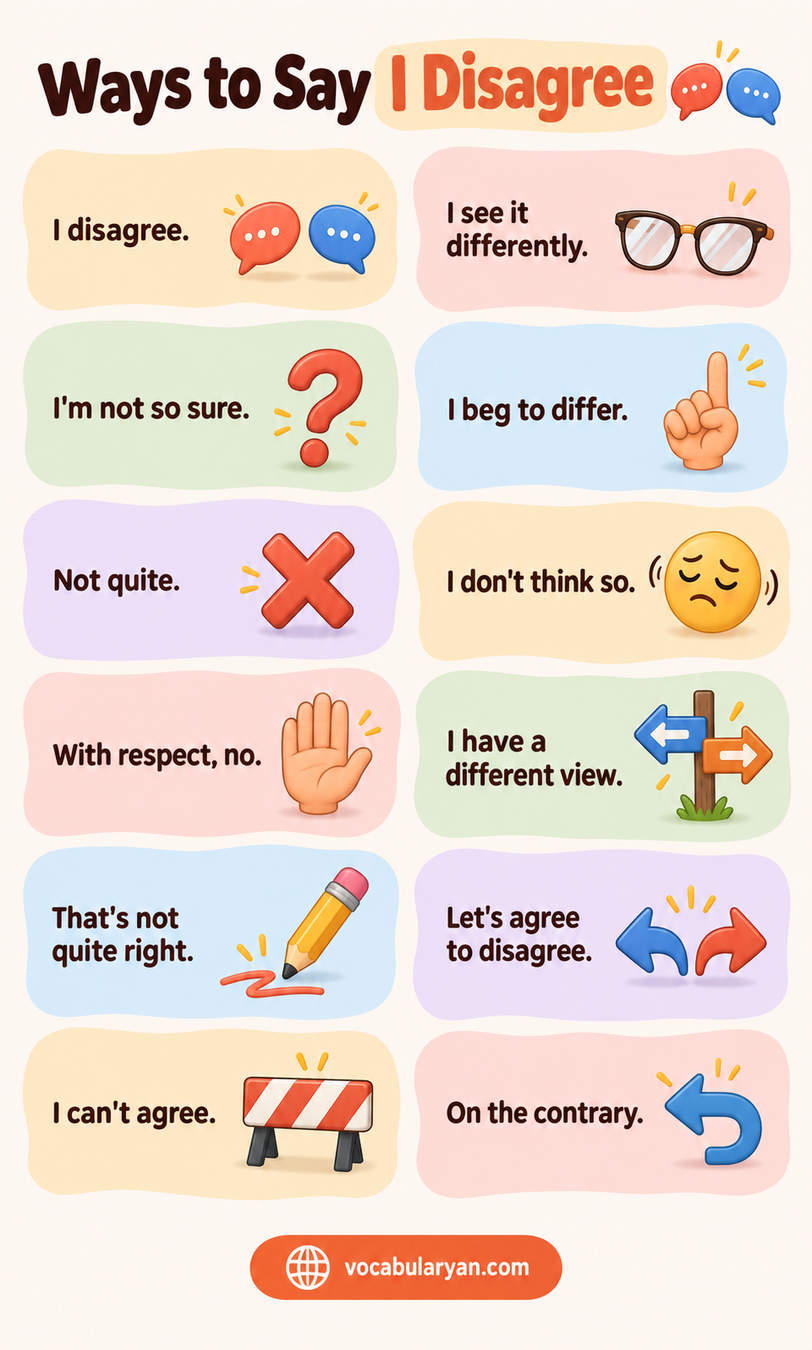
These six phrases fit a neighbour, a colleague, or a classmate, and each one says no without sounding cold.
I don’t think so: the softest everyday no, and it fits a friend, a shop assistant, or a colleague. It answers a claim, an idea, or a plan.
- I don’t think so, the shop closes at six on Sundays.
- Is Maria coming tonight? I don’t think so, she has an early shift.
- I don’t think so, that bus goes to the airport, not the station.
I’m not sure about that: a polite doubt rather than a flat no, and it fits almost anyone. The words after it give your reason.
- I’m not sure about that, the forecast said rain all day.
- Hmm, I’m not sure about that. Last time the cheaper one broke in a week.
- I’m not sure about that, Dad, the doctor told you to rest.
I don’t agree: short, plain, and honest, and it fits a discussion with a colleague or a friend. Add "with you" or "with that" to name what you reject.
- I don’t agree, the second plan costs less in the long run.
- Sorry, I don’t agree with that, the film was better than the book.
- I don’t agree with the new timetable, the breaks are too short.
I see it differently: the everyday way to disagree without saying "no" at all, and it fits work and family alike. Your own view comes straight after it.
- I see it differently, I think the early train is worth the extra money.
- I see it differently, Ana, the kids are old enough to walk to school.
- I hear you, but I see it differently on the colour of the kitchen.
Not necessarily: the reply to a general claim, and it means "that is not always true". It fits a discussion at any level.
- Bigger cars are safer. Not necessarily, the small ones have better brakes now.
- Not necessarily, some of the older students finish the course faster.
- You need a degree for that job. Not necessarily, Jake got in with experience.
I’m not convinced: the phrase for an argument you have heard and still do not accept, and it asks for more proof.
- I’m not convinced, the numbers in that report are two years old.
- I’m not convinced the new route is faster, we hit traffic every time.
- It sounds fine, but I’m not convinced they can deliver by June.
Say "I’m not sure about that" when the other person is senior or new to you, and "I don’t agree" with anyone you know well.
Casual Ways to Say I Disagree to Friends
Between friends a no comes fast and short, and each of these phrases sounds relaxed rather than rude.
No way: the loudest casual no, and it fits a friend who says something you find wrong or unlikely. To a stranger it sounds rude.
- No way, that restaurant is way too expensive for a Tuesday.
- No way! He did not score from that far out.
- No way, I’m not driving three hours for a two-hour party.
Nah: the relaxed spoken form of "no", and it fits close friends and family only.
- Nah, the blue one looks better on you.
- Nah, I don’t think she meant it that way.
- Nah, mate, that’s not how the rule works.
Come on: a friendly protest, and it means "you do not believe that yourself". The voice rises on "on".
- Come on, Sam, you know that team was lucky.
- Oh, come on, the exam wasn’t that hard.
- Come on, nobody paid full price for those tickets.
You’re kidding: a reply to a surprising claim, and it says "I do not believe that". With a serious face it is real disagreement, and with a smile it is a joke.
- You’re kidding, that phone is not worth a month’s rent.
- You’re kidding, right? Pineapple belongs on pizza.
- You’re kidding, she’d never say that about you.
I don’t buy it: casual American in origin and now common everywhere, and it means "I do not believe your explanation".
- I don’t buy it, he had the whole weekend to reply.
- Sorry, I don’t buy it, the train is never that late.
- I don’t buy it, the cheap tyres lasted longer than the expensive ones.
I’m not with you on that: a warm way to disagree about one thing while staying on the same side about everything else.
- I love the band, but I’m not with you on that album.
- I’m not with you on that, camping in November is a bad idea.
- I’m not with you on that one, Priya, the old logo was better.
Keep "no way" and "nah" for friends your own age, and use "I’m not with you on that" when you want the friendship to stay warm.
Polite Ways to Say I Disagree at Work and in Meetings
Polite disagreement at work names the idea and never the person, and each phrase leaves room for a reply.
I’m afraid I disagree: "I’m afraid" is the British softener before bad news, and it makes "I disagree" fit a meeting or a client.
- I’m afraid I disagree, the budget does not cover a second designer.
- I’m afraid I disagree with the timeline, the tests take at least a week.
- I’m afraid I disagree, Mr Osei, the old supplier was more reliable.
I respectfully disagree: the formal phrase for a senior colleague or a client, and it fits speech and email. It is very common in American offices.
- I respectfully disagree, the survey covered only two of our markets.
- I respectfully disagree with the decision to close the Leeds branch.
- I respectfully disagree, and I would like to explain why.
I’m not sure I agree: softer than "I disagree", and it fits a colleague at the same level. It opens a discussion rather than closing one.
- I’m not sure I agree, the last campaign brought in more than this one.
- I’m not sure I agree with moving the launch to March.
- I’m not sure I agree, Dana, the client asked for fewer pages, not more.
I see your point, but: the most common polite opener at work, and it accepts the other view before your own.
- I see your point, but the data is from before the price change.
- I see your point, but two interns cannot replace a full-time role.
- I see your point, but I’d still keep the meeting on Friday.
I have a different view: neutral and calm, and it fits a meeting where you want your view on the table without a fight.
- I have a different view on the hiring plan, if I may.
- I have a different view, the delay comes from the supplier, not the team.
- On pricing, I have a different view from the sales team.
I beg to differ: formal British, and it means "I disagree" said with a polite bow. In American English it sounds old or joking, so use it with British colleagues.
- I beg to differ, the contract says thirty days, not sixty.
- With respect, I beg to differ on the cause of the delay.
- I beg to differ, Dr Rahman, the results were not repeated.
The grammar trap at work is the missing "with", and it turns a polite no into a wrong sentence.
- I disagree you, the report is late. ❌
"Disagree" needs "with" before a person or a thing, and without it the sentence is wrong.
- I disagree with you, the report is late. ✅
Every phrase on this page belongs to one of five levels, from slang to very formal.
| Level | Phrases | Who it fits |
|---|---|---|
| Slang | Nah, nope, that’s cap | Close friends your own age |
| Casual | No way, come on, I don’t buy it | Friends, family, relaxed colleagues |
| Neutral | I don’t think so, I’m not sure about that, I see it differently | Anyone you know by name |
| Formal | I’m afraid I disagree, I’m not sure I agree, I have a different view | Managers, clients, meetings |
| Very formal | I respectfully disagree, I beg to differ, on the contrary | Senior people, debates, formal letters |
Open with "I see your point, but" in a meeting, and save "I respectfully disagree" for a decision you need on record.
Ways to Say I Disagree in an Email
A written no has no voice or smile to soften it, so the phrase itself must be softer than the spoken one.
I’m afraid I don’t agree: the standard email no to a colleague or a client, and it goes with a reason in the same sentence.
- I’m afraid I don’t agree that the delay was our fault, as the files arrived on the 12th.
- I’m afraid I don’t agree with the new price, and I have attached last year’s quote.
- Thanks for the draft. I’m afraid I don’t agree with the second part, for two reasons.
I have some concerns about: the softest written no, and it names a worry instead of a rejection. It fits a manager or a client.
- I have some concerns about the launch date, mainly the testing time.
- I have some concerns about the words in clause four.
- I have some concerns about moving the team to the third floor.
I’d like to suggest another approach: says "I disagree" by offering a replacement, and it fits any email to anyone.
- I’d like to suggest another approach before we sign off on the design.
- I’d like to suggest another approach to the schedule, set out in the table attached.
- Rather than cut the budget, I’d like to suggest another approach.
I’m not sure this is the best option: a written doubt, and the next sentence offers the better option.
- I’m not sure this is the best option, as the venue is an hour from the office.
- I’m not sure this is the best option for new clients, who need more time.
- I’m not sure this is the best option, so I have drafted a second plan.
The written phrase changes with the reader: a colleague, a client, or a manager.
Write "I’m afraid I don’t agree" to a colleague and "I have some concerns about" to a client, and give the reason in the same sentence.
Ways to Say I Disagree With a Boss
With a manager the no comes as a question or a concern, and the final decision stays with the manager.
Can I push back on that?: the modern office phrase for disagreeing with a decision, and it asks permission first.
- Can I push back on that? The team is already at full capacity.
- Before we move on, can I push back on that a little?
- Can I push back on that? The last time we rushed a release, we lost a client.
My concern is: names one problem with the plan, and it never says "you are wrong".
- My concern is the training, because nobody has used the new system yet.
- My concern is that the client expects a call, not an email.
- My concern is the cost of the second office, not the idea itself.
Have we considered: a question that offers a different plan without rejecting the first one, and it fits a manager or a senior colleague.
- Have we considered running the pilot in one city first?
- Have we considered asking the supplier for a longer deadline?
- Have we considered what happens if the funding is late?
I see it slightly differently: softer than "I see it differently", and "slightly" makes the no sound smaller than it is.
- I see it slightly differently, the drop in sales started before the price rise.
- I see it slightly differently, if I may, the intern needs more support, not less.
- On the schedule I see it slightly differently from the plan you sent.
Ask "can I push back on that?" before you disagree with a manager, and name one concern rather than a list.
Ways to Say I Disagree With a Customer
A customer is never told they are wrong, so the phrase corrects the fact and protects the customer’s pride.
I understand your frustration, but: accepts the feeling first, and the fact comes after "but".
- I understand your frustration, but the warranty ended in March.
- I understand your frustration, but the room was booked for the 9th, not the 10th.
- I understand your frustration, but we cannot refund a used ticket.
I’m afraid that’s not quite right: the polite correction of a wrong fact, and "quite" softens it.
- I’m afraid that’s not quite right, the delivery charge applies to orders under forty pounds.
- I’m afraid that’s not quite right, sir, the sale ended on Sunday.
- I’m afraid that’s not quite right, the account was opened in your wife’s name.
Let me check that for you: delays the no while you look, and it fits a call or a shop counter. The correction comes after the check.
- Let me check that for you. Our records show the parcel was signed for on Monday.
- Let me check that for you, because the price on the shelf was updated this morning.
- Let me check that for you. The card was charged once, not twice.
I hear you, and: "and" in place of "but" keeps the customer on your side, and the correction follows in the same sentence.
- I hear you, and the earliest slot we have is Thursday.
- I hear you, and the policy is the same for every customer.
- I hear you, and I can offer a credit note instead of a refund.
The one phrase that ends a sale is "you’re wrong", because it judges the customer rather than the fact.
- You’re wrong, the sale ended on Sunday. ❌
"You’re wrong" is about the person, and the polite form is about the fact, so the customer keeps their pride.
- I’m afraid that’s not quite right, the sale ended on Sunday. ✅
Accept the feeling first, correct the fact second, and never say "you’re wrong" to a customer.
Ways to Say I Disagree in a Debate or Essay
In a debate or an essay the no is about the argument, and each phrase names a weakness in it.
I would argue that: the standard debate opener, and it presents your view as an argument rather than a feeling. In an essay "would" softens the claim.
- I would argue that the data supports the opposite conclusion.
- I would argue that the cost of doing nothing is higher.
- I would argue that the author overstates the risk.
This view overlooks: names what the other argument has missed, and it fits a written essay.
- This view overlooks the rise in rents over the same period.
- This view overlooks the students who study part time.
- This view overlooks one fact: the survey asked only city residents.
On the contrary: a formal written phrase, and it means "the opposite is true". In speech it sounds stiff, so keep it for essays and formal debate.
- On the contrary, the evidence points to a fall in crime.
- The policy did not save money. On the contrary, it cost more.
- On the contrary, the smaller schools had the better results.
The evidence does not support: the strongest polite no in a debate, because it rejects the claim with proof rather than opinion.
- The evidence does not support the idea that longer hours raise output.
- The evidence does not support that claim, as the study had forty participants.
- The evidence does not support a ban, and three trials say so.
Reject the argument and never the person, with "I would argue that" or "the evidence does not support".
Strong Ways to Say I Disagree
Strong disagreement leaves no doubt, and each of these phrases fits a friend or an argument you have chosen to have.
I totally disagree: casual and firm, and it fits a friend or a colleague you know well. In a formal meeting "completely" replaces "totally".
- I totally disagree, the ending was the best part of the film.
- I totally disagree with you on that, cats are easier than dogs.
- I totally disagree, and I told him so at lunch.
Absolutely not: a firm no to a plan or a request, and it works in speech at every level.
- Absolutely not, we are not selling the house this year.
- Can the kids stay up till midnight? Absolutely not.
- Absolutely not, that clause has to come out of the contract.
I couldn’t disagree more: the strongest polite form, and it fits a debate or an opinion you find plainly wrong.
- I couldn’t disagree more, the city needs more buses, not more roads.
- I couldn’t disagree more with the review, the food was excellent.
- I couldn’t disagree more, and I will tell you why.
That’s not true: rejects a fact rather than an opinion, and it is direct. With a boss or a customer it sounds like an accusation.
- That’s not true, I sent the invoice on the third.
- That’s not true, she was in Madrid that week.
- That’s not true, the tickets went on sale before the announcement.
I’d say the exact opposite: means your view is not just different but the reverse, and it fits a discussion between equals.
- I’d say the exact opposite, the quiet students learn the most.
- Was the trip a waste? I’d say the exact opposite.
- I’d say the exact opposite, the new manager made the team slower.
Save "I couldn’t disagree more" for opinions and "that’s not true" for facts, and drop both with a customer.
Ways to Agree First and Then Disagree
Partial disagreement accepts part of the other view, and the word "but" marks where your own view starts.
Yes, but: the shortest partial no, and it is the most common way to disagree in English. The "yes" is polite, and the "but" is the real message.
- Yes, but the cheaper flight lands at two in the morning.
- Yes, but who is going to feed the dog for a week?
- Yes, but the last time we tried that, it took a month.
I agree up to a point, but: accepts part of the argument and rejects the rest, and it fits work and study.
- I agree up to a point, but a total ban would hurt small shops.
- I agree up to a point, but the second half of the plan needs money we do not have.
- I agree up to a point, but not every student wants to go to university.
That’s true, but: accepts a fact and then adds a second fact against it.
- That’s true, but the rent is double in that part of town.
- That’s true, but he apologised the next day.
- That’s true, but the rule changed last year.
Fair point, but: casual and friendly, and it praises the other person before the no. It fits friends and relaxed colleagues.
- Fair point, but we still need someone to drive.
- Fair point, but the client has already seen the first design.
- Fair point, but I’d rather pay more and sleep well.
The partial no has three steps: accept, "but", and your own view.
Put the real message after "but", and keep the part before it short and honest.
Ways to Say I Disagree in a Text
A text has no voice, so a short no reads colder than it sounds, and a softener fixes that.
Nope: the text form of "no", and it fits close friends. Alone it reads as annoyed, so add a word or two.
- Nope, the match is Saturday, not Sunday.
- Nope, I checked, the shop’s shut on Mondays.
- Nope, no chance, she’d never wear that.
Idk about that: "I don’t know about that" in text form, and it is a soft doubt between friends.
- Idk about that, the reviews were pretty bad.
- Idk about that, he seemed fine at lunch.
- Idk about that tbh, the earlier train is cheaper.
Not really: the soft text no to a question or an opinion, and it fits friends and family.
- Was it worth it? Not really, the queue was two hours.
- Not really, I think the grey one is nicer.
- Not really, the hotel was fine but the beach was far.
Hmm, not sure: the text softener, and "hmm" is the written form of a spoken pause.
- Hmm, not sure, my mum said the traffic is bad on Fridays.
- Hmm, not sure that’s the same guy.
- Hmm, not sure, let me ask Leo first.
Add a reason or a "hmm" to a texted no, because "nope" alone reads as a bad mood.
Ways to Say I Disagree to a Group
Disagreeing with a room needs a phrase that asks for a turn to speak and names one concern.
Can I offer a different view?: asks the group for a turn, and it fits a meeting, a class, or a family discussion.
- Can I offer a different view? The survey missed everyone under twenty-five.
- Before we vote, can I offer a different view?
- Can I offer a different view on the venue?
I’m not sure everyone agrees: speaks for the quiet members of the group, and it slows a decision without a fight.
- I’m not sure everyone agrees with the new start time.
- I’m not sure everyone agrees, Tom, the back row has been very quiet.
- I’m not sure everyone agrees that the trip is worth the cost.
I have one concern: limits your no to a single problem, and a group listens to one concern longer than to five.
- I have one concern before we sign off, and it is the parking.
- I have one concern: who covers the desk on Fridays?
- I have one concern about the date, as half the team is on leave.
Ask for the turn, name one concern, and let the group decide.
Regional Ways to Say I Disagree in English
Each English-speaking country has a casual no of its own, and each of these fits friends in that country.
British Ways to Say I Disagree
I’m not so sure about that: the British way to disagree by sounding unsure when you are not, and it fits colleagues and strangers alike.
- I’m not so sure about that, the trains from Leeds are better than you think.
- I’m not so sure about that, Mrs Hall, the builder quoted half that.
- Hmm, I’m not so sure about that, the last one took a year.
With respect: the formal British opener before a firm no, and the longer "with the greatest respect" sounds like an insult.
- With respect, Minister, the figures say otherwise.
- With respect, the committee did not read the full report.
- With respect, that is not what the contract says.
Pull the other one: casual British, and it means "I do not believe you". The full form is "pull the other one, it’s got bells on".
- Pull the other one, you’ve never been to Paris.
- Free tickets? Pull the other one.
- Pull the other one, Dave, that car is not thirty years old.
American Ways to Say I Disagree
I’m not buying it: casual American, and it means "your story does not convince me".
- I’m not buying it, he had three chances to call.
- I’m not buying it, the whole thing was planned.
- Sorry, I’m not buying it, that price is too good.
That’s not gonna fly: American office and family slang for "that will not be accepted", and it fits a plan rather than an opinion.
- That’s not gonna fly with the boss, she wants it by noon.
- A party on a school night? That’s not gonna fly.
- That’s not gonna fly, the client already said no to blue.
Australian and Irish Ways to Say I Disagree
Yeah, nah: the Australian and New Zealand no that starts with "yeah", and the "yeah" means only "I heard you".
- Yeah, nah, the beach is too rough today.
- Yeah, nah, I reckon the other pub is better.
- Yeah, nah, mate, that’s not going to work.
You’re dreaming: Australian for "that will never happen", and it fits a friend with a wild idea.
- You’re dreaming, that house is two million at least.
- Finish by Friday? You’re dreaming, mate.
- You’re dreaming if you think Dad will lend you the car.
Not a hope: Irish for "there is no chance", and it fits friends and family.
- Not a hope, the bus never comes on time.
- Not a hope, Sean, she’s not going to say yes.
- Will it stay dry? Not a hope.
Would you go away out of that: Irish for "I do not believe you", said with a laugh, and it fits close friends.
- Would you go away out of that, you never ran a marathon.
- Would you go away out of that, it wasn’t that expensive.
- Ah, would you go away out of that, Niamh, he’s a lovely fella.
Say "I’m not so sure about that" in Britain, "I’m not buying it" in America, "yeah, nah" in Australia, and "not a hope" in Ireland.
Slang Ways to Say I Disagree
Slang disagreement belongs to close friends your own age, and each phrase is wrong for anyone older or senior.
That’s cap: current slang for "that is a lie", and "no cap" means "I am serious". It fits teenagers and young adults in speech and texts.
- That’s cap, you did not finish the game in one night.
- That’s cap, the tickets were forty, not twenty.
- That’s cap and you know it.
Hard disagree: internet slang from comment threads, and it means "I strongly disagree" in a group chat.
- Hard disagree, the first season was the best.
- Hard disagree, tea is better with milk.
- Hard disagree on the haircut, sorry.
Yeah, right: sarcastic, and it means "I do not believe that" said with a smile. The voice falls on "right".
- Yeah, right, you were going to tidy up anyway.
- He’s never late? Yeah, right.
- Yeah, right, and I’m the Queen of Spain.
Keep "that’s cap" and "hard disagree" for friends who use the same slang, and drop them in any message a manager will read.
Funny Ways to Say I Disagree
A funny no works when the other person laughs, and each of these fits a friend who enjoys a joke at their own expense.
In what universe?: a mock-serious question, and it means "that is never true".
- In what universe is a Monday morning meeting a good idea?
- In what universe does pineapple belong on pizza?
- Better than the original? In what universe?
Nice try: a playful no to a weak argument or an excuse, and it fits family and friends.
- Nice try, but the dog did not eat your homework.
- Nice try, you’re still washing up tonight.
- Nice try, that discount ended last week.
I’ll pretend I didn’t hear that: a joke rejection of a shocking opinion, and it works between friends who tease each other.
- I’ll pretend I didn’t hear that, the book is always better.
- You don’t like chocolate? I’ll pretend I didn’t hear that.
- I’ll pretend I didn’t hear that, and we’ll move on.
Use a funny no with a friend who jokes back, because to anyone else it reads as a put-down.
Disagreement That Sounds Rude
These five phrases are common in speech, and each one sounds like an insult, so the polite replacement goes with it.
That’s wrong: flat and direct, and it judges the whole statement. It fits a fact check between friends and nothing else, and the polite form is "I don’t think that’s right".
- That’s wrong, the capital of Australia is Canberra.
- That’s wrong, and the receipt proves it.
- That’s wrong, we said seven, not eight.
No offence, but: a warning that an insult is coming, and the insult still offends. It fits nobody at work.
- No offence, but that shirt is terrible.
- No offence, but your plan makes no sense.
- No offence, but I’ve heard better singing from the cat.
Whatever: a one-word dismissal, and it means "I have stopped listening". Between teenagers it is a joke, and to an adult it is an insult.
- Whatever, do it your way.
- Oh, whatever, I’m not arguing about this again.
- Whatever, you always think you’re right.
You’re wrong: judges the person rather than the fact, and it ends discussions fast. In a debate the fix is "that’s not the case".
- You’re wrong, the meeting was cancelled on Tuesday.
- You’re wrong about him, he paid for everything.
- You’re wrong, and I can show you why.
That’s nonsense: British and firm, and "that’s rubbish" is the harsher form. Both fit a political argument between friends and nothing formal.
- That’s nonsense, the road was closed for one day, not a week.
- That’s nonsense, nobody said the school was closing.
- That’s nonsense and you know it, Pete.
The trap with "no offence, but" is that the words after it are the whole message.
- No offence, but your plan makes no sense. ❌
"No offence" does not remove the offence in the words after it, and the polite no names the problem instead.
- I’m not sure the plan would work, because the dates clash. ✅
For each rude phrase there is a polite version that says the same thing about the fact and nothing about the person.
Replace "that’s wrong" with "I don’t think that’s right", and drop "no offence, but" and "whatever" everywhere.
More Everyday English Phrases
- Other Ways to Say I Agree
- Other Ways to Say I Think So
- Other Ways to Say I Don’t Think So
- Other Ways to Say Sounds Good
FAQs
The smart way to say I disagree is to accept one part of the other view and then reject the rest with a reason. One form is "I agree up to a point, but the cost is too high". A reason makes a no sound thought through, and a bare "I disagree" sounds like a mood. "I would argue that" and "the evidence does not support" do the same in a debate.
Say "I’m afraid I disagree", "I’m not sure I agree", or "I have a different view", and give the reason in the same sentence. In an email, "I have some concerns about" is softer still, and "I respectfully disagree" is the formal choice for a decision you want on record. With a manager, ask "can I push back on that?" before you disagree.
Respectful disagreement names the idea and never the person, so "I see it differently" and "I’m not sure that’s right" are respectful, and "you’re wrong" is not. Add "I see your point, but" before your own view, and the other person hears that you listened. The reason after "but" is what makes it respectful rather than polite noise.
Use a question or a fact instead of "I": "have we considered the cost?", "not necessarily", "that’s not quite right", or "the evidence does not support that". Each one rejects the claim without putting you in the sentence. In a text, "hmm, not sure" and "not really" do the same.
"I can’t say I disagree" means "I agree", said in a careful, slightly reluctant way. It fits a moment when you agree with a criticism you would rather not make yourself: "The film was too long." "I can’t say I disagree." The double negative is the softener.
"I beg to differ" means "I disagree", and it is formal, polite, and British. Use it with a British colleague or in a formal discussion where "I disagree" sounds too blunt. In American English it sounds old-fashioned or ironic, so "I respectfully disagree" is the American form.
The nearest synonyms are "differ with", "take a different view from", and "not see eye to eye with", and each one fits a formal sentence. In everyday speech "I don’t agree with" and "I’m not with you on that" replace "disagree" far more than any single verb does. The verb "object to" is for a plan or a decision rather than an opinion.