
"I miss you" fits a partner, a parent, a friend, and a child, and after the tenth message in a week it starts to sound automatic. The ways to say I miss you in English change with the person and the time apart. A partner gets "I miss you like crazy", family gets "the house is too quiet without you", and a friend gets "it’s been too long". The everyday phrases that fit everyone come first.
Other Ways to Say I Miss You in Everyday English
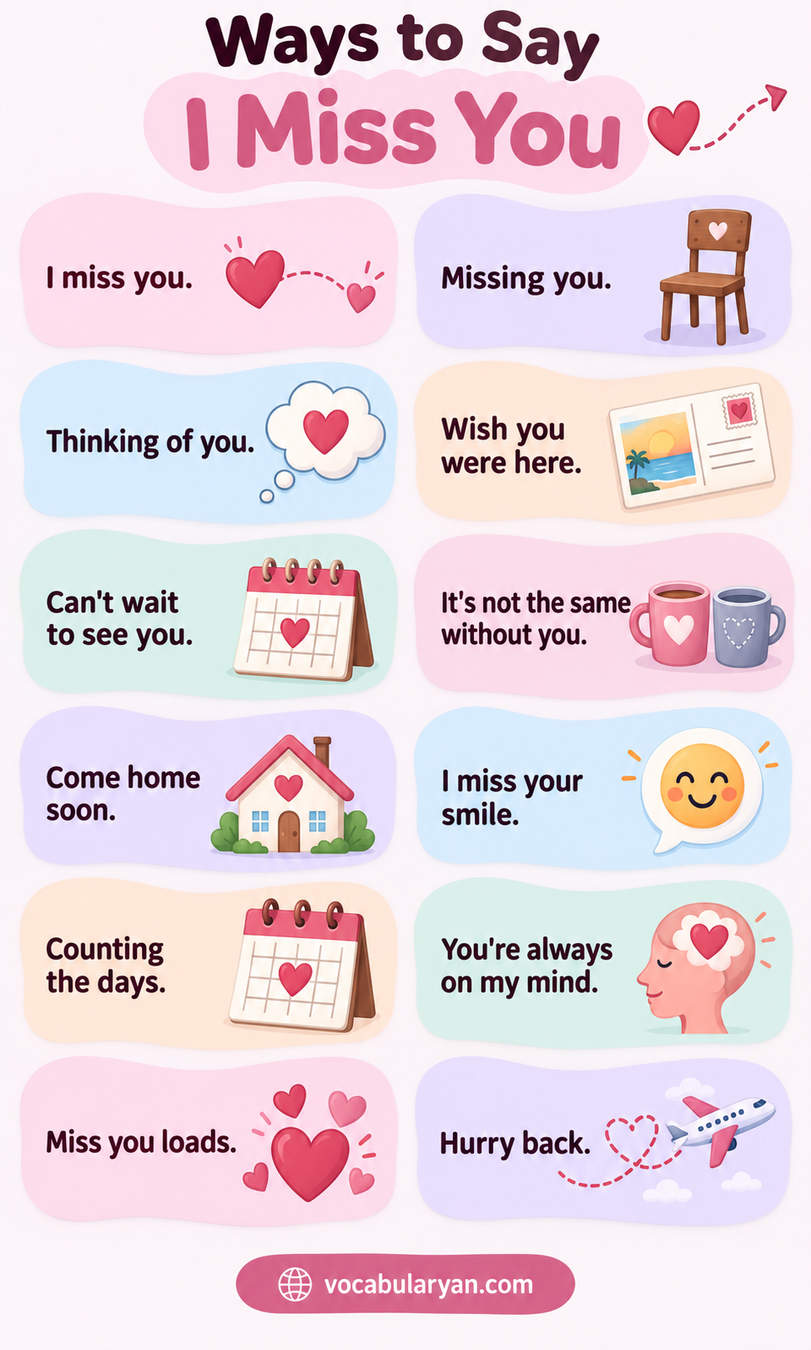
These five phrases fit almost anyone you are close to, and each one changes how strong the feeling sounds.
I miss you: the plain phrase, and the one to use when you are unsure. It fits a partner, a friend, a parent, or a child, in speech and in writing.
- I miss you, Dad, the house is strange without your radio on.
- Hi, it’s me, I miss you, is this a bad time?
- I miss you already and the train hasn’t even left the station.
I miss you so much: "so much" makes the feeling stronger, and it fits a partner, a parent, or a best friend. With a colleague it sounds too personal.
- I miss you so much, Nan, I keep looking at the photos from Christmas.
- I miss you so much that I set your place at the table by mistake.
- Goodnight, Leo, I miss you so much.
I’ve been missing you: the present perfect says the feeling started a while ago and is still going, so it fits a message after days of silence.
- I’ve been missing you all week, how’s the new flat?
- Sorry for the quiet, Sam, I’ve been missing you and work has been mad.
- I’ve been missing you, Grandad, is the garden still full of beans?
I wish you were here: a way to say you miss someone while you are somewhere they would enjoy. It fits a holiday, a party, or a quiet evening at home.
- I wish you were here, the mountains are covered in snow.
- I wish you were here tonight, the whole family is round for dinner.
- It’s a great match, I wish you were here to see it.
I can’t wait to see you: less about the sad part and more about the meeting to come, so it fits a partner, a friend, or family before a visit.
- I can’t wait to see you on Friday, I’ve booked the table.
- Only two more sleeps, Mum, I can’t wait to see you.
- I can’t wait to see you and hear about the trip.
Say "I miss you" to anyone close to you, and add "so much" only for a partner or family.
Ways to Say I Miss You to a Partner
These phrases are for a boyfriend, a girlfriend, a husband, or a wife, and each one sounds warm and private.
I miss you like crazy: casual and strong, and it fits a partner or a very close friend. Keep it out of anything a manager reads.
- I miss you like crazy, when does your flight land?
- I know it’s only been a week, but I miss you like crazy.
- I miss you like crazy, the flat is far too tidy without you.
I miss you so much it hurts: the strongest of the set, and it fits a partner after weeks apart. Said too early in a relationship, it sounds heavy.
- I miss you so much it hurts, I can’t wait for June.
- Some nights I miss you so much it hurts, and then you call and it’s fine.
- I miss you so much it hurts, come home safe.
I can’t wait to be with you again: the feeling and the plan in one line, so it fits a partner who is coming back on a fixed date.
- I can’t wait to be with you again, ten more days.
- I can’t wait to be with you again, this time no phones.
- The countdown is on, I can’t wait to be with you again.
I miss your hugs: naming one thing you miss sounds more personal than the plain phrase, and it fits a partner or a parent.
- I miss your hugs more than anything, this hotel bed is cold.
- I miss your hugs, Mum, the ones that go on too long.
- Bad day at work, I miss your hugs.
Keep "like crazy" and "so much it hurts" for a partner, and name one thing you miss when the plain phrase feels worn.
Ways to Say I Miss You in a Long-Distance Relationship
Long-distance phrases name the distance or the countdown, and each one fits a partner in another city or country.
I’m counting down the days: the standard long-distance phrase, and it fits any couple with a visit booked.
- I’m counting down the days, only fourteen to go.
- I’m counting down the days until you land, I’ve cleared the whole weekend.
- Is it sad that I’m counting down the days on the fridge?
The distance is hard: honest and plain, and it fits a serious conversation on a call rather than a quick text.
- The distance is hard this month, I won’t pretend it isn’t.
- The distance is hard, but the visit in March is booked.
- I know the distance is hard for you too, so let’s talk about it tonight.
Only two more sleeps: a playful count in nights rather than days, and it fits a partner or a child before a visit.
- Only two more sleeps and then you’re here for a whole week.
- Only two more sleeps, Dad, I’ve made a sign for the airport.
- Only two more sleeps! Have you packed yet?
Send "I’m counting down the days" when a visit is booked, and "the distance is hard" when you need a real talk.
Ways to Say I Miss You to a Friend
Friend phrases are lighter than partner phrases, and each one ends with a plan to meet or a question.
I miss hanging out with you: casual and warm, and it fits a friend you used to see every week.
- I miss hanging out with you, when did life get so busy?
- I miss hanging out with you and doing nothing all Saturday.
- Honestly, I miss hanging out with you more than I miss the city.
It’s been too long: a friendly way to say you miss someone without the word "miss", and it fits a message to a friend you have lost touch with.
- It’s been too long, Priya, are you free next week?
- It’s been too long since we had a proper catch-up.
- Saw your photos from the wedding, it’s been too long!
I miss our chats: names the thing you miss, and it fits a friend or a former colleague you used to talk to every day.
- I miss our chats on the way home, the bus is boring now.
- I miss our chats, nobody else laughs at my jokes.
- I miss our chats over coffee, let’s do one on the phone.
Things aren’t the same without you: a warm phrase for a friend who moved away or left a group, and it fits a message from the whole group.
- Things aren’t the same without you at five-a-side.
- Things aren’t the same without you in the office, nobody makes tea.
- Things aren’t the same without you at book club, come back soon.
Tell a friend "it’s been too long" and follow it with a date, because a plan is the friendliest form of "I miss you".
Ways to Say I Miss You to Family
Family phrases name the home or the everyday habits, and each one fits a parent, a child who has left home, or a grandparent.
The house is too quiet without you: the standard phrase from a parent to a child who has left for university or work.
- The house is too quiet without you, even the dog is sulking.
- The house is too quiet without you, ring your mother tonight.
- The house is too quiet without you and your terrible music.
I miss your cooking: a family phrase for a parent or grandparent, and the joke in it takes away the weight.
- I miss your cooking, Mum, I burnt rice again last night.
- I miss your cooking, Nonna, nothing here tastes right.
- I miss your cooking and your kitchen and the noise.
We all miss you: from the whole family, and it fits a card, a call, or a group message to someone far away.
- We all miss you, Uncle Femi, come for Eid.
- We all miss you, the kids drew you a picture.
- We all miss you, and Grandma says eat more.
Send a parent "the house is too quiet without you", and send a child away from home "we all miss you".
Ways to Say I Miss You to a Child
Child phrases are short, sweet, and a little silly, and each one fits a parent, a grandparent, or an aunt or uncle talking to a small child.
I miss you to the moon and back: the standard phrase from a parent to a small child, and it is based on a picture book that most children know.
- I miss you to the moon and back, sleep tight, Ellie.
- Daddy’s on the phone, sweetheart, I miss you to the moon and back.
- I miss you to the moon and back, see you on Sunday.
I miss you this much: said with the arms stretched wide, and it fits a video call with a toddler.
- I miss you this much, look, my arms can’t go any wider.
- I miss you this much, and this much, and this much!
- Grandpa says I miss you this much, and he means the whole sky.
I can’t wait for a big hug: turns the feeling into a promise, and it fits the end of every call with a child.
- I can’t wait for a big hug on Friday, save me the biggest one.
- I can’t wait for a big hug, I’m coming home tomorrow.
- I can’t wait for a big hug and a story before bed.
Say "I miss you to the moon and back" to a small child, and end the call with the hug you have promised.
Ways to Say I Miss You in a Text
Text phrases are short, and the missing words and the extra letters make them sound casual and warm.
Miss you!: "I miss you" without the "I", and the most common form in a text between friends, family, and partners. The exclamation mark makes it warm rather than sad.
- Miss you! How’s the conference?
- Miss you! Call me when you get in.
- Miss you! The cat says hi.
Miss u: the shortest form, with "u" for "you", and it fits close friends and partners under thirty. Keep it out of a message to a parent who dislikes short forms.
- Miss u, when r u back?
- Miss u loads x
- Miss u already lol
IMY: the letters of "I miss you", and it fits close friends and partners in a quick text. "IMU" is the same thing, and "IMY2" is the reply.
- IMY, this party is dead without you.
- IMY x
- IMY so much, text me later.
Missing you loads: "loads" is the casual British word for "a lot", and it fits a friend or a partner in a text or a card.
- Missing you loads, when are you next in town?
- Missing you loads today, no reason.
- Missing you loads, the gang says hi.
Write "miss you!" with an exclamation mark for a friend, and keep "miss u" and "IMY" for people who text the same way.
Ways to Say I Miss You in a Card or Letter
Card and letter phrases are longer and more formal than texts, and each one fits a birthday card, a postcard, or a letter to someone far away.
You are missed: the passive form, and it sounds warm and a little formal, so it fits a card from a group or an older relative.
- You are missed here every single day, love from all of us.
- You are missed at Sunday lunch, Grandad, the chair is still yours.
- You are missed, and the door is always open.
I miss you more than words can say: the classic card phrase, and it fits a partner, a parent, or a grandparent in a birthday or anniversary card.
- I miss you more than words can say, happy anniversary, my love.
- I miss you more than words can say, Mum, thank you for everything.
- I miss you more than words can say, but I’ll try on the next page.
Wish you were here: the standard postcard phrase, and it fits any friend or relative when you write from a holiday.
- Wish you were here, the sea is warm and the ice cream is cheap.
- Greetings from the lakes, wish you were here!
- Wish you were here to laugh at my sunburn.
Until we’re together again: a closing line for a letter, and it fits a partner or a family member on a long trip.
- Until we’re together again, take care of yourself, all my love, Ana.
- Write soon, and until we’re together again, the photo stays on my desk.
- Until we’re together again, I’ll keep your side of the garden tidy.
"Long time no see" looks like a card phrase, and it is not one, because it is a greeting for the moment you meet again.
- Dear Aunt May, long time no see, I miss you. (in a letter) ❌
"Long time no see" is said face to face on meeting, so a letter takes "it’s been too long".
- Dear Aunt May, it’s been too long, I miss you. ✅
Open a card with "you are missed" or "I miss you more than words can say", and close a letter with "until we’re together again".
Ways to Say I Miss You on the Phone or a Call
Phone phrases explain why you called, and each one fits a partner, a parent, or a close friend at the start or the end of a call.
I just wanted to hear your voice: the standard reason for a call with no other purpose, and it fits a partner or a parent.
- I just wanted to hear your voice, nothing’s wrong.
- Sorry it’s late, I just wanted to hear your voice before bed.
- I just wanted to hear your voice, Mum, how was the hospital?
It’s so good to hear you: the phrase for the first seconds of a call after a long absence, and it fits anyone you are close to.
- It’s so good to hear you, it’s been months!
- Oh, it’s so good to hear you, hang on, let me sit down.
- It’s so good to hear you, Grandma, are you keeping warm?
When can I see you?: the question that follows "I miss you" on a call, and it fits a partner or a friend who is close enough to meet.
- I miss you, when can I see you?
- When can I see you? I’m free all weekend.
- This isn’t the same as a hug, when can I see you?
Open a call with "it’s so good to hear you", and end it with "when can I see you?" so the feeling becomes a plan.
Ways to Say I Miss You After a Short Time Apart
These phrases fit a day or a week apart, and each one makes a joke of how fast the missing started.
I already miss you: said minutes or hours after a goodbye, and it fits a partner, a parent, or a best friend.
- I already miss you and you’ve only been gone an hour.
- I already miss you, is that pathetic?
- Text me when you land, I already miss you.
I missed you today: the past tense for one day apart, and it fits a partner or a child at the end of the day.
- I missed you today, how was school?
- I missed you today, the meeting was three hours long.
- I missed you today more than a Tuesday should allow.
Come back soon: short and warm, and it fits a friend or a relative leaving after a visit.
- Come back soon, the spare room is yours whenever you want it.
- Safe trip, come back soon, the kids will miss you.
- Come back soon, okay? It was so good to have you here.
Say "I already miss you" at the door, and "I missed you today" on the evening call.
Ways to Say I Miss You After a Long Time Apart
Long-absence phrases use the past or the present perfect, and each one fits a friend, a partner, or family after months or years.
I’ve missed you so much: the present perfect for a long absence that is about to end, and it fits the first seconds of a reunion.
- I’ve missed you so much, look at you, you’re so tall!
- I’ve missed you so much, two years is far too long.
- Oh, Kemi, I’ve missed you so much.
It’s been way too long: casual and warm, and it fits a friend you have not seen for years.
- It’s been way too long, Jamal, you look exactly the same.
- It’s been way too long, how are the kids?
- It’s been way too long since we sat in this pub.
I missed you every single day: the past tense for an absence that has ended, and it fits a partner or a parent after a long trip.
- I missed you every single day, welcome home.
- I missed you every single day, and the dog missed you more.
- I missed you every single day, don’t go for that long again.
The tense trap is the hardest part of this phrase, because "I miss you" and "I missed you" fit different moments.
- I miss you so much! (at the airport, hugging the person) ❌
At the moment of meeting, the missing is over, so the past tense fits: the feeling was true while the person was away.
- I missed you so much! ✅
Say "I’ve missed you so much" when the person walks in, and "I missed you every single day" once you sit down.
Ways to Say I Miss You to a Colleague Who Left
Work phrases keep the feeling professional, and each one fits a colleague who changed jobs, retired, or moved to another office.
It’s not the same here without you: the standard work phrase, and it fits a card, an email, or a message to a former colleague.
- It’s not the same here without you, the Monday meeting is very quiet now.
- It’s not the same here without you, Raj, nobody else knows how the printer works.
- It’s not the same here without you, good luck in the new role.
You’re missed around the office: the passive form keeps it formal, and it fits a leaving card or a message from a manager.
- You’re missed around the office, especially on Friday afternoons.
- You’re missed around the office, the new team asks about you all the time.
- You’re missed around the office, Mrs Lee, and the plants are missed too.
We miss you on the team: from the whole group, and it fits a message to someone who moved to another department or company.
- We miss you on the team, the project isn’t the same.
- We miss you on the team, come to the summer party.
- We miss you on the team, Dana, thank you for the handover notes.
I hope our paths cross again: the most formal phrase on the page, and it fits an email to a client or a senior colleague.
- I hope our paths cross again, it was a pleasure working with you.
- I hope our paths cross again at next year’s conference.
- Thank you for everything, and I hope our paths cross again soon.
"I miss you" to a client or a former manager sounds too personal, because the phrase belongs to family and friends.
- Dear Mr Ortiz, I miss you since you moved to the Madrid office. ❌
A work message needs the feeling without the romance, so the phrase names the office rather than the person.
- Dear Mr Ortiz, it’s not the same here without you since you moved to the Madrid office. ✅
The phrases on this page run across five levels, and the table sorts them.
| Level | Phrases | Who it fits |
|---|---|---|
| Slang | IMY, miss u, miss ya | Close friends and partners who text the same way |
| Casual | Miss you!, miss you loads, I miss you like crazy | Friends, family, partners |
| Neutral | I miss you, I wish you were here, it’s been too long | Anyone you are close to |
| Formal | It’s not the same here without you, you are missed | Colleagues, clients, older relatives |
| Very formal | I hope our paths cross again, your absence is felt | Senior colleagues, formal letters |
Write "it’s not the same here without you" to a colleague, and keep "I miss you" for people you would hug.
Ways to Say I Miss You Without Saying the Words
These phrases say that you miss someone without the word "miss", and each one fits a person who finds the direct phrase too heavy.
When are you free?: a question instead of a feeling, and it fits a friend or a new partner when "I miss you" feels too early.
- When are you free? I fancy a walk and a coffee.
- When are you free? It’s been ages.
- Hey, when are you free? I’ve got a film we should see.
I saw this and thought of you: sent with a photo or a link, and it fits a friend, a sibling, or a partner. The thinking-of-you phrases have a page of their own.
- I saw this and thought of you, it’s the exact colour of your kitchen.
- I saw this and thought of you, remember the dog in Lisbon?
- I saw this and thought of you, happy Monday.
I wish you’d been there: the feeling placed in the past, and it fits a friend who missed a party, a match, or a dinner.
- I wish you’d been there, Tom did his dance again.
- I wish you’d been there, the food was amazing and the music was terrible.
- I wish you’d been there last night, it wasn’t the same.
When can we do this again?: said at the end of a good evening, and it fits a friend or family you do not see enough.
- When can we do this again? I’d forgotten how much I laugh with you.
- That was lovely, when can we do this again?
- When can we do this again, same time next month?
Ask "when are you free?" when the direct phrase feels too early, because a question says the same thing with less weight.
Regional Ways to Say I Miss You
English-speaking countries each keep a form of "I miss you" of their own, and the difference is one small word at the end.
British Ways to Say I Miss You
Miss you loads: "loads" is the everyday British word for "a lot", and it fits friends, family, and partners in speech and in texts.
- Miss you loads, when are you back up north?
- Miss you loads, Nan, see you at the weekend.
- Night, miss you loads x
Miss you, love: "love" is a British word for a partner, a child, or a friend, and it fits speech and short messages.
- Miss you, love, drive safe.
- Miss you, love, the kettle’s on for when you’re home.
- Bye, miss you, love, ring me tomorrow.
American Ways to Say I Miss You
Miss you tons: "tons" is the American word for "a lot", and it fits friends and family in a text or on a call.
- Miss you tons, is Thanksgiving still on?
- Miss you tons, Grandpa, how’s the fishing?
- Miss you tons, come visit soon.
Miss ya: "ya" is the casual American spelling of "you", and it fits close friends and family at the end of a call.
- Miss ya, buddy, take care.
- Miss ya, Mom, talk Sunday?
- Alright, miss ya, bye.
Australian and Irish Ways to Say I Miss You
Miss ya heaps: "heaps" is the Australian word for "a lot", and it fits friends and family in speech and in texts.
- Miss ya heaps, mate, when are you back in Perth?
- Miss ya heaps, Mum, love you.
- Miss ya heaps, the beach isn’t the same.
Missing you like mad: common in Ireland and Britain, and it fits a partner or a close friend in a text or a card.
- Missing you like mad, Niamh, only a week to go.
- Missing you like mad over here, the weather’s rotten too.
- Missing you like mad, call me after the match.
Say "miss you loads" in Britain, "miss you tons" in America, "miss ya heaps" in Australia, and "I miss you" everywhere else.
Funny Ways to Say I Miss You
Funny phrases are for people who share your sense of humour, and each one hides the feeling inside a joke.
I miss you like a squirrel misses its nuts: a silly comparison, and it fits a close friend or a partner who laughs at bad jokes.
- I miss you like a squirrel misses its nuts, and I’m not sorry for that sentence.
- I miss you like a squirrel misses its nuts in January.
- Text from your brother: I miss you like a squirrel misses its nuts.
Missing you is my least favourite hobby: a dry joke, and it fits a partner or a friend in a text.
- Missing you is my least favourite hobby, and I’m doing it all day.
- Missing you is my least favourite hobby, come home so I can stop.
- Missing you is my least favourite hobby, right after ironing.
I’ve started talking to the plants: a joke that says the house is too quiet, and it fits a partner or a flatmate away for a while.
- I’ve started talking to the plants, that’s how much I miss you.
- Day nine, I’ve started talking to the plants and they’re better company than the cat.
- I’ve started talking to the plants, so please come back before they answer.
"I miss you like a hole in the head" looks like a joke phrase for missing someone, and it means the opposite.
- I miss you like a hole in the head, when are you back? ❌
"Like a hole in the head" means "not at all", so the phrase says you are glad the person is gone.
- I miss you like crazy, when are you back? ✅
Save the jokes for people who will laugh, and keep "like a hole in the head" out of every message.
How Do You Reply When Someone Says I Miss You?
The reply to "I miss you" returns the feeling at the same strength, and a plan or a question after it keeps the conversation going.
I miss you too: the standard reply at every level, and it fits a partner, a friend, or a parent.
- I miss you. I miss you too, Dad.
- Miss you loads! I miss you too, when are you back?
- I miss you so much. I miss you too, only a week to go.
Me too: the short casual reply, and it fits a text or a quick call between friends and partners.
- Miss you! Me too, call later?
- I miss you already. Me too, text me when you land.
- IMY. Me too x
I miss you more: the playful reply between partners, and it starts a small game of "no, I miss you more".
- I miss you. I miss you more.
- Miss you like crazy. I miss you more, and that’s final.
- I miss you so much. I miss you more, come home.
Same here: a neutral reply that fits a friend or a former colleague when "I miss you too" sounds too soft.
- It’s not the same here without you. Same here, the new place is very quiet.
- I miss our chats. Same here, let’s fix a call.
- We miss you on the team. Same here, say hi to everyone.
When can we meet?: a reply that turns the feeling into a plan, and it fits a friend or family close enough to visit.
- I miss you. When can we meet? I’m free on Saturday.
- Miss you tons. When can we meet? It’s been months.
- I miss hanging out with you. When can we meet, then?
Reply with "I miss you too" or "me too", and add a date if the person is close enough to visit.
More Everyday English Phrases
- Other Ways to Say I Love You
- Other Ways to Say Thinking of You
- Other Ways to Say I Care About You
- Other Ways to Say I’m Proud of You
FAQs
There is no fixed total, because new forms appear in texts every year, and this page covers more than sixty that are in everyday use today. The core set is small: "I miss you", "I miss you so much", "I wish you were here", "miss you", and "it’s not the same without you" cover almost every situation. Everything else changes the strength, the level, or the country.
The difference is the moment. "I miss you" is the present tense, and you say it while the person is away. "I missed you" is the past tense, and you say it when the time apart has ended, at the door or at the airport. "I’ve missed you" fits the first seconds of a reunion, because it joins the past absence to the present moment.
Yes, when the message is casual. "Miss you" without "I" is the normal form in a text, at the end of a call, and on a postcard to a friend. In a formal letter, an email to a colleague, or a serious conversation, the full "I miss you" or "it’s not the same without you" is the right choice.
Ask a question or send a plan instead of the feeling. "When are you free?", "when can we do this again?", and "I wish you’d been there" all say that you miss someone without the word "miss". A photo with "I saw this and thought of you" does the same in a text.
Yes, to a friend or a relative, and no, to a client or a former manager, because the phrase sounds too personal at work. A work email takes "it’s not the same here without you", "you’re missed around the office", or "I hope our paths cross again". Match the phrase to the relationship, not to the email itself.
"I hope our paths cross again" is the most formal phrase, and it fits a senior colleague, a client, or a letter to someone you respect. "You are missed" and "your absence is felt" are formal too, and both fit a card from a group. "I miss you" itself is neutral, and it sounds wrong only when the relationship is professional.
The reply changes with the level of the first phrase. "I miss you too" fits everyone, "me too" and "same here" fit a text or a friend, and "I miss you more" is the playful reply between partners. A plan works as a reply as well: "when can we meet?" answers "I miss you" with a date.
Say it once you have spent enough time together for the absence to be real, which for most couples is after a few weeks of regular dates. Said after one date, "I miss you" sounds too strong, so "when are you free?" or "I had a great time, let’s do it again" fits better. Once the other person says it first, "I miss you too" is always safe.