
"Okay" is used in five ways in English. It agrees, it says that you understood, it says that something is acceptable, it asks whether a person is fine, and it opens a new part of a conversation. The ways to say okay in English split along those five uses, and the level of each phrase changes with the listener. The everyday phrases come first.
Common Ways to Say Okay in Everyday English
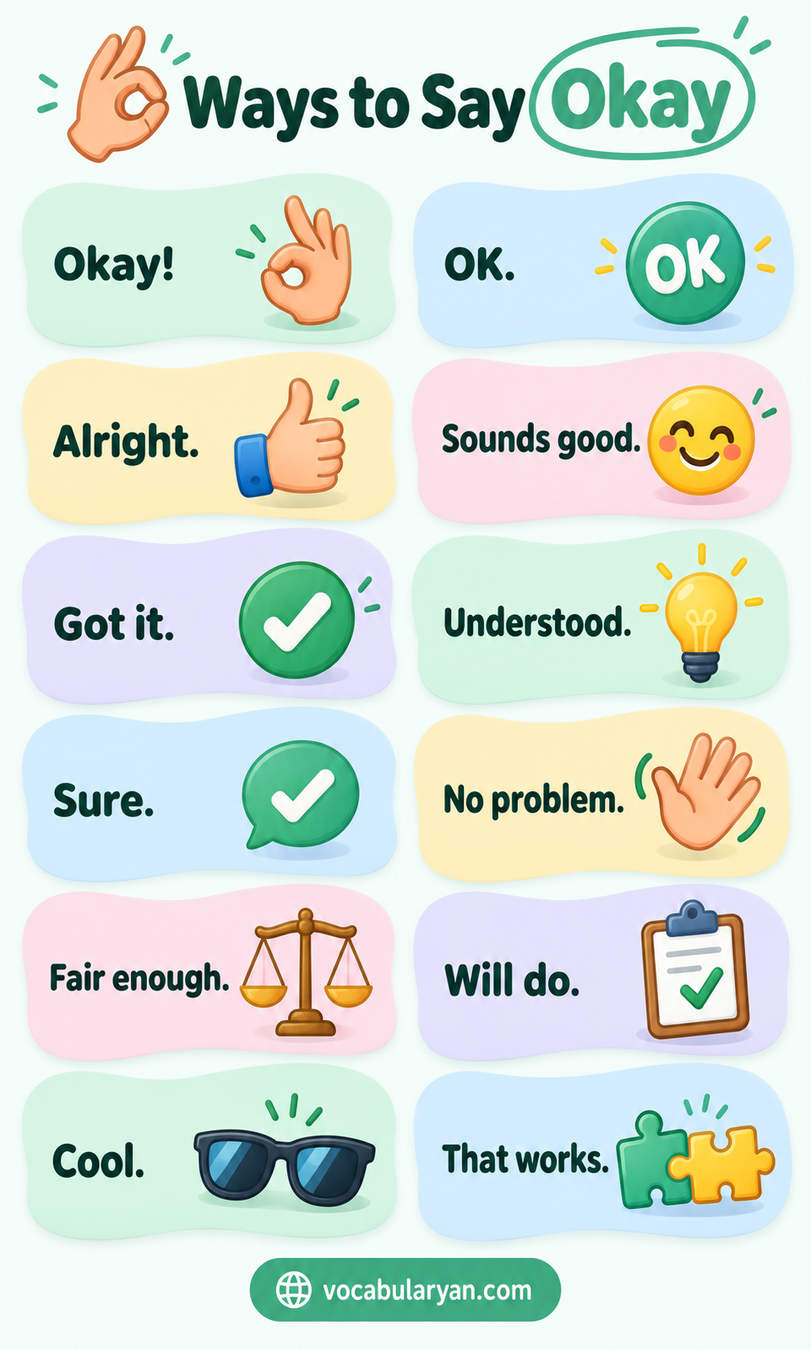
These five phrases replace "okay" in speech with almost anyone, from a shop assistant to a close friend.
Alright: the nearest match to "okay" and the same level. It fits a plan, an instruction, or a question, and it works in speech and in messages.
- Alright, I’ll meet you outside the library at four.
- Alright, that’s enough television for tonight.
- Is Wednesday better for you? Alright, Wednesday it is.
Sure: a friendly yes to a request, a step warmer than "okay". It is common enough to have its own page, so one note here: it fits friends and colleagues, and it sounds short with a stranger.
- Can you hold this for a second? Sure.
- Sure, I can drop the keys off on my way home.
- Sure, let’s try the new café on Bridge Street.
Fine: agreement with a plan, and the word also means "acceptable" or "in good health". Said with a flat voice it sounds annoyed, so add a warm word after it.
- Fine, we’ll take the earlier train, then.
- The room is small but fine for one night.
- Are you hurt? No, I’m fine, just a scratch.
Okay then: "okay" plus "then", used to close a small decision and move on. It sounds relaxed, and it fits family, friends, and colleagues.
- Okay then, I’ll book the table for seven.
- Okay then, see you at the gym tomorrow.
- You don’t want dessert? Okay then, more for me.
No problem: the reply to a request or an apology, and it means that the request is no trouble. It fits shops, offices, and friends.
- Could you send that again? No problem, two minutes.
- Sorry I’m late. No problem, we haven’t started.
- No problem, I’ll cover your shift on Saturday.
Say "alright" when you want the exact level of "okay", and add a short next step so it does not sound flat.
Ways to Say Okay When You Agree
Agreement phrases answer a plan, an offer, or a suggestion, and each one says yes at a set level of warmth.
Agreed: a firm yes to a plan or a decision, and it fits a meeting, a family talk, or a deal between friends.
- Lunch at one, then a walk? Agreed.
- Agreed, we’ll split the cost of the present three ways.
- We stop at ten and finish tomorrow. Agreed.
Deal: the word for accepting an offer or a trade, and it fits friends, family, and relaxed work talk. A handshake goes with it.
- You cook, I wash up. Deal.
- Deal, but you’re driving on the way back.
- Fifty for the bike and you deliver it? Deal.
Fine by me: the way to say that a plan suits you, and it sounds easygoing rather than eager.
- Pizza tonight? Fine by me.
- If Sam wants the window seat, that’s fine by me.
- Fine by me, as long as we leave before the traffic starts.
That works: agreement with a time or a plan, and it is the most common yes in a work conversation. "That works for me" is the full form.
- Thursday at two? That works.
- That works for me, I’ll send the invitation.
- The blue version with the smaller logo? Yes, that works.
Fair enough: acceptance of a point you did not choose but can live with. It is not a full yes, so it fits a small disagreement that ends in peace.
- You want to leave early? Fair enough, you’ve had a long week.
- Fair enough, I hadn’t seen the forecast.
- She says the deadline is fixed. Fair enough, we’ll work late.
I’m in: an eager yes to an invitation, and it fits friends and colleagues who are planning something together.
- Beach on Sunday? I’m in.
- Count me in, I’m in for the quiz night.
- If there’s cake, I’m in.
Why not: a relaxed yes that says there is no reason to refuse, and it sounds spontaneous.
- Another coffee? Why not.
- Why not, we haven’t been to the cinema in months.
- Should we ask Dan too? Sure, why not.
Use "agreed" for a decision, "deal" for a trade, and "fair enough" when you accept a point without loving it.
Ways to Say Okay When You Understand
These phrases say that you heard and understood, and they follow an instruction, a piece of news, or an explanation.
Got it: the everyday way to say "I understand", and it fits a colleague, a teacher, or a friend giving directions.
- Turn left after the bank, then second right. Got it.
- Got it, I’ll change the date on the poster.
- So the red wire goes here? Got it, thanks.
Understood: the formal form of "got it", and it fits a manager, a client, or written instructions. It sounds serious, so keep it for work.
- Understood, the report will be with you by Friday.
- The client must not see the draft yet. Understood.
- Understood, Dr Mensah, I’ll take the tablets after food.
Noted: the way to say that you have written a fact down or will remember it, and it fits email and meetings. On its own it sounds cold, so add "thanks".
- Noted, thanks, I’ll add it to the agenda.
- The office closes at three on Fridays. Noted.
- Noted with thanks, we’ll adjust the invoice.
I see: a soft way to say that you follow an explanation, and the speaker then continues. It fits any level.
- I see, so the meeting moved because of the strike.
- Oh, I see, you meant the other Lucy.
- I see. And what happened after that?
Roger that: a casual "understood" borrowed from radio talk, and it fits friends and relaxed colleagues. In a formal meeting it sounds like a joke.
- Pick up bread and milk on the way? Roger that.
- Roger that, I’ll start the car.
- Roger that, boss, doors locked and lights off.
Makes sense: the reply to an explanation that you accept, and it sounds thoughtful rather than automatic.
- You want to test it on a small group first? Makes sense.
- Makes sense, the earlier flight gives us a full day.
- That makes sense, thanks for explaining the fee.
Reply "got it" to a friend, "understood" to a manager, and "noted, thanks" in an email, so each one matches the listener.
Ways to Say Okay When Something Is Acceptable
"Okay" also means "good enough" or "not a problem", and these phrases say that about a plan, a result, or a mistake.
It’s fine: the standard way to tell someone that a mistake or a delay does not matter. Said gently it calms the other person.
- You spilled a little water, it’s fine, I’ll get a cloth.
- It’s fine if you’re ten minutes late, we’ll wait.
- The photo is a bit dark but it’s fine for the newsletter.
No worries: a relaxed reply to an apology or a request, Australian in origin and now common everywhere. It fits friends, shops, and relaxed offices.
- Sorry I missed your call. No worries, I’ll ring back later.
- No worries, take the book for as long as you need.
- Can we move the meeting? No worries, Thursday is free.
Don’t worry about it: a fuller and warmer form of "no worries", used when someone feels bad about a mistake.
- I forgot your birthday. Don’t worry about it, we’ll celebrate this weekend.
- Don’t worry about it, the vase was cheap.
- You owe me for the taxi? Don’t worry about it.
It’s all good: casual American English for "everything is fine", and it fits friends after a small problem.
- We’re late, but it’s all good, the show starts at eight.
- It’s all good, I found my keys in the other coat.
- No stress, it’s all good, we’ll go next week.
That’ll do: British and casual, used for a result that is good enough rather than perfect.
- The paint’s a bit patchy, but that’ll do for a garage.
- That’ll do, stop stirring or the sauce will burn.
- Two chairs and a table? That’ll do for a picnic.
Say "it’s fine" after a small mistake and "no worries" after an apology, and keep "that’ll do" for a result that is good enough.
Ways to Ask if Someone Is Okay
"Are you okay?" asks about health or mood, and these forms change the level of concern from a quick check to real worry.
Are you alright?: the everyday question after a fall, a shock, or a quiet mood, and it fits anyone. In Britain it also works as a greeting, so context decides.
- Are you alright? That was a nasty trip on the stairs.
- You’ve been quiet all evening, are you alright?
- Are you alright, Mrs Okoro? Shall I call someone?
Is everything okay?: a softer question that asks about the whole situation rather than the person’s body. It fits a colleague, a neighbour, or a customer.
- Is everything okay? You left the meeting quite fast.
- Is everything okay with the order, sir?
- I saw the ambulance next door, is everything okay?
You okay?: the short casual form for a friend or family member, said with a worried look.
- You okay? You look pale.
- Hey, you okay? That exam was tough.
- You okay in there? You’ve been ages.
Are you feeling alright?: the question about physical health, and it fits a friend, a child, or a colleague who looks unwell.
- Are you feeling alright? You’ve hardly eaten.
- Are you feeling alright, love? Your forehead is hot.
- Sam, are you feeling alright? You can go home early.
Is something wrong?: the direct question when a person looks upset, and a real conversation follows it.
- Is something wrong? You haven’t said a word since lunch.
- Is something wrong with the car? It’s making a noise.
- Talk to me, is something wrong at school?
How are you holding up?: the gentle question for someone in a hard time, such as illness or grief, and it fits friends and kind colleagues.
- How are you holding up since the funeral?
- How are you holding up, Amara? Three night shifts in a row is a lot.
- I heard about the redundancies, how are you holding up?
Ask "are you alright?" after a shock and "how are you holding up?" during a hard week, and wait for the real answer.
Ways to Say Okay to Start or Change a Conversation
"Okay" at the start of a sentence opens a meeting, a lesson, or a new part of a talk, and these words do the same in speech.
Right: the British opener for a new task or a new point, said with a small pause after it.
- Right, let’s get started, everyone open your books.
- Right, that’s the shopping done, what’s next?
- Right, so where were we before the phone rang?
Alright then: the relaxed way to move a group from talking to doing, and it fits family, friends, and small teams.
- Alright then, coats on, we’re leaving in five minutes.
- Alright then, who’s reading first?
- Alright then, that’s settled, I’ll email the landlord.
So: the softest opener, used to change the theme or return to a question after a break.
- So, how was the interview?
- So, back to the budget, we still have two questions.
- So, what did the doctor say?
Now: a formal opener for the next stage of a talk or a lesson, and it fits a teacher, a presenter, or a tour leader.
- Now, turn to page twelve and read the first paragraph aloud.
- Now, the second part of the tour takes us to the old kitchen.
- Now, if there are no questions, we’ll vote.
Open with "right" or "alright then" in a group, and use "so" to move to a new question smoothly.
Casual Ways to Say Okay to Friends
Casual forms of "okay" belong to friends, family, and classmates, and each one adds warmth or speed to the plain word.
Cool: the most common casual "okay" among younger speakers, and it also means that you like the plan.
- Meet at the park at six? Cool.
- Cool, I’ll bring the speaker.
- You got the tickets? Cool, thanks.
Sweet: the same as "cool" with a little more pleasure, and it fits good news from a friend.
- The pizza’s free tonight? Sweet.
- Sweet, I’ve never been to that beach.
- No homework this weekend? Sweet!
Yep: the casual form of "yes", and it fits a quick answer to a friend. "Yes" has its own page, so one note: "yep" and "yup" sound the same and are both fine in a text.
- You coming? Yep, two minutes.
- Yep, I’ve locked the back door.
- Did you feed the cat? Yep, twice.
Okey-dokey: a playful "okay" for family and close friends, and it sounds cheerful. A manager will read it as a joke.
- Okey-dokey, bedtime, teeth first.
- Okey-dokey, I’ll pick you up at eight.
- One sugar or two? Two. Okey-dokey.
Sure thing: a warm American yes to a request, and it fits friends, family, and friendly shops.
- Can you save me a seat? Sure thing.
- Sure thing, the printer’s in the back room.
- Sure thing, I’ll tell her you called.
You bet: an enthusiastic American yes, and it says that the answer was never in doubt.
- Are you coming to the match? You bet.
- You bet, I wouldn’t miss your birthday.
- Can I borrow the car? You bet, keys are on the hook.
Say "cool" or "sweet" to a friend, and keep "okey-dokey" for people who laugh at it.
Formal Ways to Say Okay at Work
Formal forms of "okay" fit a manager, a client, or a customer, and they sound complete rather than short.
Certainly: the polite yes to a request from a customer or a senior person, common in hotels, shops, and offices.
- Could I see the menu? Certainly, madam.
- Certainly, I’ll have the figures to you by noon.
- Certainly, Mr Haddad, please follow me.
Of course: a warm formal yes that says the request was expected and welcome.
- May I open the window? Of course.
- Of course, take all the time you need.
- Of course, Professor, the slides are on the shared drive.
Very well: the formal way to accept a decision you did not choose, and it fits a serious meeting or an older speaker.
- Very well, we’ll postpone the launch until March.
- Very well, Ms Lind, I’ll sign the revised contract.
- Very well, if the board insists, we’ll follow its plan.
By all means: a polite way to give permission, and it means "yes, please do".
- May I bring a colleague? By all means.
- By all means, use my office while I’m away.
- By all means, ask questions as we go.
I’d be happy to: the warmest formal yes, and it fits a request for help from a client or a manager.
- Could you show the new starter around? I’d be happy to.
- I’d be happy to review the draft this afternoon.
- I’d be happy to join the call from the airport.
"Fine" and "okay" both sound abrupt to a manager, because they accept without any warmth.
- Can you take the Monday meeting? Fine. ❌
"Fine" on its own sounds annoyed, and a warm formal yes needs a second word or a full sentence.
- Can you take the Monday meeting? Of course, I’ll prepare the notes. ✅
Every way to say okay on this page belongs to one of five levels.
| Level | Phrases | Who it fits |
|---|---|---|
| Slang | Bet, aight, say less | Close friends your own age |
| Casual | Cool, sweet, yep, okey-dokey, sure thing | Friends, family, relaxed colleagues |
| Neutral | Alright, sure, got it, that works, no problem | Anyone you know by name |
| Formal | Certainly, understood, of course, noted | Managers, clients, customers, older people |
| Very formal | Very well, by all means, I’d be happy to | Senior guests, ceremonies, official replies |
Answer a customer with "certainly", a manager with "understood", and a request for help with "I’d be happy to".
Ways to Say Okay in an Email
An email reply to a request needs a full phrase, because a single "okay" reads as cold on a screen.
Confirmed: the one-word reply that says a booking, a date, or a change is fixed. It fits work and travel emails.
- Confirmed, the room is booked for 14 September.
- Confirmed, thank you, I’ll see you at the Leeds office.
- Meeting moved to 3 p.m. Confirmed on my side.
Will do: a friendly written yes to a task, and it fits a colleague or a client you know.
- Will do, I’ll send the signed copy this afternoon.
- Could you add Priya to the thread? Will do.
- Will do, and thanks for the reminder.
Noted with thanks: the polite written form of "noted", common in offices across Asia and in British English.
- Noted with thanks, the change is now in the calendar.
- Noted with thanks, I’ll inform the rest of the team.
- Noted with thanks, and apologies for the earlier mix-up.
That works for me: the written yes to a proposed time or plan, and it is the most common agreement line in a work email.
- Tuesday at ten? That works for me.
- That works for me, I’ll send the invite.
- Both options are fine, but the second works for me best.
Happy to: a short warm yes to a request for help, and it fits any colleague or client.
- Happy to, send the file over whenever you’re ready.
- Happy to help with the slides, just share the link.
- Could you present the first part? Happy to.
Thanks for letting me know: the reply to news or a change, and it says "okay, understood" without sounding short.
- Thanks for letting me know, I’ll plan around the closure.
- Thanks for letting me know about the delay, no problem at all.
- Thanks for letting me know, I’ve updated the schedule.
A one-word "OK" as a whole email reply reads as annoyed, even when you feel fine.
- OK. ❌
The reader cannot hear your voice, so a written yes needs a second phrase.
- OK, thanks, I’ll start on it this morning. ✅
Write "confirmed" for a date, "will do" for a task, and "thanks for letting me know" for news.
Ways to Say Okay in a Text
Text forms of "okay" are short, and the number of letters changes how warm the reply sounds.
Ok: the standard text form, neutral and safe with anyone. "Okay" written in full sounds a little softer.
- Ok, see you at 7.
- Ok, I’ll grab the tickets.
- Ok, no rush, take your time.
Okay: the full spelling, and in a text it reads as calm and a touch warmer than "ok".
- Okay, I’ll wait by the entrance.
- Okay, that’s fine, Sunday it is.
- Okay! Can’t wait.
Kk: a friendly quick "okay" between close friends, and the double letter softens it.
- Kk, on my way.
- Kk, I’ll bring the charger.
- Kk see you soon x
Okie: a cute casual form for friends and partners, and it sounds playful.
- Okie, meet you at the food court.
- Okie, I’ll save you a seat.
- Okie dokie, see you tomorrow.
Np: the text form of "no problem", used after a thank you or a request.
- Thanks for the lift! Np.
- Np, I’ll send the address now.
- Can you feed the fish? Np.
A single "k" is the one text form to avoid, because it reads as angry or bored.
- k ❌
One letter takes less effort than the shortest word, so the reader feels dismissed.
- ok, sounds good ✅
Write "ok" or "okay" to anyone, "kk" or "okie" to a friend, and never a single "k".
Ways to Say Okay to a Group
A group "okay" opens a task, closes a decision, or asks the whole room to agree.
Okay everyone: the standard call for attention before a task or an announcement, in a class, a meeting, or a family kitchen.
- Okay everyone, phones away, we’re starting.
- Okay everyone, dinner is on the table.
- Okay everyone, thank you for coming at short notice.
Alright team: a warm opener for a work group or a sports group, and it fits a coach or a manager.
- Alright team, two goals down but plenty of time.
- Alright team, let’s go through the numbers from Monday.
- Alright team, last push before the holiday.
All agreed?: the question that closes a group decision, and the reply is "agreed" or a nod.
- We move the launch to May. All agreed?
- All agreed that Sam leads the next project?
- Pizza for the party, all agreed?
Sounds like a plan: a cheerful group yes to a suggestion, and it fits friends and relaxed teams.
- Museum in the morning, lunch by the river? Sounds like a plan.
- Sounds like a plan, I’ll book the minibus.
- Sounds like a plan, everyone bring a dish.
Open a group with "okay everyone", and close a group decision with "all agreed?".
Regional Ways to Say Okay in English
Each English-speaking country keeps a few forms of "okay" of its own, and the right one in the right place sounds local at once.
British Ways to Say Okay
Righto: a cheerful British and Australian "okay" for an instruction, and it sounds a little old-fashioned in a friendly way.
- Righto, I’ll lock up on my way out.
- Two sugars? Righto.
- Righto, back in ten minutes.
Right you are: a warm British reply to an instruction, common with shopkeepers, drivers, and older speakers.
- Drop me at the station, please. Right you are.
- Right you are, love, one large chips coming up.
- Right you are, I’ll leave the parcel with next door.
Lovely: a British "okay" that also says the plan pleases you, and it fits shops, cafés, and neighbours.
- Table for two by the window? Lovely.
- Lovely, I’ll see you Thursday then.
- The keys are under the mat. Lovely, thanks.
American Ways to Say Okay
Alrighty: a friendly American "alright", used to start a task or wrap up a chat.
- Alrighty, let’s get this table cleared.
- Alrighty, I’ll call you when I land.
- Alrighty then, who wants the first pancake?
For sure: an American yes with confidence, and it fits friends and relaxed workmates.
- You’re coming to the barbecue? For sure.
- For sure, I’ll text you the address.
- Can I borrow your notes? For sure, I’ll email them tonight.
Right on: a relaxed American "okay, good", and it sounds like approval.
- You fixed the sink yourself? Right on.
- Right on, meet you at the trailhead.
- She got the job? Right on!
Australian and Irish Ways to Say Okay
Too easy: the Australian reply to a request, and it means that the request is no trouble at all.
- Can you drop the ute back by six? Too easy.
- Too easy, mate, I’ll grab the ice on the way.
- Another round? Too easy.
Grand: the Irish "okay" or "fine", used for a plan, a person’s health, and a result. Here it does not mean "big".
- How’s your mum? Ah, she’s grand, thanks.
- We’ll meet at eight? Grand.
- The car’s a bit old but it’s grand for the city.
Sound: Irish and northern British for "okay, good", and it also describes a person you like.
- I’ll get the next round. Sound.
- Sound, see you at the match.
- He lent me his bike, he’s sound.
Say "righto" in Britain, "alrighty" in America, "too easy" in Australia, and "grand" in Ireland.
Slang Ways to Say Okay
Slang forms of "okay" belong to close friends under thirty, and each one sounds wrong from a manager or a stranger.
Bet: current American slang for "okay, agreed", and it says that the plan is on.
- Pick you up at nine? Bet.
- Bet, I’ll bring the snacks.
- We’re winning this game. Bet.
Aight: a spoken short form of "alright", common in American English between friends.
- Aight, I’m leaving now.
- Meet at the court? Aight.
- Aight, cool, text me when you’re close.
Say less: slang for "okay, you don’t need to explain", and it means that you agree at once.
- Free tacos after practice? Say less.
- Say less, I’m already getting my shoes.
- You need a lift to the airport? Say less.
Word: older American slang for "okay, I agree", and it still sounds natural between friends.
- We start the project tonight? Word.
- Word, that’s the best café in town.
- I’ll pay you back Friday. Word.
Keep "bet", "aight", and "say less" for friends your own age, and use "alright" with everyone else.
Funny Ways to Say Okay
A funny "okay" is a longer or sillier form of a plain one, and it fits family and friends who enjoy a joke.
Okey-dokey artichokey: a rhyming "okay" for children and playful friends, and the joke is the vegetable.
- Okey-dokey artichokey, into the bath you go.
- Okey-dokey artichokey, I’ll see you at the school gate.
- One scoop of chocolate? Okey-dokey artichokey.
Aye aye, captain: a sailor’s "yes, understood", used as a joke when someone gives you an order.
- Take the bins out, please. Aye aye, captain.
- Aye aye, captain, three coffees coming up.
- Aye aye, captain, homework first, then football.
Roger dodger: a silly form of "roger that", and it fits a friend or a child who has just given instructions.
- Left at the big tree, then straight on? Roger dodger.
- Roger dodger, I’ll get the paper on my way back.
- Roger dodger, sleeping bags are in the car.
Use a funny "okay" only when the other person will laugh, because it reads as mockery to a stranger.
How Do You Reply When Someone Says Okay?
The reply changes with the job the word is doing: an agreeing "okay" needs a thank you, and an opening "okay" needs your attention.
Okay or alright (agreeing to your plan): thank the person, or confirm the next step.
- Okay, I’ll come at six. Great, thanks, see you then.
- Alright, you can borrow it. Thank you, I’ll bring it back on Monday.
- Okay, that works. Perfect, I’ll send the details.
Got it or understood (after your instructions): close with a short thanks or an offer of help.
- Got it. Thanks, shout if anything is unclear.
- Understood. Good, let me know when it’s done.
- Noted, thanks. No problem, thanks for the quick reply.
Are you okay? (asked to you): answer honestly and briefly, then thank the person for asking.
- Are you okay? I’m fine, thanks, just tired.
- You alright? Yeah, I’m alright, thanks for asking.
- Is everything okay? Not really, can we talk later?
Okay? (asked as a check): answer with "okay" or "yes" so the speaker knows you follow.
- We leave at eight, okay? Okay.
- Don’t touch the wet paint, okay? Yes, got it.
- I’ll call you tonight, okay? Sure, speak later.
Okay, let’s begin (opening a task): respond with attention, not with another "okay".
- Okay, let’s begin. Ready when you are.
- Right, everyone. Yes, we’re all here.
- So, back to the budget. Yes, where were we?
Thank an "okay" that agrees, answer an "okay?" that checks, and give your attention to an "okay" that opens.
More Everyday English Phrases
- Other Ways to Say Sounds Good
- Other Ways to Say Sure
- Other Ways to Say I Agree
- Other Ways to Say of Course
FAQs
The count changes with slang and with the country, and this page covers more than seventy that native speakers use today. All of them do one of five jobs: agreeing, saying that you understood, saying that something is acceptable, asking whether someone is fine, and opening a new part of a talk. Learn "alright", "got it", "fine", "are you alright?", and "right" first, and the rest add a level or a place on top.
"Certainly", "of course", and "understood" are the polite forms of "okay", and each one fits a customer, a manager, or a stranger. "Certainly" answers a request, "of course" gives permission, and "understood" follows an instruction. Add the person’s name or a short next step, and the reply sounds warm as well as polite.
"Are you alright?", "is everything okay?", and "how are you holding up?" replace "are you okay?" at different levels of concern. "Are you alright?" fits a small shock, "is everything okay?" asks about the whole situation, and "how are you holding up?" fits illness or grief. Choose the softest form that matches how worried you are.
No, "ok" is not slang, because "OK" and "okay" are two spellings of the same word and both are correct. "OK" is the older form and "okay" is the fuller one, and "okay" is the safer choice in a formal document. The slang forms are "k", "kk", "okie", and "aight", and those belong to texts between friends.
Yes, when it is the whole reply in an email or a text, because the reader cannot hear your voice. A one-word "okay" to a request reads as annoyed, and a single "k" reads as angry. Add a thank you or a next step, and the same word sounds fine.
"Got it, thanks" is the best reply to a message from a colleague or a friend, and "noted with thanks" is the formal form for a manager or a client. "Will do" fits a task and "confirmed" fits a date or a booking. Each one says that you read the message and that you will act on it.
Yes, when someone asks you for a favour or offers you something, because "sure" is a warm yes to a request. It does not replace "okay" after an instruction, where "got it" fits, or after bad news, where "I see" fits. "Sure" has its own page with its levels and traps.
No, because "okey-dokey", "bet", and "aight" belong to friends and family, and a manager or a client reads them as a joke. The work forms are "certainly", "understood", "noted", and "that works for me". Keep the playful forms for a team you know well and for messages after hours.