
"Excuse me" is one phrase with seven jobs. It opens a path through a crowd, stops a stranger, breaks into a conversation, lets you leave a table, asks for a repeat, and covers a cough. Said with a sharp voice, it says that you are offended. The ways to say excuse me in English split along those same seven jobs, so the job decides the phrase. The first job, getting past someone, is where most learners meet it.
Ways to Say Excuse Me to Get Past Someone
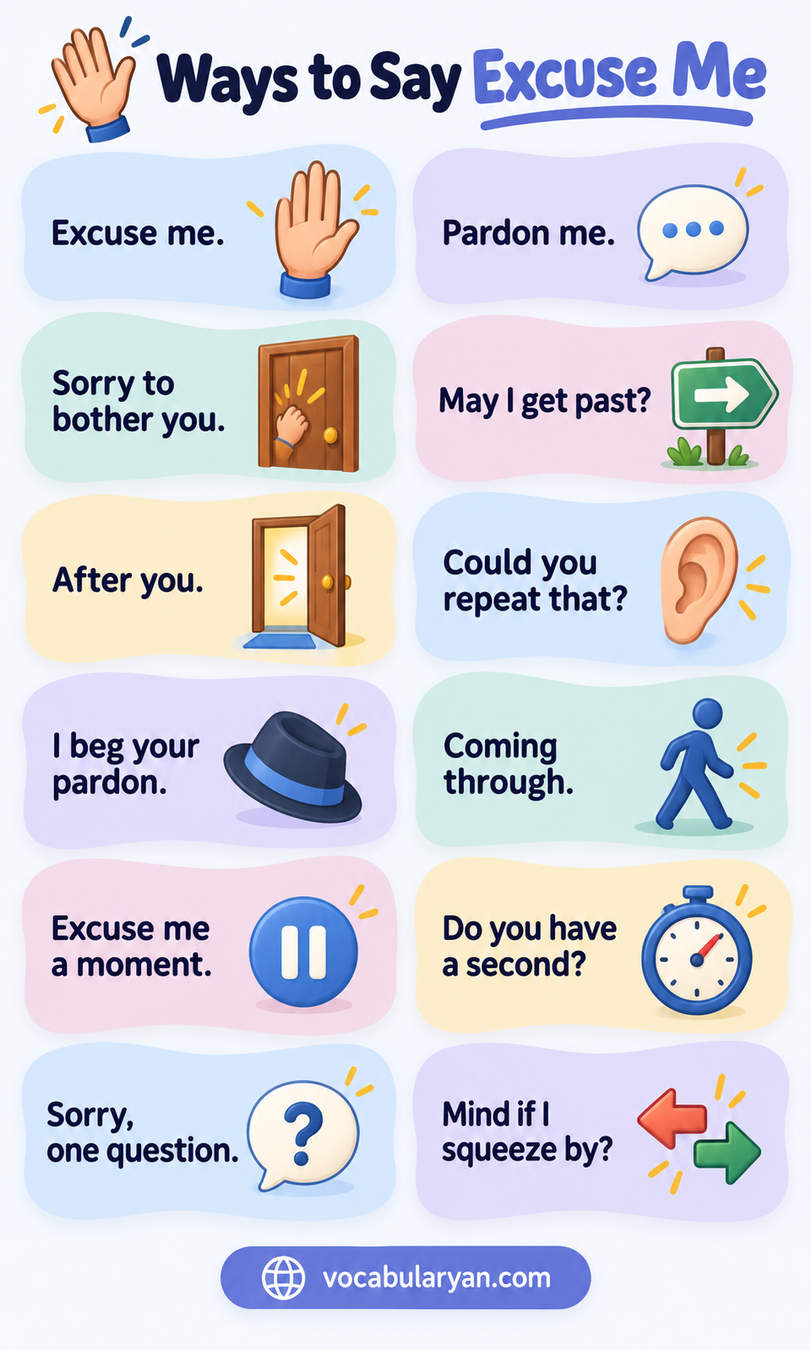
These phrases ask a person to move so that you can pass, and each one fits a bus, a shop aisle, or a crowded room.
Excuse me: the standard phrase for moving past a stranger, said before you move. It fits every country and every level, and it never sounds rude when your voice is soft.
- Excuse me, I need to get off at the next stop.
- Excuse me, are you in the queue or just waiting?
- Oh, excuse me, I didn’t see your bag on the floor.
Sorry: the British way to ask for space, said in the same moment as "excuse me". It is not an apology for anything, and the reply is a step to one side.
- Sorry, can I just get through here?
- Sorry, is anyone sitting there?
- Sorry, coming past with a pram.
Can I get past?: a direct request that names what you want, so it fits a narrow aisle or a crowded doorway. It goes after "excuse me" or "sorry".
- Excuse me, can I get past? My train leaves in two minutes.
- Sorry, can I get past you to the exit?
- Can I get past, please? I’m with the little boy at the front.
Can I squeeze through?: the friendly form of "can I get past", and it fits a tight space where you will touch shoulders with someone.
- Sorry, can I squeeze through? I left my coat on that chair.
- Can I squeeze through to the bar? I’m getting the drinks in.
- Excuse me, can I squeeze through with these boxes?
Coming through: a warning rather than a request, said by someone carrying a tray, a ladder, or a pile of plates. It fits work and a party, and it sounds rude to a stranger on the street.
- Coming through, hot plates, mind your arms!
- Coming through, sorry, this thing is heavy.
- Excuse me, coming through with the cake.
Mind your backs: a British phrase from markets and pubs, said behind a group of people who have their backs to you. The reply is a step forward, not a word.
- Mind your backs, please, trolley coming through.
- Mind your backs, lads, I’ve got the bins.
- Sorry, mind your backs, this crate is full.
Say "excuse me" before you move, add "can I get past?" when the person has not heard you, and keep "coming through" for a tray or a ladder.
Ways to Say Excuse Me to Get Someone’s Attention
These phrases open a conversation with a stranger or a busy person, and each one is a polite tap on the shoulder in words.
Excuse me, sir: "excuse me" with a form of address for a man you do not know, and it fits a shop, a street, or an airport. "Madam" is the form for a woman, and both sound formal.
- Excuse me, sir, you dropped your glove.
- Excuse me, sir, is this the right platform for Leeds?
- Excuse me, madam, the museum closes in ten minutes.
Sorry to bother you: a soft opening for a stranger or a colleague who looks busy. It says that you know you are taking time, and it goes before a short question.
- Sorry to bother you, but does this bus go to the station?
- Sorry to bother you while you’re eating, could we get the bill?
- Sorry to bother you, Dr Rahman, do you have two minutes?
Hi, sorry: the casual opening for a shop assistant, a waiter, or a passer-by, and it is common with younger speakers in Britain. The "hi" makes it friendly, and the "sorry" makes it polite.
- Hi, sorry, do you work here?
- Hi, sorry, is this seat free?
- Hi, sorry, I think you’ve got my order by mistake.
Hello?: a call to a person you cannot see, said at an empty counter or into a room. It rises at the end like a question.
- Hello? Is anyone at the desk?
- Hello? I’ve been waiting at the counter for a while.
- Hello? Sorry, the door was open, is this the dentist?
Hey: the casual way to stop a friend or a classmate, and it fits nobody older or senior. To a stranger it sounds like a complaint, so keep it for people who know you.
- Hey, you left your phone on the table.
- Hey, Jamal, wait for me!
- Hey, is that your dog running off?
Pardon me: the American way to open a question to a stranger, a step more formal than "excuse me". In Britain it sounds like something from an old film.
- Pardon me, ma’am, is this your bag?
- Pardon me, do you know where the restrooms are?
- Pardon me, officer, we’re looking for the parking garage.
Open with "excuse me, sir" or "sorry to bother you" for a stranger, and save "hey" for a friend.
Ways to Say Excuse Me to Interrupt
These phrases break into a conversation or a meeting, and each one names the interruption before you speak.
Sorry to interrupt: the standard way to break into a meeting or a chat at work, and it fits every level. It goes with "but" and a short reason.
- Sorry to interrupt, but the client is on the phone.
- Sorry to interrupt, Ana, do you have the numbers for March?
- Sorry to interrupt your lunch, the taxi is outside.
Can I jump in?: a casual request to speak in a group, common in video calls and workshops. The reply is "go ahead" or "sure".
- Can I jump in here? I’ve seen this problem before.
- Can I jump in? I think we’ve missed the deadline question.
- Quick one, can I jump in before we move on?
If I may: the formal way to ask permission to speak, and it fits a senior person, a board, or a courtroom. It goes at the start of the sentence, and the sentence goes on without a pause.
- If I may, I’d like to add one figure to that report.
- If I may, Chair, the vote was not unanimous.
- If I may, Professor, the date on the slide is wrong.
Pardon the interruption: the formal phrase for stepping into a room where a meeting is happening, and it fits an assistant, a receptionist, or a nurse.
- Pardon the interruption, Mr Osei, your car has arrived.
- Pardon the interruption, there’s a call for Dr Silva.
- Pardon the interruption, but the fire alarm test starts in five minutes.
Sorry to butt in: casual and honest, and it fits friends or close colleagues when you cut into their chat. "Butt in" means to enter a conversation without an invitation.
- Sorry to butt in, but is that the new café on Mill Road?
- Sorry to butt in, guys, does anyone have a charger?
- Sorry to butt in, I couldn’t help hearing, you’re from Cork?
One quick thing before you go on: a warm way to stop a speaker for a moment, and it fits a colleague, a teacher, or a friend telling a story.
- One quick thing before you go on, is this the same Sam from your old job?
- One quick thing before you go on, the projector isn’t working.
- One quick thing before you go on, can everyone at the back hear?
Say "sorry to interrupt" at work, "can I jump in?" on a call, and "if I may" to someone senior.
Ways to Say Excuse Me When You Leave a Room or a Table
These phrases let you step away from a meal, a meeting, or a conversation, and each one promises a return or names the reason.
Excuse me a moment: the neutral way to leave for a short time, and it fits a phone call, a bathroom visit, or a knock at the door.
- Excuse me a moment, I need to take this call.
- Excuse me a moment, the oven timer is going off.
- Excuse me a moment, I’ll just find the waiter.
Would you excuse me?: the formal form, said to a guest, a client, or a table of people you do not know well. The reply is "of course".
- Would you excuse me? My daughter is calling from school.
- Would you excuse me for a minute? The director needs a signature.
- Would you excuse me, Mrs Bell? I’ll be back before the coffee.
If you’ll excuse me: a polite way to end a conversation and leave, rather than a short break. It fits a party, a reception, or the end of a meeting.
- If you’ll excuse me, I have an early train tomorrow.
- If you’ll excuse me, I should say hello to the host.
- If you’ll excuse me, gentlemen, the next meeting starts at four.
I’ll be right back: the casual promise to return, and it fits friends, family, and colleagues at lunch. It goes after "excuse me" or on its own.
- Excuse me, I’ll be right back, I left my wallet in the car.
- I’ll be right back, keep my seat warm.
- Hold that thought, I’ll be right back.
Back in a sec: the shortest form, said between friends or typed in a group chat. "Sec" is short for "second".
- Back in a sec, the kettle’s boiling.
- Back in a sec, someone’s at the door.
- Excuse me, back in a sec, the dog wants to go out.
Can I be excused?: the phrase a child says to leave the dinner table, and it also fits a student asking to leave a class. The adult replies "yes, you can".
- Can I be excused? I’ve finished my dinner.
- Can I be excused, Miss? I don’t feel well.
- Mum, can I be excused to go and play?
Say "excuse me a moment" for a short break, "if you’ll excuse me" when you are leaving for good, and "back in a sec" to friends.
Ways to Say Excuse Me When You Did Not Hear
These phrases ask someone to say something again, and each one is a question with a rising voice at the end.
Sorry?: the most common repeat request in British English, said with a rising voice and a slight lean forward. It fits every person and every place.
- Sorry? The music’s very loud in here.
- Sorry, what time did you say?
- Sorry? I missed the last word.
Pardon?: the polite British repeat request, and it fits a shop, a school, or an older person. It is one word, and the voice rises on the second syllable.
- Pardon? Did you say the third floor?
- Pardon? I’m afraid my hearing isn’t what it was.
- Pardon, love, which bus did you want?
Excuse me?: the American repeat request, with a rising voice. The same two words with a sharp, falling voice mean something different, so the voice counts for more than the words.
- Excuse me? Did you say gate twelve?
- Excuse me? I didn’t hear the price.
- Excuse me, sorry, the line is breaking up.
Say that again?: the casual repeat request between friends and colleagues, and it fits a noisy room or a bad phone line.
- Say that again? A lorry just went past.
- Sorry, say that again, the baby was crying.
- Say that again, who’s getting married?
Could you repeat that?: the formal repeat request, and it fits a phone call with a bank, a meeting, or an interview.
- Could you repeat that, please? I’m writing it down.
- Sorry, could you repeat that? The reference number was too fast for me.
- Could you repeat that last part about the deadline?
I didn’t catch that: a polite way to say that you heard sound but not words, and it fits a call, a lecture, or a strong accent.
- Sorry, I didn’t catch that, was it Tuesday or Thursday?
- I didn’t catch that, could you say the address once more?
- I didn’t catch that last name, how do you spell it?
Come again?: casual and a little surprised, and it fits a friend who has said something strange or unexpected.
- Come again? You’re moving to Iceland?
- Come again? I thought you said the meeting was cancelled.
- Sorry, come again? Fifty pounds for parking?
"What?" on its own is the trap here, because it sounds like a challenge to anyone outside your family.
- What? (to a shop assistant who spoke too quietly) ❌
"What?" sounds rude to a stranger or an older person, and "sorry?" or "pardon?" asks the same question politely.
- Sorry? I didn’t quite hear you. ✅
Say "sorry?" or "pardon?" to a stranger, "say that again?" to a friend, and "could you repeat that?" on a work call.
Ways to Say Excuse Me After a Cough or a Sneeze
These phrases cover a small noise from your own body, and each one is short, quiet, and said at once.
Oh, excuse me: the standard phrase after a sneeze, a burp, a yawn, or a loud stomach, and it fits every level. The listener replies "bless you" after a sneeze and says nothing after the rest.
- Oh, excuse me, I’ve had this cold all week.
- Oh, excuse me, that was the fizzy drink.
- Oh, excuse me, I was up at five this morning.
Pardon me: the formal form after a burp or a cough, and it is more common in America than in Britain. At a dinner table it sounds polite and a little old-fashioned.
- Pardon me, I think I ate too fast.
- Pardon me, it’s the dust in here.
- Pardon me, sorry, allergies.
Oops, sorry: the casual form between friends and family, and it fits a burp at the dinner table or a loud yawn in the cinema.
- Oops, sorry, that was louder than I meant.
- Oops, sorry, long day.
- Oops, sorry, Mum, it slipped out.
The sneeze itself catches learners out, because the two phrases belong to two different people.
- Bless you. (said by the person who sneezed) ❌
"Bless you" is the listener’s line, and the person who sneezed says "excuse me" instead.
- Excuse me. (said by the person who sneezed) ✅
Say "excuse me" after any noise from your body, and wait for "bless you" only after a sneeze.
Ways to Say Excuse Me to Show You Are Offended
These phrases use "excuse me" as a challenge, and each one says that the other person has crossed a line.
Excuse me?!: the sharp, rising form, said when someone has been rude or has pushed in front of you. The voice makes the meaning, and the reply is a step back or an apology.
- Excuse me?! There is a queue here, you know.
- Excuse me?! I was talking to the lady at the desk.
- Excuse me?! Say that to my face.
I beg your pardon!: the formal offended phrase, and it fits a shocked older person or a manager who has heard something rude. With a question mark it asks for a repeat, and with an exclamation mark it means "how dare you".
- I beg your pardon! I have never been so insulted.
- I beg your pardon! That is my seat, and I have the ticket for it.
- I beg your pardon, young man, mind your language.
Well, excuse me!: the sarcastic form, said when someone has corrected you or been fussy. It sounds playful between friends and rude to anyone else.
- Well, excuse me! I didn’t know you were the expert.
- Oh, well, excuse me for trying to help.
- Well, excuse me, I’ll use the other door next time.
Excuse you: a casual comment on someone else’s bad manners, said after a burp, a shove, or a rude remark. It is a joke between friends and a complaint to a stranger.
- Excuse you, that was my foot.
- Excuse you! Nobody wants to hear that at the table.
- Excuse you, some of us were here first.
Do you mind?: the British offended phrase, said to someone who is standing too close, reading over your shoulder, or making a noise. The question needs no answer.
- Do you mind? I’m trying to read.
- Do you mind? That’s my coffee you’re drinking.
- Do you mind? There are children here.
Keep "excuse me?!" and "do you mind?" for someone who has been rude to you, because the same words to a friend start an argument.
Formal Ways to Say Excuse Me at Work
Formal phrases fit a manager, a client, an interviewer, or a customer, and they replace "sorry" with a full sentence.
My apologies: the formal apology for a small mistake at work, such as a wrong name, a late arrival, or a missed message.
- My apologies, I had the wrong time in my diary.
- My apologies, Mr Grant, the file is on its way now.
- My apologies for the noise, the builders start at eight.
Forgive me: the very formal phrase before a question that sounds personal or a remark that sounds blunt. It fits a doctor, a lawyer, or a senior colleague.
- Forgive me, but how old is your mother now?
- Forgive me, I don’t think that figure is right.
- Forgive me for asking, but is the company for sale?
Please excuse me: the polite full form for leaving a room or moving past someone senior, and it fits a formal dinner or a ceremony.
- Please excuse me, I have to take my medicine at nine.
- Please excuse me, Your Honour, my client has arrived.
- Please excuse me for a moment, the minister is on the line.
Sorry to trouble you: the British formal opening for a request to a client, a landlord, or a stranger, and it goes in speech and in writing.
- Sorry to trouble you, Mrs Doyle, but the parcel was left at my flat.
- Sorry to trouble you so late, is the office still open?
- Sorry to trouble you, could I have a copy of the invoice?
I do apologise: the formal British apology after a real mistake, and the "do" makes it stronger. In American spelling it is "I do apologize".
- I do apologise, the table should have been ready at seven.
- I do apologise, I misread your email.
- I do apologise for the delay, the system was down all morning.
Would you mind if I…: the formal way to ask permission before you do something small, such as opening a window or taking a call.
- Would you mind if I stepped out for a moment?
- Would you mind if I opened the window? It’s very warm in here.
- Would you mind if I sat here? The other room is full.
The phrases on this page fall into five levels, from slang to very formal.
| Level | Phrases | Who it fits |
|---|---|---|
| Slang | ‘Scuse me, my bad, budge up | Close friends your own age |
| Casual | Sorry, oops, one sec, say that again | Friends, family, relaxed colleagues |
| Neutral | Excuse me, sorry to bother you, excuse me a moment | Strangers, shops, everyday work |
| Formal | Pardon me, my apologies, sorry to trouble you, if I may | Managers, clients, customers, older people |
| Very formal | Forgive me, would you excuse me, I beg your pardon | Ceremonies, courts, guests of honour |
Say "my apologies" for a small mistake, "forgive me" before a blunt question, and "would you excuse me?" before you leave a client.
Casual Ways to Say Excuse Me to Friends
Casual phrases are for friends, family, and classmates, and each one is short and relaxed.
‘Scuse me: the spoken short form of "excuse me", with the first syllable dropped, and it fits a crowd of friends or a busy pub.
- ‘Scuse me, just grabbing my jacket.
- ‘Scuse me, mate, that’s my drink.
- ‘Scuse me, I’ll be two seconds.
My bad: American slang for "my mistake", said after a bump, a wrong turn, or a forgotten message. It is wrong for a manager or a customer.
- My bad, I thought you’d already left.
- Oh, my bad, that was your sandwich.
- My bad, I forgot to text you the address.
Oops: the sound you make after a small accident, such as a dropped fork or a wrong door, and it goes on its own or before "sorry".
- Oops, wrong classroom.
- Oops, sorry, I’ve knocked your bag over.
- Oops, did I just step on your toe?
One sec: the casual "excuse me a moment" between friends, said before you answer a phone or check a message.
- One sec, my phone’s going.
- One sec, I’ll find the photo.
- One sec, the kettle’s clicked off.
Budge up: the British request for a friend to move along a bench or a sofa so that you can sit down. "Shift up" and "scoot over" mean the same thing.
- Budge up, I want to sit next to Nan.
- Budge up a bit, there’s room for three.
- Go on, budge up, the film’s starting.
Say "’scuse me" and "budge up" to friends, and keep "excuse me" for anyone you would not text.
Ways to Say Excuse Me in a Text or an Email
In writing, "excuse me" becomes a short apology at the top of the message, and the phrase changes with the reader.
Sorry to bother you: the standard first line of an email that asks a busy person for a small favour, and it fits a colleague, a teacher, or a landlord.
- Hi Priya, sorry to bother you, could you resend the link?
- Sorry to bother you on a Friday, but the form is due today.
- Hello Mr Lee, sorry to bother you again about the deposit.
Apologies for the interruption: the formal first line of a message sent into a busy day, and it fits a client or a senior manager.
- Apologies for the interruption, the client has moved the call to three.
- Apologies for the interruption, but the printer on floor two is down.
- Apologies for the interruption during your leave, one quick signature is needed.
Quick question: the casual opening of a message that asks one small thing, and it fits a colleague or a friend in a chat.
- Quick question, is the meeting in room B or room C?
- Quick question, did you get the spare key back?
- Quick question, what size shoes does Ben wear?
Sorry, missed this: the reply to a message you saw late, and it fits friends and relaxed colleagues.
- Sorry, missed this, yes, Saturday works for me.
- Sorry, missed this, I was on the train with no signal.
- Sorry, missed this, still on for lunch?
Please excuse the delay: the formal apology for a late reply, and it fits a customer, a client, or an application.
- Please excuse the delay, the office was closed for the holiday.
- Please excuse the delay in replying, I was travelling last week.
- Please excuse the delay, your refund has now been processed.
Excuse the typos: the short line at the end of a message written in a hurry on a phone, and it fits colleagues and friends.
- Excuse the typos, sent from the bus.
- Excuse the typos, I’m typing with one hand.
- Running late, excuse the typos!
"Excuse me" itself is the trap in an email, because it is a spoken phrase.
- Excuse me for the late reply, the report is attached. ❌
"Excuse me" is a phrase for speech, and a written apology takes "apologies" or "please excuse the delay".
- Apologies for the late reply, the report is attached. ✅
Open a work email with "sorry to bother you" or "apologies for the interruption", and end a rushed text with "excuse the typos".
Regional Ways to Say Excuse Me in English
Each English-speaking country divides the jobs of "excuse me" and "sorry" in its own way, and the split is the biggest difference between British and American manners.
British Ways to Say Excuse Me
Sorry: the British word for almost every job of "excuse me", from passing in a crowd to stopping a waiter. It is said before the action, and it is not an apology.
- Sorry, could I get a menu?
- Sorry, is this the way to the platforms?
- Sorry, you’ve dropped your scarf.
Pardon: the British repeat request, and it also follows a burp or a cough. It is a step more polite than "sorry?" and is common in shops and schools.
- Pardon? It’s very noisy in here.
- Oh, pardon, that was me.
- Pardon, sir, which floor?
Mind out: a British warning to move, said to a friend, a child, or a crowd when something heavy is coming. It sounds sharp to a stranger.
- Mind out, the tea’s hot!
- Mind out, love, the door opens this way.
- Mind out, I’m coming through with the ladder.
American Ways to Say Excuse Me
Pardon me: the polite American phrase for a stranger, a burp, or a small bump, and it is more common in the South than in the North.
- Pardon me, is this seat taken?
- Pardon me, I didn’t mean to step on your bag.
- Pardon me, ma’am, you dropped your keys.
Huh?: the casual American repeat request between friends, and it sounds rude to a stranger, a teacher, or a customer.
- Huh? What did you say?
- Huh? I wasn’t listening, sorry.
- Huh? The game’s tonight, not tomorrow?
Australian and Irish Ways to Say Excuse Me
‘Scuse us: the Australian form of "excuse me", and "us" means "me" here even when you are alone. It fits a crowd, a shop, or a bar.
- ‘Scuse us, mate, just need to get to the door.
- ‘Scuse us, is this the line for tickets?
- ‘Scuse us, coming through with the esky.
Sorry, mate: the Australian phrase after a bump, said to any man and to many women, and it fits a footpath or a pub.
- Sorry, mate, didn’t see you there.
- Sorry, mate, was that your foot?
- Sorry, mate, this aisle is a bit tight.
Sorry, now: the Irish phrase for stopping a waiter or a passer-by, with "now" as a softener. It fits a pub, a shop, or a bus.
- Sorry, now, could we get two more of those?
- Sorry, now, is this bus going into town?
- Sorry, now, where would I find the post office?
What’s that?: the Irish and Scottish repeat request, warmer than "pardon?" and common between neighbours and in shops.
- What’s that? The wind took your words away.
- What’s that, love? Speak up a bit.
- What’s that you said about the match?
Say "sorry" in Britain and Ireland, "excuse me" or "pardon me" in America, and "’scuse us" in Australia, and every country understands "excuse me".
How Do You Reply When Someone Says Excuse Me?
The reply depends on which job "excuse me" is doing: a request for space gets a movement, a question gets "yes?", and an apology gets "no problem".
Excuse me, can I get past?: the reply is a step to one side, with "sure", "of course", or "go ahead".
- Excuse me, can I get past? Sure, go ahead.
- Sorry, coming through. Of course, after you.
- Mind your backs! Oh, sorry, come through.
Excuse me, sir: the reply is "yes?" or "how can I help?", said with a turn towards the speaker.
- Excuse me, sir? Yes? How can I help?
- Sorry to bother you. No bother at all, what do you need?
- Hi, sorry, do you work here? I do, what are you looking for?
Sorry to interrupt: the reply gives permission or asks for a minute, and both are polite.
- Sorry to interrupt. Go ahead, Ana.
- Can I jump in? Sure, jump in.
- If I may? Please, one moment, and then you.
Excuse me a moment: the reply is "of course" or "take your time", and it never asks why.
- Excuse me a moment. Of course, take your time.
- Would you excuse me? Certainly, we’ll wait.
- Back in a sec. No rush.
Sorry? and pardon?: the reply is the same sentence again, said more slowly and a little louder.
- Sorry? I said the meeting is at three.
- Pardon? The third floor, on the left.
- Say that again? Half past six, at the station.
Oh, excuse me: the reply after a sneeze is "bless you", and after any other noise the reply is silence or a smile.
- Oh, excuse me. (after a sneeze) Bless you!
- Pardon me. (after a burp) No problem.
- Oops, sorry. Don’t worry about it.
Excuse me?!: the reply is a quick apology and a step back, because the phrase says that you have offended someone.
- Excuse me?! There’s a queue. Oh, sorry, I didn’t see it.
- I beg your pardon! I’m sorry, I didn’t mean that the way it sounded.
- Do you mind? Sorry, I’ll move.
Match the reply to the job: step aside for a request, say "yes?" to a question, repeat the sentence for "sorry?", and say "bless you" only after a sneeze.
More Everyday English Phrases
FAQs
The main ways to say excuse me are "sorry", "pardon", "pardon me", "sorry to bother you", "sorry to interrupt", "excuse me a moment", and "would you excuse me?". Each one belongs to one job: "sorry" and "pardon me" for getting past, "sorry to bother you" for getting attention, "sorry to interrupt" for a meeting, and "excuse me a moment" for leaving a table. More than sixty phrases on this page cover those jobs at every level from slang to very formal.
No, "excuse me" is polite when your voice is soft and rises a little at the end, and it is the standard phrase in every English-speaking country. It becomes rude only when the voice is sharp and falls, because "excuse me?!" said that way means "how dare you". The words are the same, so the voice is the difference.
"Excuse me" is the everyday phrase for getting past, getting attention, and leaving a table, and it works everywhere. "Pardon me" is used for the same purposes in American English and sounds a step more formal, while in British English it is rare outside a repeat request. In Britain, "pardon?" on its own is the polite way to ask someone to repeat a sentence.
Yes, a quiet "excuse me" after a yawn is polite in a meeting, a class, or a conversation, because a yawn looks like boredom. Cover your mouth with your hand at the same time. Between friends, "oops, sorry" or a smile is enough.
Say "sorry to interrupt" to enter a conversation, "pardon the interruption" to enter a meeting room, "would you excuse me?" to leave a table, and "my apologies" for a small mistake. In an email, write "sorry to bother you" or "apologies for the interruption" as the first line. "Excuse me" on its own is fine in speech at work, and "hey" is not.
No, "excuse me" is not a greeting, because it asks for something rather than saying hello. It opens a question to a stranger, and the greeting comes after it when one is needed. "Excuse me, hi, is this seat free?" is the normal order. To greet a person you know, "hello" or "hi" is the phrase, and "excuse me" sounds as if you have a complaint.
"Excuse you" is said to another person after their burp, shove, or rude remark, and it names their bad manners. Between friends and family it is a joke, and to a stranger it is a complaint. It never replaces "excuse me" for your own noise or your own request.
"Sorry" is the British phrase for almost every job of "excuse me": "sorry, can I get past?", "sorry, is this seat free?", and "sorry?" for a repeat. "Excuse me" is also correct and a little more formal, and "pardon?" is the polite repeat request in shops and schools. "Pardon me" sounds old-fashioned in Britain, so keep it for America.