
"Congratulations" always ends in "s", and it is the one phrase that fits every piece of good news. The other ways to say congratulations narrow that news down: "congrats" for a friend, "warmest congratulations" for a client, "welcome to the world" for a baby. Pick the phrase by the occasion and by how well you know the person, starting with the everyday set.
Common Ways to Say Congratulations in Everyday English
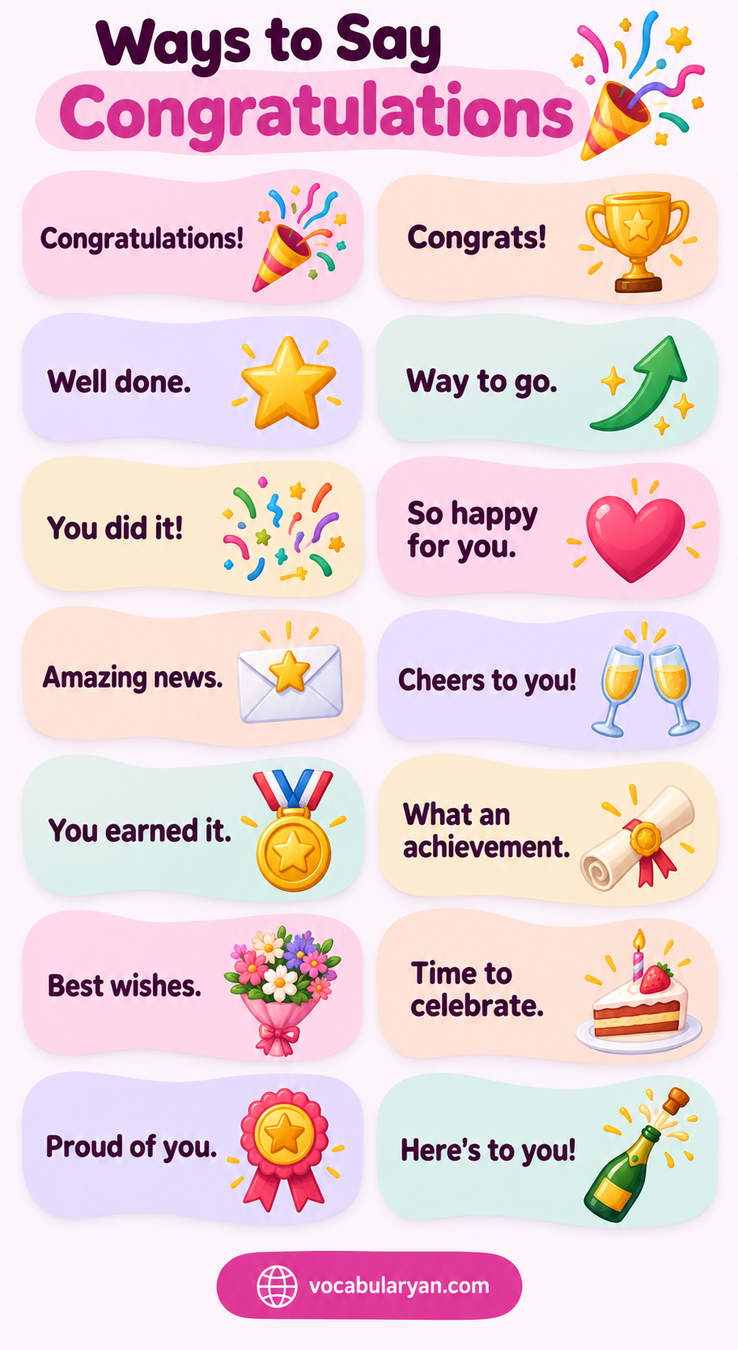
These phrases fit a neighbour, a classmate, a colleague, or a relative, and each one works in speech and in writing.
Congratulations: the full form, correct at every level and for every kind of good news. It goes with "on" and a noun: "congratulations on your engagement".
- Congratulations on the new flat, when do you move in?
- Congratulations, Dr Haddad, the whole department is proud of you.
- Oh, congratulations! I had no idea you two were expecting.
Congrats: the short form, casual and warm, and the most common form in texts and in speech between friends. Keep it out of a letter to a client or a card for a senior person.
- Congrats on passing, Ben, first time as well!
- Hey, congrats! I just saw the announcement.
- Congrats, mate, you deserved that promotion months ago.
Well done: praise for effort, so it fits an exam, a match, a speech, or a piece of work. It sounds odd for a wedding or a birth, because nobody "does" those. A full page on ways to say well done covers its sister phrases.
- Well done on the presentation, the client loved it.
- Well done, Priya, that was a brave thing to say in the meeting.
- Well done! You finished the whole race.
Good job: the American form of "well done", and it fits a child, a student, or a colleague after a task. Between adults it sounds a little like a teacher, so keep it warm with a name.
- Good job, Leo, the garden looks brilliant.
- Good job on the report, I only changed two lines.
- Good job, everyone, the customer signed today.
Way to go: casual American praise, said with energy when someone finishes something hard.
- Way to go, Marcus! Two goals in one game.
- You got the loan? Way to go!
- Way to go, Grandma, ten thousand steps again today.
Good for you: warm praise for a personal choice or a personal win, such as leaving a bad job or running a first race. Said flat, it can sound sarcastic, so say it with a smile.
- You quit? Good for you, that place was making you miserable.
- Good for you, Ana, the course sounds perfect.
- Running a marathon at sixty? Good for you!
I’m so happy for you: the phrase for news that is about the person’s life rather than their work, such as an engagement or a pregnancy. It fits friends and family at every age.
- I’m so happy for you both, the ring is beautiful.
- Oh, Kemi, I’m so happy for you, you wanted that house so much.
- I’m so happy for you, when is the baby due?
Write "congratulations" when the news is a life event, and "well done" when the person worked for the result.
Casual Ways to Say Congratulations to Friends
Casual phrases are for people who know you well, and each one sounds quick, loud, and pleased.
You did it: the shout of joy when a friend reaches a goal you knew about, such as a test, a job, or a big move.
- You did it! I knew the interview would go well.
- Look at you, you did it, a whole book written.
- You did it, Sam, and on your first try!
You nailed it: slang that means "you did it perfectly", and it fits a speech, an audition, an exam, or a recipe.
- Your speech was perfect, you nailed it.
- You nailed it in the second round, the judges were smiling.
- Honestly, you nailed it, that cake looks like a shop bought one.
You smashed it: British slang with the same meaning as "you nailed it", loud and full of energy.
- You smashed it, Dan, top of the class!
- Ninety percent? You smashed it!
- I watched the video, you smashed it, well done.
Nice one: short British praise for a small or medium win, and it doubles as "thanks" in the same accent.
- Nice one, Jess, first place in the pub quiz.
- You fixed the bike? Nice one.
- Nice one, that’s the best photo you’ve ever taken.
You rock: casual American praise that means "you are great", and it fits a friend who helped or won.
- You rock, Tara, thanks for finishing the poster.
- You got the part? You rock!
- You rock, little brother, first goal of the season.
Kudos: a word for praise, from Greek, and it fits friends and relaxed colleagues. It is one word, not a plural, so "kudos is" not "kudos are".
- Kudos to you for running the whole thing on your own.
- Kudos, Ravi, the app finally works.
- Big kudos to whoever baked these.
So proud of you: the warm phrase from a parent, a partner, or a close friend, and it fits any win the person worked for.
- So proud of you, love, all those late nights paid off.
- So proud of you, Dad, sixty and running your first 10k.
- I’m so proud of you, you handled that so well.
Keep "you smashed it" and "you rock" for friends your own age, and use "congratulations" with everyone else.
Formal Ways to Say Congratulations at Work
Formal phrases fit a manager, a client, a professor, or a letter, and they pair with a title and a full sentence.
Congratulations on your achievement: the standard formal line for a letter or a speech when you do not name the exact win.
- Congratulations on your achievement, Ms Adams, the board is delighted.
- Congratulations on your achievement, and thank you for your work this year.
- On behalf of the team, congratulations on your achievement.
Please accept my warmest congratulations: the most formal written form, and it opens a letter or a card to a senior person or a client.
- Please accept my warmest congratulations on your appointment as director.
- Please accept my warmest congratulations on twenty years with the firm.
- Dear Dr Okafor, please accept my warmest congratulations on the award.
Many congratulations: a polite British form that sounds warm without sounding casual, and it fits a colleague, a client, or a neighbour.
- Many congratulations on the new role, Tom.
- Many congratulations to you both on the wedding.
- Many congratulations, Professor Grant, the prize is well earned.
Well deserved: the phrase that says the person earned the win, and it follows "congratulations" in speech or in writing.
- Congratulations on the promotion, well deserved.
- Well deserved, Fatima, nobody works harder than you.
- A well deserved win after a very long season.
Your hard work has paid off: a formal line for a student, a junior colleague, or anyone who finished a long project.
- Congratulations, Omar, your hard work has paid off.
- Your hard work has paid off, and the results speak for you.
- I am glad to see that your hard work has paid off at last.
I’m delighted for you: the polite spoken form of "I’m so happy for you", and it fits a manager speaking to a colleague.
- I’m delighted for you, Lena, the new post suits you.
- I’m delighted for you both, and I wish you every happiness.
- Congratulations, I’m delighted for you.
The spelling trap is the missing "s", because the word is plural in every use.
- Congratulation on your promotion, Ms Adams. ❌
"Congratulation" without "s" is a spelling mistake in modern English, and the plural form is the only correct one.
- Congratulations on your promotion, Ms Adams. ✅
The second trap is "congrats" in a formal letter, because the short form belongs to friends.
- Dear Mr Petrov, congrats on the contract. ❌
"Congrats" sounds casual, so a letter to a client takes the full word or "warmest congratulations".
- Dear Mr Petrov, warmest congratulations on the contract. ✅
Every phrase on this page belongs to one of five levels.
| Level | Phrases | Who it fits |
|---|---|---|
| Slang | You smashed it, you nailed it, props, get in | Close friends your own age |
| Casual | Congrats, nice one, way to go, you rock | Friends, family, relaxed colleagues |
| Neutral | Congratulations, well done, so happy for you | Anyone you know by name |
| Formal | Many congratulations, well deserved, congratulations on your achievement | Managers, clients, older people |
| Very formal | Please accept my warmest congratulations, heartfelt congratulations | Letters, speeches, ceremonies |
Write "congratulations" with a title and surname for a client, and keep "congrats" for people who write "congrats" to you.
Ways to Say Congratulations in an Email
An email of congratulations opens with the phrase in the first line, then names the news, and it stays short.
Congratulations on your promotion: the standard first line for a work email, and the noun after "on" changes with the news.
- Hi Sara, congratulations on your promotion, nobody deserves it more.
- Congratulations on your promotion to team lead, Ravi.
- Dear Ms Adams, congratulations on your promotion to partner.
I was so pleased to hear: a warm formal opening for an email when the news reached you from someone else.
- I was so pleased to hear about the award, congratulations.
- Hi Tom, I was so pleased to hear that the funding came through.
- I was so pleased to hear your news this morning.
Great news about: the casual email opening for a colleague you know well, and it goes before the reason.
- Great news about the contract, well done all.
- Hi Jess, great news about the house!
- Great news about the exam, Ben, I knew you’d pass.
Warmest congratulations: the formal email opening for a client, a partner firm, or a senior person, and it works alone or with "on".
- Warmest congratulations on the launch, the site looks superb.
- Dear Dr Okafor, warmest congratulations on your new position.
- Warmest congratulations from all of us at Northfield.
Heartfelt congratulations: a step warmer than "warmest congratulations", and it fits a personal email about a wedding, a baby, or a retirement.
- Heartfelt congratulations on your retirement, Mr Lewis.
- Heartfelt congratulations to you and Maya on the baby.
- Please pass on my heartfelt congratulations to the whole family.
The preposition trap is "for", because learners copy it from "thank you for".
- Congratulations for your new job, Lena. ❌
"Congratulations" takes "on" before the reason, and "for" sounds wrong to a native reader.
- Congratulations on your new job, Lena. ✅
Open a work email with "congratulations on" plus the news, and add "warmest" for a client.
Ways to Say Congratulations in a Card
A card phrase is written once and read many times, so the phrases are warm, complete, and a little more formal than speech.
With warmest congratulations: the classic card opening or closing line, and it goes with your name under it.
- With warmest congratulations on your wedding day, from Aunt Ruth.
- With warmest congratulations and every good wish for the future.
- With warmest congratulations, the Patel family.
Wishing you every happiness: a card line for a wedding, an engagement, a baby, or a new home, and it looks at the future rather than the win.
- Wishing you every happiness in your new home.
- Congratulations, and wishing you every happiness together.
- Wishing you every happiness, today and always.
Here’s to: a toast written in a card, and the noun after it names the future: "here’s to the next chapter".
- Here’s to the next chapter, congratulations on the new job.
- Here’s to many happy years together.
- Here’s to you, graduate, the hard part is done.
Congratulations and best wishes: the two phrases together, standard on a wedding card or a retirement card. The best wishes page covers the second half on its own.
- Congratulations and best wishes on your retirement, Mrs Ali.
- Congratulations and best wishes to you both.
- Congratulations and best wishes for the years ahead.
Write one congratulations line and one wish for the future, and sign with your full name if the couple has many guests.
Ways to Say Congratulations in a Text
Text phrases are short, and extra letters and exclamation marks replace the sound of your voice.
Congrats!!: the default text to a friend, and the second exclamation mark makes it louder.
- Congrats!! When do you start?
- Congrats!! Knew you’d get it.
- Congrats!! Drinks on you tonight.
Yesss: the text form of a cheer, sent the second the good news arrives, and the extra letters mean joy.
- Yesss! I’m so happy for you!
- Yesss, finally! Congrats, mate.
- Yesss, you passed, told you!
Amazing news: a warm text for news about life rather than work, and it works with a parent or a friend.
- Amazing news, congratulations to you both!
- Amazing news! Call me when you’re free.
- Amazing news about the house, so pleased for you.
I knew you could do it: the text for a friend who was nervous before the result, because it says you believed in them.
- Passed?! I knew you could do it.
- I knew you could do it, congrats on the job.
- I knew you could do it, now go and celebrate.
Get in: British slang for a cheer, sent as a text when a friend wins a match, a bet, or a place on a course.
- Get in! Congrats, that’s brilliant.
- You got the place? Get in!
- Get in, Dan, three out of three.
Keep a text to five words and an exclamation mark, and save the full sentences for the card.
Ways to Say Congratulations for a New Job or Promotion
Job phrases name the role, praise the work behind it, and wish the person luck in the new position.
Congratulations on the new job: the standard line for a friend or a colleague who has been hired somewhere new.
- Congratulations on the new job, Nadia, when’s your first day?
- Hi Ben, congratulations on the new job, the company is lucky to have you.
- Congratulations on the new job! Lunch on me next week.
Congratulations on your promotion: the line for someone moving up inside the same company, and it fits speech, a card, and an email.
- Congratulations on your promotion, Mr Chen, the team is pleased.
- Congratulations on your promotion to manager, Lucy.
- Congratulations on your promotion, you earned every bit of it.
You’ve earned it: the phrase that says the promotion was fair, and it follows "congratulations" in speech.
- Congratulations, Sofia, you’ve earned it.
- You’ve earned it, five years of weekends in the office.
- Enjoy the new title, you’ve earned it.
Best of luck in the new role: the wish for the future that closes a job message, and it fits a card or an email.
- Congratulations, and best of luck in the new role.
- Best of luck in the new role, Aisha, keep in touch.
- Best of luck in the new role, they’re lucky to have you.
Onwards and upwards: a British phrase for moving to something better, said when someone leaves for a bigger job.
- Onwards and upwards, Joel, congratulations.
- New job, new city, onwards and upwards!
- Onwards and upwards, as they say, well done.
Name the role in the first line, then add "you’ve earned it" or "best of luck in the new role".
Ways to Say Congratulations for a Wedding or Engagement
Wedding phrases speak to two people at once, and they wish for the future rather than praise a result.
Congratulations to you both: the standard line to a couple, spoken at the wedding or written in the card.
- Congratulations to you both, what a beautiful day.
- Congratulations to you both on your engagement!
- Congratulations to you both, from everyone at the office.
Wishing you a lifetime of happiness: the classic wedding card line, formal and warm, and it fits a couple of any age.
- Wishing you a lifetime of happiness together.
- Congratulations, and wishing you a lifetime of happiness.
- Wishing you a lifetime of happiness, love from Grandma.
Congratulations on your engagement: the line for the news of a proposal, said before the wedding rather than at it.
- Congratulations on your engagement, Mia, the ring is lovely.
- Congratulations on your engagement! Have you set a date?
- Congratulations on your engagement, we’re so pleased for you.
Here’s to the happy couple: a toast, said with a raised glass at the reception, and the reply is a cheer from the room.
- Here’s to the happy couple! Cheers!
- Everyone, raise your glasses, here’s to the happy couple.
- Here’s to the happy couple, may the years be kind to you both.
Mazel tov: the Hebrew and Yiddish phrase for congratulations, common in American English and at Jewish weddings, and it fits a friend of any background.
- Mazel tov, you two, what a night!
- Mazel tov on the engagement, Rachel.
- Mazel tov! We’ll see you at the wedding.
The old rule that "congratulations" was for the groom only is gone, so say it to the bride, the groom, or both.
Say "congratulations to you both" at the wedding, and write "wishing you a lifetime of happiness" in the card.
Ways to Say Congratulations for a New Baby
Baby phrases greet the child as well as the parents, and most of them are said or written in the first week.
Congratulations on your new arrival: the standard card line for a birth, and it works before you know the baby’s name.
- Congratulations on your new arrival, from all of us next door.
- Congratulations on your new arrival! She’s beautiful.
- Congratulations on your new arrival, Priya and Raj.
Welcome to the world: a line written to the baby rather than the parents, common on cards and in messages with a photo.
- Welcome to the world, little Leo!
- Welcome to the world, baby Ada, you have the best parents.
- Welcome to the world, you lucky boy.
Congratulations on your pregnancy: the line for the news before the birth, and "congratulations" alone works too once the parents have shared the news.
- Congratulations on your pregnancy, Emma, how are you feeling?
- Congratulations on your pregnancy! When is the baby due?
- Congratulations on your pregnancy, we’re thrilled for you both.
Wait until the parents share the news, then say "congratulations" to them and "welcome to the world" to the baby.
Ways to Say Congratulations for Graduation or Exams
Study phrases praise the work as much as the result, so "well done" and "you did it" fit here better than anywhere else.
Congratulations, graduate: the line for the day itself, said in person or written on the card, with the word "graduate" as the name.
- Congratulations, graduate! Throw that hat as high as you can.
- Congratulations, graduate, four years and you never missed a deadline.
- Congratulations, graduate, we’re so proud.
Well done on passing: the British phrase for an exam, a driving test, or a course, and the noun after "passing" is optional.
- Well done on passing, Hana, first time!
- Well done on passing your driving test, the car is yours on Saturday.
- Well done on passing, now the fun part begins.
All that studying paid off: the phrase for a student who spent weeks at a desk, and it fits a parent, a friend, or a teacher.
- All that studying paid off, congratulations on the grade.
- See? All that studying paid off.
- All that studying paid off, Jamal, an A in chemistry.
You made it: the casual line for the end of a long course, said with a hug or a high five.
- You made it, graduate, I never doubted you.
- Three years of night classes, and you made it.
- You made it! Where’s the party?
Say "well done on passing" for a test, and "congratulations, graduate" for the ceremony.
Ways to Say Congratulations for a New Home
Home phrases mix congratulations with a wish for the new place, and they fit a card, a text, or a housewarming gift.
Congratulations on your new home: the standard card line, and it fits a first flat, a family house, or a move to a new city.
- Congratulations on your new home, the garden looks wonderful.
- Congratulations on your new home! When can we visit?
- Congratulations on your new home, love from the Kaurs.
Happy new home: a short card or gift-tag phrase, built like "happy birthday", and it fits friends and family.
- Happy new home, Sam and Jess!
- Happy new home, here’s a plant for the kitchen window.
- Happy new home, may the kettle always be on.
Welcome to the neighbourhood: the line from a new neighbour, and it doubles as congratulations on the move.
- Welcome to the neighbourhood, we’re at number twelve if you need anything.
- Welcome to the neighbourhood! The bins go out on Tuesday.
- Welcome to the neighbourhood, congratulations on the house.
Write "congratulations on your new home" on the card, and say "welcome to the neighbourhood" at the door.
Ways to Say Congratulations to a Team
Team phrases name everyone at once, and the level matches the room: a work group takes "well done all", a group of friends takes "we did it".
Congratulations, team: the manager’s line after a win, a launch, or a signed contract, in speech or in a message.
- Congratulations, team, the launch went without a single error.
- Congratulations, team, on a record quarter.
- Congratulations, team, take Friday afternoon off.
Well done, everyone: warm formal praise for a group, and it fits a teacher, a coach, or a team lead.
- Well done, everyone, the best set of results in years.
- Well done, everyone, you kept going when it got hard.
- Well done, everyone, drinks are on me.
We did it: the phrase from inside the team, said by a member rather than the boss, and it means the win belongs to all of you.
- We did it! Three years of work and the bridge is open.
- We did it, guys, top of the league.
- I can’t believe it, we did it.
Hats off to everyone: praise for a whole group, from an old habit of lifting a hat to show respect, and it fits a speech or an email.
- Hats off to everyone who worked the night shift this week.
- Hats off to everyone involved, the event was a triumph.
- Hats off to everyone, and thank you.
Say "congratulations, team" as the manager and "we did it" as a member, and name the win in the same breath.
Regional Ways to Say Congratulations in English
Each English-speaking country keeps a few congratulations of its own, and the level of every one of them is casual.
British Ways to Say Congratulations
Well done, you: "well done" with "you" on the end, warm and a little playful, and it fits a friend or a child.
- Well done, you, first prize!
- Passed your test? Well done, you.
- Well done, you, I’d never have had the nerve.
Good on you: praise for a personal decision or a kind act, common in Britain and Australia, and it means "I approve".
- You gave the money back? Good on you.
- Good on you for finishing the course, Claire.
- Good on you, mate, that took guts.
American Ways to Say Congratulations
Props: American slang for respect or credit, and it fits friends and younger colleagues.
- Props to Jay for closing the deal.
- Props, man, that was a great set.
- Major props on the new album.
You killed it: American slang that means "you did it perfectly", the same as "you smashed it" in Britain.
- You killed it on stage tonight!
- Great interview, you killed it.
- You killed it, coach, the team looked ready.
Australian and Irish Ways to Say Congratulations
Onya: the Australian short form of "good on you", said to a friend or a teammate.
- Onya, Liam, great catch!
- Onya, mate, congrats on the house.
- Onya! Knew you’d get through.
Fair play to you: the Irish phrase for "well done, I respect that", and it fits any win or any brave choice.
- Fair play to you, Sean, first in the county.
- You ran the whole thing? Fair play to you.
- Fair play to you, that’s a grand result.
Good man yourself: an Irish phrase of praise for a man or a boy, warm and casual, and "good woman yourself" is the form for a woman.
- Good man yourself, Paddy, congrats on the exam.
- Good woman yourself, Niamh, that’s some news.
- Good man yourself! I owe you a pint.
Use "well done, you" in Britain, "you killed it" in America, "onya" in Australia, and "fair play to you" in Ireland.
Funny Ways to Say Congratulations
Funny phrases are for close friends who laugh at teasing, and each one puts a joke on top of the praise.
Look at you go: mock surprise at a friend’s success, warm and teasing at the same time.
- Look at you go, a promotion and a new car in one month.
- Look at you go, Mr Manager!
- Look at you go, I can’t keep up.
Drinks are on you: the joke that a win means the winner pays, said after a promotion or a prize.
- Congratulations on the raise, drinks are on you.
- You won the lottery? Drinks are on you, then!
- Drinks are on you tonight, graduate.
Who’s a clever clogs: a British tease for someone who did well, said to a child, a partner, or a friend.
- Who’s a clever clogs, then? Top of the class!
- Who’s a clever clogs? You fixed the boiler!
- Full marks? Who’s a clever clogs!
I’m taking full credit: the joke that you are the reason for the win, sent by a friend who helped even a little.
- You passed! I’m taking full credit for those flashcards.
- Congrats on the job, I’m taking full credit for the CV tips.
- I’m taking full credit, I told you to apply.
Save the funny phrases for people who tease you back, because a joke to a new colleague reads as a mistake.
How Do You Reply When Someone Says Congratulations?
The reply to congratulations starts with "thank you", and a warmer reply adds why the news means so much or who helped.
Thank you: the reply that fits every level, and it works alone or with the person’s name.
- Congratulations on the promotion. Thank you, Ms Adams.
- Congrats, mate! Thanks, I’m still in shock.
- Many congratulations. Thank you, that’s very kind.
That means a lot: the reply that says the congratulations matter to you, and it fits a colleague or a mentor.
- Well done on the award. That means a lot coming from you.
- Congratulations, Sara. Thank you, that means a lot.
- Warmest congratulations. That means a lot, thank you.
I couldn’t have done it without you: the reply for someone who helped, and it turns the praise back to them.
- Congrats on passing! I couldn’t have done it without you and your notes.
- Thank you, I couldn’t have done it without you, coach.
- I couldn’t have done it without you, honestly.
We’re over the moon: the reply to congratulations on a wedding, a baby, or a house, and it means "very happy".
- Congratulations on the baby! Thank you, we’re over the moon.
- We’re over the moon, the house is everything we wanted.
- Thanks so much, we’re over the moon about the engagement.
It still hasn’t sunk in: the reply for very big news, and it means you do not yet believe it.
- Congratulations, Dr Malik. Thank you, it still hasn’t sunk in.
- Thanks! It still hasn’t sunk in, I keep checking the letter.
- It still hasn’t sunk in, ask me again next week.
Answer "thank you" first, and add "that means a lot" or "I couldn’t have done it without you" when the speaker helped.
More Everyday English Phrases
- Other Ways to Say Good Luck
- Other Ways to Say Happy Birthday
- Other Ways to Say Best Wishes
- Other Ways to Say Get Well Soon
- Other Ways to Say Well Done
FAQs
More than seventy phrases are in everyday use, and this page covers them by situation, from "congrats" to "please accept my warmest congratulations". The core set is small: "congratulations", "congrats", "well done", "good job", and "I’m so happy for you" cover almost every piece of good news. The rest add a level, a country, or an occasion on top of those five.
No, because "congratulations" is plural in every modern use, and "congratulation" without the "s" reads as a spelling mistake. The singular exists as a grammar word, as in "a letter of congratulation", but nobody says it to a person. Write "congratulations" in speech, in a card, and in an email.
Say "congrats" to a friend, a classmate, or a colleague you joke with, and "congratulations" to everyone else. "Congrats" is casual, so it fits a text or a chat message and looks wrong in a formal letter or a card for a senior person. When in doubt, the full word is never a mistake.
Say "thank you", and add one short line if you want to sound warm: "that means a lot", "I’m still in shock", or "I couldn’t have done it without you". For a wedding or a baby, "we’re over the moon" is the standard reply. The reply never repeats "congratulations" back.
Praise the work with "well done", "you did it", or "you’ve earned it", or share the joy with "I’m so happy for you" and "so proud of you". For a wedding or a baby, "wishing you every happiness" and "welcome to the world" say it without the word. The choice depends on whether the person worked for the news or received it.
Yes, "congratulations and best wishes" is a fixed pair on wedding cards and retirement cards, with "congratulations" for the news and "best wishes" for the future. On its own, "best wishes" is a sign-off, not a congratulation. A separate page on ways to say best wishes covers that use.
"Kudos", "bravo", and "well done" are the nearest single words, and each one fits a different moment. "Kudos" is casual praise for effort, "bravo" is a cheer for a performance, and "well done" is praise for a result. "Felicitations" also exists, but it is rare and sounds old, so keep it for a joke.