
"Sounds good" is a reply, and it answers a plan or a suggestion with a yes. Said with a smile it means "I agree and I am happy", but typed alone it reads as a shrug. The ways to say sounds good in English solve that problem: "that works for me" for a colleague, "sounds like a plan" for a friend, "happy to proceed" for a client. The replies to a plan come first.
Other Ways to Say Sounds Good When You Reply to a Plan
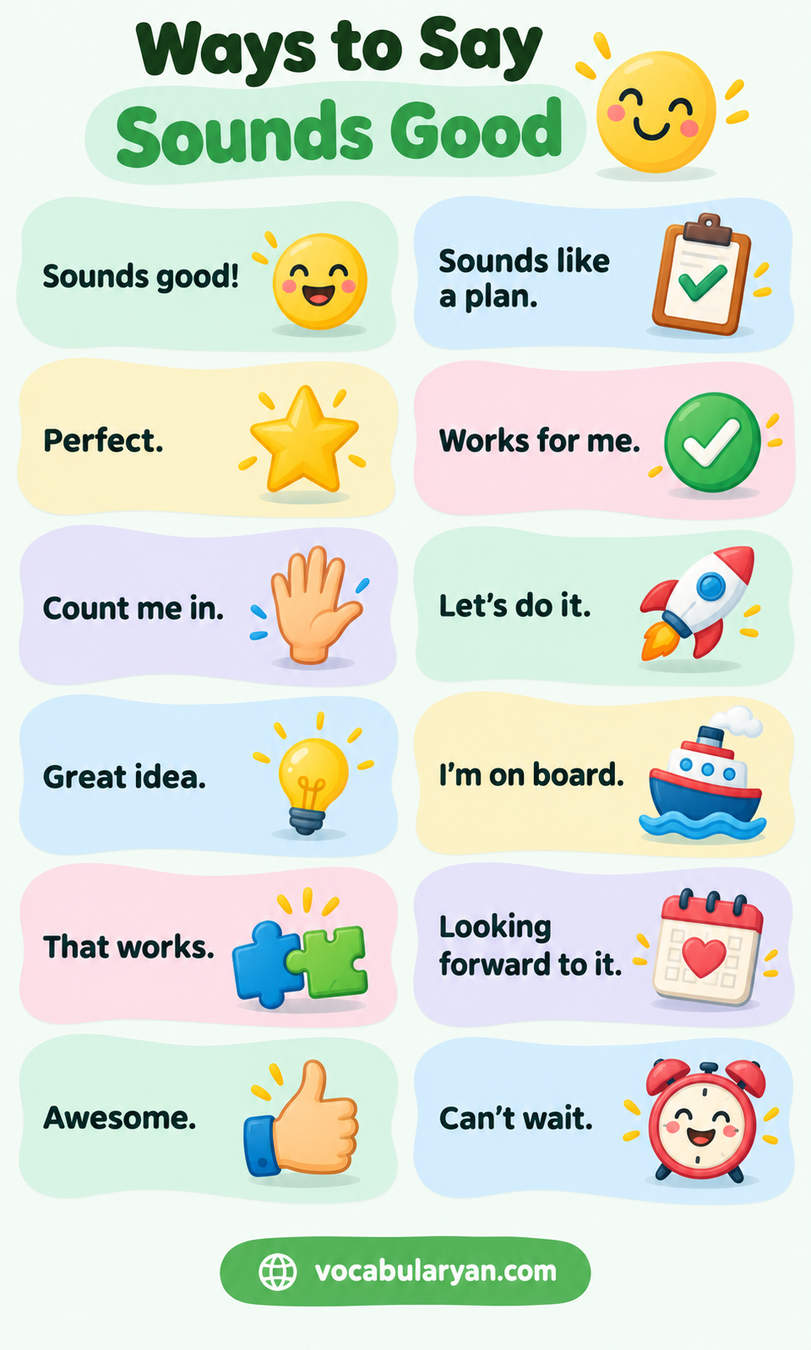
A plan names a time, a place, or a next step, and these replies accept all three in a few words.
That works for me: the most common reply to a proposed time or date, and it fits every level from a friend to a client. It says that the plan fits your diary.
- Thursday at ten? That works for me, I’ll add it to the calendar.
- That works for me, I’ll book the room for the whole afternoon.
- If the delivery comes on Monday, that works for me and I can sign for it myself.
Sounds like a plan: a warm, casual reply to a friend or a colleague who has just set out the steps. It sounds relaxed, so keep it out of a first email to a client.
- Pizza first, then the film? Sounds like a plan.
- Sounds like a plan, I’ll pick you up at seven.
- We leave early, stop for breakfast, and reach the coast by noon, sounds like a plan to me.
Works for me: the shorter form of "that works for me", used in speech and in quick messages between people who know each other.
- Six o’clock works for me.
- Works for me, see you at the station.
- Meeting at yours instead of the café works for me, it’s closer anyway.
Let’s do it: a reply full of energy, and it fits a plan you want to start now. The level is casual.
- A road trip in June? Let’s do it.
- Let’s do it, I’ll send the invite tonight.
- Everyone is free on Saturday, so let’s do it then and stop waiting for a better week.
I’m in: a reply that says you will take part, and it fits an invitation to a trip, a game, or a project.
- Bowling on Friday? I’m in.
- I’m in, just tell me what to bring.
- If the team needs one more person for the charity run, I’m in and I’ll ask my brother too.
Count me in: the same meaning as "I’m in" with a little more warmth, used when a group is being put together.
- Count me in for the picnic.
- Count me in, I haven’t been to the beach all summer.
- Whoever is organising the leaving party, count me in for the cake and the card.
Reply to a time with "that works for me", and reply to an invitation with "I’m in" or "count me in".
Ways to Say Sounds Good When You Reply to a Suggestion
A suggestion is an idea rather than a fixed plan, and these replies accept the idea and let the other person go on.
Good idea: the plainest way to accept an idea, and it fits friends, family, and colleagues alike. The reply after it is the next step.
- Good idea, let’s ask Dana before we book anything.
- Move the meeting online? Good idea.
- Painting the hallway first is a good idea, because the furniture is still out.
That makes sense: a reply that agrees with the reasoning behind the idea, and it sounds calm and thoughtful at work.
- That makes sense, the morning slot is quieter.
- Two smaller orders instead of one large one? That makes sense.
- That makes sense now that you have explained the budget, so go with the cheaper option.
Fair enough: a reply that accepts a point you had not thought of, and it sounds honest rather than eager. It is most common in Britain.
- Fair enough, we’ll wait for the report.
- You’d rather drive than take the train? Fair enough.
- Fair enough, I hadn’t realised the shop closes at five on Saturdays.
Why not?: a light, casual yes to an idea that costs you little, and it is not a real question.
- Dessert? Why not?
- Why not? Let’s try the new place on the corner.
- We could take the long way home past the lake, why not, the weather is lovely.
Let’s go with that: a reply that chooses one idea from several, and it closes the discussion politely.
- The blue design? Let’s go with that.
- Let’s go with that, and we can change the wording later.
- Between the two dates, the fourteenth is better for everyone, so let’s go with that.
Say "good idea" to accept an idea, and "let’s go with that" to choose one idea over the rest.
Formal Ways to Say Sounds Good at Work
Formal replies fit a manager, a client, or a colleague you do not know well, and each one is a full word or a full sentence.
Agreed: the one-word formal yes, used at the end of a discussion when both sides accept the same plan.
- Agreed, we’ll review the figures on Friday.
- The deadline moves to the twentieth. Agreed.
- Agreed, and I’ll confirm the change with the supplier this afternoon.
Certainly: a polite yes to a request, and it sounds formal and willing at the same time.
- Could you send the slides before the call? Certainly.
- Certainly, I’ll have the draft with you by noon.
- Certainly, Mr Osei, the second option is available on the same terms.
I’m happy with that: a formal yes with a little warmth, and it fits a decision that you had a say in.
- The new logo? I’m happy with that.
- I’m happy with that, the layout is far easier to read.
- I’m happy with that price, so please prepare the order form.
I’m on board: a reply that says you support the plan and will help with it, common in offices and project teams.
- I’m on board, count on my team for the testing.
- The move to weekly reports? I’m on board.
- I’m on board with the new schedule, though I’d like to see the training dates first.
That would be ideal: a very formal reply to an offer or a proposed time, and it sounds polite and pleased.
- Could we meet at your office? That would be ideal.
- That would be ideal, thank you for offering the earlier slot.
- A printed copy for each board member would be ideal, if the print room has time.
"Noted" is a word to watch, because it is not a yes at all.
- Let’s launch on the first of March. (reply) Noted. ❌
"Noted" means "I have read this", so the other person still does not know whether you agree with the date.
- Let’s launch on the first of March. (reply) Agreed, the first of March works. ✅
A reply to a plan is spoken at one of five levels, and the table sorts them.
| Level | Replies | Who it fits |
|---|---|---|
| Slang | Bet, say less, sweet | Close friends your own age |
| Casual | Sure thing, cool, sounds like a plan, I’m in | Friends, family, relaxed colleagues |
| Neutral | That works for me, good idea, perfect | Anyone you know by name |
| Formal | Agreed, certainly, happy to proceed, I’m on board | Managers, clients, new colleagues |
| Very formal | That would be ideal, we would be delighted to | Senior clients, official letters |
Write "agreed" to close a decision, "certainly" to accept a request, and "I’m happy with that" when you had a say in the choice.
Ways to Say Sounds Good in an Email
An email reply is read without your voice, so a full sentence and a thank-you do the work that a smile does in speech.
That works, thank you: the standard email reply to a proposed time, and the "thank you" stops it from reading as short.
- That works, thank you, I’ll dial in at two.
- Tuesday at nine? That works, thank you.
- That works, thank you, and please send the calendar invite when you have a moment.
Confirmed: a one-word reply that fixes a date, a booking, or a number, and it fits a message that asked for a yes or a no.
- Confirmed, see you on the fifteenth.
- Two rooms for three nights. Confirmed.
- Confirmed, I have added the meeting to the shared calendar.
Happy to proceed: a formal yes to a plan or a quote, and it says that the reader is free to start the work.
- Happy to proceed on the terms in your email.
- Thanks for the revised quote, happy to proceed.
- Happy to proceed with phase one, and we can discuss phase two after the review.
Please go ahead: a reply that gives permission, and it fits a colleague or a supplier who asked before acting.
- Please go ahead and order the parts.
- The updated design looks right, please go ahead.
- Please go ahead with the booking, and let me know the total once it is paid.
Looks good to me: the reply to a draft, a design, or a document you were asked to check. It says that you found nothing to change.
- Looks good to me, nice work on the summary table.
- The final version looks good to me.
- Looks good to me, though the date on page two needs the new year.
I’m aligned with this: a formal phrase from project emails, and it says that your view and the plan match.
- I’m aligned with this, let’s brief the team on Monday.
- Thanks for laying out the options, I’m aligned with this approach.
- I’m aligned with this timeline, and I’ll flag it if anything slips on our side.
Reply to a time with "that works, thank you", to a quote with "happy to proceed", and to a draft with "looks good to me".
Ways to Say Sounds Good to a Customer or Client
A reply to a customer accepts the request and promises the next step, so each phrase pairs with an action.
Absolutely: a strong, polite yes to a customer’s request, and it sounds willing rather than dutiful.
- Can I change the delivery address? Absolutely.
- Absolutely, I’ll update the booking now.
- Absolutely, we can hold the table until half past eight for you.
We can do that: a reply that says the request is possible, and it fits a shop, a hotel, or a service call.
- A vegetarian option for two guests? We can do that.
- We can do that, the extra chairs will be in the room by nine.
- We can do that, but the larger size will take two days longer to arrive.
That’s no problem at all: a reply that says the request costs you nothing, and it puts a worried customer at ease.
- That’s no problem at all, I’ll email the receipt again.
- You’d like the invoice in euros? That’s no problem at all.
- That’s no problem at all, Mrs Nair, the driver can call you ten minutes before he arrives.
Consider it done: a confident reply that promises the task is as good as finished, and it fits a client who asked for a favour.
- Send the report to the whole board? Consider it done.
- Consider it done, you’ll have the samples by Friday.
- Consider it done, and I’ll copy you in when the courier confirms the pickup.
We’d be delighted to: a very formal reply to an invitation or a request from a valued client, common in hospitality and in letters.
- Could your team join the launch? We’d be delighted to.
- We’d be delighted to host the dinner again next year.
- We’d be delighted to arrange a private viewing, if Tuesday afternoon suits you.
"Roger that" and "copy that" come from radio talk, and to a client they sound like a joke.
- We’d like the order moved to next week. (reply) Roger that. ❌
Radio replies fit friends and film scenes, and a client expects a plain business yes with the next step.
- We’d like the order moved to next week. (reply) Certainly, I’ll move it to the twelfth. ✅
Say "absolutely" or "we can do that" to a customer, and add the next step in the same sentence.
Ways to Say Sounds Good to a Boss
A reply to a manager accepts the task and says when or how you will do it, so a short promise follows the yes.
Will do: the everyday reply to an instruction from a manager, and it means "I will do that". It fits speech and messages.
- Can you update the tracker before you leave? Will do.
- Will do, I’ll have it done by three.
- Will do, and I’ll let Priya know that the figures have changed.
I’ll get on it: a casual work reply that says you will start straight away, used with a manager you speak to every day.
- I’ll get on it now.
- Need the venue list today? I’ll get on it.
- I’ll get on it as soon as the morning call finishes.
That suits me: a polite reply to a change in your hours or your desk, and it says that the change fits you well.
- Start at eight and finish at four? That suits me.
- That suits me, the earlier train is quieter.
- Moving my day off to Friday suits me better, because the school closes early that day.
Yes, that’s fine: a neutral yes to a small change, and the "yes" at the front makes it sound settled rather than reluctant.
- Can we push the review to Wednesday? Yes, that’s fine.
- Yes, that’s fine, I’ll move my other meeting.
- Yes, that’s fine, though I’ll need the new brief before I start.
Understood, I’ll do that: a reply that accepts an instruction with a correction in it, and it works after a manager has explained a change.
- Send the draft to Legal first from now on. Understood, I’ll do that.
- Understood, I’ll do that for all the new accounts.
- Understood, I’ll do that, and I’ll fix the two files I sent yesterday.
Reply to a task with "will do", to a changed instruction with "understood, I’ll do that", and to a new shift with "that suits me".
Casual Ways to Say Sounds Good to Friends
Casual replies are short, and they fit friends, family, and anyone you joke with.
Sure thing: a friendly, quick yes to a small request, and it fits speech and messages between friends.
- Grab me a coffee? Sure thing.
- Sure thing, I’ll bring the charger.
- Sure thing, the door’s open, come straight through to the garden.
Cool: the shortest casual yes, and it says that you are happy with the plan. Add a word after it so it does not sound flat.
- Meet at the park at three? Cool, see you there.
- Cool, I’ll text you when I leave.
- Cool, bring the board game, we can play after dinner.
Fine by me: a relaxed reply that says you have no objection, and it fits a friend choosing where to eat or what to watch.
- Chinese instead of pizza? Fine by me.
- Fine by me, you pick the film.
- Fine by me if we leave the tent up and come back tomorrow.
Sweet: slang for "great", common with younger speakers, and it fits good news from a friend.
- I got us free tickets. Sweet!
- Sweet, what time does it start?
- Sweet, my cousin has a spare room we can use for the weekend.
I’m game: a playful yes to an activity, and it says that you are ready to try it.
- Karaoke tonight? I’m game.
- I’m game, as long as you sing first.
- If the others want to go swimming in the lake, I’m game.
Deal: a reply that closes an offer between friends, and it fits a swap, a bet, or a promise.
- You cook, I’ll wash up. Deal.
- Deal, but you owe me the next round.
- Deal, I’ll lend you the car if you fill the tank on the way back.
Say "sure thing" to a request, "deal" to an offer, and "fine by me" when the other person is choosing.
Ways to Say Sounds Good in a Text
Text replies are one to four words, and an exclamation mark or an extra word turns a flat yes into a warm one.
Yep: the casual text form of "yes", and it fits a friend who asked a quick question about the plan.
- Still on for tonight? Yep, leaving now.
- Yep, 7 is good.
- Yep, I’ve got the tickets on my phone, don’t print anything.
Perfect: a text reply that says the plan needs no change, and it sounds pleased in one word.
- Table booked for eight. Perfect!
- Perfect, see you there.
- Perfect, that’s right next to my office, so I’ll walk over.
Bet: American slang for "okay, agreed", common with younger speakers in texts. To an older reader it looks like a mistake.
- Meet at the gym at six? Bet.
- Bet, I’ll grab the drinks.
- Bet, save me a seat near the front if you get there first.
Say less: American slang that means "you don’t need to say more, I’m in", and it fits a close friend’s invitation.
- Free pizza at Jay’s tonight. Say less.
- Say less, I’ll grab my coat.
- Road trip this weekend, my car, your playlist? Say less.
Sounds great, see you then: the text reply that adds a next step, and the second half is what makes it warm.
- Sounds great, see you then!
- Coffee at ten by the fountain? Sounds great, see you then.
- Sounds great, see you then, and I’ll wear something warm this time.
Keep a text reply short, and add a second word or an exclamation mark so it does not read as a shrug.
Ways to Say Sounds Good to a Group
A group reply answers for more than one person, so "we" or "everyone" replaces "I".
That works for all of us: the group form of "that works for me", used when you answer for a team or a family.
- Saturday morning? That works for all of us.
- That works for all of us, thanks for finding a slot.
- That works for all of us except Tom, who joins after lunch.
We’re in: the group form of "I’m in", and it fits a team accepting a challenge or an invitation.
- The five-a-side tournament? We’re in.
- We’re in, put our names down.
- We’re in for the quiz, and we’ve already picked a team name.
Sounds good to everyone?: a check rather than a reply, and the person leading the group says it before closing a plan.
- Pizza at seven, sounds good to everyone?
- Sounds good to everyone? Then I’ll book it.
- Two cars, leaving at eight, sounds good to everyone?
Happy with that, everyone?: a British check for agreement, said at the end of a meeting or a family discussion.
- We meet on Tuesdays from now on, happy with that, everyone?
- Happy with that, everyone? Good, moving on.
- Nan’s house for Christmas again, happy with that, everyone?
Answer for a group with "we’re in" or "that works for all of us", and check a group with "sounds good to everyone?".
Ways to Say Sounds Good With Enthusiasm
An enthusiastic reply says that you like the plan a lot, and each phrase is louder than a plain yes.
Sounds great: the warmer form of "sounds good", and it fits friends, family, and colleagues at every level.
- Dinner at the new Thai place? Sounds great.
- Sounds great, I’ve wanted to try it for months.
- Sounds great, and thank you for thinking of me for the panel.
Sounds perfect: a reply that says the plan needs nothing changed, and it fits a friend or a colleague who worked hard on it.
- A cabin by the lake for three nights? Sounds perfect.
- Sounds perfect, I’ll pack tonight.
- The order, the timing, the room, all of it sounds perfect.
Love it: a short, warm reply to an idea, and it fits friends and relaxed colleagues.
- A photo wall for the party? Love it.
- Love it, let’s start collecting pictures.
- Love it, that’s the best idea we’ve had all week.
Brilliant: a British reply that means "excellent", used for good news and good plans alike.
- The tickets came through. Brilliant!
- Brilliant, I’ll tell the others.
- Brilliant, that saves us the drive to the airport.
Can’t wait: a reply that says you are excited about the plan and want it to arrive sooner.
- Camping next weekend? Can’t wait.
- Can’t wait, I’ve already bought the marshmallows.
- Can’t wait to see the new house, send me the address.
I’m all for it: a reply that gives full support to a plan, and it fits a discussion where others were unsure.
- A shorter working day on Fridays? I’m all for it.
- I’m all for it, the team has earned it.
- If the club wants to start a junior team, I’m all for it and I’ll help coach.
Say "sounds great" to a plan you like, "can’t wait" to one you are excited about, and "I’m all for it" when others are unsure.
Ways to Say Sounds Good With a Condition
A yes with a condition accepts the plan and names one change, and the condition comes after a joining word such as "as long as".
That works, as long as…: the most common conditional yes, and the condition after "as long as" is a fact that must stay true.
- That works, as long as we finish before five.
- Friday is fine, that works, as long as the venue has parking.
- That works, as long as the client signs the new terms first.
Fine, provided that…: a formal conditional yes, and "provided that" fits contracts, emails, and meetings.
- Fine, provided that the price stays the same.
- We can go ahead, fine, provided that Legal has seen the wording.
- Fine, provided that the second payment arrives before the goods leave the warehouse.
Yes, with one caveat: a formal reply that accepts and then names one warning, and "caveat" means a condition.
- Yes, with one caveat: the launch date cannot move again.
- Yes, with one caveat, I’ll need two extra days for testing.
- Yes, with one caveat, the new supplier has to pass the safety check.
I’m on board if…: a reply that offers support on one condition, common in project discussions.
- I’m on board if we keep the old system running for a month.
- I’m on board if the budget covers the training.
- I’m on board if the whole team gets a say in the new rota.
Sure, but can we…?: the casual conditional yes between friends, and the question after "but" asks for one small change.
- Sure, but can we make it eight instead of seven?
- Sure, but can we take my car? Yours has no heating.
- Sure, but can we stop at the shop first? I’ve got nothing in the fridge.
Put the yes first and the condition second, so the other person hears the agreement before the change.
Regional Ways to Say Sounds Good
English-speaking countries each keep a few replies of their own, and using the right one in the right place sounds natural at once.
British Ways to Say Sounds Good
Lovely: the everyday British reply to a plan or an offer, and it means "good, thank you". It fits shops, cafés, and friends.
- Tea at four? Lovely.
- Lovely, I’ll bring a cake.
- Lovely, that’s the last thing sorted before the wedding.
Sorted: a British reply that means "the plan is settled", said at the end of a short discussion.
- I’ll drive, you bring the food. Sorted.
- Sorted, see you at the pub at eight.
- Tickets booked, hotel paid, taxi ordered, sorted.
Go on then: a British reply that gives in to a tempting offer, and it sounds playful.
- One more biscuit? Go on then.
- Go on then, a quick drink after work.
- Go on then, I’ll come to the match, but only if it’s not raining.
American Ways to Say Sounds Good
You bet: a warm American yes to a request or a plan, and it means "of course".
- Can you cover my shift? You bet, same time as last week?
- You bet, I’ll be there at nine.
- You bet, the whole family will be at the game on Saturday.
Right on: casual American approval, and it sounds relaxed and pleased.
- We got the cabin for the weekend. Right on.
- Right on, I’ll bring the fishing gear.
- Right on, that band is playing the same night, so we can go after dinner.
Sounds good to me: the fuller American form of "sounds good", and it fits colleagues and friends alike. The "to me" makes it a personal yes.
- Lunch at noon? Sounds good to me.
- Sounds good to me, let’s tell the rest of the team.
- Splitting the bill four ways sounds good to me.
Australian and Irish Ways to Say Sounds Good
No worries: the Australian reply to a request or a plan, and it means "yes, that’s easy". It also replaces "you’re welcome".
- Can you pick me up from the airport? No worries.
- No worries, I’ll be out the front at six.
- No worries, mate, the barbecue can start whenever you get here.
Grand: the Irish reply that means "fine, that’s good", and it fits every small plan in daily life.
- Meet at the church gate at ten? Grand.
- Grand, I’ll bring the umbrella.
- Grand, sure the bus goes right past the door anyway.
Sound: an Irish reply that means "good, thanks", used between friends and in shops. It is not about noise.
- I’ll get this round. Sound.
- Sound, I’ll meet you at the gate.
- Sound, thanks for the lift, I’ll text you when I’m home.
Say "lovely" or "sorted" in Britain, "you bet" in America, "no worries" in Australia, and "grand" in Ireland.
Funny Ways to Say Sounds Good
Funny replies play on films, radio talk, or old manners, and they fit close friends who know the joke.
Aye aye, captain: a mock sailor’s reply to an instruction, said to a bossy friend or a child giving orders.
- Set the table, please. Aye aye, captain.
- Aye aye, captain, the snacks are loaded.
- Aye aye, captain, we sail for the supermarket at once.
Roger that: a radio reply that means "message received and agreed", used as a joke between friends and in messages.
- Meet at the back door at nine. Roger that.
- Roger that, bringing the spare keys.
- Roger that, I’ll keep the dog away from the birthday cake.
Your wish is my command: a mock-formal reply from a fairy tale, said with a bow to a friend or a partner.
- Bring me an ice cream. Your wish is my command.
- Your wish is my command, one cup of tea coming up.
- Your wish is my command, though a genie would want a bigger tip.
Save the funny replies for friends who laugh with you, because "roger that" to a client sounds like a joke at the wrong time.
When Sounds Good Reads as Lukewarm or a Brush-Off
"Sounds good" spoken with a smile is warm, but typed alone after a long message it reads as "I stopped reading", so a second half is needed.
Sounds good, thanks for setting it up: a reply that answers the effort as well as the plan, and the thanks is what stops the brush-off.
- Sounds good, thanks for setting it up, I’ll be there at nine.
- Sounds good, thanks for setting it up so quickly.
- Sounds good, thanks for setting it up, and let me know if you need help with the room.
That’s exactly what I was hoping for: a reply for a plan that matches what you wanted, and it removes any doubt about your feelings.
- A window seat on the morning train? That’s exactly what I was hoping for.
- That’s exactly what I was hoping for, thank you.
- That’s exactly what I was hoping for, the earlier flight gives us the whole day.
The lukewarm reading comes from three habits: a full stop after one word, no name, and no next step.
- I’ve booked the restaurant, the taxi, and a babysitter for Friday. (reply) Sounds good. ❌
After a message full of effort, one word and a full stop read as a brush-off, and the fix is a thank-you and a detail.
- I’ve booked the restaurant, the taxi, and a babysitter for Friday. (reply) Sounds good, thank you for sorting all that, I’ll be ready by seven. ✅
The same happens with "fine", which reads as "I’m not happy but I’ll stop arguing".
- Shall we go to your mum’s on Sunday instead? (reply) Fine. ❌
"Fine" with a full stop sounds reluctant, so a real yes takes a warmer word and a reason.
- Shall we go to your mum’s on Sunday instead? (reply) Sounds great, she’ll love seeing the kids. ✅
Add a thank-you, a name, or a next step to "sounds good", and never send it as one word with a full stop after someone has done the organising.
More Everyday English Phrases
FAQs
No, "sounds good" is not unprofessional, and colleagues who know each other use it every day in chat and in short emails. It becomes a problem only in a first email to a client or a reply to a senior manager, where it reads as too quick. In those two cases "that works for me, thank you" or "happy to proceed" is the safer choice.
The professional forms are "that works for me", "agreed", "happy to proceed", "I’m on board", and "please go ahead". Each one is a full phrase, so it reads as considered rather than rushed. Add a thank-you or the next step in the same sentence, and the reply sounds both polite and warm.
Yes, when your manager speaks to you in a relaxed way and you are replying to a small change, such as a new meeting time. For a task or an instruction the better reply is "will do" or "understood, I’ll do that", because those say that you will act. In a formal email to a manager you rarely see, "that works for me, thank you" is the safer form.
"Perfect", "yep", "sure thing", "cool, see you there", and "sounds great, see you then" all work in a text, and each one is short. "Bet" and "say less" are the slang forms for a close friend. Whatever you choose, add an exclamation mark or a second word, because a single word with a full stop reads as cold.
The casual replies are "sure thing", "cool", "fine by me", "I’m in", "count me in", "deal", and "let’s do it". "Sweet" and "bet" are the slang forms. Every one of them fits friends and family, and "sure thing" and "I’m in" fit relaxed colleagues too.
The reply is "sounds good", with the "s", because the full sentence is "that sounds good" and "that" takes a verb ending in "s". "Sound good" without the "s" is used only in a question, as in "does that sound good?", or after "you", as in "you sound good on the phone". As a reply on its own, "sound good" is a mistake.
You say "sounds good" when someone proposes a plan, a time, or an idea and you accept it. It is a reply, so it never opens a conversation, and it answers a suggestion rather than a question about facts. After a request for help the better reply is "sure" or "will do", because the other person asked for action rather than agreement.
"Confirmed", "agreed", and "that works, thank you" are the shortest replies that still read as polite in an email. "Confirmed" fits a date or a booking, "agreed" fits the end of a discussion, and "that works, thank you" fits a proposed time. Each one is stronger with the detail repeated, as in "confirmed, Tuesday at ten".