
"Good afternoon" covers the hours from noon until about six, and with a stranger, a customer, or a manager it is the polite choice. A colleague gets the short "afternoon", a friend gets "hey, how’s your day going?", and a full room gets "good afternoon, everyone". Those everyday forms are the ones you will say most, so they come first among the ways to say good afternoon.
Common Ways to Say Good Afternoon in Everyday English
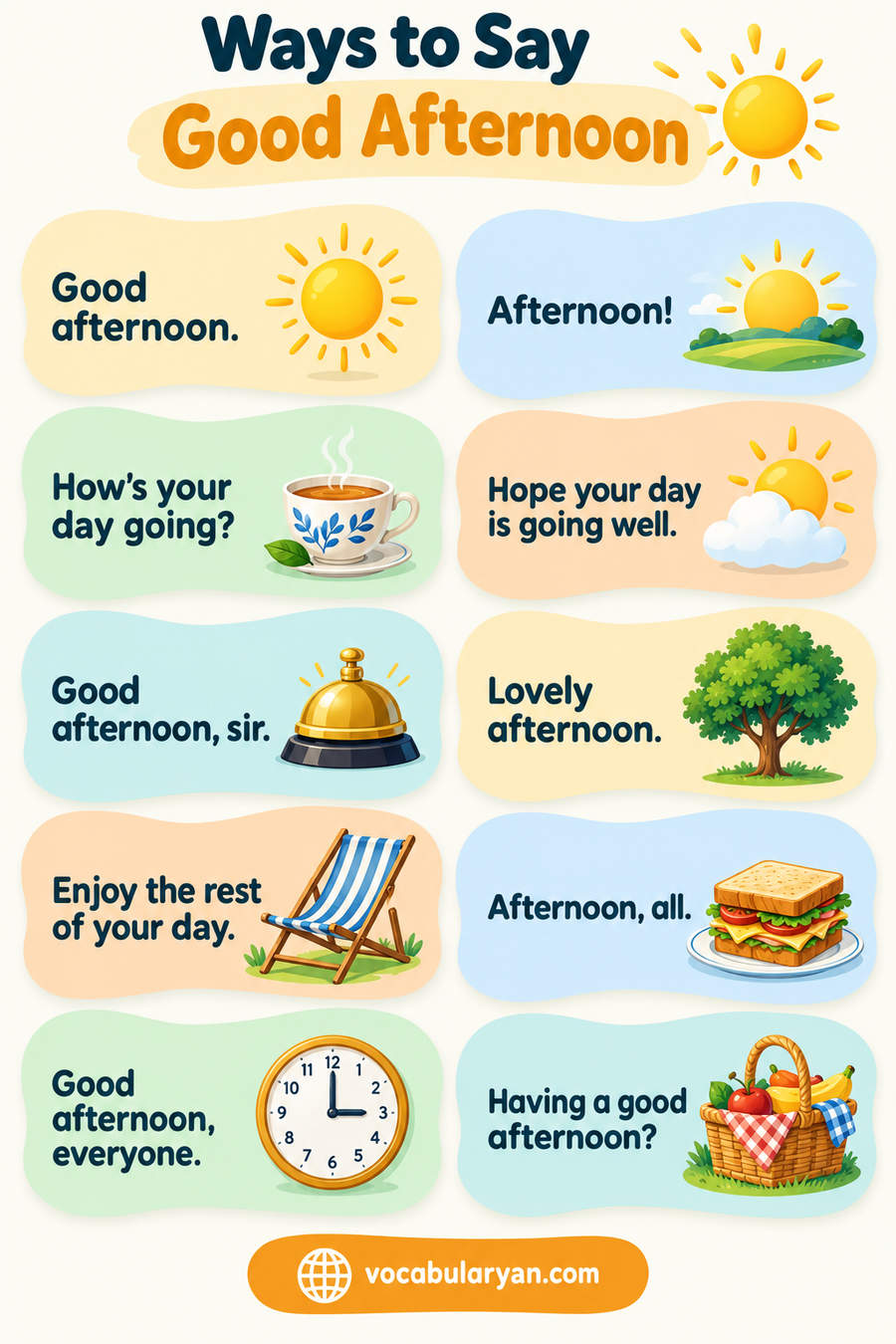
These six greetings fit almost anyone you meet after lunch, from a receptionist to a neighbour at the gate.
Good afternoon: the standard polite greeting between noon and six. It fits a shop, a school, a clinic, an office, and any stranger.
- Good afternoon, I have a table booked under the name Okoro.
- Good afternoon, Mrs Bennett, the parcel for you is at the front desk.
- Oh, good afternoon! I didn’t expect to see you on this side of town.
Afternoon: the short form, said with a nod between colleagues, neighbours, and shopkeepers you see every week. It sounds friendly and quick, and it fits speech rather than a letter.
- Afternoon, Raj, how did the meeting go?
- Afternoon! Two teas and a slice of the lemon cake, please.
- Afternoon, Mrs Kaur, the tomatoes look good this week.
Hello, good afternoon: "hello" with the time-of-day greeting after it, common at a counter, a door, or the start of a call. The two words together sound warm and polite at once.
- Hello, good afternoon, I’m here to collect a prescription for Ana Silva.
- Hello, good afternoon, is the manager in today?
- Hello, good afternoon, everyone, thanks for waiting.
Hi, how’s your afternoon going?: a greeting and a question in one, and it fits a friend, a classmate, or a colleague you like. The reply is short: "Good, you?"
- Hi, how’s your afternoon going? Mine has been one long spreadsheet.
- Hi, how’s your afternoon going, Lena? Still waiting on the plumber?
- Hi, how’s your afternoon going? I’ve got ten minutes if you want a coffee.
How’s your day been so far?: a friendly question for a friend or a colleague you meet after lunch, and it asks for a real update rather than one word.
- How’s your day been so far, Amira? Any news from the school?
- Hey, Tom, how’s your day been so far?
- How’s your day been so far? You look as if you need a break.
Hi there: "hi" with extra warmth, used when you greet someone you do not know by name in the middle of the day.
- Hi there, is this the queue for the afternoon tour?
- Hi there! Come in, the others are already in the garden.
- Hi there, I’m Sam, I’ll be looking after your table today.
Say "good afternoon" to anyone you do not know, and "afternoon" to anyone you see every day.
Casual Ways to Say Good Afternoon to Friends
Casual greetings are for people who know you well, and each one skips the time of day or turns it into a joke.
Hey: the warmest everyday greeting, and it fits friends, family, and colleagues you joke with at any hour. With a stranger or a manager it sounds too familiar.
- Hey, Priya, did you save me a seat?
- Hey! I was just about to text you.
- Hey, Dad, I’m at the gate, can you let me in?
Hey, how’s your day going?: the friendly question that replaces "good afternoon" between friends. The reply is "not bad" or "pretty good, you?"
- Hey, how’s your day going? I heard the interview went well.
- Hey, how’s your day going, Marco? You’ve been quiet.
- Hey, how’s your day going? Fancy a walk when you finish?
What’s up?: a greeting rather than a real question, so the reply is "not much". It fits friends and classmates and is wrong for anyone senior.
- What’s up, Jess? You’ve been at that desk since nine.
- Hey, what’s up? I saw your car outside.
- What’s up, everyone? Who’s got the football?
How’s it going?: relaxed and friendly, and it fits a friend or a colleague you get on with when you pass in the corridor after lunch.
- How’s it going, Ben? Survived the dentist?
- Afternoon, Ruth, how’s it going?
- How’s it going, guys? Sorry, the train was late.
How’s everything?: softer than "how are you", and it fits family and friends in speech and in a message. The reply is a short update.
- How’s everything, Grandma? Is the garden still full of beans?
- Hi, Tomasz, how’s everything with the new flat?
- How’s everything? Haven’t heard from you since Sunday.
Hey there: a playful afternoon hello for a friend, a partner, or a colleague you joke with.
- Hey there, stranger, where have you been all week?
- Hey there! I brought the book you wanted.
- Hey there, Jamal, how was the match?
Hope you’re having a good one: a relaxed line that fits a friend or a colleague you pass in a hurry, and it needs no reply at all.
- Hope you’re having a good one, Sophie, see you at five.
- Hey, Dan, hope you’re having a good one, I’m off to the site.
- Hope you’re having a good one! Catch you later.
Keep "hey" and "what’s up" for friends your own age, and say "afternoon" to everyone else.
Formal Ways to Say Good Afternoon at Work
Formal greetings fit a manager, a client, an interviewer, or a guest, and they pair with a title and surname or with a full sentence.
Good afternoon, Ms Adams: "good afternoon" with a title and surname is the standard formal greeting in an office, a bank, or a clinic. Use the title until the person offers a first name.
- Good afternoon, Ms Adams, the figures you asked for are on your desk.
- Good afternoon, Dr Okafor, thank you for fitting me in today.
- Good afternoon, Mr Petrov, we spoke on the phone last Tuesday.
Good afternoon, and welcome: the greeting for a guest, a new starter, or an audience, and it fits the first line of a speech or a tour.
- Good afternoon, and welcome to Northfield Museum.
- Good afternoon, and welcome, Mrs Novak, your desk is by the window.
- Good afternoon, and welcome to the second day of the course.
I hope you’re having a pleasant afternoon: a polite line for a client or a senior colleague, said after "good afternoon" or written as the first line of a note.
- Good afternoon, Mr Chen, I hope you’re having a pleasant afternoon.
- I hope you’re having a pleasant afternoon, and thank you for your patience.
- Hello, Professor Grant, I hope you’re having a pleasant afternoon despite the rain.
It’s a pleasure to see you this afternoon: a very formal greeting for a guest of honour, a partner, or an older person you respect.
- It’s a pleasure to see you this afternoon, Ambassador.
- It’s a pleasure to see you this afternoon, Mrs Whitmore, please come through.
- It’s a pleasure to see you this afternoon, and the whole team is glad you came.
I trust your afternoon is going well: a formal opener for a meeting or a letter, and "trust" here means "I expect". It sounds older than "I hope" and fits a senior person.
- I trust your afternoon is going well, Mr Haddad, shall we begin?
- Good afternoon, I trust your afternoon is going well so far.
- I trust your afternoon is going well, and I will keep this short.
How do you do?: a very formal first-meeting greeting, now rare outside formal British settings. It is not a question about health, and the reply is the same words back.
- How do you do? I’m Eleanor Marsh from the legal team.
- How do you do, Sir James? Thank you for receiving us.
- How do you do? My colleague has told me a great deal about your work.
The one greeting to avoid with a client you met a minute ago is "hey", because it puts you on the level of a close friend before the relationship is there.
- Hey, Ms Adams, got the numbers? ❌
"Hey" sounds too familiar for a first conversation with a senior person, and "good afternoon" with a title fits the same moment.
- Good afternoon, Ms Adams, do you have the numbers? ✅
Every afternoon greeting belongs to one of five levels.
| Level | Greetings (9) | Who it fits (11) |
|---|---|---|
| Slang | What’s up, sup, what’s crackin’ (31) | Close friends your own age (26) |
| Casual | Hey, how’s your day going, how’s it going (41) | Friends, family, relaxed colleagues (35) |
| Neutral | Afternoon, hi there, hello (26) | Colleagues, neighbours, anyone you know by name (47) |
| Formal | Good afternoon, good afternoon with a title, good afternoon everyone (68) | Managers, clients, strangers, older people (42) |
| Very formal | It’s a pleasure to see you this afternoon, how do you do (56) | Guests of honour, interviews, ceremonies (40) |
Use "good afternoon" with a title and surname on the first day, and move to a first name only after the other person does.
Ways to Say Good Afternoon in an Email
An email greeting is called a salutation, and a time-of-day salutation only works when the reader opens the message in the same afternoon.
Good afternoon, Tom,: the warm formal salutation for a colleague or a client you expect to read the message before six. It goes on its own line before the message.
- Good afternoon, Tom, the signed contract is attached.
- Good afternoon, Tom, a quick reminder that the call moved to three.
- Good afternoon, Tom, thanks for turning the slides round so fast.
Good afternoon, Ms Adams,: the formal salutation for someone senior or someone you have never written to, with a title and surname after the greeting.
- Good afternoon, Ms Adams, please find the invoice for July attached.
- Good afternoon, Dr Okafor, I am writing to confirm Thursday’s appointment.
- Good afternoon, Mr Petrov, thank you for your time earlier today.
Hi Sara, hope your afternoon is going well: the friendly salutation plus a first line, and it fits a colleague you write to every week.
- Hi Sara, hope your afternoon is going well. Are you free for a short call at four?
- Hi Sara, hope your afternoon is going well, and thanks again for covering this morning.
- Hi Sara, hope your afternoon is going well. The client has signed off on the design.
Good afternoon, all,: the salutation for a message to a whole team sent after lunch, and it works in a meeting invite too.
- Good afternoon, all, the agenda for Friday is attached.
- Good afternoon, all, thank you for the quick turnaround on the report.
- Good afternoon, all, one change to tomorrow’s schedule.
Dear Mr Petrov,: the salutation that ignores the time of day, and it fits a stranger, a formal request, or any reader in another time zone.
- Dear Mr Petrov, I am writing about the order placed on 4 March.
- Dear Ms Adams, thank you for your letter of 12 June.
- Dear Dr Okafor, I would like to request a copy of my results.
Hello, I hope your day is going well: the neutral first line for a reader whose time zone you do not know, and it follows a salutation such as "Hi Ana".
- Hi Ana, hello, I hope your day is going well. I have a question about the invoice.
- Hello Team, I hope your day is going well, and here is the update I promised.
- Dear Ms Rossi, I hope your day is going well. I am writing to follow up on our call.
"Good afternoon" in an email dates the message, and the reader in another time zone opens it at breakfast.
- Good afternoon, Tom, the report is ready. (sent to a reader in a time zone eight hours ahead) ❌
A time-of-day salutation fits a reader in your own time zone only, so a reader far away gets "hi" or "dear" instead.
- Hi Tom, the report is ready. ✅
Write "Good afternoon" plus a name when the reader is in your time zone, and "Hi" or "Dear" plus a name when you are not sure.
Ways to Say Good Afternoon on the Phone
A phone greeting names the time of day and the speaker in one breath, because the other person cannot see you.
Good afternoon, Rivera Dental, how can I help you?: the business greeting for answering a work phone after lunch, with the company name and an offer of help in one breath.
- Good afternoon, Hartley Vets, how can I help you?
- Good afternoon, Rivera Dental, Ella speaking, how can I help you?
- Good afternoon, Rivera Dental, you’re through to reception, how can I help?
Good afternoon, this is Ana from Greenway Lettings: the formal opening for a work call you make, with your name and your company in the first line.
- Good afternoon, this is Ana from Greenway Lettings, I’m calling about the flat on Mill Road.
- Good afternoon, this is Ana from Greenway Lettings, could I speak to Mr Lewis?
- Good afternoon, this is Ana from Greenway Lettings, I’m returning your call from this morning.
Good afternoon, could I speak to Mrs Ali?: the polite way to ask for a person once the phone is answered, and it fits any office or home.
- Good afternoon, could I speak to Mrs Ali? It’s about her car.
- Good afternoon, could I speak to the person who deals with bookings?
- Good afternoon, could I speak to Dr Okafor’s secretary, please?
Hi, it’s Mark, good afternoon: the friendly opening for a call to someone who knows you, and "it’s" plus your name replaces "I am" on the phone.
- Hi, it’s Mark, good afternoon, is this a good time?
- Hi, it’s Mark, good afternoon, I’m calling about Saturday.
- Hi, it’s Mark, good afternoon, did you get my email?
Afternoon, it’s me: the greeting for a partner, a parent, or a close friend who knows your voice at once.
- Afternoon, it’s me, I’m leaving the office now.
- Afternoon, it’s me, can you check if I left my keys on the table?
- Afternoon, it’s me, the train’s delayed again.
On a call, say who you are in the first sentence, because "good afternoon" alone makes the other person guess.
Ways to Say Good Afternoon Over Text
Text greetings are short, and the exclamation mark replaces the smile you would give in speech.
Afternoon!: the short form with an exclamation mark, and it fits the first message after lunch to a friend, a partner, or a relaxed colleague.
- Afternoon! Did the delivery turn up?
- Afternoon! Coffee at three?
- Afternoon! Don’t forget the dentist at half past four.
Hey, how’s your afternoon?: a soft opener for a friend or a partner, and the reply is a short chat rather than one word.
- Hey, how’s your afternoon? Mine is all meetings.
- Hey, how’s your afternoon? Any news from the vet?
- Hey, how’s your afternoon going? I’m stuck at the airport.
Happy afternoon!: a playful text greeting between friends, and it sounds cheerful rather than correct. Keep it out of a work message.
- Happy afternoon! Guess who just finished the essay.
- Happy afternoon! Sun’s out, pub garden later?
- Happy afternoon! You alive over there?
Hope your day’s going well: a gentle opener for a friend, a parent, or a colleague, and it works when you have not spoken since the morning.
- Hope your day’s going well, Mum, call me when you’re free.
- Hope your day’s going well! Quick question about Friday.
- Hope your day’s going well, the meeting got moved, so I’m free at four.
You around this afternoon?: a greeting and a question in one, used when you want to meet or talk within the next few hours.
- You around this afternoon? I’m near your office.
- You around this afternoon? Need to borrow your drill.
- Hey, you around this afternoon for a call?
An afternoon text stays short, and the exclamation mark or the question mark sets the mood.
Ways to Say Good Afternoon to a Group
One afternoon greeting to a whole room saves five separate ones, and its level follows the most formal person present.
Good afternoon, everyone: the standard greeting for a class, a meeting, a video call, or an audience, and it fits every level from a school to a conference.
- Good afternoon, everyone, please take a seat and we’ll begin.
- Good afternoon, everyone, can you all hear me at the back?
- Good afternoon, everyone, and thank you for coming in on a Friday.
Good afternoon, team: a warm formal greeting for a work group, in person or in a message, and it fits the first line after lunch.
- Good afternoon, team, let’s start with the numbers from this morning.
- Good afternoon, team, one quick change before we begin.
- Good afternoon, team, great work on the launch.
Afternoon, all: the short friendly form for a group of colleagues, and it fits a message or the door of a shared office.
- Afternoon, all, the kettle’s fixed.
- Afternoon, all, quick reminder about the fire drill at three.
- Afternoon, all, sorry I missed the stand-up.
Good afternoon, ladies and gentlemen: the very formal greeting for an audience at a ceremony, a flight, or a large event. It sounds old-fashioned in a small meeting.
- Good afternoon, ladies and gentlemen, and welcome aboard this flight to Lisbon.
- Good afternoon, ladies and gentlemen, please take your seats for the second half.
- Good afternoon, ladies and gentlemen, it is my honour to open this year’s awards.
Good afternoon, class: the teacher’s greeting at the start of an afternoon lesson, and the class answers with the same words.
- Good afternoon, class, open your books to page forty.
- Good afternoon, class, phones away, please.
- Good afternoon, class, today we finish the chapter on rivers.
Say "good afternoon, everyone" to a room you do not know, and "afternoon, all" to a team you see every day.
When to Say Good Afternoon and When to Say Good Evening
"Good afternoon" covers noon to about six, and the greeting on either side of it belongs to a different word.
Good morning: used from waking until noon, and it stays "good morning" at half past eleven even after an early lunch.
- Good morning, everyone, we have a full agenda.
- Good morning! Two coffees to take away, please.
- Good morning, Mr Lewis, the dentist will see you in a moment.
Good afternoon: used from twelve until about six. At five o’clock in winter, when the sky is already dark, "good afternoon" is still correct, and "good evening" is also fine.
- Good afternoon, Mrs Ali, I’m here for my two o’clock.
- Good afternoon, class, let’s pick up where we stopped.
- Good afternoon, is the pharmacy still open?
Good evening: used after about six, and it sounds a little more formal than the other two. It fits a restaurant, a theatre, and an evening event.
- Good evening, and welcome to tonight’s concert.
- Good evening, Mrs Novak, your table is ready for you.
- Good evening, are you still serving dinner?
Good day: a greeting at any hour in Australia and in older British English, and in modern British speech a cold, formal farewell. In America it is rare and sounds like a joke.
- Good day, mate, warm enough for you?
- Good day to you, Mrs Whitmore, and to your family.
- Good day, is the office still open?
"Good afternoon" stops at about six, and after that the same greeting sounds wrong.
- Good afternoon, do you have a table for two? (at 8 p.m.) ❌
After six the greeting is "good evening", because "afternoon" names the part of the day between noon and early evening.
- Good evening, do you have a table for two? ✅
"Good night" looks like the fourth greeting in the set, and it is a farewell instead.
- Good night, Mr Lewis, welcome to the hotel. (on arrival at 9 p.m.) ❌
"Good night" is said when someone leaves or goes to bed, so the greeting on arrival is "good evening".
- Good evening, Mr Lewis, welcome to the hotel. ✅
Say "good afternoon" from noon, "good evening" from six, and never "good night" on arrival.
Regional Ways to Say Good Afternoon in English
English-speaking countries each keep a few afternoon greetings of their own, and using one in the right country wins a smile at once.
British Ways to Say Good Afternoon
Afternoon, love: "afternoon" with "love", the friendly British word a shopkeeper, a bus driver, or an older neighbour uses for a customer of any age. It is warm, not romantic.
- Afternoon, love, what can I get you?
- Afternoon, love, mind the step.
- Afternoon, love, your usual, is it?
Alright?: the everyday British greeting at any hour, and it is not a question about health. The reply is "alright?" back, or "yeah, you?"
- Alright? Busy afternoon?
- Alright, Dave? Fancy a pint after work?
- Oh, alright? I didn’t know you worked afternoons.
Afternoon, mate: "afternoon" with "mate", the casual British word for a friend or any man you speak to in a relaxed way.
- Afternoon, mate, is this seat taken?
- Afternoon, mate, cheers for the lift yesterday.
- Afternoon, mate, long time no see.
American Ways to Say Good Afternoon
Howdy: a friendly American greeting from the South and West, said at any hour to neighbours, shop staff, and strangers on a trail.
- Howdy, neighbour, hot enough for you this afternoon?
- Howdy, neighbour, need a hand with those boxes?
- Howdy! Y’all here for the two o’clock tour?
Hey y’all: "hey" plus "you all", the Southern American greeting for a group of friends or family in the afternoon or at any time.
- Hey y’all, lunch is on the table.
- Hey y’all, thanks for coming out this afternoon.
- Hey y’all, who wants the last slice of pie?
Hey, how’s your day?: the everyday American greeting for a colleague, a cashier, or a friend, and it replaces "good afternoon" in most casual American speech.
- Hey, how’s your day? Busy in here today.
- Hey, how’s your day, Marcus? Still on for the game?
- Hey, how’s your day? Find everything okay?
Australian and Irish Ways to Say Good Afternoon
G’day: the Australian "good day", said at any hour to friends and strangers alike, and it replaces "good afternoon" all day long.
- G’day, mate, good afternoon for a swim.
- G’day, does this bus go to the harbour?
- G’day, all, sorry to keep you waiting.
How’s your arvo going?: "arvo" is Australian slang for "afternoon", and the question fits friends and relaxed colleagues.
- How’s your arvo going, Liam? Surf any good?
- Hey, Mel, how’s your arvo going?
- How’s your arvo going? Mine’s been all paperwork.
What’s the story?: the Irish greeting that means "what’s happening?", used between friends at any time of day. The reply is "not much" or "no story".
- What’s the story, Sean? Any news?
- Hi, lads, what’s the story?
- What’s the story? Haven’t seen you since the match.
Use "alright?" in Britain, "howdy" in the American South, "g’day" in Australia, and "what’s the story?" in Ireland, and use "good afternoon" everywhere else.
Funny Ways to Say Good Afternoon
Funny greetings are for close friends who know your sense of humour, and each one plays with the time of day.
Top of the afternoon to you: a joke on the old Irish "top of the morning", said with a mock bow for a laugh.
- Top of the afternoon to you, my friend, the coffee is on.
- Top of the afternoon to you! Did you bring the cake?
- Top of the afternoon to you, fellow survivors of the Monday meeting.
Afternoon, sunshine: a cheerful greeting for a child, a partner, or a friend who is clearly in a bad mood, and the joke is the contrast.
- Afternoon, sunshine! Somebody needs a nap.
- Afternoon, sunshine, ready for football practice?
- Afternoon, sunshine! Nice of you to join us at two.
Made it through the morning?: a teasing greeting for a colleague or a friend after a hard start to the day, and the reply is a joke back.
- Made it through the morning? You look like you need cake.
- Well, made it through the morning, I see. Coffee?
- Made it through the morning? Only five hours to go.
Halfway there!: a cheerful afternoon greeting between colleagues, and the joke is that the workday is a race.
- Halfway there! How’s the report coming?
- Halfway there, folks, keep going.
- Halfway there! Lunch was the easy part.
Well, look who’s awake: a teasing greeting for a friend or a flatmate who gets up for the first time after noon. Use it only with someone who laughs at jokes about themselves.
- Well, look who’s awake, it’s nearly one o’clock.
- Well, look who’s awake! Rough night?
- Well, look who’s awake, the kettle’s still warm.
Save the funny greetings for people who will laugh, because a joke greeting to a stranger reads as a mistake.
Ways to Say Have a Good Afternoon When You Leave
"Have a good afternoon" and its friends are farewells, said at the end of a conversation or a visit, and never on arrival.
Have a good afternoon: the standard polite farewell between noon and six, and it fits a shop, a call, or a colleague leaving for a meeting.
- Thanks for your help, have a good afternoon.
- Have a good afternoon, Mrs Bennett, see you next week.
- That’s everything, have a good afternoon!
Enjoy your afternoon: a warmer farewell for someone with free time ahead, such as a customer on holiday or a friend leaving early.
- Enjoy your afternoon, the weather is perfect for the beach.
- Enjoy your afternoon, Raj, and don’t check your email.
- Here’s your change, enjoy your afternoon.
Enjoy the rest of your day: the farewell that fits any hour after lunch, common from shop staff and on the phone.
- Your order will arrive by Thursday, enjoy the rest of your day.
- Enjoy the rest of your day, Ms Adams, and thank you for calling.
- It was good to catch up, enjoy the rest of your day.
Have a nice afternoon: the same farewell with "nice", a little softer than "good", and common in America.
- Have a nice afternoon, folks, drive safe.
- Have a nice afternoon, and thanks for stopping by.
- Take care, have a nice afternoon.
Have a productive afternoon: a farewell for a colleague going back to work, and it sounds friendly rather than bossy.
- Have a productive afternoon, everyone, and I’ll see you at the four o’clock.
- Right, have a productive afternoon, I’m off to the client.
- Have a productive afternoon, Lena, the deadline is closer than it looks.
See you this afternoon: a farewell that names a meeting later the same day, said in the morning or at lunch.
- See you this afternoon at the dentist, don’t be late.
- Bye, Sam, see you this afternoon.
- See you this afternoon, the meeting room is booked from two.
A farewell on arrival confuses the other person, because it sounds as if you are already leaving.
- Have a good afternoon, Mrs Ali, I’m here for my two o’clock. (on arrival) ❌
"Have a good afternoon" is a farewell, so the greeting on arrival is "good afternoon".
- Good afternoon, Mrs Ali, I’m here for my two o’clock. ✅
Say "good afternoon" when you arrive and "have a good afternoon" when you leave.
How Do You Reply When Someone Says Good Afternoon?
The reply to an afternoon greeting matches it: "good afternoon" gets "good afternoon" back, and a question-shaped greeting gets a short answer and the same question returned.
Good afternoon: reply with the same words, or "afternoon", plus the person’s name.
- Good afternoon, Priya. Good afternoon, Tom, how was the flight?
- Good afternoon, Mr Chen. Good afternoon, Ms Adams, please come in.
- Good afternoon! Afternoon, come and sit down.
How’s your afternoon going? and how’s it going?: the reply is short and positive, then the question goes back.
- How’s your afternoon going? Good, thanks, you?
- How’s it going? Not bad, busy, and you?
- How’s your day been so far? Long, but fine, how about yours?
Alright? and what’s up?: the reply is the same greeting or "not much", because neither one asks a real question.
- What’s up? Not a lot, you?
- Alright? Alright, you?
- What’s the story? No story, you?
Good afternoon, everyone: the reply from a room is "good afternoon" back, together or from the nearest person.
- Good afternoon, everyone. Good afternoon.
- Good afternoon, class. Good afternoon, Miss Reyes.
- Good afternoon, team. Afternoon, boss.
Have a good afternoon: the reply thanks the speaker and returns the wish.
- Have a good afternoon. Thanks, you too.
- Enjoy your afternoon. I will, thank you, and you.
- Enjoy the rest of your day. You as well, bye now.
Match the level of the greeting you were given, and keep a reply to a question-shaped one to three words.
More Everyday English Phrases
- Other Ways to Say Good Evening
- Other Ways to Say Good Morning
- Other Ways to Say Hello
- Other Ways to Say What’s Up
FAQs
The closest replacements are "afternoon" for colleagues and neighbours, "hello" or "hi" for anyone at any hour, and "hey, how’s your day going?" for a friend. At work, "good afternoon" with a title and surname stays the safest choice. To a group, say "good afternoon, everyone" or "afternoon, all".
Yes, five o’clock is still the afternoon, and "good afternoon" is correct until about six. In winter, when it is dark at five, "good evening" is also fine, and nobody will correct either one. After six, "good evening" is the greeting.
No, because "afternoon" names the hours between noon and early evening, and at night the greeting is "good evening". "Good afternoon" at nine at night sounds like a mistake or a joke. "Good night" is a farewell, so it is not the greeting at night either.
Yes, when the reader is in your time zone and will open the message the same afternoon, "Good afternoon, Tom," is warm and polite. When the reader is in another time zone or will read the email later, the greeting dates the message, so "Hi Tom," or "Dear Mr Lewis," fits better.
The professional form is "good afternoon" with a title and surname, such as "Good afternoon, Ms Adams". For a guest or an audience, "good afternoon, and welcome" or "good afternoon, everyone" fits. A line such as "I hope you’re having a pleasant afternoon" follows the greeting with a client or a senior colleague.
Reply with "good afternoon" and the person’s name, or with "afternoon" when the greeting is casual. A room replies with "good afternoon" together. The reply is never "good evening" or "have a good afternoon", because the first names a different hour and the second is a farewell.
"Good afternoon" is formal to neutral, so it fits a manager, a customer, a teacher, and a stranger, and it never sounds rude. Between friends it sounds stiff, and "afternoon", "hey", or "how’s your day going?" replaces it. The short form "afternoon" is the friendly middle ground.
Yes, "afternoon" is the short form, and it fits colleagues, neighbours, and shopkeepers you see every day. It sounds friendly and quick, and it belongs in speech and in a text rather than in a formal email. With a manager you have just met, a client, or an interviewer, say the full "good afternoon".