
At a first meeting "nice to meet you" is always correct. A client, a party, and an email each take a version that fits better: "pleased to meet you", "great to meet you", and "nice to e-meet you". The ways to say nice to meet you in English are set by the person and the place. The everyday forms come first.
Other Ways to Say Nice to Meet You in Everyday English
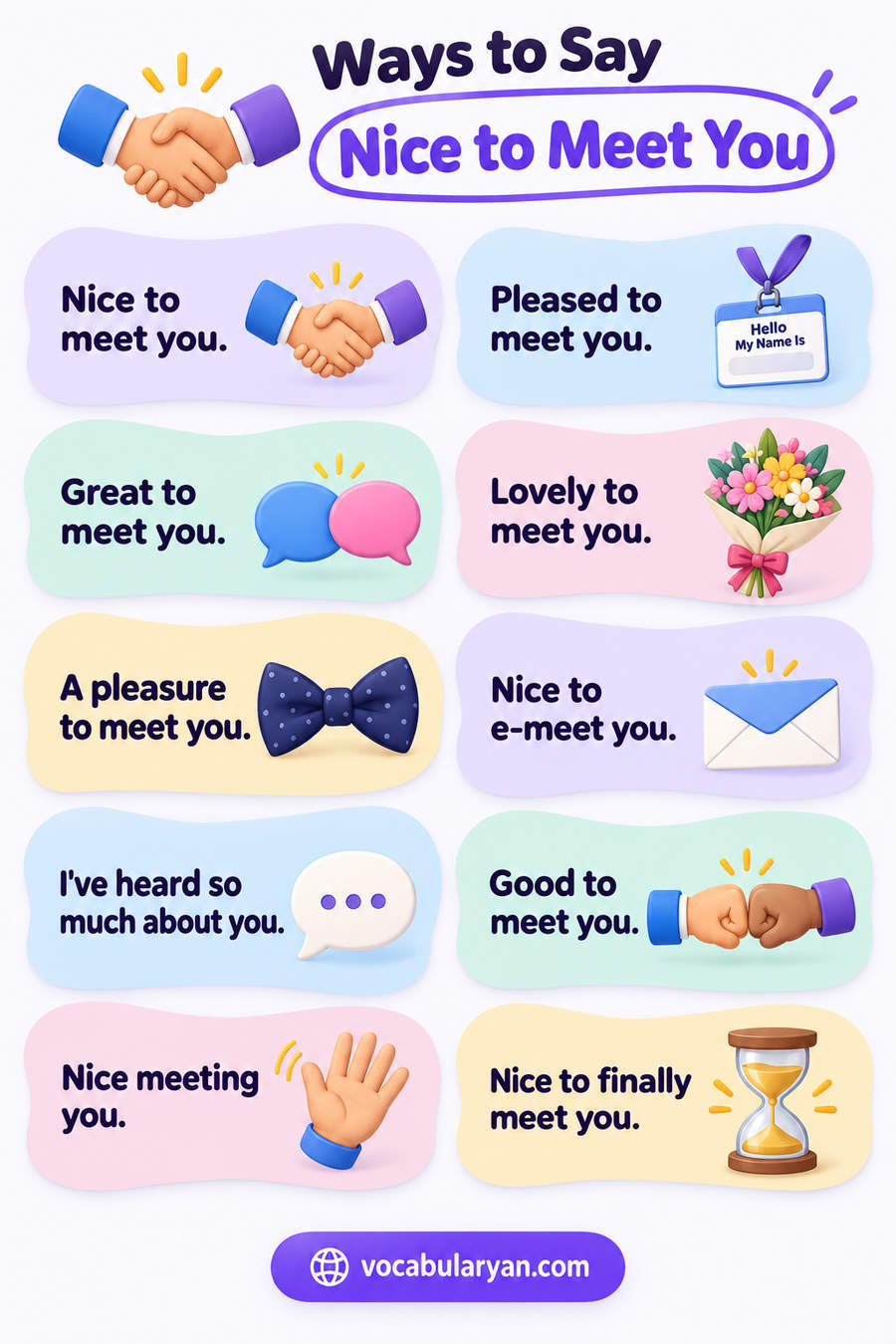
These six phrases fit a first meeting with almost anyone, from a new neighbour to a colleague on your first day.
Nice to meet you: the standard phrase at a first meeting, and it fits every level from a classmate to a client. It comes after "hello" and your name.
- Hello, I’m Farah, nice to meet you.
- Nice to meet you, Jonas, Ella told me you’d be here.
- It’s really nice to meet you after all those emails.
Good to meet you: a shade more relaxed than "nice to meet you", and it fits colleagues, neighbours, and friends of friends.
- Good to meet you, Tariq, welcome to the team.
- Good to meet you! Are you here for the running club too?
- Right, good to meet you, I’ll see you at the meeting on Monday.
Great to meet you: warm and energetic, and it fits a first meeting you are pleased about. It sounds natural at a party, a conference, or a first day.
- Great to meet you, Lena, I loved your talk this morning.
- Hey, great to meet you, I’ve been looking for someone who plays chess.
- Great to meet you, thanks for having me over.
Glad to meet you: "glad" means pleased, so the phrase sounds sincere and a little old-fashioned. It fits older people and quiet, polite moments.
- Glad to meet you, Mr Osei, my father speaks well of you.
- I’m glad to meet you, we’ve been short of a goalkeeper all season.
- Glad to meet you, young man, sit down and tell me about school.
Happy to meet you: the same meaning as "glad to meet you", with a lighter mood. It works with anyone, in speech and in a message.
- Happy to meet you, Ana, I’m the other volunteer on Saturdays.
- So happy to meet you! Rosa never stops talking about her cousin.
- Happy to meet you, sir, please follow me to the meeting room.
Nice to finally meet you: the phrase for someone you have heard about or written to for a while, and "finally" says that you have waited for this meeting.
- Nice to finally meet you, Marta, after six months of video calls.
- Nice to finally meet you! You’re taller than I expected.
- Well, nice to finally meet you, I feel as if I know you already.
"Nice to meet you" belongs to the first meeting only, and on a second meeting it sounds as if you have forgotten the person.
- Nice to meet you, Mr Osei. (at your second meeting) ❌
"Meet" means the first time, so from the second meeting on the phrase is "nice to see you".
- Nice to see you again, Mr Osei. ✅
Say "nice to meet you" the first time you meet anyone, and switch to "nice to see you" every time after that.
Casual Ways to Say Nice to Meet You
Casual phrases fit a party, a classroom, or a friend’s kitchen, and each one sounds relaxed and quick.
Hey, nice to meet you: "hey" in front of the phrase makes it friendly and young, and it fits classmates, housemates, and friends of friends.
- Hey, nice to meet you, I’m Kai, I live upstairs.
- Hey, nice to meet you! Are you the one who bakes?
- Hey, nice to meet you, Sam said you’re into climbing.
Nice to meet ya: "ya" is the relaxed spoken form of "you", and the phrase belongs to friends your own age. Keep it out of any first meeting at work.
- Nice to meet ya, Jess, grab a chair.
- Nice to meet ya! Drinks are in the fridge.
- Yeah, nice to meet ya, see you at practice.
So nice to meet you: "so" adds warmth, and the phrase fits a first meeting with a partner’s friends or family.
- So nice to meet you, Maria, come and sit with us.
- Oh, so nice to meet you! I’ve seen you at the school gate.
- It’s so nice to meet you, please stay for dinner.
Great to finally put a face to the name: the phrase for someone you know from messages or from other people, and it means you have waited to see the real person.
- Great to finally put a face to the name, Tom, I’ve read all your reports.
- It’s great to finally put a face to the name! Everyone in the office mentions you.
- Great to finally put a face to the name, I only knew you as the person who signs the forms.
Good to meet you, man: an American casual form between young men, and "man" replaces the name. It sounds friendly and quick.
- Good to meet you, man, thanks for the lift.
- Hey, good to meet you, man, Chris says you play bass.
- Good to meet you, man, catch you at the game.
Keep "nice to meet ya" and "good to meet you, man" for friends your own age, and use "nice to meet you" with everyone else.
Formal Ways to Say Nice to Meet You at Work
Formal phrases fit a client, a senior manager, a doctor, or a guest of honour, and each one goes with a title and a surname.
Pleased to meet you: the standard formal phrase in an office, a clinic, or a bank, and it goes with a handshake.
- Pleased to meet you, Ms Ferreira, I’m the account manager for your region.
- Good morning, I’m David Kwan, pleased to meet you.
- Pleased to meet you, Dr Rahman, thank you for coming so far.
It’s a pleasure to meet you: more formal than "pleased to meet you", and it fits a client, a senior official, or a future employer. The short form "a pleasure to meet you" means the same.
- It’s a pleasure to meet you, Mr Novak, welcome to our office.
- It’s a pleasure to meet you, Professor, I studied your book at university.
- A pleasure to meet you, Mrs Adebayo, please come this way.
I’m delighted to meet you: "delighted" means very pleased, so the phrase says that the meeting is a real pleasure for you. It fits a guest, a partner from another company, or someone whose work you admire.
- I’m delighted to meet you, Ms Lindqvist, your team’s work is well known here.
- I’m delighted to meet you at last, my colleagues have said so much about the project.
- I’m delighted to meet you, and my wife sends her regards.
Pleased to make your acquaintance: a very formal phrase, and "acquaintance" means a person you have met. It sounds right at a ceremony or a formal dinner, and a little heavy in an everyday office.
- Pleased to make your acquaintance, Sir Alan.
- I’m pleased to make your acquaintance, Mrs Whitfield, your husband spoke of you warmly.
- Pleased to make your acquaintance, Doctor, the hospital board sends its thanks.
It’s an honour to meet you: the phrase for someone famous, senior, or admired, and it says that the meeting means a great deal to you. With an ordinary colleague it sounds too strong.
- It’s an honour to meet you, Minister.
- It’s an honour to meet you, Mrs Okonkwo, your research changed my career.
- It’s an honour to meet you, sir, I’ve followed your work for twenty years.
How do you do?: the most formal first-meeting phrase, now rare outside formal British settings, and it is not a question. The reply is "how do you do?" back.
- How do you do? I’m Margaret Hale, the chair of the trust.
- How do you do, Mr Sato? Welcome to London.
- How do you do? My grandmother has told me about your garden.
It’s a privilege to meet you: as strong as "it’s an honour", and it fits a public figure, an award winner, or a very senior guest.
- It’s a privilege to meet you, Your Excellency.
- It’s a privilege to meet you, Dr Vance, thank you for agreeing to speak tonight.
- It’s a privilege to meet you, and my whole class sends thanks for your letter.
The casual forms do not belong in a first meeting with a client.
- Hey, nice to meet ya, Ms Ferreira. ❌
"Ya" and "hey" put you on the level of a close friend, and a client expects the formal form with a title.
- Pleased to meet you, Ms Ferreira. ✅
A first-meeting phrase is spoken at one of five levels, and the table sorts them.
| Level | Phrases | Who it fits |
|---|---|---|
| Slang | Nice to meet ya, good to meet you, man | Friends your own age |
| Casual | Hey, nice to meet you, great to meet you, so nice to meet you | Classmates, housemates, friends of friends |
| Neutral | Nice to meet you, good to meet you, happy to meet you | Anyone, at any first meeting |
| Formal | Pleased to meet you, it’s a pleasure to meet you, I’m delighted to meet you | Clients, managers, doctors, older people |
| Very formal | It’s an honour to meet you, pleased to make your acquaintance, how do you do | Officials, guests of honour, ceremonies |
Use "pleased to meet you" with a title and surname at work, and save "it’s an honour to meet you" for someone you truly admire.
Ways to Say Nice to Meet You at an Interview
An interview phrase is formal, short, and thankful, and it comes with a handshake and the interviewer’s name.
It’s a pleasure to meet you, Mr Brandt: the safest interview opening, said as you shake hands, with the interviewer’s title and surname. Wait until the interviewer offers a first name.
- It’s a pleasure to meet you, Mr Brandt, thank you for inviting me today.
- It’s a pleasure to meet you, Ms Grant, I’ve been looking forward to this.
- Good morning, it’s a pleasure to meet you, Dr Ali.
Thank you for taking the time to meet me: a polite line that follows the greeting, and it thanks the interviewer before the questions begin.
- Pleased to meet you, and thank you for taking the time to meet me.
- Thank you for taking the time to meet me, I know the schedule is busy this week.
- Thank you for taking the time to meet me on a Friday afternoon.
I’ve been looking forward to meeting you: the phrase for an interviewer or a manager whose name you already know, and it says that the meeting is a big one for you.
- I’ve been looking forward to meeting you, Ms Grant, since I read about the team.
- Hello, I’ve been looking forward to meeting you, the recruiter spoke very highly of you.
- I’ve been looking forward to meeting you and to hearing more about the role.
It’s good to meet you in person: the phrase for a second-round interview after a phone or video call, and "in person" names the change from screen to room.
- It’s good to meet you in person, Ms Grant, after our call last week.
- It’s good to meet you in person at last, the video kept freezing last time.
- Hello again, it’s good to meet you in person.
Open an interview with "it’s a pleasure to meet you" plus the interviewer’s title and surname, and thank them before you sit down.
Ways to Say Nice to Meet You in an Email
In an email the phrase goes in the first line after the greeting, and the form changes with how you met and who is reading.
Nice to e-meet you: the phrase for a first email to someone you have never seen, and the "e" means electronic. It fits a relaxed work email and sounds odd in a formal one, so keep it for colleagues and contacts at your own level.
- Hi Rosa, nice to e-meet you, Karim passed on your address.
- Nice to e-meet you, Ben! Looking forward to the workshop next month.
- Nice to e-meet you too, and thanks for the quick reply.
It’s great to connect with you: the neutral email form, and "connect" fits a first contact on a work network or by email. It is the safe choice.
- Hello Ms Park, it’s great to connect with you after Jan’s kind note.
- It’s great to connect with you, I’ve followed your company for a while.
- It’s great to connect with you, and I’d welcome a short call next week.
Thanks for the introduction: the line to the person who introduced you by email, and it goes before you address the new contact. Move the introducer to bcc in the same message.
- Thanks for the introduction, Jan, I’ll take it from here. Ms Park, it’s great to connect with you.
- Thanks for the introduction, Karim, moving you to bcc.
- Thanks for the introduction! Rosa, I’d love to hear more about the project.
I’ve heard great things about you: a warm first line for someone a colleague has praised, and it fits a formal or a relaxed email.
- Dear Mr Novak, I’ve heard great things about you from our Berlin office.
- I’ve heard great things about you, Priya, and I’m glad we’re finally in touch.
- Hi Tom, I’ve heard great things about you from the whole design team.
I’m looking forward to working with you: the closing form for a first email to a new colleague or client, and it says that the contact will continue.
- I’m looking forward to working with you on the spring launch.
- Nice to meet you by email, and I’m looking forward to working with you.
- I’m looking forward to working with you, Ms Park, please let me know a good time for a call.
It’s a pleasure to make your acquaintance: the formal written form for a first email to someone senior, and it replaces "nice to e-meet you" in a formal message.
- Dear Dr Ali, it’s a pleasure to make your acquaintance.
- It’s a pleasure to make your acquaintance, Mr Whitfield, and thank you for your letter.
- It’s a pleasure to make your acquaintance, I have admired your firm’s work for years.
"Nice to e-meet you" is too relaxed for a first email to someone senior.
- Dear Dr Ali, nice to e-meet you. ❌
A formal email takes the full written form, and "e-meet" fits a colleague at your own level.
- Dear Dr Ali, it’s a pleasure to make your acquaintance. ✅
Write "it’s great to connect with you" when you are unsure, because it fits every level and never sounds strange.
Ways to Say Nice to Meet You on a Call
On a phone or video call the phrase names the way you are meeting, because you have not met face to face.
Nice to meet you, even if only over the phone: the phrase for a first work call, and the second half says that a face-to-face meeting has not happened yet.
- Nice to meet you, even if only over the phone, Mr Brandt.
- Hi Rosa, nice to meet you, even if only over the phone for now.
- Nice to meet you, even if only over the phone, I hope we can meet at the conference.
It’s good to put a voice to the name: the call version of "put a face to the name", and it fits someone you know from emails.
- It’s good to put a voice to the name, Ben, thanks for calling.
- It’s good to put a voice to the name at last, I’ve signed a hundred of your forms.
- Well, it’s good to put a voice to the name, your emails are always so quick.
Nice to finally speak with you: the phrase for a call that took weeks to arrange, or for a contact you know only by email.
- Nice to finally speak with you, Ms Park, I know we’ve both been busy.
- Nice to finally speak with you! Jan has been trying to connect us since March.
- Nice to finally speak with you, is the line okay at your end?
Nice to meet you virtually: "virtually" means online, and the phrase fits a video call at work. It sounds a little more formal than "e-meet".
- Nice to meet you virtually, Dr Ali, I’m the project lead.
- Nice to meet you virtually, everyone, my camera is a bit dark today.
- It’s nice to meet you virtually at last, I’ve heard about your team for months.
On a call, say your name first and add "over the phone" or "virtually", so the other person knows you count this as a first meeting.
Ways to Say Nice to Meet You After a Friend Introduces You
When a friend introduces you, the phrase names the friend, because the friend is the link between you.
I’ve heard so much about you: the standard line after a mutual friend has talked about the person, and it follows "nice to meet you".
- Nice to meet you, Priya, I’ve heard so much about you.
- I’ve heard so much about you, and now I know why Sam smiles when he says your name.
- I’ve heard so much about you from Mum, welcome to the family.
Any friend of Sam’s is a friend of mine: a warm, slightly playful welcome, and it says that the friend’s approval is enough for you.
- Nice to meet you, Leo, any friend of Sam’s is a friend of mine.
- Any friend of Sam’s is a friend of mine, come in and get a plate.
- Well, any friend of Sam’s is a friend of mine, so sit down and tell me about yourself.
Sam has told me all about you: the same idea as "I’ve heard so much about you", with the friend named.
- Sam has told me all about you, nice to meet you at last.
- Hi, Sam has told me all about you, you’re the one who runs marathons.
- Sam has told me all about you, all of it good, I promise.
You must be Priya: the line when you guess who the person is from what the friend has said, and it goes before "nice to meet you".
- You must be Priya, nice to meet you, I’m Sam’s sister.
- You must be Priya, Sam’s told us so much, come in.
- Hello, you must be Priya, we’ve been waiting for you.
Name the friend in your first line, because with "I’ve heard so much about you" the person knows the friend has talked about them.
Ways to Say Nice to Meet You to a Group
A group phrase adds "all", "both", or "everyone", and it fits a new team, a class, or a family dinner.
Nice to meet you all: the standard group form, and it fits a new team, a class, or a group of your partner’s friends.
- Nice to meet you all, I’m Hana, I start on the reception desk today.
- Nice to meet you all, thanks for making room at the table.
- Hi, nice to meet you all, which of you is the teacher?
Nice to meet you both: the form for exactly two people, and it fits a couple, two colleagues, or two interviewers.
- Nice to meet you both, Ana and Luis, the house is lovely.
- Nice to meet you both, I hear the two of you run the whole department.
- It was nice to meet you both, drive safely.
It’s great to meet everyone: the warm form for a room of people, and it fits a first team meeting or a family gathering.
- It’s great to meet everyone, I’ve read all your names on the org chart.
- It’s great to meet everyone at last, Sam has talked about this family for a year.
- It’s great to meet everyone, please tell me your names again slowly.
It’s a pleasure to meet the whole team: the formal form for a new manager or a visiting client speaking to a group.
- It’s a pleasure to meet the whole team, I’ve seen the results you produced last quarter.
- It’s a pleasure to meet the whole team in one room.
- Good morning, it’s a pleasure to meet the whole team, I’m the new regional director.
Good to meet you guys: the casual form for a group of friends or classmates of any gender, and it sounds too relaxed for a client.
- Good to meet you guys, thanks for letting me join the game.
- Hey, good to meet you guys, I’m Kai from the Tuesday class.
- Good to meet you guys, see you at rehearsal.
Say "nice to meet you all" to a work group and "good to meet you guys" to friends, and count the people before you choose "both".
Ways to Say Nice to Meet You at the End of a First Meeting
At the end of a first meeting the phrase changes form, and "meeting" or "it was" replaces "to meet".
Nice meeting you: the standard farewell after a first meeting, and "meeting" with "ing" marks the end of the conversation.
- Nice meeting you, Jonas, enjoy the rest of the conference.
- Nice meeting you! I’ll send you that recipe.
- Okay, nice meeting you, good luck with the move.
It was nice to meet you: the past-tense form, and "was" says that the meeting is over. It fits every level.
- It was nice to meet you, Mrs Bello, I’ll see you at parents’ evening.
- It was nice to meet you, Kai, say hi to Sam for me.
- Well, it was nice to meet you, safe journey home.
It was a pleasure meeting you: the formal farewell for a client, an interviewer, or a senior person, and it goes with a handshake at the door.
- It was a pleasure meeting you, Mr Brandt, thank you again for your time.
- It was a pleasure meeting you both, I look forward to your decision.
- It was a pleasure meeting you, Doctor, and thank you for the advice.
It was great meeting you: warm and casual, and it fits a party, a course, or a new friend.
- It was great meeting you, Lena, let’s do this again.
- It was great meeting you! Message me when you’re back in town.
- Honestly, it was great meeting you, I hardly ever talk to anyone at these events.
Lovely meeting you: the British farewell form of "lovely to meet you", and it sounds warm and polite.
- Lovely meeting you, Ruth, give my love to the kids.
- Lovely meeting you! Pop round any time.
- It was lovely meeting you both, thanks for the tea.
It was nice talking to you: the farewell after a long chat, and it fits a stranger on a train, a neighbour, or a new colleague.
- It was nice talking to you, this is my stop.
- It was nice talking to you, Ana, I’ll think about what you said.
- Right, it was nice talking to you, my taxi’s here.
"It was" belongs to the end of the meeting, and at the start it sounds as if you are already leaving.
- It was nice to meet you, Jonas. (as you shake hands on arrival) ❌
At the start the phrase takes "it’s" and "to meet", and the "was" form waits for the goodbye.
- It’s nice to meet you, Jonas. ✅
Say "nice to meet you" when you arrive and "nice meeting you" when you leave, and let "it was" mark the goodbye.
Regional Ways to Say Nice to Meet You
English-speaking countries each keep a few first-meeting phrases of their own, and the right one in the right country wins a smile at once.
British Ways to Say Nice to Meet You
Lovely to meet you: the warmest British form, and it fits a friend of a friend, a new neighbour, or a partner’s parents.
- Lovely to meet you, Claire, the garden looks wonderful.
- Lovely to meet you! Come through, the kettle’s just boiled.
- It’s lovely to meet you at last, Ben has been promising this for months.
Pleasure to meet you: the British short form of "it’s a pleasure to meet you", said with a handshake at work and at formal events.
- Pleasure to meet you, Mr Hale, I’m the site manager.
- Pleasure to meet you, Mrs Kaur, do sit down.
- Pleasure to meet you, and thank you for the invitation.
American Ways to Say Nice to Meet You
Awesome to meet you: casual American, and "awesome" means very good. It fits friends, classmates, and relaxed workplaces, and it sounds too loud in a formal meeting.
- Awesome to meet you, Tyler, I’ve seen your videos.
- Awesome to meet you! You’re on the same team as Jordan, right?
- Hey, awesome to meet you, let’s grab lunch sometime.
Nice to meet you, ma’am: "ma’am" and "sir" after the phrase are polite American forms for an older person or a customer, and they are most common in the South.
- Nice to meet you, ma’am, how can I help you today?
- Nice to meet you, sir, my father says you served together.
- Nice to meet you, ma’am, welcome to Charleston.
Australian and Irish Ways to Say Nice to Meet You
G’day, nice to meet you: the Australian greeting with the phrase after it, said to friends and strangers alike.
- G’day, nice to meet you, I’m Mel from the surf school.
- G’day, nice to meet you, mate, Liam said you’d be coming.
- G’day, nice to meet you, is this your first time in Sydney?
Good to meet ya, mate: the relaxed Australian form, and "mate" fits a man or a woman you speak to casually.
- Good to meet ya, mate, grab a drink from the esky.
- Good to meet ya, mate, you working on the site too?
- Yeah, good to meet ya, mate, see you at the barbie.
Grand to meet you: the Irish form, and "grand" means fine or good in Irish English. It fits friends, neighbours, and a friendly pub.
- Grand to meet you, Niamh, Sean’s told me about the band.
- Grand to meet you! Will you have a cup of tea?
- Ah, grand to meet you, you’re very welcome to Galway.
Delighted to meet you: more common in Irish speech than anywhere else, and there it sounds warm rather than stiff. In Ireland "delighted" is an everyday word.
- Delighted to meet you, Aoife, come in out of the rain.
- Delighted to meet you, and how was the drive from Cork?
- Delighted to meet you, Father, Mam has been hoping you’d call.
Use "lovely to meet you" in Britain, "awesome to meet you" with American friends, "good to meet ya, mate" in Australia, and "grand to meet you" in Ireland.
How Do You Reply When Someone Says Nice to Meet You?
The reply returns the phrase, and the level of the reply matches the level of the phrase you heard.
Nice to meet you too: the standard reply at every level, and "too" is the word that returns the feeling. Without "too" the reply sounds like a second, separate greeting.
- Nice to meet you, Farah. Nice to meet you too, Jonas.
- It’s nice to meet you. It’s nice to meet you too, come in.
- Great to meet you. Great to meet you too!
You too: the short casual reply, and it fits friends, classmates, and quick meetings in a corridor or a shop.
- Nice to meet you. You too!
- Good to meet you, man. You too, see you around.
- Lovely to meet you. You too, Ruth, thanks for having us.
Likewise: a one-word reply that means "the same for me", and it fits a neutral or formal first meeting. Add a name so it does not sound cool.
- Pleased to meet you, Ms Ferreira. Likewise, Mr Kwan.
- Nice to meet you. Likewise, I’ve heard a lot about the project.
- Good to meet you. Likewise, welcome aboard.
The pleasure is mine: the formal reply to "it’s a pleasure to meet you", and "all mine" makes it warmer.
- It’s a pleasure to meet you, Professor. The pleasure is mine, please sit down.
- A pleasure to meet you, Mr Novak. The pleasure is all mine.
- Pleased to make your acquaintance. The pleasure is mine, Sir Alan.
And you: the short British reply, polite and quick, and it fits work as well as friends.
- Nice to meet you, Claire. And you, Ben.
- Pleased to meet you. And you, thank you for coming.
- Lovely to meet you. And you, love, mind the step.
How do you do? as a reply: the reply to "how do you do?" is the same phrase back, never a report on your health.
- How do you do? How do you do? Charles Whitmore.
- How do you do, Mr Sato? How do you do, Mrs Hale.
- How do you do? How do you do? It’s kind of you to see us.
Return the phrase with "too", say "likewise" or "the pleasure is mine" at work, and answer "how do you do?" with the same words.
More Everyday English Phrases
- Other Ways to Say How Are You
- Other Ways to Say Welcome
- Other Ways to Say What’s Up
- Other Ways to Say Good Evening
FAQs
The difference is the number of times you have met. "Nice to meet you" is for the first meeting only, because "meet" means to be introduced. "Nice to see you" is for every meeting after that, and "again" makes the second meeting plain. If you say "nice to meet you" to someone you met last month, it sounds as if you have forgotten them.
Respond with "nice to meet you too", and the word "too" is what returns the feeling. "You too" is the casual reply, "likewise" fits work, and "the pleasure is mine" is the formal reply to "it’s a pleasure to meet you". Add the person’s name if you have just heard it, because a name in the reply says that you listened.
Yes, when the email is relaxed and the reader is at your own level. "Nice to e-meet you" means that you have met by email and not in person, and it is common in work messages between colleagues. In a first email to a client, a manager, or anyone senior, write "it’s great to connect with you" or "it’s a pleasure to make your acquaintance" instead.
Yes, "nice to meet you" is a greeting, but it comes after "hello" and your name rather than in place of them. The full order is "hello", your name, then "nice to meet you", with a handshake or a nod. It is not a question, so it needs no answer beyond "nice to meet you too".
Yes, when the text is the first contact with someone, such as a new colleague, a landlord, or a friend of a friend. "Nice to meet you" works as it is, and "nice to e-meet you" or "nice to meet you, even if only by text" says that you have not met in person. Keep the phrase for the first message, and switch to "hi" plus a name after that.
Yes, "nice to meet you" is professional in an email, and most first work emails open with it or with "it’s great to connect with you". The formal forms are "it’s a pleasure to meet you" and "it’s a pleasure to make your acquaintance", and they fit a client or a senior contact. Leave out exclamation marks in a formal email, because even one reads as too excited.
Say "nice to meet you all" to a group, "nice to meet you both" to exactly two people, and "it’s great to meet everyone" to a room. "Good to meet you guys" is the casual form for friends, and "it’s a pleasure to meet the whole team" is the formal form for work. "Nice to meet you" on its own also works for a group, because "you" is plural in English as well as singular.