
From about six o’clock the greeting is "good evening", and it is a greeting only, never a goodbye. A neighbour gets the short "evening", a client gets "good evening, Ms Adams", and a friend gets "how’s your evening going?". The ways to say good evening in English split by person and place, and the everyday greetings open the set.
Common Ways to Say Good Evening in Everyday English
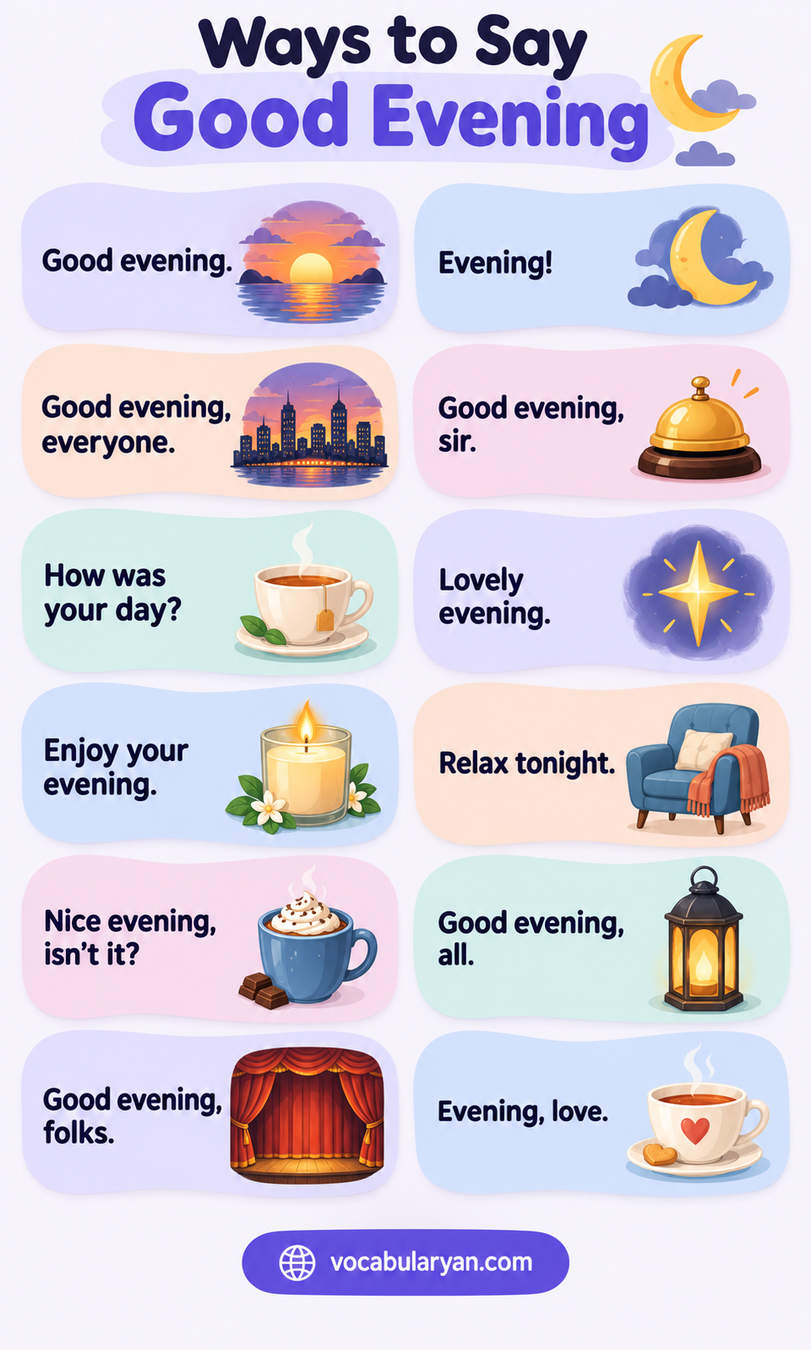
These seven greetings fit almost anyone after five o’clock, from a shop assistant to a friend at the door.
Good evening: the full form, and it fits strangers, colleagues, and formal settings. It sounds a little more formal than "good morning", because evening events are more formal than morning ones.
- Good evening, is the pharmacy still open?
- Good evening, Mrs Bello, please come through.
- Good evening! I didn’t expect to see you at the gym this late.
Evening: the short form, said with a nod or a smile to neighbours, colleagues, and friends. Keep it out of formal writing.
- Evening, Sam, long day?
- Evening! Is the kettle on?
- Evening, all, sorry I’m late, the traffic was terrible.
Hello, good evening: "hello" first, then the time-of-day greeting, and it fits a doorstep, a reception desk, or a phone call.
- Hello, good evening, I’m here to collect a parcel for Okafor.
- Hello, good evening, is this the right room for the Spanish class?
- Hello, good evening, Dr Haddad, thank you for waiting.
Good evening, how are you?: a greeting and a question in one. The reply is short and positive: "Very well, thank you, and you?"
- Good evening, how are you? I heard the trip went well.
- Good evening, how are you, Mr Lopez? Please take a seat.
- Good evening, how are you both? It’s lovely to see you.
Good evening, Nadia: the greeting plus a first name, and it fits anyone you know by name, from a neighbour to a colleague leaving the office.
- Good evening, Nadia, did you get the message about tomorrow?
- Good evening, Nadia, your mum said you’d be here.
- Oh, good evening, Nadia, I was just about to lock up.
Good evening to you: a warm, slightly old-fashioned form, and it fits an older neighbour, a shopkeeper, or a polite reply to someone who greeted you first.
- Good evening to you, Mr Kaur, lovely night for a walk.
- And a good evening to you as well, come in out of the cold.
- Good evening to you, is there a table free for two?
Good to see you this evening: a greeting for someone you know and are glad to see, at a dinner, a class, or a meeting after work.
- Good to see you this evening, Elena, how’s the new job?
- It’s good to see you this evening, we missed you last week.
- Good to see you this evening, everyone, let’s begin.
Say "good evening" to a stranger and "evening" to a friend, and add a name whenever you know one.
Casual Ways to Say Good Evening to Friends
Casual evening greetings are for people who know you well, and each one sounds relaxed, quick, and a little warm.
Hey, evening: "hey" plus the short form, and it fits a friend who walks in, a flatmate, or a partner home from work.
- Hey, evening, how was the drive back?
- Hey, evening! Dinner’s nearly ready.
- Hey, evening, Kai, grab a chair.
Evening, you: a fond greeting for a partner, a close friend, or a child you are happy to see.
- Evening, you, I saved you some pasta.
- Evening, you! Where have you been all day?
- Evening, you, come and look at this.
How’s your evening going?: the friendly question form, and the reply is a short chat. The reply is a sentence or two, not a full report.
- How’s your evening going? Mine has been all homework.
- Hey, Lena, how’s your evening going?
- How’s your evening going, guys? Any room on that sofa?
How’s the evening treating you?: a playful form of the same question, and it fits a friend at a bar, a picnic, or a party.
- How’s the evening treating you, Marco? Still standing?
- Hey, how’s the evening treating you? Found the food yet?
- How’s the evening treating you so far? The band’s on at nine.
Evening, stranger: a teasing greeting for a friend you have not seen for a while, said with a grin.
- Evening, stranger, I thought you’d moved abroad.
- Well, evening, stranger, look who remembered where we live.
- Evening, stranger! Sit down, tell me everything.
Evening, sunshine: a cheerful greeting for a partner, a child, or a friend who looks tired, and the joke is the contrast.
- Evening, sunshine, someone needs a cup of tea.
- Evening, sunshine! Rough day at school?
- Evening, sunshine, nice of you to join us at last.
Keep "evening, you" and "evening, sunshine" for people you love, and use "hey, evening" with any friend.
Formal Ways to Say Good Evening at Work
Formal evening greetings fit a client, a guest, a manager, or a stranger, and they pair with a title and surname or with a full sentence.
Good evening, Ms Adams: "good evening" with a title and surname is the standard formal greeting at a reception desk, a dinner, or a late meeting. Use the title until the person offers a first name.
- Good evening, Ms Adams, the boardroom is ready for you.
- Good evening, Dr Okafor, thank you for staying late.
- Good evening, Mr Petrov, we spoke by email last week.
Good evening, sir: the greeting for a male guest or customer whose name you do not know, and "madam" or "ma’am" is the form for a woman. Hotel, restaurant, and shop staff use both.
- Good evening, sir, do you have a reservation?
- Good evening, madam, can I take your coat?
- Good evening, sir, the lift is just to your left.
A very good evening to you: the most formal form, and it fits a host at a ceremony, a speaker at a dinner, or a senior person at the door.
- A very good evening to you, Ambassador, welcome to the embassy.
- A very good evening to you all, and thank you for coming.
- A very good evening to you, Professor Grant, please, after you.
Good evening, it’s a pleasure to see you: a warm formal greeting for someone you have met before, and it fits a client or a partner at an evening event.
- Good evening, it’s a pleasure to see you again, Mrs Novak.
- Good evening, it’s a pleasure to see you here in person at last.
- Good evening, it’s a pleasure to see you, how was the flight?
Good evening, thank you for coming: the host’s greeting to each guest as they arrive, and it works for a launch, a lecture, or a dinner.
- Good evening, thank you for coming, the talk starts in ten minutes.
- Good evening, thank you for coming, Mr Diaz, your seat is at the front.
- Good evening, thank you for coming on such a wet night.
I hope you’re having a pleasant evening: a polite line that follows "good evening" with a customer or a guest, and it needs no real answer.
- Good evening, I hope you’re having a pleasant evening, how can I help?
- I hope you’re having a pleasant evening, Mrs Ali, the dessert menu is here.
- Good evening, sir, I hope you’re having a pleasant evening so far.
The one greeting to avoid with a client you met a minute ago is the short "evening", because it puts you on the level of a neighbour before the relationship is there.
- Evening, Ms Adams, got a minute? ❌
The short form sounds too familiar for a first conversation with a senior person, and the full greeting with a title fits the same moment.
- Good evening, Ms Adams, do you have a minute? ✅
Every evening greeting on this page belongs to one of five levels.
| Level | Greetings | Who it fits |
|---|---|---|
| Slang | Evening, you; evening, sunshine; evening, stranger | Close friends, partners, family |
| Casual | Evening; hey, evening; how’s your evening going | Friends, neighbours, relaxed colleagues |
| Neutral | Good evening; hello, good evening; good evening plus a first name | Anyone you know by name |
| Formal | Good evening with a title; good evening, sir; good evening, how are you | Clients, guests, strangers, older people |
| Very formal | A very good evening to you; good evening, it’s a pleasure to see you | Ceremonies, speeches, guests of honour |
Use "good evening" with a title and surname at the first meeting, and move to a first name only after the other person does.
Ways to Say Good Evening in an Email
An email greeting is called a salutation, and a time-of-day salutation works only when the reader opens the message in the same evening.
Good evening, Tom,: the warm form for a colleague or a client you know, sent late in the day when you expect a reply before the reader logs off.
- Good evening, Tom, the final numbers are attached.
- Good evening, Tom, just a reminder that the car leaves at seven tomorrow.
- Good evening, Tom, thanks for turning the draft round so fast.
Good evening, Ms Adams,: the formal form, with a title and surname, for a customer, a stranger, or anyone senior.
- Good evening, Ms Adams, please find the signed contract attached.
- Good evening, Dr Okafor, I am writing to confirm tomorrow’s appointment.
- Good evening, Mr Petrov, thank you for your call this afternoon.
Good evening, all,: the salutation for a message to several colleagues sent at the end of the day.
- Good evening, all, the office closes at four on Friday.
- Good evening, all, the client has approved the design.
- Good evening, all, one last update before the weekend.
Good evening, team,: a warm formal opening for a work group, in an email or a chat message, after a long day.
- Good evening, team, great work on the launch today.
- Good evening, team, tomorrow’s stand-up moves to ten.
- Good evening, team, please log your hours before you leave.
I hope your evening is going well: not a salutation on its own, but the first line after one, and it softens a request sent late.
- Hi Sara, I hope your evening is going well. Could you check the invoice?
- Good evening, Tom, I hope your evening is going well and the move is done.
- Dear Ms Adams, I hope your evening is going well. I am writing about Friday.
A time-of-day salutation goes wrong when the reader opens the email at a different hour.
- Good evening, Tom, the report is ready. (sent at 11 p.m., read at 8 a.m.) ❌
"Good evening" in a message read at breakfast sounds odd, so a salutation without a time fits any email the reader opens tomorrow.
- Hello Tom, the report is ready. ✅
Write "good evening" in an email only when you expect a same-evening reply, and write "hi" or "hello" for everything else.
Ways to Say Good Evening on the Phone
On the phone after six, the greeting names the hour and the caller together, because the listener cannot see who is speaking.
Good evening, this is Ana from Northfield Clinic: the formal opening for a work call after five, with your name and your company in the first line.
- Good evening, this is Ana from Northfield Clinic, I’m calling about your appointment.
- Good evening, this is Ana from Northfield Clinic, is Mr Lewis available?
- Good evening, this is Ana from Northfield Clinic, I’m returning your call.
Good evening, Rivera Dental, how can I help you?: the business greeting for answering a work phone in the evening, with the company name and an offer of help.
- Good evening, Rivera Dental, how can I help you?
- Good evening, Rivera Dental, Ella speaking, how can I help you?
- Good evening, Hartley Vets, Ella speaking, how can I help?
Good evening, is this a good time to call?: a polite opener for a call after work hours, and it gives the other person a way to say no.
- Good evening, is this a good time to call? It’s about the flat.
- Good evening, is this a good time to call, Mrs Ali? I can ring back tomorrow.
- Good evening, is this a good time to call? I’ll only be two minutes.
Good evening, sorry to call so late: the opener for a call after eight or nine, and it fits a colleague, a client, or a neighbour.
- Good evening, sorry to call so late, the meeting has moved to nine.
- Good evening, sorry to call so late, is Priya there?
- Good evening, sorry to call so late, but the alarm at the shop is going off.
Evening, it’s me: the greeting for a partner, a parent, or a close friend who knows your voice at once.
- Evening, it’s me, I’m on the last train.
- Evening, it’s me, did you feed the cat?
- Evening, it’s me, can you open the door, my hands are full.
On an evening call, say who you are in the first sentence, and say sorry if it is after nine.
Ways to Say Good Evening Over Text
An evening text is a line or two, and the mood comes from the punctuation rather than from your voice.
Evening!: the default evening text between friends, and the exclamation mark makes it warm rather than flat.
- Evening! Are we still on for the film?
- Evening! Just got home, my feet are dead.
- Evening! Did you see the sky tonight?
Evening, how was your day?: a soft opener for a friend or a partner, and the reply is a short chat rather than one word.
- Evening, how was your day? Mine was meetings from nine to six.
- Evening, how was your day, love? Any news from the bank?
- Evening, how was your day? I’m bored on the bus.
Hey, how’s your night going?: the casual American form of the question, and "night" here means the free hours after work, not bedtime.
- Hey, how’s your night going? We’re at the taco place.
- Hey, how’s your night going? Still studying?
- Hey, how’s your night going, Jess? You free to talk?
Evening, you free?: a greeting and a question in one, used when you want to talk or meet right now.
- Evening, you free? I’m near your place.
- Evening, you free? Need a quick favour.
- Evening, you free tonight? Fancy a walk?
Evening, just checking in: a gentle greeting for a friend or a relative who has been unwell, busy, or quiet.
- Evening, just checking in, how did the interview go?
- Evening, just checking in, is your dad home from hospital?
- Evening, just checking in, no need to reply if you’re tired.
Keep an evening text to two or three words, and let the exclamation mark do the smiling.
Ways to Say Good Evening to a Group
An evening greeting to a room names everyone at once, and it takes the level of the most senior person there.
Good evening, everyone: the standard opening for a class, a meeting, a speech, or a video call after five, and it fits every level.
- Good evening, everyone, thank you for coming tonight.
- Good evening, everyone, can you all hear me at the back?
- Good evening, everyone, welcome to week four of the course.
Good evening, all: a little warmer than "good evening, everyone", and it fits colleagues, a club, or a group chat.
- Good evening, all, the minutes from today are in the shared folder.
- Good evening, all, who’s driving on Saturday?
- Good evening, all, quick reminder about the deadline.
Evening, everybody: the casual form for friends, teammates, or a family dinner.
- Evening, everybody, sorry I’m late, save me a plate.
- Evening, everybody! Who’s winning?
- Evening, everybody, ready for the quiz?
Good evening, ladies and gentlemen: the formal greeting for an audience, and it opens a speech, a show, a flight, or an awards night.
- Good evening, ladies and gentlemen, and welcome to tonight’s performance.
- Good evening, ladies and gentlemen, this is your captain speaking.
- Good evening, ladies and gentlemen, please take your seats.
Good evening, folks: the friendly American form for a crowd, and it fits a host, a tour leader, or a coach.
- Good evening, folks, thanks for coming out in the rain.
- Good evening, folks, the bus leaves at seven sharp.
- Good evening, folks, let’s get this game started.
Write "good evening, everyone" for a work group or a class, and keep "evening, everybody" for friends.
Ways to Say Good Evening as a Host at a Dinner or an Event
A host’s greeting says good evening and welcomes the guest in the same breath, at a restaurant, a party, or a wedding.
Good evening and welcome: the standard greeting at the door of a restaurant, a theatre, or an event, and it fits every level of guest.
- Good evening and welcome, do you have a booking?
- Good evening and welcome to the Riverside, I’m Leo, I’ll be looking after you tonight.
- Good evening and welcome, everyone, the bar is open on the terrace.
Good evening, your table is ready: the greeting a waiter gives a guest who has booked, and it goes with a surname.
- Good evening, your table is ready, Mr Chen, please follow me.
- Good evening, your table is ready, would you like the window seat?
- Good evening, your table is ready, can I take your coats first?
Good evening, thank you for joining us: the host’s greeting for a guest at a private dinner, a launch, or a lecture.
- Good evening, thank you for joining us, Mrs Kaur, the others are in the garden.
- Good evening, thank you for joining us tonight, the talk starts at eight.
- Good evening, thank you for joining us, we’re so glad you could come.
Good evening, so glad you could come: a warmer form of the same greeting, and it fits a friend or a relative at a party.
- Good evening, so glad you could come, come in, come in.
- Good evening, so glad you could come, Ruth, Sam’s just opening the wine.
- Good evening, so glad you could come all this way.
Good evening, come in: the greeting at your own front door, and it fits a neighbour, a friend, or a guest for dinner.
- Good evening, come in, mind the step.
- Good evening, come in, you must be frozen.
- Good evening, come in, dinner’s in ten minutes.
Greet a guest with "good evening and welcome" at a venue, and with "good evening, come in" at your own door.
When to Say Good Evening Instead of Good Afternoon
The evening greeting starts at a fixed hour, and the three time-of-day greetings each cover one part of the day.
Good afternoon: used from noon until about five or six, and it fits a shop, a school, a clinic, or a meeting.
- Good afternoon, I have a booking under Lopez.
- Good afternoon, everyone, let’s start with the homework.
- Good afternoon, I have a three o’clock with Dr Rahman.
Good evening: used from about five or six until people go to bed, and it fits a restaurant, a theatre, or a late meeting. At five o’clock both greetings are correct, and most speakers switch to "good evening" once it is dark or once work has ended.
- Good evening, do you have a table for two without a booking?
- Good evening, Mr Petrov, your table is by the window.
- Good evening, and welcome to the six o’clock news.
Evening: the short form, said between colleagues and neighbours, and it starts at the same hour as "good evening".
- Evening, Mrs Kaur, lovely night for it.
- Evening, Dan, kettle’s on.
- Evening, all, who’s got the remote?
"Good afternoon" after dark sounds as if you have lost track of the time.
- Good afternoon, everyone, thank you for coming. (at 8 p.m.) ❌
After about six, and at any hour after dark, the greeting is "good evening".
- Good evening, everyone, thank you for coming. ✅
Say "good afternoon" until five, "good evening" from six, and pick either one in the hour between.
Ways to Wish Someone a Good Evening When You Leave
These lines are farewells, not greetings: they wish the other person a good evening as you go, and each one fits a different level.
Have a good evening: the standard farewell after five, and it fits a shop assistant, a colleague, or a neighbour.
- Have a good evening, Mrs Ali, see you on Thursday.
- Thanks for your help, have a good evening.
- Have a good evening, everyone, and drive safely.
Have a lovely evening: a warmer British form of the same farewell, and it fits a friend, a customer, or an older neighbour.
- Have a lovely evening, and give my love to Tom.
- Have a lovely evening, both of you, enjoy the show.
- Right, I’m off, have a lovely evening.
Enjoy your evening: a polite farewell for a customer or a guest who is on their way to dinner, a show, or a night out.
- Enjoy your evening, sir, the taxi is outside.
- Enjoy your evening, and thank you for shopping with us.
- Enjoy your evening, Nadia, you’ve earned it.
Enjoy the rest of your evening: the farewell for someone whose evening has already started, and it fits a waiter, a receptionist, or a host at the door.
- Enjoy the rest of your evening, Mr Chen, it was a pleasure.
- Thank you for coming, enjoy the rest of your evening.
- Enjoy the rest of your evening, I’ll lock up here.
Good night: the farewell for the end of the evening, said when someone leaves late or goes to bed. It is never a greeting on arrival.
- Good night, Grandma, sleep well.
- Good night, everyone, and thank you for a wonderful evening.
- Right, that’s me done, good night.
See you tomorrow: the farewell between colleagues, classmates, and family at the end of the day, and it needs no time-of-day word at all.
- See you tomorrow, Priya, don’t forget the slides.
- Night, see you tomorrow!
- See you tomorrow at eight, then.
"Good night" looks like the fourth greeting in the set with "good morning" and "good afternoon", and it is not one.
- Good night, Mrs Ali, table for two? (at 8 p.m., on arrival) ❌
"Good night" is a farewell said when someone leaves or goes to bed, so the greeting on arrival is "good evening" at any hour after six. The mix-up happens because the morning and afternoon forms work as greetings, so "good night" looks as if it belongs with them.
- Good evening, Mrs Ali, table for two? ✅
Say "good evening" when you arrive, "have a good evening" when you leave early, and "good night" when you leave late.
Regional Ways to Say Good Evening in English
English-speaking countries each keep a few evening greetings of their own, and using one in the right country wins a smile at once.
British Ways to Say Good Evening
Evening, mate: the short form with "mate", the friendly British word for a friend or any man you speak to casually.
- Evening, mate, pint?
- Evening, mate, is this seat taken?
- Evening, mate, cheers for the lift earlier.
Evening, love: a warm greeting from a shopkeeper, a bus driver, or an older neighbour, common in the north of England. It is friendly, not romantic.
- Evening, love, what can I get you?
- Evening, love, mind the wet floor.
- Evening, love, your mum’s already inside.
Lovely evening, isn’t it?: a British greeting built on the weather, and it fits a neighbour, a dog walker, or a stranger at a bus stop. The reply agrees.
- Lovely evening, isn’t it? First warm one this year.
- Lovely evening, isn’t it? Shame about the midges.
- Lovely evening, isn’t it? We should have brought the picnic.
American Ways to Say Good Evening
Evening, y’all: the Southern American greeting for a group of friends or family after five.
- Evening, y’all, supper’s on the table.
- Evening, y’all, thanks for coming out tonight.
- Evening, y’all, who wants the last slice?
Good evening, ma’am: the polite American form with "ma’am", used in the South and in service jobs everywhere, and "sir" is the form for a man.
- Good evening, ma’am, do you need help with those bags?
- Good evening, ma’am, the manager will be right with you.
- Good evening, ma’am, welcome to the hotel.
Howdy, evening: "howdy", the American South and West greeting, with the evening word added, and it fits neighbours, a ranch, or a diner.
- Howdy, evening, folks, table for four?
- Howdy, evening, neighbour, storm’s coming in.
- Howdy, evening, you must be the new family on the corner.
Australian and Irish Ways to Say Good Evening
G’day: the Australian "good day", said at any hour, so it works as an evening greeting to friends and strangers alike.
- G’day, mate, how’s the barbecue going?
- G’day, is this the queue for the late ferry?
- G’day, everyone, thanks for having me tonight.
Evening, how are you going?: the Australian "how are you" with the evening greeting in front, and the reply is "good, thanks".
- Evening, how are you going, Liam? Surf any good today?
- Evening, how are you going? Find the place alright?
- Evening, how are you going, Mel? Long shift?
Evening, what’s the craic?: the Irish greeting that means "what’s happening, what’s the fun?", said "crack". It fits friends and a friendly pub.
- Evening, what’s the craic, Sean? Any news?
- Evening, what’s the craic, lads?
- Evening, what’s the craic? Haven’t seen you since the wedding.
Good evening, how’s the form?: the Irish question that asks how someone is feeling, used between friends after a day’s work.
- Good evening, how’s the form, Niamh? Still on nights?
- Good evening, how’s the form? You look well.
- Good evening, how’s the form, Paddy? Long week?
Use "evening, mate" in Britain, "evening, y’all" in the American South, "g’day" in Australia, and "what’s the craic?" in Ireland, and use "good evening" everywhere else.
Funny Ways to Say Good Evening
Funny evening greetings are for close friends who know your sense of humour, and each one plays on an old or unusual form of the greeting.
Top of the evening to you: a joke built on the mock-Irish "top of the morning", said with a wink. No one in Ireland says it seriously.
- Top of the evening to you, good sir, the pizza has arrived.
- Top of the evening to you! Did you bring the cards?
- Top of the evening to you, my friend, the kettle awaits.
Good evening, night owls: a greeting for friends who stay up late, and it fits a group chat after ten or a late study group.
- Good evening, night owls, who’s still awake?
- Good evening, night owls, coffee’s on me.
- Good evening, night owls, the library shuts at midnight, move it.
Evening, sleepyhead: a teasing greeting for a friend or a partner who has just woken from an afternoon nap.
- Evening, sleepyhead, you missed the whole match.
- Evening, sleepyhead! It’s nearly seven.
- Evening, sleepyhead, dinner’s gone cold.
Good evening, Your Majesty: a mock-formal greeting for a friend who is late, bossy, or dressed up, said with a bow for a laugh.
- Good evening, Your Majesty, your chariot is a bus, and it leaves in two minutes.
- Good evening, Your Majesty, nice of you to grace us with your presence.
- Good evening, Your Majesty, shall I fetch your slippers?
A joke greeting works only with people who will laugh, so keep the funny evening lines for friends.
How Do You Reply When Someone Says Good Evening?
The reply to an evening greeting matches the greeting: "good evening" gets "good evening" back, and a question form gets a short answer and the same question returned.
Good evening or evening: reply with the same word, or a warmer one, plus the person’s name.
- Good evening, Mr Chen. Good evening, Ms Adams, please come in.
- Evening, Sam. Evening, Raj, how was the match?
- Good evening! Evening! Cold out there.
Good evening, how are you? and how’s your evening going?: the reply is short and positive, then the question goes back.
- Good evening, how are you? Very well, thank you, and you?
- How’s your evening going? Good, thanks, yours?
- How’s the evening treating you? Can’t complain, you?
Good evening and welcome: the reply thanks the host, and a surname follows if you have a booking.
- Good evening and welcome. Thank you, we have a table under Lopez.
- Good evening, thank you for coming. Thank you for having us.
- Good evening, come in. Thanks, it’s freezing out there.
Have a good evening: the reply returns the wish, in two or three words.
- Have a good evening. You too.
- Enjoy your evening. Thanks, you as well.
- Have a lovely evening. And you, see you Thursday.
Lovely evening, isn’t it?: the reply agrees, then adds a word about the weather or the plan.
- Lovely evening, isn’t it? It is, first dry one all week.
- Lovely evening, isn’t it? Beautiful, we’re heading to the beach.
- Lovely evening, isn’t it? Gorgeous, shame I’m working.
Return the greeting at the same level, and answer a question form in three words or fewer before you ask it back.
More Everyday English Phrases
- Other Ways to Say Good Afternoon
- Other Ways to Say What’s Up
- Other Ways to Say Good Morning
- Other Ways to Say How Are You
FAQs
The most common alternatives are "evening" for a friend, "good evening, how are you?" for a colleague or a customer, and "good evening, Ms Adams" for a client or a stranger. At a party or a restaurant the host says "good evening and welcome". Every one of them fits the hours after about five or six.
Yes, five o’clock is the hour when "good afternoon" and "good evening" overlap, so both are correct. Most speakers switch to "good evening" once work has ended or once it is dark, and by six "good evening" is the only natural choice. Before five, stay with "good afternoon".
"Good evening" is the greeting on arrival, and "good night" is the farewell when you leave or go to bed. On arrival at nine or ten at night the greeting is still "good evening". "Good night" as a first word makes it sound as if you are leaving the moment you have come in.
Yes, "good evening, everyone" is correct and it is the standard opening for a class, a meeting, a speech, or a video call after five. In writing a comma goes between the greeting and "everyone". "Good evening, all" is a warmer form for colleagues, and "good evening, ladies and gentlemen" is the formal form for an audience.
Yes, "evening" on its own is the casual short form, and it fits friends, neighbours, and colleagues you know well. It sounds too relaxed with a client, a guest, or an older stranger, and it does not belong in a formal email. With those people the full "good evening" fits the same moment.
"Good evening" works in an email only when you expect the reader to open it the same evening, such as a late message to a colleague who is still online. An email read the next morning makes the greeting sound odd, so "hi" or "hello" plus a name is the safer choice. For a stranger or a senior person, "Dear" with a title and surname fits at any hour.
No, because "good evening" is a greeting on arrival, and a goodbye after five takes "have a good evening", "enjoy your evening", or "good night". "Good evening" as a farewell sounds old-fashioned and a little cold, and most listeners will hear it as a mistake. Keep it for the moment you arrive or answer the phone.
The formal form is "good evening" with a title and surname, such as "good evening, Dr Okafor", and "good evening, sir" or "good evening, madam" when you do not know the name. At a ceremony or a speech the most formal form is "a very good evening to you". "Good evening, it’s a pleasure to see you" fits a client or a guest you have met before.