
"How are you?" is a greeting first and a question second, and the reply is two or three words. A friend hears "how’s it going?", someone who was ill hears "how are you feeling?", and a client hears the full question with a title. Person and place set the choice among the ways to say how are you in English, and the everyday forms come first.
Common Ways to Say How Are You in Everyday English
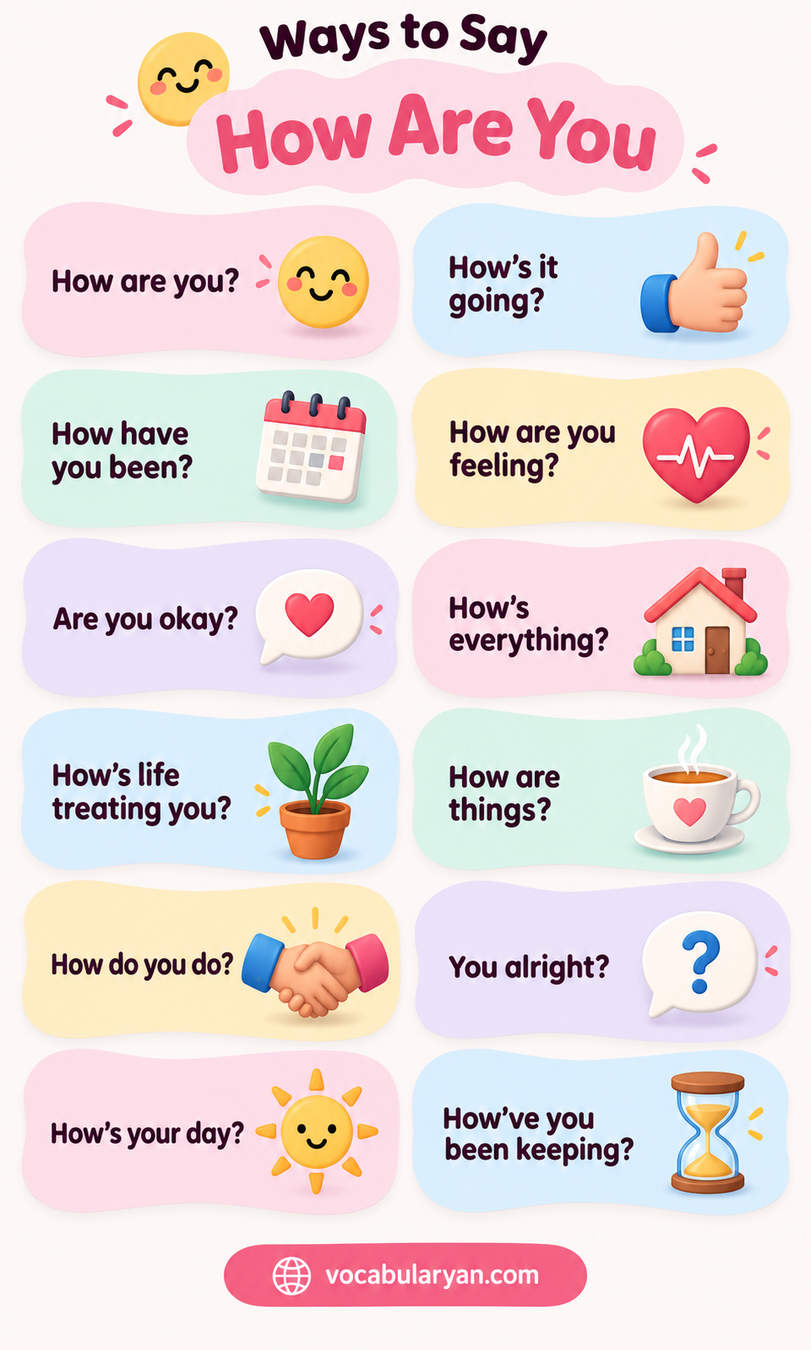
These seven questions fit almost everyone you meet in a day, from a neighbour to a new colleague.
How are you?: the standard form at every level, and it fits a stranger, a manager, or a friend. The reply is short and positive: "Fine, thanks, and you?"
- How are you, Mrs Ali? I haven’t seen you at the market lately.
- Hi, Dan, how are you? Did the car pass its test?
- Good morning, how are you? Please come through, the doctor is ready.
How are you doing?: a warmer form of "how are you", common in American English with friends and colleagues alike. It sounds relaxed without sounding rude.
- Hey, Priya, how are you doing? You look busy.
- How are you doing after the move? Boxes everywhere still?
- Hello, Mr Petrov, how are you doing today?
How’s it going?: a greeting and a question in one, and it fits a friend, a classmate, or a colleague you joke with. The reply is "good, you?" or "not bad".
- How’s it going, Tom? Ready for the match tonight?
- Hi, how’s it going? Sorry I’m late, the bus broke down.
- How’s it going with the essay, Lena?
How are things?: softer than "how are you", and it asks about life in general rather than health. It fits friends and family in speech and in messages.
- How are things, Grandad? Is the garden surviving the heat?
- Hey, Sofia, how are things at the new school?
- How are things? I feel like we haven’t talked in weeks.
How’s everything?: the same warmth as "how are things", and it fits the start of a call, a coffee, or a chat in the corridor.
- How’s everything, Mum? Did the plumber turn up?
- Morning, Kemi, how’s everything on your side of the office?
- How’s everything? You’ve been quiet on the group chat.
How are you today?: a little warmer than "how are you", and it fits a shop assistant, a nurse, or a teacher greeting someone at the door.
- Good afternoon, how are you today? Any pain in the knee?
- How are you today, Ravi? Ready for the presentation?
- Hi there, how are you today? Table for two?
How’s your day going?: a question about the day so far, and it fits a colleague at lunch, a friend on the phone, or a partner in a message.
- How’s your day going, Anna? Mine has been meetings since eight.
- Hey, how’s your day going? Any news from the bank?
- How’s your day going so far? Busy at the front desk?
Say "how are you?" when you are unsure, because it never sounds too warm and never sounds cold.
Casual Ways to Say How Are You to Friends
Casual forms are for people who know you well, and each one sounds quick, relaxed, and a little playful.
What’s up?: a greeting rather than a real question, so the reply is "not much" or "hey". It fits friends and classmates and sounds odd with a manager.
- What’s up, Marco? You look half asleep.
- Hey, what’s up? I got your message about Saturday.
- What’s up, guys? Who’s driving tonight?
What’s new?: a friendly question for news, and it fits a friend you have not seen for a week or two.
- What’s new, Ben? Still working at the bakery?
- Hi, Aisha, what’s new with you?
- What’s new? Did you hear back about the flat?
What’s going on?: a casual question that asks what is happening in someone’s life, and the reply is a short update. With a worried face it means "what is wrong?".
- Hey, Chris, what’s going on? Haven’t seen you at practice.
- What’s going on with you and Sam? You both look tired.
- What’s going on? Good weekend?
What are you up to?: a question about what someone is doing right now or these days, and it fits a friend on a call or in a text.
- What are you up to this weekend, Jess?
- Hey, what are you up to? Fancy a walk?
- What are you up to these days? Still painting?
How’s life?: a broad casual question about everything at once, and it fits a friend you have not seen for a week or more.
- How’s life, Omar? How’s the new job treating you?
- Hey, stranger, how’s life?
- So, how’s life in the countryside? Missing the city yet?
Everything good?: a two-word check that fits friends and family, and the reply is "yeah, all good" or a short worry.
- Everything good, Lucy? You went quiet in the meeting.
- Hey, everything good at home?
- Everything good? You left the party early last night.
How you doing?: the spoken short form of "how are you doing", with "are" dropped, and it fits close friends in speech or in a text.
- How you doing, mate? Long week?
- Hey, Nadia, how you doing? Feeling better?
- How you doing? Still on for Friday?
What’s happening?: casual American slang that means "what’s up", and it fits close friends and a group chat.
- What’s happening, Marcus? Game tonight?
- Hey, what’s happening? You disappeared after class.
- What’s happening, everyone? Let’s get going.
Keep "what’s up" and "what’s happening" for friends your own age, and say "how are you?" to everyone else.
Formal Ways to Say How Are You at Work
Formal forms fit a manager, a client, a doctor, or a visitor, and they pair with a title and surname or with a full sentence.
How are you, Ms Adams?: "how are you" with a title and surname is the standard formal question in an office, a clinic, or a bank. Use the title until the person offers a first name.
- Good morning, how are you, Ms Adams? The contract is ready for review.
- Hello, how are you, Dr Okafor? Thank you for seeing me so quickly.
- How are you, Mr Petrov? We spoke on the phone last week.
Are you well?: a polite, slightly old-fashioned question for a client or an older person, and the reply is "very well, thank you".
- Are you well, Professor Grant? I enjoyed your talk last month.
- Good afternoon, Mrs Novak, are you well?
- Are you well? You were away from the office last week.
How is everything with you?: a warm formal question that asks about work and life at once, and it fits a client you have met before.
- How is everything with you, Mr Chen? How was the flight?
- Good morning, Fatima, how is everything with you since the merger?
- How is everything with you at the Manchester branch?
How was your journey?: the question for a visitor who has just arrived, and it fits a guest, a candidate, or a client at reception.
- Welcome, Mr Diaz, how was your journey?
- Good morning, how was your journey in from the airport?
- How was your journey? The trains were slow this morning.
How are things going with the project?: a question about a piece of work rather than health, and it opens a meeting or a call with a colleague.
- Hi, Sara, how are things going with the project?
- Good afternoon, team, how are things going with the project since Monday?
- How are things going with the project? Any delays I should know about?
How do you do?: a very formal first-meeting greeting, now rare outside formal British settings. It is not a question about health, and the reply is the same words.
- How do you do? I’m Charles Whitmore from the London office.
- How do you do, Mr Whitmore? My mother sends her regards.
- How do you do? My father sends his regards.
The one form to avoid with a manager you met a minute ago is "what’s up", because it puts you on the level of a close friend before the relationship is there.
- What’s up, Ms Adams? Got a minute? ❌
"What’s up" sounds too familiar for a first conversation with a senior person, and "how are you" with a title fits the same moment.
- Good morning, Ms Adams, how are you? Do you have a minute? ✅
"How do you do?" also catches people out, because it looks like a question about health.
- How do you do? (reply) I’m fine, thanks, a bit tired today. ❌
"How do you do?" is a fixed greeting for a first meeting, so the reply is the same phrase or a short "pleased to meet you".
- How do you do? (reply) How do you do? Pleased to meet you. ✅
Every question on this page belongs to one of five levels.
| Level | Questions | Who it fits |
|---|---|---|
| Slang | Sup, what’s good, how’s it hanging | Close friends your own age |
| Casual | What’s up, how’s it going, how’s life | Friends, family, relaxed colleagues |
| Neutral | How are you, how are you doing, how are things | Anyone you know by name |
| Formal | How are you with a title, are you well, how was your journey | Managers, clients, strangers, older people |
| Very formal | How do you do, I trust you are well | Guests of honour, interviews, formal letters |
Use "how are you" with a title and surname on the first day, and move to a first name only after the other person does.
Ways to Say How Are You in an Email
An email version of "how are you" goes on the line after the greeting, and most of them are statements rather than questions.
I hope you’re well: the most common opening line in a work email, and it softens the request that follows. It is a statement, so the reader does not have to answer it.
- Hi Sara, I hope you’re well. Could you send me the invoice by Friday?
- Hello Tom, I hope you’re well and the new house is taking shape.
- Dear Ms Adams, I hope you’re well. I am writing to follow up on our call.
I hope this email finds you well: the formal version of "I hope you’re well", and it fits a first email to a client, a professor, or a stranger.
- Dear Dr Okafor, I hope this email finds you well. I am writing about the June conference.
- I hope this email finds you well. My name is Ana Ruiz and I am applying for the analyst role.
- Dear Mr Petrov, I hope this email finds you well after your trip.
I hope you had a good weekend: a Monday opener for a colleague or a client you know, and it sounds warm without asking for a reply.
- Hi Ravi, I hope you had a good weekend. Quick question about the slides.
- Morning, Kemi, I hope you had a good weekend. Are you free at two?
- Hello Ms Novak, I hope you had a good weekend. The figures are attached.
How are things on your end?: a real question for a colleague in another office or another country, and it expects a short update in the reply.
- Hi Fatima, how are things on your end? We’re nearly ready to launch here.
- Hello Leo, how are things on your end with the supplier?
- How are things on your end? The Lisbon team sent their report yesterday.
I trust you are well: the most formal opener of the set, and it fits a letter to a board member, a lawyer, or an official. Keep it out of a note to a friend.
- Dear Mr Whitmore, I trust you are well. Please find the signed papers attached.
- I trust you are well. I am writing on behalf of the residents’ committee.
- Dear Professor Grant, I trust you are well and that the term has started smoothly.
"I hope this email finds you well" belongs to work, and in a message to a friend it sounds like a bank.
- Hey, Dan, I hope this email finds you well. Pub on Friday? ❌
A friend gets a spoken form in writing, because the level of the opener matches the level of the friendship.
- Hey, Dan, how’s it going? Pub on Friday? ✅
Write "I hope you’re well" to a colleague, "I hope this email finds you well" to a stranger, and "how’s it going?" to a friend.
Ways to Say How Are You on the Phone
A phone version of "how are you" comes right after your name, because the other person cannot see your face.
Hi, it’s Ana, how are you?: the standard opening for a call to someone who knows you, with your name first and the question second.
- Hi, it’s Ana, how are you? Is this a good time to talk?
- Hi, it’s Ana, how are you? I’m calling about the flat on Green Street.
- Hi, it’s Ana, how are you? Sorry I missed your call earlier.
How are you doing today?: the question a call centre or a clinic asks after the company name, and the reply is "fine, thanks" before the real business starts.
- Good morning, Rivera Dental, Ella speaking, how are you doing today?
- Hello, this is Mark from the bank, how are you doing today?
- Thanks for holding, how are you doing today?
How’s your day been?: a warm question for a friend or a partner in an evening call, and it asks for a short story rather than one word.
- Hey, love, how’s your day been? Did the meeting go okay?
- Hi, Grandma, how’s your day been? Did the nurse come?
- How’s your day been? Mine was all spreadsheets.
How are things at your end?: the question for a family member or a colleague in another town, and "at your end" means "where you are".
- Hi, Mum, how are things at your end? Is the snow bad?
- Hello, Ravi, how are things at your end? The office here is empty.
- How are things at your end? We’ve had rain all week.
Long time, how have you been?: the opening for a call to someone you have not spoken to for months, and it names the time apart before it asks the question.
- Hi, Joel, it’s Dana, long time, how have you been?
- Long time, how have you been? I saw your name in the paper.
- Hey, long time, how have you been? Still in Leeds?
On a call, say your name first and ask the question second, because "how are you?" alone makes the other person guess who is speaking.
Ways to Say How Are You Over Text
Text forms are short, and a question mark or an exclamation mark replaces your voice.
How’s your day?: the most common text check-in between friends and partners, and the reply is one line about the day so far.
- How’s your day? Mine is dragging.
- Hey, how’s your day? Did the parcel come?
- How’s your day going, Priya? Still in the library?
You good?: a two-word text that asks if everything is fine, and it fits close friends. The reply is "yeah, you?" or a short worry.
- You good? You sounded off on the phone.
- Hey, you good? Saw the news about your team.
- You good for tonight? Still 8?
Everything okay?: a soft text for a friend who has gone quiet or missed something, and it means "I am a little worried about you".
- Everything okay? You weren’t at training.
- Hey, everything okay? No reply since Monday.
- Everything okay at home? Call me if you want.
How’s things?: a casual text form with "things" and "is" together, and it sounds relaxed between friends. In formal writing the form is "how are things".
- How’s things, Ben? Long time.
- Hey, how’s things? Free this weekend?
- How’s things with the new flatmate?
hru: the text abbreviation for "how are you", and it fits close friends only. In a message to a teacher or a manager, write the full words.
- Hey, hru? Miss you.
- hru? Heard you had a cold.
- Morning! hru today?
Keep a text question to three or four words, and write the full words to anyone senior.
Ways to Say How Are You to Someone Who Was Ill
These questions ask about health for real, so the reply is longer and the voice is softer than in a normal greeting.
How are you feeling?: the standard question for someone who was ill, tired, or upset, and it asks for a real answer about the body or the mood.
- How are you feeling, Dad? Did the tablets help?
- Hi, Lucy, how are you feeling after the operation?
- How are you feeling today? You look a lot brighter.
Are you feeling any better?: the follow-up question a day or two after someone was ill, and the reply is "a bit" or "much better, thanks".
- Are you feeling any better, Sam? You sounded rough yesterday.
- Morning, are you feeling any better after a night’s sleep?
- Are you feeling any better? The whole class asked about you.
How are you holding up?: the question for someone in a hard time, such as an illness in the family, a loss, or a long recovery. It says you know the time is hard.
- How are you holding up, Nadia? I heard about your mum.
- Hi, Tom, how are you holding up with the night shifts?
- How are you holding up? Let me know if you need a lift to the hospital.
Are you on the mend?: a warm British question that asks if someone is getting better, and "on the mend" means "recovering".
- Are you on the mend, Grandad? Mum said the cough is gone.
- Hi, Claire, are you on the mend? We missed you at the club.
- Are you on the mend? Take it slowly this week.
How’s the recovery going?: a question for someone weeks into getting better from an injury or an operation, and it fits a friend, a colleague, or a patient.
- How’s the recovery going, Ravi? Back on the bike yet?
- Hello, Mrs Kaur, how’s the recovery going since the hip operation?
- How’s the recovery going? The physio said you’re doing well.
How are you keeping?: a gentle question for an older person or someone with a long-term illness, common in Britain and Ireland, and the reply is "not too bad".
- How are you keeping, Mr Lewis? Is the chest better in the warm weather?
- Hello, Auntie May, how are you keeping?
- How are you keeping? Still walking to the shops every day?
A casual greeting sounds cold to someone in a hospital bed.
- What’s up, Grandad? (in the ward) ❌
"What’s up" is a greeting that asks for nothing, so someone who was ill gets a question that asks about health.
- How are you feeling, Grandad? ✅
Ask "how are you feeling?" first, and follow with "are you feeling any better?" a day or two later.
Ways to Say How Are You After a Long Time
These questions name the time apart before they ask, and they fit friends, family, and old colleagues.
How have you been?: the question that follows a hello after a long absence, and it asks for news from the months in between rather than a quick "fine".
- Hi, Aisha, how have you been? I heard about the new baby.
- Two years, is it? How have you been?
- How have you been, Auntie Rose? How is the garden?
What have you been up to?: a casual question about the months apart, and the reply is a short list of news.
- What have you been up to, Marco? Still in the band?
- Hey, stranger, what have you been up to?
- What have you been up to since college? I lost track of you.
How’s life been treating you?: a warm, slightly playful question that asks if life has been kind, and it fits an old friend or a former colleague.
- How’s life been treating you, Joel? You look well.
- Hey, Lucy, how’s life been treating you since you moved?
- So, how’s life been treating you? Better than the old office?
It’s been a while, how are you?: "it’s been a while" names the absence, and "how are you" asks the question, so the pair fits a friend after weeks or months.
- Hi, Ravi, it’s been a while, how are you?
- It’s been a while, how are you? How’s the team?
- Well, it’s been a while, how are you? Still at the hospital?
How’s everything been?: softer than "how have you been", and it asks about work, family, and health at once.
- How’s everything been, Omar? How are the kids?
- Hey, Nadia, how’s everything been since the wedding?
- How’s everything been? Sorry I’ve been out of touch.
What’s new with you?: the question for a friend you see every few months, and it asks for the news you missed.
- What’s new with you, Ben? Any news on the house?
- Hi, Sofia, long time, what’s new with you?
- What’s new with you? Last time we spoke you were job hunting.
Ask "how have you been?" after months apart, and "what’s new with you?" after a few weeks.
Ways to Say How Are You to a Group
A group question names everyone at once, and the level of the question matches the room.
How is everyone?: the standard question for a family, a team, or a class, and it fits speech and messages at every level.
- How is everyone? Did you all get home safely last night?
- Good morning, team, how is everyone after the long weekend?
- Hi all, how is everyone doing with the deadline?
How’s everyone doing?: a warmer, more casual form of "how is everyone", and it opens a meeting, a class, or a video call.
- How’s everyone doing? Can you all hear me at the back?
- Hey, guys, how’s everyone doing today?
- How’s everyone doing with chapter three? Any questions?
How are you all?: the question for a family or a group of friends you know well, and it fits the start of a visit or a call.
- How are you all? It’s been too long.
- Hi, Mum, how are you all? Is Dad’s knee better?
- How are you all getting on in the new house?
How are we all doing?: a friendly question from a host, a teacher, or a coach, and "we" makes the speaker part of the group.
- Right, how are we all doing? Ready to start?
- How are we all doing for time? Ten minutes left.
- Morning, class, how are we all doing today?
Say "how is everyone?" to a work group, and keep "how are you all?" for family and friends.
Regional Ways to Say How Are You in English
English-speaking countries each keep a few forms of their own, and using one in the right country wins a smile at once.
British Ways to Say How Are You
Alright?: the everyday British form, and it is not a question about health. The reply is "alright?" back, or "yeah, you?"
- Alright? Long shift?
- Alright, Sam? Coming to the quiz?
- Alright? I was just thinking about you.
You alright?: "alright" with "you", said to a friend, a colleague, or a customer, and it means "hello" more than "are you okay?".
- You alright, mate? Long time no see.
- You alright, love? What can I get you?
- You alright? You look like you’ve been running.
How do?: a northern English greeting, short for "how do you do?", and it fits neighbours and market stalls.
- How do, Sam? Cold one today.
- How do? Two of the white loaves, please.
- How do, lad? Your dad about?
American Ways to Say How Are You
How y’all doing?: "how are you all doing" from the American South, and it fits a family, a crowd, or a table of friends.
- How y’all doing? Welcome to the ranch.
- How y’all doing tonight? Ready for some music?
- How y’all doing back there? Need more tea?
How ya doin’?: the fast spoken form of "how are you doing", common in New York and across American casual speech, and it fits friends and neighbours.
- How ya doin’, Marcus? Good to see you.
- Hey, how ya doin’? Grab a seat.
- How ya doin’, buddy? Long week?
What’s good?: American slang that means "what’s up", and it fits close friends in speech or a group chat.
- What’s good, Marcus? Still on for tonight?
- What’s good? I finished early today.
- Yo, what’s good, everyone? Who has the tickets?
How’s it hanging?: very casual American slang between close male friends, and it sounds rude to anyone else.
- How’s it hanging, Chris? Still fixing that truck?
- Hey, man, how’s it hanging?
- How’s it hanging? You missed a good game.
Australian and Irish Ways to Say How Are You
How are you going?: the Australian "how are you", with "going" in place of "doing". The reply is "good, thanks, you?"
- How are you going, Mia? Enjoying the new job?
- G’day, Mel, how are you going?
- How are you going? Did you find the car park?
How ya going, mate?: the fast spoken form of "how are you going", with "mate" for a friend or any man you speak to casually.
- How ya going, mate? Hot enough for you?
- How ya going, mate? Is this the queue for the ferry?
- How ya going, mate? Cheers for the lift yesterday.
How’s the form?: an Irish question that asks how someone is feeling, used between friends. The reply is "grand" or "not too bad".
- How’s the form, Ciara? Over the cold yet?
- How’s the form? You look rested.
- Hey, Declan, how’s the form this morning?
What’s the craic?: the Irish greeting that means "what’s happening, what’s the fun?", said "crack", and it fits friends and a friendly pub.
- What’s the craic, Aoife? How was Galway?
- Well, lads, what’s the craic?
- What’s the craic? I heard you moved.
Say "alright?" in Britain, "how y’all doing?" in the American South, "how are you going?" in Australia, and "how’s the form?" in Ireland.
Funny Ways to Say How Are You
Funny forms are for close friends who know your sense of humour, and each one plays with rhyme or an old saying.
What’s cooking, good looking?: a rhyming greeting from old films, said with a grin to a partner or a close friend.
- What’s cooking, good looking? Smells amazing in here.
- Well, what’s cooking, good looking? Day off?
- What’s cooking, good looking? Need a hand with dinner?
What’s up, buttercup?: "what’s up" with a rhyme, and it fits a child, a partner, or a friend who needs cheering up.
- What’s up, buttercup? Why the long face?
- Morning, what’s up, buttercup? Sleep okay?
- What’s up, buttercup? Ready for the big day?
What’s shakin’?: casual American slang from the 1950s that means "what’s happening?", and it sounds playful today.
- What’s shakin’, Marco? You look pleased with yourself.
- Hey, what’s shakin’? Any plans tonight?
- What’s shakin’, everyone? Where’s the music?
How’s the world treating you?: a friendly question that asks if life has been kind, and it fits an older friend or a neighbour with a smile.
- How’s the world treating you, Frank? Still beating the grandkids at chess?
- Hiya, Ruth, how’s the world treating you?
- How’s the world treating you these days? Any better?
Save the funny forms for people who will laugh, because a joke question to a stranger reads as a mistake.
How Do You Reply When Someone Says How Are You?
The reply matches the question: a health question gets a short positive answer, and a greeting-shaped question gets a greeting back.
How are you? and how are you doing?: the reply is short and positive, then the question goes back.
- How are you? I’m well, thank you, and yourself?
- How are you doing? Good, thanks, you?
- How are you today? Good, thanks, glad it stopped raining.
How’s it going? and how are things?: the reply is "good" or "not bad", with one line of news if you have some.
- How’s it going? Not bad, busy week, you?
- How are things? All good, the kids are back at school.
- How’s everything? Pretty good, thanks, and with you?
What’s up? and alright?: the reply is "not much" or the same greeting, because there is no real question in them.
- What’s up? Nothing much, what about you?
- Alright? Yeah, alright, you?
- What’s good? Nothing much, just got here.
How are you feeling? and are you on the mend?: the reply is honest, because the question asks about health for real.
- How are you feeling? Much better, thanks, the fever’s gone.
- Are you on the mend? Slowly, the doctor says another week.
- How are you holding up? Some days are hard, but we’re okay.
How have you been? and what’s new with you?: the reply is a short piece of news, then the question goes back.
- How have you been? Really good, I changed jobs in March, and you?
- What’s new with you? Not a lot, we got a dog, that’s the big news.
- How’s life been treating you? Can’t complain, how about you?
I hope you’re well and how do you do?: the email opener needs no reply, and "how do you do?" gets the same words back.
- I hope you’re well. Thanks, I hope you are too. (or no reply at all)
- How do you do? How do you do?
- I trust you are well. Thank you, all is well here.
Answer a greeting-shaped question in three words or fewer, give a real answer to a health question, and always ask the question back.
More Everyday English Phrases
- Other Ways to Say Nice to Meet You
- Other Ways to Say What’s Up
- Other Ways to Say Good Evening
- Other Ways to Say Welcome
FAQs
There is no fixed number, because new forms appear every few years, and this page covers more than sixty that native speakers use today. The core set is small: "how are you?", "how are you doing?", "how’s it going?", "how are things?", and "what’s up?" cover almost every moment. Everything else adds a level, a place, or a mood on top of those five.
Answer in two or three words, keep it positive, and ask the question back. "Fine, thanks, and you?" fits a stranger or a manager, and "good, you?" fits a friend. A real answer about your health belongs only in a reply to "how are you feeling?" or a question from a close friend.
Yes, "how are you doing?" is correct at every level, and in American English it is the more common of the two with friends and colleagues. With a manager or an older stranger, "how are you?" sounds a little more polite. Both take the same short reply.
Yes, "how are you?" is polite in every English-speaking country, and it works with a stranger, a boss, or a friend. It becomes more formal with a title and surname, and warmer with a first name. The only form that is more formal is "how do you do?", which fits a first meeting only.
The question is a greeting first, and the short reply is part of the greeting rather than a report on health. The question form is used to sound warm, in the same way "what’s up?" and "alright?" are. A person who wants a real answer asks "how are you feeling?" or "how have you been?" instead.
The written forms are statements rather than questions. "I hope you’re well" fits a colleague, "I hope this email finds you well" fits a stranger, and "I hope you had a good weekend" fits a Monday. A real question such as "how are things on your end?" fits a colleague in another office. None of the statement forms needs a reply.
"What’s cooking, good looking?", "what’s up, buttercup?", and "what’s shakin’?" are the ones most friends recognise, and each one rhymes or plays with an old saying. Keep every one of them for people who know your sense of humour.