
A one-word "no" is a full sentence in English, and native speakers almost never leave it on its own. The ways to say no in English add one small piece to the word: thanks, a sorry-word, a reason, or another offer. "No, thanks" refuses a drink, "I’m afraid I can’t" refuses a task, and "nope" refuses a friend. The everyday refusals come first, because they fit the most people.
Other Ways to Say No in Everyday English
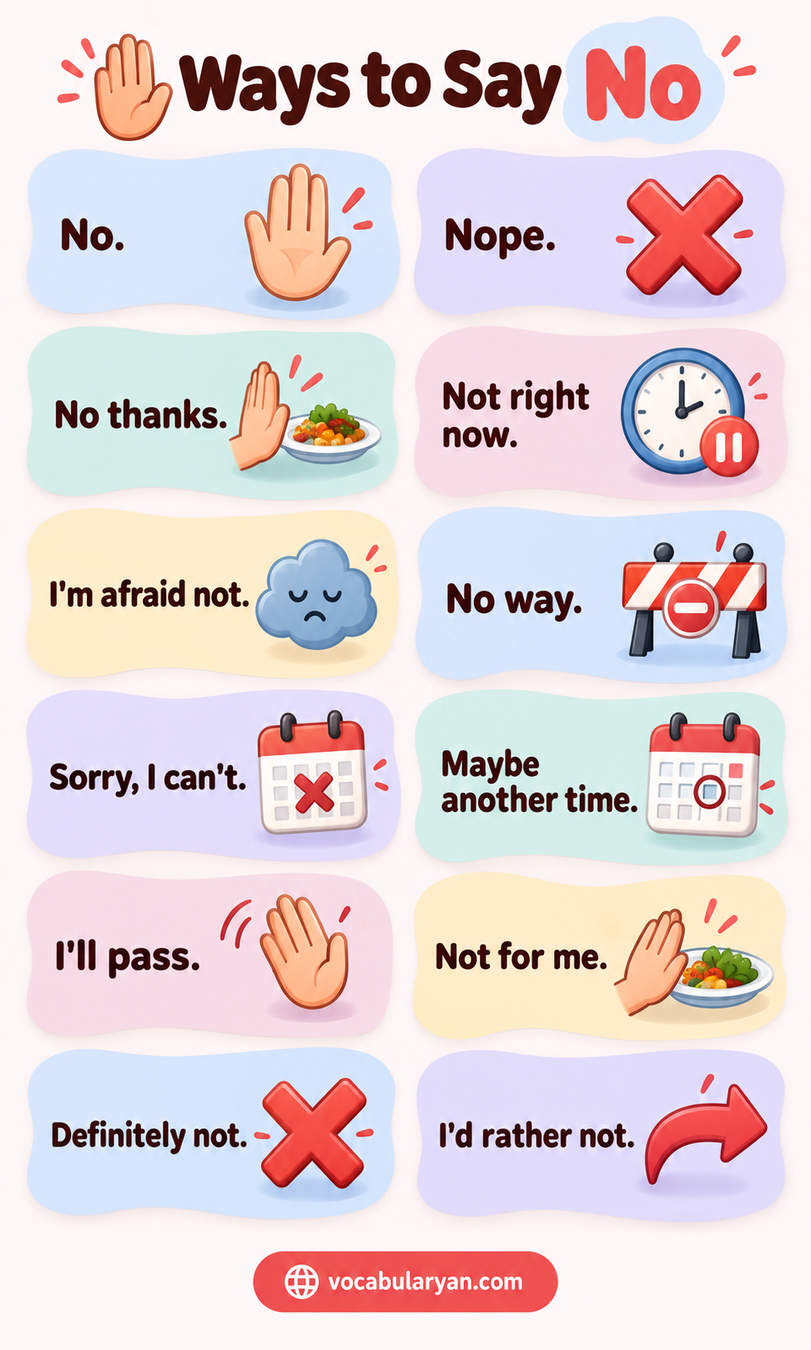
These refusals fit an offer, a question, or a small request from anyone, in a shop, at home, or at work.
No, thanks: the standard polite refusal of an offer, and it fits a stranger, a waiter, a colleague, or a friend. The comma is written, and the two words are said as one quick unit.
- No, thanks, I’ve just had a coffee.
- Would you like a bag for that? No, thanks, I’ve brought my own.
- No, thanks, I’m driving tonight, so water is fine.
No, thank you: the same refusal in its full form, a step more polite, and it fits an older person, a host, or a first meeting.
- No, thank you, the meal was lovely, but I’m full.
- No, thank you, Mrs Bello, I’ll stand.
- More wine? No, thank you, I have an early start tomorrow.
Not really: a soft no to a question about wanting or liking, and it sounds gentle rather than final. The reply to "Do you fancy a walk?" is "not really, it’s raining".
- Do you want to see the film again? Not really, once was enough.
- Not really, I’m not a fan of spicy food.
- Are you hungry? Not really, I had a big lunch.
Not right now: a refusal for this moment only, and it says that later is possible. It fits a colleague, a child, or a shop assistant.
- Can you look at my essay? Not right now, I’m on a call.
- Not right now, thanks, I’m just looking.
- Not right now, sweetheart, wait until I’ve finished cooking.
I’m afraid not: a polite no to a yes-or-no question, and "I’m afraid" here means "sorry to say". It fits a customer, a caller, or a stranger who asks for something you do not have.
- Is the manager in today? I’m afraid not, she’s back on Monday.
- I’m afraid not, we sold the last ticket an hour ago.
- Do you take cards? I’m afraid not, cash only, sorry.
I’d rather not: a refusal that names a preference, and it works when you do not want to give a reason. It fits family, friends, and colleagues.
- Can I put your photo on the team page? I’d rather not, if that’s okay.
- I’d rather not talk about it tonight, Dad.
- I’d rather not drive after such a long day.
Say "no, thanks" to an offer and "I’m afraid not" to a question, and add nothing else unless the person asks why.
Casual Ways to Say No to Friends
Casual refusals are short, relaxed, and a little playful, and each one belongs to people who know you well.
Nope: "no" with a p sound at the end, and it sounds light and friendly. It fits a friend, a sibling, or a partner, and it sounds rude to a boss.
- Did you eat my crisps? Nope, ask Jamie.
- Nope, not going out tonight, I’m shattered.
- Have you seen my keys? Nope, try the kitchen.
Nah: the shortest spoken no in English, said with a shrug. It is common in Britain, America, and Australia between friends of any age.
- Coming to the gym? Nah, my legs still hurt from Tuesday.
- Nah, I’ll skip dessert.
- Want the last slice? Nah, you have it.
Uh-uh: a no made of two sounds and a head shake, with the stress on the first sound. Its opposite, "uh-huh", means yes, so listen for the stress.
- Did you finish the report? Uh-uh, not even close.
- Uh-uh, you’re not borrowing my car again.
- Was it good? Uh-uh, worst pizza I’ve ever had.
No way: a strong casual no, with surprise or refusal in it. To a friend it sounds fun, and to a customer it sounds like an argument.
- Are you going to sing at the wedding? No way, not in front of Grandma.
- No way am I paying forty pounds for a burger.
- No way, I’m not lending him money again.
I’ll pass: a relaxed refusal of an offer or a plan, from the idea of passing on a turn in a game. It fits friends and relaxed colleagues.
- Pub after work? I’ll pass, I’ve got an early flight.
- I’ll pass on the karaoke, but I’ll come and watch.
- Anyone want to try the chilli? I’ll pass, thanks.
I’m good: an American refusal of an offer that means "no, thanks, I have enough". It fits food, drink, and help.
- Want a refill? I’m good, thanks.
- Do you need a hand with those boxes? I’m good, they’re lighter than they look.
- I’m good, honestly, I ate on the train.
Use "nope" and "nah" with friends your own age, and switch to "no, thanks" the moment a stranger or a manager is in the room.
Formal Ways to Say No at Work
Formal refusals fit a manager, a client, or a colleague you do not know well, and each one names the refusal without the bare word "no".
I’m afraid I can’t: the most common polite refusal at work, and "I’m afraid" is the softener that says "I’m sorry to tell you". A reason follows in the same breath.
- I’m afraid I can’t join the call at three, I’m with a client until four.
- I’m afraid I can’t approve that without a receipt.
- I’m afraid I can’t stay late tonight, my daughter has a concert.
Unfortunately, that won’t be possible: a formal refusal of a request, and it fits a customer, a supplier, or a senior colleague. It sounds final and calm.
- Unfortunately, that won’t be possible before the end of the month.
- We asked for a discount, and the reply was, "Unfortunately, that won’t be possible at this order size."
- Unfortunately, that won’t be possible, the room is already booked.
I won’t be able to: a refusal about time or ability, and it sounds softer than "I can’t" because it looks ahead. It fits a task, a meeting, or a deadline.
- I won’t be able to finish the slides by Friday.
- I won’t be able to attend the training next week.
- I’m sorry, but I won’t be able to take on the new account.
I have to decline: a formal refusal of an invitation, an offer, or a role, and "decline" is the formal verb for "say no to".
- I have to decline the offer, as I’ve accepted another position.
- Thank you for the invitation, but I have to decline this year.
- After some thought, I have to decline the committee seat.
"Nope" and "nah" sound wrong the moment the person asking is senior to you.
- Nope, can’t do Friday, Mr Osei. ❌
A one-word slang refusal to a manager sounds careless, and a softener with a reason fits the same moment.
- I’m afraid I can’t do Friday, Mr Osei, I’m at the site visit all day. ✅
Every refusal on this page belongs to one of five levels.
| Level | Refusals | Who it fits |
|---|---|---|
| Slang | Nope, nah, uh-uh, hard pass | Close friends your own age |
| Casual | No way, I’ll pass, no chance, I’m good | Friends, family, relaxed colleagues |
| Neutral | No, thanks, not really, I’d rather not | Anyone you know by name |
| Formal | I’m afraid I can’t, I won’t be able to, unfortunately | Managers, clients, strangers, older people |
| Very formal | I have to decline, I regret to inform you | Letters, officials, ceremonies |
Open a work refusal with "I’m afraid" or "unfortunately", and add the reason in the same sentence.
Ways to Say No in an Email
An email refusal comes in three parts: thanks for the offer, the refusal itself, and a warm last line, all in one short message.
Thank you for thinking of me, but: the standard opening for refusing an invitation or an offer by email, and it fits a colleague, a client, or a contact you know.
- Thank you for thinking of me, but I’m not able to speak at the event this year.
- Thank you for thinking of me, but I’ll have to pass on the project.
- Thank you for thinking of me, but my schedule is full until spring.
I appreciate the offer, but: a refusal of a job, a deal, or a favour, and "appreciate" is the polite verb for "am grateful for".
- I appreciate the offer, but I’ve decided to stay in my current role.
- I appreciate the offer, but the timing doesn’t work for us.
- I appreciate the offer, but we’re happy with our current supplier.
After careful consideration: a formal opener that says you thought before refusing, and it fits a job offer, a proposal, or a bid.
- After careful consideration, we’ve decided not to go ahead with the merger.
- After careful consideration, I’m going to decline the position.
- After careful consideration, the committee has chosen another design.
I’m not in a position to: a formal refusal that puts the blame on your situation, not on the person asking. It fits money, permission, and promises.
- I’m not in a position to approve extra spending this quarter.
- I’m not in a position to comment on the case at this stage.
- I’m not in a position to promise a start date yet.
I regret to inform you: the most formal refusal in English, used for a rejected application, a cancelled order, or bad news from an office. It sounds cold in a personal email.
- I regret to inform you that your application was not successful on this occasion.
- I regret to inform you that the course is now full.
- I regret to inform you that we cannot extend the deadline.
Write the thanks first, the refusal second, and one warm line last, and keep the whole email under six sentences.
Ways to Say No When You Decline an Invitation
An invitation refusal thanks the person and names the day, and each one lets the friendship stay warm.
I’d love to, but I can’t make it: the standard polite refusal of an invitation, and "make it" means "be there". It fits friends, colleagues, and family.
- I’d love to, but I can’t make it on Saturday, it’s my nephew’s birthday.
- I’d love to, but I can’t make it to the launch, I’m in Leeds all week.
- Thanks for asking. I’d love to, but I can’t make it this time.
I wish I could: a warm refusal that says you are sorry to refuse, and it fits a friend or a colleague you like. A reason follows in most cases.
- I wish I could, but I’m working the late shift.
- I wish I could come to the reunion, honestly.
- I wish I could, Ana, but the babysitter cancelled.
I already have plans: the refusal that gives a reason without saying what the plans are, and it fits anyone. Nobody asks what the plans are.
- Sorry, I already have plans on Friday.
- I already have plans that evening, but thank you.
- We’d come, but we already have plans with Sam’s parents.
Maybe another time: the refusal that asks for the next invitation, and it fits a friend or a colleague you want to see again.
- I can’t tonight, maybe another time?
- Maybe another time, I’ve got an exam on Monday.
- Thanks, though, maybe another time when things are quieter.
Let’s take a rain check: an American refusal that means "not today, but ask me again", from a ticket given when rain stops a baseball game. It fits friends and casual colleagues.
- I’m exhausted. Let’s take a rain check on the cinema.
- Can we take a rain check on lunch? My meeting ran over.
- Let’s take a rain check, I’ll text you when I’m back.
Thank the person, name the day you cannot do, and offer another day if you want to see them.
Ways to Say No When You Refuse a Request
A request refusal names the limit, which is your time, your skill, or your comfort, and it fits a colleague, a neighbour, or a friend.
I can’t take on anything else right now: the refusal for a new task when your list is already full, and it fits work and volunteering.
- I can’t take on anything else right now, the audit is taking all my time.
- I’d like to help with the newsletter, but I can’t take on anything else right now.
- I can’t take on anything else right now, ask me again in March.
I’ve got too much on my plate: a casual way to say you are too busy, and "plate" here means the work in front of you. It fits colleagues and friends.
- I’ve got too much on my plate this month to organise the party.
- Sorry, I’ve got too much on my plate, can Priya do it?
- I’ve got too much on my plate with the move and the new job.
I’m not the right person for that: a refusal about skill rather than time, and it fits a task outside your job. It sounds honest and not lazy.
- I’m not the right person for that, you need someone who knows the tax rules.
- Honestly, I’m not the right person for that, my Spanish is basic.
- I’m not the right person for that, but Dev has done it before.
That’s not something I can do: a calm refusal of a request that breaks a rule or crosses a line, and it fits work, money, and favours.
- That’s not something I can do without my manager’s sign-off.
- Lend you my password? That’s not something I can do, sorry.
- That’s not something I can do, the policy is the same for everyone.
Name the limit in one sentence, and offer a person or a later date if you have one.
Ways to Say No to a Boss
A refusal to a manager names what will move, not what you refuse, and each one leaves the choice with the boss.
I can do that, but something else will have to wait: the safest refusal to a manager, because it says yes to the task and asks which task loses. The boss decides the order.
- I can do that, but something else will have to wait, which one is more urgent?
- I can do that, but something else will have to wait, and the client report is due tomorrow.
- I can do that, but the training slides will have to wait until next week.
I’m at capacity this week: a work refusal that means "my hours are full", and "capacity" is the business word for the most you can do.
- I’m at capacity this week, can it wait until Monday?
- I’m at capacity this week with the launch, but I’m free after the twelfth.
- Honestly, I’m at capacity this week, and I’d rather do it well than do it fast.
Can we look at the deadline?: a refusal shaped as a question, and it asks for more time rather than saying no to the task.
- Can we look at the deadline? Three days isn’t enough for a full review.
- I’m happy to lead it. Can we look at the deadline, though?
- Can we look at the deadline? The data doesn’t arrive until Thursday.
I’m not comfortable with that: the refusal for a request that feels wrong, unsafe, or unfair, and it fits a boss who asks you to bend a rule.
- I’m not comfortable with that, the numbers aren’t final yet.
- I’m not comfortable with that without a written request.
- I’m not comfortable with that, and I’d like to check with HR first.
Tell a manager what will move and when, and let the manager choose which task waits.
Ways to Say No to a Customer
A customer refusal names the limit, says you understand, and offers the next step, all in a friendly voice.
I’m afraid that’s not something we offer: the standard polite refusal of a service or a product, and it fits a shop, a hotel, or a call centre.
- I’m afraid that’s not something we offer, but the shop on the corner does repairs.
- I’m afraid that’s not something we offer on the weekend menu.
- I’m afraid that’s not something we offer at this branch, only online.
Unfortunately, we’re unable to: a formal refusal for a refund, a change, or a request that breaks a policy, and it fits speech and writing.
- Unfortunately, we’re unable to refund tickets after the event has started.
- Unfortunately, we’re unable to deliver outside the city.
- Unfortunately, we’re unable to hold the room without a deposit.
I understand, but: the refusal that says you heard the customer before you say no, and it fits an angry or upset caller.
- I understand, but the warranty ended in June.
- I understand, but I can’t change a booking made under another name.
- I understand, but the price was correct at the time of sale.
What I can do is: the line that follows a refusal and offers the next step, and it changes a no into a plan.
- We can’t refund it, but what I can do is give you a credit note.
- What I can do is put you on the waiting list.
- What I can do is send a technician on Monday.
A bare "that’s not possible" to a customer sounds final and cold.
- That’s not possible. ❌
A customer refusal needs a softener and a next step, because the bare line sounds like an argument.
- I’m afraid that’s not something we offer, but what I can do is order it for you. ✅
Say no to the request, not to the person, and finish the sentence with the next step.
Ways to Say No With an Alternative
A no with an alternative refuses one thing and offers another, and it fits anyone you want to stay friendly with.
Not this week, but how about next?: the refusal that moves the plan rather than cancelling it, and it fits friends and colleagues.
- Not this week, but how about next? Tuesday works for me.
- Lunch? Not this week, but how about next, when the report is done?
- Not this week, but how about next Saturday for the walk?
I can’t do all of it, but I can do part: a refusal that offers a smaller yes, and it fits a boss, a colleague, or a committee.
- I can’t do all of it, but I can do the first two chapters.
- I can’t do all of it, but I can check the numbers.
- I can’t do all of it, but I can do the morning session.
Have you tried asking Sam?: a refusal that names another person, and it fits a favour that someone else does better.
- I’m no good with cars. Have you tried asking Sam?
- Have you tried asking Sam? He’s off on Fridays.
- I can’t babysit tonight. Have you tried asking Sam?
Let me get back to you: a refusal that asks for time instead of saying no at once, and it fits an offer you need to think about. Give a real date for the reply.
- Let me get back to you by Thursday.
- Let me get back to you once I’ve checked with my partner.
- That’s a big decision. Let me get back to you next week.
Refuse the exact thing asked, and offer the day, the part, or the person you can give instead.
Firm Ways to Say No
A firm no leaves no space for a second ask, and it fits a repeated request, a pressure sale, or anything that feels unsafe.
No: the one-word refusal, said once, in a calm voice, with a full stop. It is the strongest refusal in English because nothing follows it.
- No. I’ve told you twice.
- Do you want to buy insurance with that? No.
- No, and please stop asking.
Absolutely not: a firm no with force in it, and it fits a request that shocks you. It sounds angry to a stranger.
- Can I borrow your passport? Absolutely not.
- Absolutely not, you’re not going out in that storm.
- Should we skip the safety check? Absolutely not.
My answer is no: a firm refusal for someone who keeps asking, and it sounds final without sounding rude.
- I’ve thought about it, and my answer is no.
- My answer is no, and it won’t change next week either.
- You can ask again, but my answer is no.
Please don’t ask me again: the refusal that closes the conversation, and it fits a friend, a relative, or a salesperson who will not stop.
- I’ve said no three times. Please don’t ask me again.
- Please don’t ask me again about the loan, Uncle Femi.
- Thank you, but I’m not interested. Please don’t ask me again.
Say a firm no once, in a calm voice, and repeat the same words if the person asks again.
Ways to Say No in a Text
Text refusals are two or three words long, and a "sorry" or an emoji replaces the smile.
Can’t, sorry: the fastest polite refusal by text, and it fits a friend or a colleague who asks for a favour or a plan.
- Can’t, sorry, at the dentist.
- Drinks tonight? Can’t, sorry, early start.
- Can’t, sorry, got the kids till six.
Not today: a refusal for this day only, and it fits a friend who asks you to meet or help.
- Not today, I’m wiped. Tomorrow?
- Run at seven? Not today, knee’s bad.
- Not today, need to finish this essay.
I’m out: a refusal that removes you from a group plan, and it fits a group chat with friends.
- Camping this weekend? I’m out, sorry, work.
- I’m out for the quiz, got a cold.
- Sorry all, I’m out this time.
Rain check?: the shortest version of "let’s take a rain check", and it fits a friend you plan to see later.
- Bit late for me. Rain check?
- Rain check? Car’s in the garage.
- Love to, but rain check? Mum’s visiting.
No can do: a playful refusal that means "I can’t do that", and it fits friends and relaxed colleagues by text or in speech.
- Swap shifts Friday? No can do, I’m away.
- No can do, the file is locked.
- Lend you a tenner? No can do, I’m broke till payday.
Keep a text refusal under five words, and add a "sorry" if the person is a friend.
Regional Ways to Say No in English
English-speaking countries each keep a few refusals of their own, and some of them look like a yes.
British Ways to Say No
Not on your nelly: an old London slang refusal that means "definitely not", now said for a laugh between friends.
- Lend you my bike in the rain? Not on your nelly.
- Not on your nelly, I’m not wearing that hat.
- Are you going back to that restaurant? Not on your nelly.
No chance, mate: a firm casual refusal with "mate", the British word for a friend or any man you speak to casually.
- Can I have a lift at midnight? No chance, mate.
- No chance, mate, the boss would see it.
- Swap seats? No chance, mate, I booked the window.
You’re alright: a British refusal of an offer that means "no, thanks, I’m fine". It confuses learners because it sounds like a comment on the other person.
- Want a hand with the bags? You’re alright, they’re not heavy.
- Cup of tea? You’re alright, thanks, I’ve just had one.
- Shall I wait with you? You’re alright, the bus is due.
American Ways to Say No
Not on your life: an American refusal that means "never", and it fits a dare, a bad idea, or a request from a friend.
- Would you go bungee jumping? Not on your life.
- Not on your life am I eating that.
- Let him borrow the truck? Not on your life.
Hard pass: a strong form of "I’ll pass", common with younger American speakers, and it fits friends and social media.
- Another zombie series? Hard pass.
- Hard pass on the 6 a.m. spin class.
- A blind date with your cousin? Hard pass.
Not gonna happen: a firm American refusal that means "this will not happen", and it fits a friend, a child, or a teammate.
- A puppy in this apartment? Not gonna happen.
- Not gonna happen, I’m not driving to Ohio tonight.
- Extra day off in launch week? Not gonna happen.
Australian and Irish Ways to Say No
Yeah nah: the Australian and New Zealand refusal, where "yeah" means "I heard you" and "nah" is the answer. The answer is no.
- Coming to the beach? Yeah nah, too windy today.
- Yeah nah, I’ll give the party a miss.
- Another beer? Yeah nah, I’m driving.
Not a hope: an Irish refusal that means "there is no chance", and it fits friends, family, and a match that is already lost.
- Will we get tickets for the final? Not a hope.
- Not a hope, the shop closed at six.
- Ask Dad for the car? Not a hope.
I will yeah: an Irish refusal that means "I definitely will not", said with a flat voice. It looks like a yes on paper, so listen to the voice.
- Will you tidy your room? I will yeah.
- Lend him fifty euro? I will yeah.
- I will yeah, after last time.
"Yeah nah" and "nah yeah" look like the same words in a different order, and their meanings are opposite.
- Want to come for a swim? Nah yeah, too cold. ❌
"Nah yeah" ends on "yeah", so it means yes, and the refusal has to end on "nah".
- Want to come for a swim? Yeah nah, too cold. ✅
Say "you’re alright" in Britain, "hard pass" in America, "yeah nah" in Australia, and "not a hope" in Ireland, and say "no, thanks" everywhere else.
Funny Ways to Say No
Funny refusals are for close friends who know your sense of humour, and each one makes the no bigger than it needs to be.
Over my dead body: a dramatic refusal that means "I will stop this from happening", said with a smile between friends and family.
- Sell the piano? Over my dead body.
- Over my dead body is my daughter getting on that motorbike.
- Sell Grandad’s watch? Over my dead body.
That’s a no from me: a refusal borrowed from talent-show judges, said in a serious voice for a laugh.
- Pineapple on pizza? That’s a no from me.
- That’s a no from me, the last camping trip was enough.
- Matching outfits for the party? That’s a no from me.
Ask me again never: a joke refusal that plays on "ask me again later", and it fits friends and siblings.
- Can I borrow your headphones? Ask me again never.
- Ask me again never, you still have my charger.
- Help you move house a third time? Ask me again never.
Nice try: a refusal that names the trick behind the request, said with a grin to a child, a friend, or a partner.
- Can I have ice cream for breakfast? Nice try.
- Nice try, but you’re still washing up.
- Skip the meeting and say the train was late? Nice try.
Save the joke refusals for people who will laugh, because a dramatic no to a stranger reads as anger.
How to Soften a No Without Sounding Weak
A soft no has one softener, one reason, and one refusal, and the weakness comes from adding a "maybe" or a second apology.
Thanks for asking, but: the softener that opens with gratitude, and it fits any invitation, offer, or request. The refusal follows at once.
- Thanks for asking, but I can’t take on another client.
- Thanks for asking, but I’m not free that weekend.
- Thanks for asking, but I’ll sit this one out.
I’ve thought about it, and: the softener that says the no is a decision, not a mood, and it fits a boss, a partner, or a friend.
- I’ve thought about it, and I’m going to say no to the transfer.
- I’ve thought about it, and the answer is still no.
- I’ve thought about it, and I don’t want to move house this year.
Not this time: a soft refusal that says yes to a future ask, and it fits a friend or a colleague who asks for the same favour more than once.
- Not this time, but ask me for the next one.
- I’ll help with the fundraiser, but not this time.
- Not this time, I need a quiet weekend.
I appreciate it, but the answer’s still no: the line for the second or third ask, and it repeats the refusal with thanks and without a new reason.
- I appreciate it, but the answer’s still no.
- I know you mean well. I appreciate it, but the answer’s still no.
- I appreciate it, but the answer’s still no, so let’s talk about something else.
A refusal built on "maybe" sounds weak because the other person hears a yes that has not arrived yet.
- Maybe, I’m not sure, I’ll see, maybe not, sorry, I don’t know. ❌
Five soft words in a row sound like a yes in waiting, and one softener plus one refusal sounds kind and final.
- Thanks for asking, but I can’t this time. ✅
Pick one softener, give one reason, say the no, and stop talking.
More Everyday English Phrases
FAQs
The count is open, because a refusal is any sentence that turns down an offer or a request, and this page covers more than sixty in daily use. The short core is "no, thanks", "I’m afraid I can’t", "I’d rather not", and "nope", and those four cover most moments. The rest add a level, a place, or a joke.
Thank the person first, then refuse, then give one short reason. One full line is "Thanks for asking, but I can’t make Friday, I’m working late". The thanks shows the offer was welcome, and the reason shows the no is about the day and not the person. Add another day if you want to see them.
Name what you can’t do, name a reason, or name an alternative, and the word "no" is absent. "I’m afraid I can’t", "I already have plans", and "how about next week?" all work, and each of those is understood as a refusal. In a shop or with a stranger, "I’m good" and "you’re alright" refuse an offer without the word too.
Yes, a refusal is normal in English, and a polite one is expected rather than rude. The refusal needs one softener such as "I’m afraid" or "thanks, but", and the person asking then moves on. A yes you cannot keep causes more trouble than a no said kindly.
Use a short refusal, say it once, and repeat the same words if the pressure continues. "No, thanks, I’m good" is enough. A reason is optional, and "I’m driving" or "I’ve got an early start" ends the discussion faster than a long explanation. "Not for me, thanks" and "I’ll pass" both sound relaxed rather than judging.
The difficulty comes from the fear that a refusal will hurt the relationship, so the speaker says yes to a plan, a task, or a loan and regrets it later. The fix in English is a refusal with a softener, because "I’d love to, but I can’t" keeps the warmth and still refuses. Most people accept the first polite no.
"No" is the answer word and the word before a noun: "No, thanks" and "no time". "Not" makes a verb negative and goes after the auxiliary: "I can’t", "I’m not free", "I don’t think so". In a refusal, "no" opens the sentence and "not" goes inside the verb phrase: "No, I’m not able to."