
"Of course" is used in two ways: it says yes to a request, and it agrees that something is obvious. The second use is the danger, because a flat "of course" after a real question sounds like "you should have known that". The other ways to say of course in English split along that line, and the warm replies to a request come first.
Common Ways to Say Of Course When Someone Asks for Something
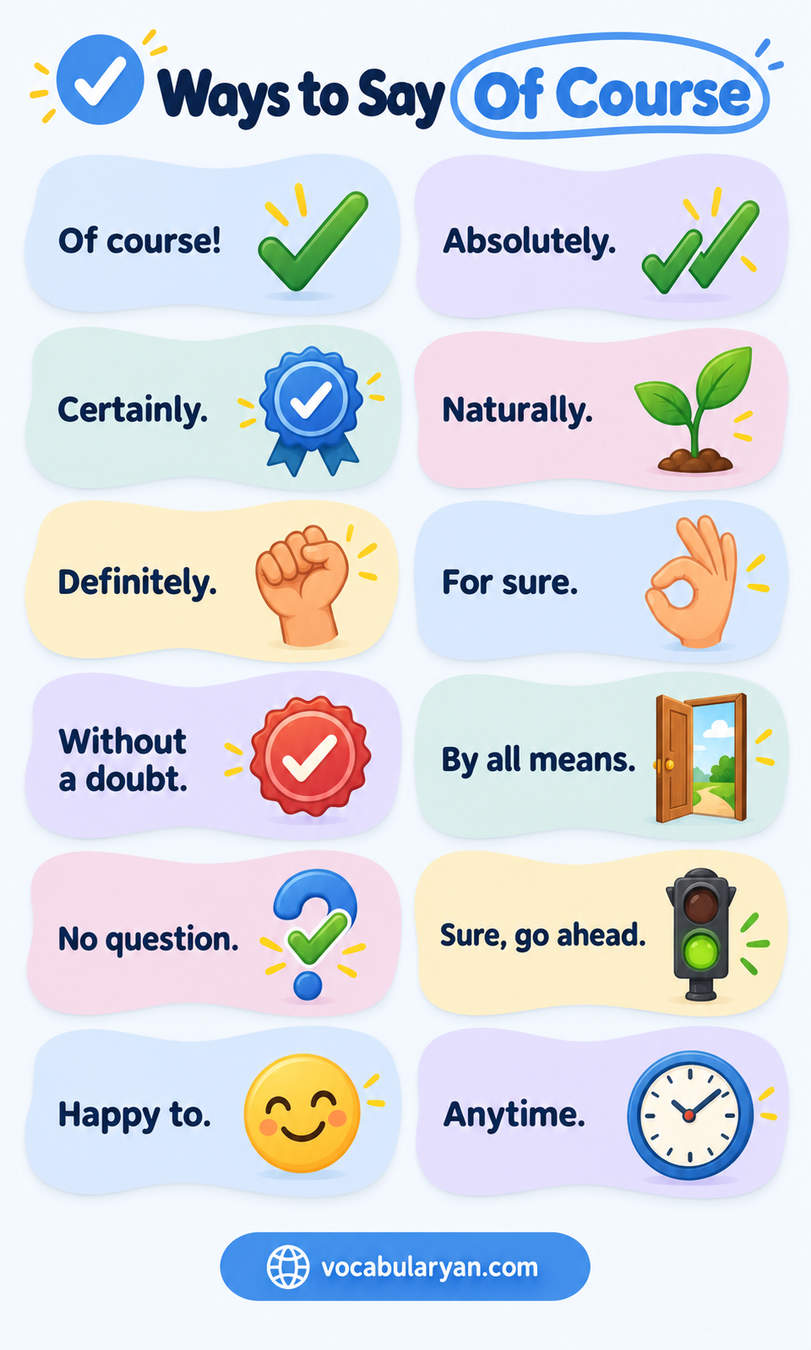
These eight replies say yes to a request or a question of permission, and each one sounds warm rather than flat.
Certainly: the most common polite form, and it fits a colleague, a customer, or a stranger. It sounds a little formal in a text to a friend.
- Certainly, I’ll send the file before lunch.
- Can I borrow your charger? Certainly, it’s in the front pocket.
- Certainly, sir, the lift is on your left.
Absolutely: the warmest yes at every level, from a client to a child, and it means there is no doubt at all. Strong stress goes on the second syllable.
- Absolutely, bring your sister, the more the merrier.
- Is the report ready? Absolutely, I finished it last night.
- Absolutely, you can park in my space while I’m away.
Definitely: a firm yes that means "there is no question about it". It fits plans, offers, and promises between friends and colleagues.
- Are you coming on Saturday? Definitely, I’ve already bought the ticket.
- Definitely, count me in for the early train.
- I’ll definitely call you when I land.
No problem: the relaxed yes to a favour, and it means the favour costs you nothing. It fits friends, shops, and colleagues you talk to every day.
- Could you cover my shift on Friday? No problem, I owe you one.
- No problem, I’ll drop the keys through the letterbox.
- No problem at all, take as long as you need.
By all means: a polite, slightly formal yes to a request for permission, and it means "please, go ahead". It fits an office, a meeting, or a host at the door.
- May I open a window? By all means, it’s warm in here.
- By all means, take a look at the draft before it goes out.
- By all means, use the meeting room, nobody has booked it.
Go ahead: the everyday yes to "can I?", and it fits friends, colleagues, and strangers in a queue. "Go right ahead" adds a little warmth.
- Mind if I take this chair? Go ahead, I’m leaving anyway.
- Go ahead, ask her, she won’t mind.
- Go right ahead, the printer is free now.
Be my guest: a friendly yes to a request to use or take something of yours, and it fits a host, a neighbour, or a colleague.
- Can I finish the last slice? Be my guest.
- Be my guest, the garden shears are in the shed.
- Want to try the new bike? Be my guest, but wear the helmet.
Feel free: a yes that removes any worry about asking, and it fits a manager to staff, a host to guests, or a teacher to a class.
- Feel free to call me at home if the server goes down.
- Feel free to help yourself to coffee, the pot is fresh.
- Can I email you my questions? Feel free, I check my inbox every hour.
Say "certainly" or "absolutely" to a request from anyone, and keep "no problem" for people you speak to every day.
Ways to Say Of Course When the Answer Is Obvious
These seven replies agree that a fact was expected, and they answer a statement or a question, never a request.
Naturally: the closest match to "of course" in the sense of "as anyone would expect". It fits speech and writing and sounds calm rather than sharp.
- Naturally, the trains were late on the one day I had an interview.
- Did he bring his guitar? Naturally, he takes it everywhere.
- Naturally, we’ll refund the full amount.
Needless to say: a formal opener that means "everyone already knows this", and it goes before a fact, not after a question. It fits reports, emails, and speeches.
- Needless to say, the deadline has not moved.
- The rain never stopped, and, needless to say, the match was cancelled.
- Needless to say, we are all very proud of her.
It goes without saying: the same meaning as "needless to say" with a warmer sound, and it fits a manager thanking a team or a friend making a promise.
- It goes without saying that you’re welcome to stay with us.
- It goes without saying, the whole team put in extra hours for this.
- It goes without saying that the offer is still open.
Without a doubt: a strong yes to a question of opinion, and it means the speaker is completely sure. It fits interviews, reviews, and everyday talk.
- Was it worth the trip? Without a doubt, the view alone was enough.
- She’s the best keeper in the league, without a doubt.
- Without a doubt, this is the busiest week of the year.
Indeed: a formal agreement with something that was just said, common in British English, and it also strengthens a yes: "yes, indeed".
- Was the room satisfactory? Indeed it was, thank you.
- Indeed, the figures back up what you said in the meeting.
- Yes, indeed, we’ve met before, at the conference in June.
Exactly: an agreement that the other person has said what you were thinking, and it fits friends, meetings, and classrooms.
- So we need to leave by seven? Exactly, or we’ll miss the ferry.
- Exactly, that’s the problem with the old system.
- Exactly! I couldn’t have put it better.
Of course not: the reply to a question about a problem, such as "do you mind?" or "is it a bother?", and it means "there is no problem at all".
- Do you mind if I sit here? Of course not, go ahead.
- Would it be a bother to drop me at the station? Of course not, it’s on my way.
- Is it too late to change my order? Of course not, the kitchen hasn’t started yet.
Use "naturally" and "needless to say" for a fact everyone expected, and never as a reply to "can I?".
Formal Ways to Say Of Course at Work
Formal replies to a request at work name the action you will take, and each one sounds respectful to a manager, a client, or a senior colleague.
I’d be happy to: the standard polite yes to a work request, and it means the task is welcome. It fits speech and email, and the verb after it stays in the base form.
- Could you present the numbers on Monday? I’d be happy to.
- I’d be happy to show the new starters around the building.
- I’d be happy to take that call if you’re in the meeting.
Without question: a formal yes that means there is nothing to discuss, and it fits a decision, a promise, or a matter of trust.
- Can we count on your support for the merger? Without question.
- Without question, the safety checks come first.
- She’ll get the job done, without question.
That won’t be a problem: the calm formal reply to a request that sounds difficult, and it reassures the person that the task is manageable.
- Can you have the translation ready by Friday? That won’t be a problem.
- That won’t be a problem, the venue has space for two hundred.
- Two extra guests? That won’t be a problem, I’ll tell the caterer.
Consider it done: a confident yes that promises fast action, and it fits a colleague who trusts you. With a new manager it sounds a little bold.
- Book the flights for the whole team, please. Consider it done.
- Consider it done, the invoice will be with them this afternoon.
- Can you update the slides before the client arrives? Consider it done.
With pleasure: a very polite yes that says you enjoy doing the favour, and it fits a host, a hotel, or a senior colleague.
- Would you sign a copy for my daughter? With pleasure.
- With pleasure, Mr Ortega, I’ll arrange a car for six.
- Could you show the visitors the lab? With pleasure.
Most certainly: "certainly" with extra weight, used in very formal speech or writing when a strong yes is needed.
- Will the board receive the report before the vote? Most certainly.
- Most certainly, we intend to honour the agreement in full.
- Are the results reliable? Most certainly, we ran the test three times.
A flat "of course" to a manager’s question sounds like the question was a waste of time.
- Have you sent the contract to the client? Of course. ❌
The manager asked a real question, so the reply names the action and sounds polite: "yes" plus a fact.
- Have you sent the contract to the client? Yes, it went out at nine this morning. ✅
Five levels of formality sort the replies on this page, from slang to very formal.
| Level | Replies | Who it fits |
|---|---|---|
| Slang | Ofc, bet, np, 100%, duh | Close friends in a text |
| Casual | Sure thing, you bet, for sure, no worries, totally | Friends, family, relaxed colleagues |
| Neutral | Absolutely, definitely, no problem, go ahead | Anyone you know by name |
| Formal | Certainly, by all means, I’d be happy to, that won’t be a problem | Managers, clients, customers, strangers |
| Very formal | With pleasure, most certainly, without question | Senior guests, official letters, ceremonies |
Answer a manager’s real question with "yes" and a fact, and answer a manager’s request with "I’d be happy to".
Ways to Say Of Course in an Email
An email reply to a request opens with the yes and then states what happens next, and the level of the yes matches the greeting the sender used.
Happy to: the short form of "I’d be happy to", and it fits a reply to a colleague who signs with a first name.
- Hi Lena, happy to, I’ll send the figures by three.
- Happy to join the call on Thursday, just send the link.
- Happy to review the draft, leave it with me.
Please go ahead: the polite yes to a request for permission by email, and it fits a manager to a team member or a client to a supplier.
- Please go ahead and book the venue, the budget is approved.
- Please go ahead with the print run, the proof looks good.
- Can we share the slides with the partner team? Please go ahead.
That works for me: the reply to a proposed time, place, or plan, and it means the plan suits you. It fits colleagues at every level.
- Thursday at ten? That works for me.
- That works for me, I’ll add it to the calendar.
- A shorter deadline is fine, that works for me.
That’s fine by me: a little more casual than "that works for me", and it fits a colleague you know well.
- Swap the order of the slides? That’s fine by me.
- That’s fine by me, as long as the client agrees.
- That’s fine by me, go with the blue design.
I’ll take care of it: a yes that promises the sender need not think about the task again, and it fits a request from a manager or a customer.
- Thanks for flagging the broken link, I’ll take care of it today.
- I’ll take care of it, no need to chase the supplier.
- Could you arrange the refund? I’ll take care of it this morning.
Not at all: the polite reply to "would you mind?" or "sorry to ask", and it means the request is no trouble.
- Would you mind resending the invoice? Not at all, it’s attached.
- Sorry to ask again. Not at all, ask as many times as you need.
- Not at all, I’m glad you checked before printing.
Open an email reply with "happy to" for a colleague and "please go ahead" for permission, and put the next step in the same sentence.
Ways to Say Of Course to a Customer
A reply to a customer says yes and then says what you are about to do, and each one sounds warm without sounding too familiar.
Certainly, madam: "certainly" with "sir" or "madam" is the standard yes in a hotel, a restaurant, or a bank, and the title keeps the reply polite.
- Could I see the wine list? Certainly, madam, one moment.
- Certainly, sir, I’ll bring a high chair for your son.
- Can you hold the bag until six? Certainly, madam, here is your ticket.
My pleasure: a warm yes that says the service is a pleasure, not a duty, and it is also the reply to "thank you" in a shop or a hotel.
- Could you call me a taxi? My pleasure, where are you heading?
- My pleasure, I’ll have the room made up while you’re at dinner.
- Thanks for carrying the bags. My pleasure, mind the step.
Right away: a yes that promises immediate action, and it fits a waiter, a receptionist, or a support line.
- We need another chair, please. Right away.
- Right away, madam, I’ll fetch the manager.
- Can you reset my password? Right away, please stay on the line.
Not a problem: the friendly yes in a shop or on a call, a step more polite than "no problem" because of the extra word.
- Can I pay half by card and half in cash? Not a problem.
- Not a problem, we’ll exchange it for a larger size.
- Could you gift-wrap it? Not a problem, that’s free today.
Let me take care of that for you: a full-sentence yes that takes the task off the customer, and it fits a hotel desk, a bank, or a support chat.
- My booking has the wrong date. Let me take care of that for you.
- Let me take care of that for you, I’ll move the delivery to Tuesday.
- The card machine won’t read my card. Let me take care of that for you, try this one.
Say "certainly" or "my pleasure" to a customer, and keep "no problem" for a customer you already joke with.
Casual Ways to Say Of Course to Friends
Casual replies fit friends and family, and each one sounds quick, warm, and relaxed.
Sure thing: the friendly yes to a favour, common in American English, and it fits friends and colleagues you joke with.
- Can you grab my post while I’m away? Sure thing.
- Sure thing, I’ll pick you up at eight.
- Save me a seat? Sure thing, front row.
For sure: a casual yes to a plan or a question of opinion, and it fits friends in speech and in texts.
- You coming to the barbecue? For sure, I’m bringing salad.
- For sure, that was the best game of the season.
- Can I borrow your notes? For sure, they’re in my bag.
You bet: an American yes with energy in it, and it means "you can be certain". It fits friends, family, and friendly shops.
- Will you be at the match? You bet, I’ve got my scarf ready.
- You bet, I’ll bring the speaker.
- Thanks for the lift. You bet, any time.
Totally: a casual agreement that means "completely", and it fits younger speakers and close friends.
- That film was too long, right? Totally, I fell asleep twice.
- Totally, we should book the cabin again next year.
- Can I come too? Totally, the more the better.
No worries: a relaxed yes to a favour or a reply to "sorry", and it means there is nothing to worry about. It began in Australia and now fits friends everywhere.
- Can I pay you back on Friday? No worries.
- No worries, I’ll water the plants while you’re gone.
- Sorry I’m late. No worries, we haven’t ordered yet.
Course: "of course" with the first word dropped, common in fast British speech between friends. In writing it looks odd, so keep it for talk.
- Can I stay at yours tonight? Course you can.
- Course I remembered, it’s in the fridge.
- You’ll come to the wedding? Course I will.
Go for it: a yes that also encourages, and it fits a friend who asks whether to try something.
- Should I ask for the promotion? Go for it, you’ve earned it.
- Go for it, the pool’s warm.
- Can I have the last dumpling? Go for it.
Obviously: a yes that means "everyone knows that", and between close friends it sounds playful. To anyone else it sounds like a put-down, so keep it inside the joke.
- Are you getting the chips? Obviously, it’s Friday.
- Obviously I’m coming, it’s your birthday.
- Did you watch the final? Obviously, don’t spoil it for Dan.
Duh: slang that means "that was a silly question", and it fits a joke between close friends only. To anyone else it is rude.
- Do you want ice cream? Duh.
- Duh, I checked the tickets twice.
- Are we still going? Duh, get your coat.
Keep "obviously" and "duh" for friends who laugh at the joke, and use "sure thing" or "for sure" with everyone else.
Ways to Say Of Course in a Text
A text yes is one or two words, and the letters, numbers, and marks around it do the work your voice would do in speech.
Ofc: the text form of "of course", and it fits close friends in a chat. In an email it reads as careless.
- Coming tonight? Ofc, what time?
- Ofc you can borrow it, it’s in my locker.
- Still on for lunch? Ofc!!
Np: the text form of "no problem", used as a yes to a favour or a reply to "thanks".
- Can you send me the address? Np, one sec.
- Np, I’ll bring the charger.
- Thanks for covering me. Np, you’d do the same.
100%: a text yes that means "I completely agree" or "I’m completely in", and it fits friends and group chats.
- Pizza after the game? 100%.
- 100%, that was the right call.
- You in for the road trip? 100%, I’m packed already.
Bet: American slang for "yes, agreed", common with younger speakers, and it fits a plan made in a chat.
- Meet at the corner at six? Bet.
- Bet, I’ll bring the ball.
- I’ll pay you back tomorrow. Bet.
Say no more: a playful text yes that means "I understand, consider it done", and it fits a friend who asks for a favour.
- Can you grab me a coffee on the way? Say no more.
- Say no more, tickets booked.
- Need a lift to the airport? Say no more, what time?
Write "ofc" and "np" to a friend, and write the full "of course" or "no problem" to anyone else.
Ways to Say Of Course to a Group
A group yes names everyone at once, and it fits a host, a teacher, or a manager answering a room.
Everyone’s welcome to: a yes that opens an offer to the whole group, and it fits a host, a manager, or a teacher.
- Can we bring partners? Everyone’s welcome to, the hall is big enough.
- Everyone’s welcome to take a copy of the slides.
- Everyone’s welcome to stay for coffee after the talk.
Go ahead, everyone: the group form of "go ahead", and it fits a teacher, a coach, or a host giving permission to a crowd.
- Can we start eating? Go ahead, everyone, the food is getting cold.
- Go ahead, everyone, take a seat wherever you like.
- Go ahead, everyone, you can take photos in this room.
The more the merrier: a warm yes to "can others come too?", and it fits parties, trips, and team dinners.
- Can my cousins join us? The more the merrier.
- The more the merrier, I’ll book a bigger table.
- Is it okay if the whole class comes? The more the merrier.
Say "everyone’s welcome to" or "the more the merrier" when a group asks for permission, and name the group in the reply.
Enthusiastic Ways to Say Of Course
An enthusiastic yes says that you want to do the favour, and it says more than a plain yes, and each one fits friends, family, and warm colleagues.
I’d love to: the warm yes to an invitation, and it means the invitation itself makes you happy. It fits every level from a friend to a client.
- Would you like to join us for dinner? I’d love to.
- I’d love to see the new studio, when suits you?
- Come and speak to my class? I’d love to.
Yes, please: the polite, warm reply to an offer, and it is the right reply where "of course" sounds rude.
- Would you like another cup? Yes, please.
- Shall I send you the photos? Yes, please, I’d love to see them.
- Want me to save you a seat? Yes, please, near the front.
Count me in: a yes to a plan that says you want to be part of it, and it fits friends, family, and a friendly team.
- We’re doing the coast walk on Sunday. Count me in.
- Count me in, I’ll bring the map.
- Anyone up for karaoke? Count me in!
Anytime: a yes that says the favour is always open, and it also answers "thank you" between friends.
- Could you look at my CV again? Anytime, send it over.
- Anytime, you know where I am.
- Thanks for listening. Anytime, that’s what friends are for.
You don’t even need to ask: a warm yes that says the favour was already yours, and it fits close friends and family.
- Can I stay with you during the exams? You don’t even need to ask.
- You don’t even need to ask, the spare key is under the pot.
- Can we use your car for the move? You don’t even need to ask.
I wouldn’t miss it: the yes to an invitation to an event the other person cares about, such as a wedding, a show, or a final.
- You’ll come to the graduation? I wouldn’t miss it.
- I wouldn’t miss it for the world, save me a seat.
- Are you watching my match on Saturday? I wouldn’t miss it.
Say "yes, please" to an offer and "I’d love to" to an invitation, because both say that the other person’s kindness is welcome.
Regional Ways to Say Of Course in English
Each English-speaking country keeps a few casual forms of yes of its own, and each one fits friends and friendly strangers in that country.
British Ways to Say Of Course
Course you can: the everyday British yes to "can I?", said fast and warmly between friends and family.
- Can I have a lift into town? Course you can, get in.
- Course you can stay for tea.
- Mind if I bring the dog? Course you can.
Right you are: a cheerful British yes to an instruction, and it fits a shop, a taxi, or a workplace.
- Two teas and a bacon roll, please. Right you are.
- Right you are, I’ll drop you at the station entrance.
- Leave the boxes by the door, please. Right you are, love.
Go on then: a British yes that pretends to give in, said with a smile when a friend offers something tempting.
- Another biscuit? Go on then.
- Go on then, one more song and then I’m off.
- Fancy a quick pint? Go on then, just the one.
American Ways to Say Of Course
You got it: an American yes that promises to do what was asked, and it fits diners, shops, and friends.
- Could I get extra ketchup? You got it.
- You got it, I’ll have the truck here by seven.
- Can you text me the score? You got it.
You betcha: "you bet" in the voice of the Upper Midwest, and it fits friendly strangers and neighbours.
- Will the store be open on Sunday? You betcha.
- You betcha, I’ll bring the snow shovel.
- Thanks for the ride, Dale. You betcha.
Heck yeah: a loud American yes with excitement in it, and it fits friends, family, and anyone at a game.
- Want to go to the fair tonight? Heck yeah.
- Heck yeah, I’ll run the marathon with you.
- Are you watching the game? Heck yeah, front row.
Australian and Irish Ways to Say Of Course
Too easy: the Australian yes to a request, and it means the favour is no effort at all. It fits shops, mates, and workplaces.
- Can I get the burger without onion? Too easy.
- Too easy, I’ll swing by and grab the ladder.
- Can you help me move on Saturday? Too easy, mate.
Grand: the Irish yes that means "that’s fine" or "no problem", and it answers a request, an apology, or an offer.
- Can I pay you back next week? Grand, no rush.
- Grand, I’ll leave the key with your mam.
- Sorry for the wait. Ah, you’re grand.
No bother: the Irish and northern English yes to a favour, and it means the favour is no trouble.
- Could you mind the shop for ten minutes? No bother.
- No bother, I’ll drop the parcel in on my way.
- Thanks for the lift. No bother at all.
Say "too easy" in Australia, "grand" in Ireland, "you got it" in America, and "course you can" in Britain, and say "certainly" everywhere else.
When Of Course Sounds Rude
"Of course" sounds rude when the other person asked something real, because the reply means "you should have known". A flat voice makes it worse, and a polite offer makes it worst of all.
Yes, I am: the plain yes to a real question about you, and it answers the question instead of judging it.
- Are you coming to the party? Yes, I am, I’ll be there by eight.
- Are you free on Monday? Yes, I am, from ten onwards.
- Are you the new tenant? Yes, I am, I moved in on Sunday.
That would be great: the warm reply to an offer of help, and it thanks the person for offering.
- Want me to bring dessert? That would be great, thanks.
- Shall I pick up the kids? That would be great, I’m stuck in traffic.
- I can look at your essay if you like. That would be great, thank you.
I’d like that: a soft, warm yes to an offer or an invitation, and it fits friends, family, and colleagues.
- Shall we have lunch sometime? I’d like that.
- Want me to come with you to the appointment? I’d like that, thanks.
- Can I show you around the city? I’d like that very much.
Yes, it’s ready: a yes that adds the fact the person was asking about, so the reply sounds like help rather than a put-down.
- Is the room ready? Yes, it’s ready, the key is at the desk.
- Have you finished the report? Yes, it’s done, I sent it an hour ago.
- Did the parcel arrive? Yes, it came this morning.
"Of course" after a polite offer treats the offer as a duty.
- Want me to bring anything to the dinner? Of course. Bring the wine. ❌
The offer was a kindness, so the reply thanks the person and then names the request.
- Want me to bring anything to the dinner? That would be great, a bottle of red would be perfect. ✅
"Of course" after a real question about a fact sounds like the question was stupid.
- Did you lock the back door? Of course. ❌
The person asked because they did not know, so the reply is "yes" plus the fact.
- Did you lock the back door? Yes, I checked it twice before we left. ✅
"Obviously" has the same problem, and it is sharper than "of course" because it names the other person’s mistake.
- Is the museum open on Sundays? Obviously. ❌
The stranger has no way of knowing the opening hours, so the reply is "yes" plus the hours.
- Is the museum open on Sundays? Yes, from ten until four. ✅
Answer a real question with "yes" and a fact, answer an offer with "that would be great", and save "of course" for a request you are glad to grant.
How Do You Reply When Someone Says Of Course?
"Of course" as a yes to your request gets a short thank-you back, and the level of the thank-you matches the level of the yes.
Thanks: the everyday reply to any yes, and it fits friends, colleagues, and shops.
- Can I borrow a pen? Of course. Thanks, I’ll give it back after class.
- Sure thing. Thanks, Sam, you’re a star.
- Go ahead. Thanks, I’ll be quick.
Great, thank you: a warmer reply that fits a colleague, a customer service desk, or a host.
- Certainly, madam, the table is ready. Great, thank you.
- I’d be happy to. Great, thank you, I’ll send the brief now.
- Please go ahead. Great, thank you, I’ll book it today.
Cheers: the British and Australian casual thank-you, and it fits friends and friendly shops.
- Course you can. Cheers, mate.
- No worries. Cheers, I owe you a coffee.
- Too easy. Cheers, see you at ten.
Much appreciated: a polite, slightly formal thank-you for a favour, and it fits email and work speech.
- That won’t be a problem. Much appreciated, I’ll confirm the date.
- Consider it done. Much appreciated, Priya.
- With pleasure. Much appreciated, thank you.
Reply to a yes with "thanks" or "cheers" from a friend, and with "great, thank you" or "much appreciated" from anyone else.
More Everyday English Phrases
FAQs
The nearest match depends on the job "of course" is doing. As a yes to a request, the closest replies are "certainly", "absolutely", and "sure thing". As an agreement that something is obvious, the closest are "naturally" and "needless to say". As a reply to "do you mind?", the match is "of course not" or "not at all".
No, when it answers a request, because then it means "yes, gladly". It becomes rude after a real question or a polite offer, because it means "you should have known" or "you owed me that anyway". The safe replies in those two moments are "yes" plus a fact and "that would be great".
The professional replies to a request are "certainly", "I’d be happy to", "by all means", and "that won’t be a problem". Each one names or promises the action, and each one sounds respectful to a manager, a client, or a customer. "With pleasure" and "most certainly" are the choices for a very formal setting.
Yes, "of course" is a common reply to "thank you" in American English, and it means "it was no trouble". In a shop or a hotel "my pleasure" sounds warmer, and between friends "anytime" or "no worries" sounds more relaxed. In British English "you’re welcome" and "not at all" are more common than "of course".
Yes, but only in the sense of "as everyone would expect", and only where the fact is obvious to every reader. In an essay the phrase goes between commas, as in "the results were, of course, lower in winter". Where the fact needs proof, the phrase is out of place, and "as expected" or "as the data show" fits better.
"Of course" is neutral, and it fits speech and writing at every level. The forms around it change the level: "ofc" and "course" are casual, "certainly" and "by all means" are formal, and "with pleasure" is very formal. The risk with "of course" is not the level but the moment, because a flat "of course" after a real question sounds rude at any level.
The text forms are "ofc", "np", "100%", "bet", and "say no more". "Ofc" is the direct short form, "np" answers a favour, "100%" agrees with an opinion, and "bet" agrees to a plan. All of them belong in a chat with friends, and a text to a manager or a customer takes the full word: "certainly" or "no problem".
The phrase is "of course", with "course" meaning a path or a direction, so "of course" means "as a matter of course", the expected way. "Coarse" is an adjective that means rough, as in coarse sand or coarse language, and it never belongs in the phrase. The two words sound the same, which is the only reason the mistake is common.