
"Sure" is used in two ways in English: it agrees to a request ("Sure, I’ll send it") and it states certainty ("I’m sure it’s fine"). Said fast and flat, the first "sure" sounds as if you would rather say no, and that is the reason native speakers add a word or swap it. The ways to say sure on this page cover both uses, and the everyday replies come first.
Other Ways to Say Sure in Everyday English
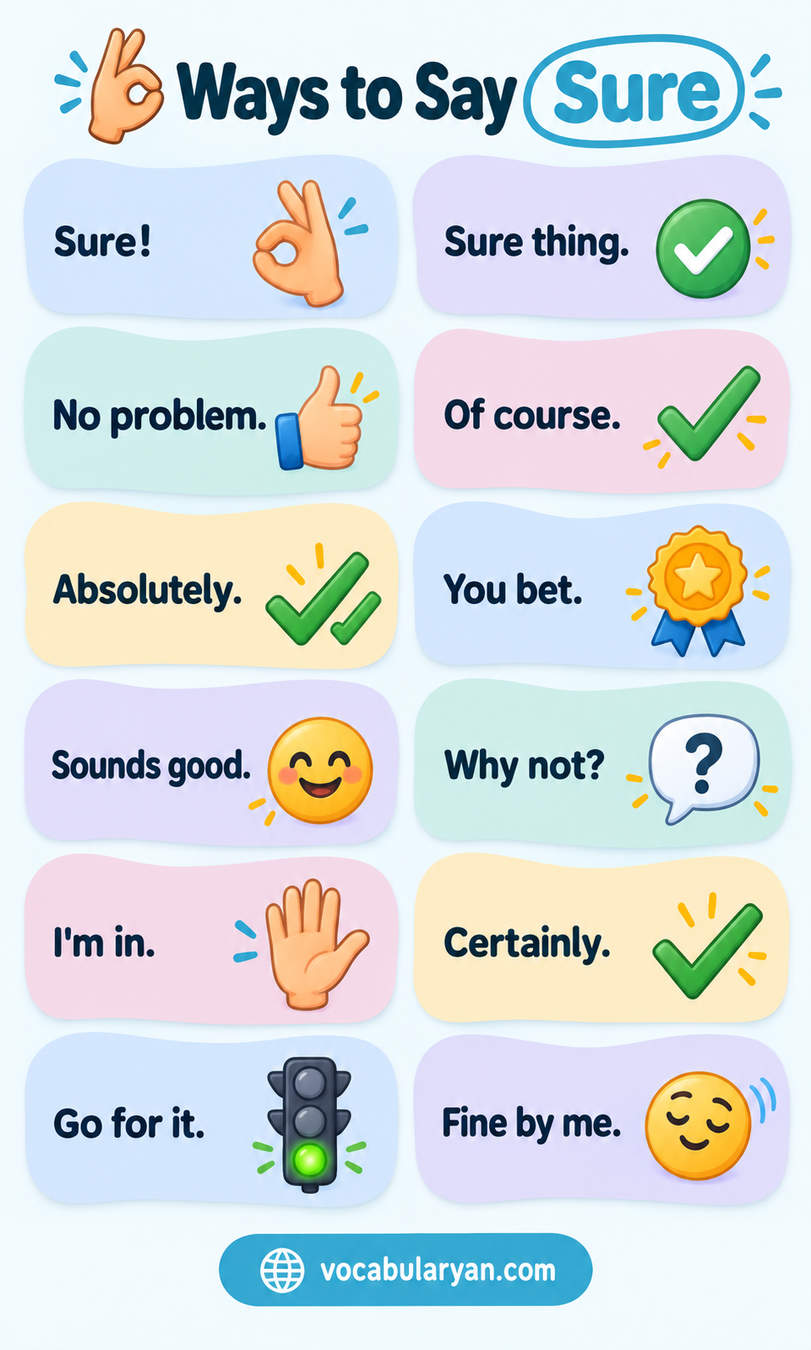
These six replies agree to a request at a neutral level, so each one fits a colleague, a neighbour, or a shop.
Sure thing: the warm form of "sure", and it fits a friend, a colleague, or a customer who asks for something small. It says yes and sounds glad at the same time.
- Sure thing, I’ll drop the keys off on my way home.
- Can you hold the door? Sure thing.
- Sure thing, Mrs Lopez, your table will be ready in five minutes.
No problem: the reply to a request that costs you a little effort, and it says the effort does not bother you. It works in speech and in messages.
- No problem, I’ll move the meeting to Thursday.
- Could you cover my shift on Saturday? No problem, I’m free anyway.
- No problem at all, I’ll wait outside.
Certainly: polite and neutral, so it fits a manager, a customer, or a stranger without sounding stiff. In a shop or a hotel it is the standard reply from staff.
- Certainly, I’ll bring the bill straight over.
- Would you check the dates for me? Certainly, give me one moment.
- Certainly, Dr Adeyemi, the results are on your desk.
Absolutely: a strong yes that fits both jobs of "sure". As a reply it says you agree with energy, and as a statement it says you are certain.
- Absolutely, count me in for Friday.
- Is the report ready? Absolutely, it went out this morning.
- Absolutely, you can borrow the car this weekend.
Sounds good: the reply to a plan or a suggestion rather than a favour, and it says the plan works for you.
- Lunch at one? Sounds good.
- Sounds good, I’ll book the room and send the invite.
- Let’s start with the budget and then move to hiring. Sounds good to me.
Will do: the short reply to an instruction, and it promises the action. It fits a colleague or a friend, not a formal email.
- Send me the file before you leave. Will do.
- Will do, I’ll ring the supplier first thing.
- Remind Sam about the dentist. Will do, I’ll text him now.
Say "sure thing" to a friend, "no problem" for a favour, and "certainly" to anyone you serve.
Casual Ways to Say Sure to Friends
Casual replies agree fast and sound relaxed, and they fit friends, family, and classmates only.
Yeah, sure: "sure" with a "yeah" in front of it, which makes it sound relaxed rather than reluctant. It is the most common casual yes to a request.
- Yeah, sure, grab whatever you want from the fridge.
- Can I borrow your charger? Yeah, sure, it’s in my bag.
- Yeah, sure, I’ll come, what time does it start?
Yep: the one-word yes for a friend, and it fits a question rather than a favour. Said alone it can sound short, so add a few words.
- Coming to the match? Yep, I’ve got my ticket.
- Yep, I’ll be there by eight.
- Did you lock the door? Yep, and the back one.
Why not?: a yes said as a question, and it means you have no reason to refuse. It fits an invitation from a friend.
- Fancy a coffee after class? Why not?
- Why not? I’ve got nothing on tonight.
- One more song? Why not, we’re already late.
I’m in: the reply to a plan that needs a group, and it says you will join. It fits a trip, a game, or a night out.
- Pizza and a film at mine? I’m in.
- I’m in, as long as we leave before the traffic.
- If you two are going hiking on Sunday, I’m in.
I’m up for it: a step warmer than "I’m in", and it says you want to do the thing, rather than that you will do it.
- Karaoke on Friday? I’m up for it.
- I’m up for it if the weather holds.
- A five-kilometre run at six in the morning? Fine, I’m up for it.
Fine by me: the reply when you do not mind either way, and it hands the choice back to the other person.
- Curry or pizza? Fine by me, you pick.
- Fine by me if we take the later train.
- Can Jo bring her brother? Fine by me.
Use "yeah, sure" and "why not?" with friends, and keep "I’m in" for a plan that needs you there.
Formal Ways to Say Sure at Work
Formal replies agree to a request from a manager, a client, or a senior colleague, and each one names the action you promise.
Certainly, I can do that: the full formal reply, and it goes with a title or a first name depending on the office. It fits a request in a meeting or on a call.
- Certainly, I can do that, Ms Okafor, I’ll have it ready by Monday.
- Certainly, I can do that, would you like the figures in a table?
- Could you present the numbers on Thursday? Certainly, I can do that.
I’d be happy to: a warm formal yes, and it says the task is welcome rather than a burden. The reply fits a request from anyone senior.
- I’d be happy to take the minutes today.
- Could you show the new intern around? I’d be happy to.
- I’d be happy to review the draft before it goes out.
Consider it done: a confident promise that the task is as good as finished, and it fits a manager who trusts you.
- Book the venue for the launch, please. Consider it done.
- Consider it done, I’ll confirm the caterer this afternoon.
- We need the slides translated by Friday. Consider it done.
Understood: the reply to an instruction rather than a favour, and it says you have taken in what to do. It sounds firm, so use it for a task, not for an invitation.
- Send the contract to legal before anyone signs. Understood.
- Understood, I’ll hold the release until you approve it.
- No overtime this month. Understood, I’ll plan the roster around that.
By all means: a polite formal yes to a request for permission, and it means "please go ahead". It fits a client or a visitor who asks to do something.
- May I take a photo of the display? By all means.
- By all means, use the meeting room for as long as you need.
- Could I bring a colleague to the briefing? By all means, the more the better.
I have no objections: the formal reply in a meeting when a decision needs your agreement, and it says you will not block it.
- I have no objections to moving the deadline to March.
- If the finance team is comfortable, I have no objections.
- I have no objections, please put it to a vote.
The reply to avoid with a manager is a bare "sure", because at work it sounds as if you agree without interest.
- Can you lead the client call? Sure. ❌
A flat "sure" sounds unwilling to a manager, and a named action turns it into a real yes.
- Can you lead the client call? Certainly, I’d be happy to. ✅
Every version of "sure" on this page is spoken at one of five levels.
| Level | Replies (7) | Who it fits (11) |
|---|---|---|
| Slang | Bet, say less, yessir (21) | Close friends your own age (26) |
| Casual | Yeah sure, why not, you bet, no worries (39) | Friends, family, relaxed colleagues (35) |
| Neutral | Sure thing, no problem, sounds good (35) | Anyone you know by name (23) |
| Formal | Certainly, I’d be happy to, understood (38) | Managers, clients, customers (28) |
| Very formal | By all means, I have no objections, with pleasure (49) | Boards, senior guests, official letters (39) |
Name the action after your yes at work, and save "sure" on its own for friends.
Ways to Say Sure in an Email
An email reply to a request has to sound willing in writing, where the reader cannot hear your voice, so each of these adds a promise.
Happy to help: the standard short yes in a work email, and it fits a colleague or a client who asks a favour.
- Happy to help, I’ve attached the template you asked for.
- Happy to help with the onboarding, just send me the dates.
- Of course, happy to help, let me know which version you need.
Confirmed: the one-word reply to a date, a time, or a booking, and it goes at the top of a short email.
- Confirmed, see you at ten on Tuesday.
- Confirmed, the room is booked for twelve people.
- Thanks for the dates. Confirmed on my side.
Noted, thank you: the reply to news or a fact rather than a request, and it says you have read it and will act on it.
- Noted, thank you, I’ll update the schedule today.
- Noted, thank you for flagging the change in price.
- Noted, thank you. I’ll pass this on to the design team.
Please go ahead: the written form of "by all means", and it gives permission in an email to a colleague or a supplier.
- Please go ahead and order the extra chairs.
- Please go ahead with the changes we discussed.
- Yes, please go ahead, the budget is approved.
That works for me: the reply to a proposed time or plan, and it sounds friendly and firm at once.
- Thursday at three? That works for me.
- That works for me, I’ll send a calendar invite.
- Either day is fine. That works for me.
I’ll take care of it: a yes that also takes the task off the other person’s list, so it fits a request from a manager or a client.
- I’ll take care of it, you don’t need to chase the printer again.
- Thanks for the reminder, I’ll take care of it this morning.
- I’ll take care of it and copy you on the reply.
A one-word "sure" as a whole email reads as cold, and the fix is one more line.
- Sure. ❌
In writing there is no smile to soften a bare "sure", so the reader takes it as reluctant.
- Sure, happy to help. I’ll send it over by lunch. ✅
Write "happy to help" for a favour, "confirmed" for a time, and "please go ahead" for permission.
Ways to Say Sure to a Customer
A reply to a customer agrees and reassures at the same time, and the polite forms are the ones staff use in a shop, a hotel, or on a support line.
Certainly, sir: the classic polite yes from staff, with "sir" or "madam" added in a hotel or a restaurant. In a casual shop the title drops off.
- Certainly, sir, I’ll have the car brought round.
- Certainly, madam, would you like that gift-wrapped?
- Certainly, I can change the booking to the later flight.
With pleasure: a very polite yes that says the request is welcome, and it fits a waiter, a concierge, or a shop assistant.
- Could we have another jug of water? With pleasure.
- With pleasure, I’ll show you to the fitting room.
- With pleasure, madam, the porter will take your bags.
Right away: the reply that promises speed, and it fits a customer who is waiting.
- Two coffees, please. Right away.
- Right away, I’ll fetch the manager for you.
- I’ll print that receipt for you right away.
Not a problem at all: the customer-service form of "no problem", and it reassures someone who apologises for asking.
- Sorry to ask, but could you check the back for a size ten? Not a problem at all.
- Not a problem at all, refunds take three working days.
- Not a problem at all, I’ll reset the password now.
Absolutely, I can do that for you: the full support-line reply, and it names the customer’s request and the action in one line.
- Absolutely, I can do that for you, may I take the account number?
- Absolutely, I can do that for you, the change will show on your next bill.
- You’d like the delivery moved to Friday? Absolutely, I can do that for you.
Say "certainly" to a customer, add "right away" when they are waiting, and never answer with a bare "sure".
Ways to Say Sure in a Text
In a text the reply is short, and the punctuation replaces your voice, so an exclamation mark changes everything.
Sure!: "sure" with an exclamation mark, and the mark makes it a glad yes. Without it, the same word reads as flat.
- Sure! What time?
- Sure! I’ll bring the snacks.
- Can you pick me up from the station? Sure! Text me when you’re close.
Yup: the text form of "yes" between friends, and it fits a quick question. It is a little warmer than "yep".
- Still on for tonight? Yup.
- Yup, leaving now.
- Did you lock the back door? Yup, checked it twice.
On it: the reply to a task in a message, and it says you have started already. It fits a friend, a flatmate, or a colleague in a chat.
- Can you order the cake? On it.
- On it, I’ll send the link in a sec.
- Mum wants the photos from Sunday. On it.
You got it: a friendly promise in American English, and it fits a favour from a friend or a customer in a chat.
- Can you save me a seat? You got it, front row.
- You got it, I’ll add your name to the list.
- Extra cheese on mine? You got it.
Deal: the one-word reply to an offer or a trade, and it closes the plan.
- I’ll cook if you wash up. Deal.
- Deal, see you at seven.
- Split the taxi? Deal.
Send "sure!" with the mark, or swap to "on it" or "you got it", because a plain "sure." in a text reads as annoyed.
Ways to Say Sure When You Are Certain
These phrases use the second meaning of "sure", and each one says how certain you are that a fact is true.
I’m sure: the standard statement of certainty, and it says you believe something and have no real doubt. It fits speech and writing at every level.
- I’m sure the shop is open until nine.
- I’m sure she’ll say yes if you ask her.
- Are we on the right road? I’m sure we are, the sign said Leeds.
I’m certain: a step stronger than "I’m sure", and it fits a fact you have checked.
- I’m certain I locked the door, I remember turning the key.
- I’m certain the meeting was moved to Tuesday.
- I’m certain of it, I read the email twice.
I’m positive: as strong as "I’m certain" and more common in speech, and the reply to "are you sure?" is "I’m positive".
- Are you sure the flight is at six? I’m positive, I checked the app.
- I’m positive that’s the same man we saw yesterday.
- I’m positive we’ve met before, was it at Lena’s wedding?
Definitely: an adverb of certainty that fits both jobs of "sure". As a reply it is a strong yes, and inside a sentence it says the fact is settled.
- We’ll definitely be there by noon.
- Is this the right bus? Definitely, it stops outside the museum.
- She’s definitely the best cook in the family.
No doubt: a short form of "there is no doubt", and it says the fact is certain in your mind. It fits friends and colleagues in speech.
- No doubt he’ll win, he’s trained all year.
- It’ll rain on the picnic, no doubt.
- No doubt the train will be late again.
I’m convinced: the certainty you reach after thinking or seeing proof, and it fits an opinion more than a fact.
- I’m convinced the new route is faster.
- After that meeting, I’m convinced we should hire her.
- I’m convinced the cat can open the fridge.
Say "I’m sure" for a belief, "I’m certain" for a checked fact, and "I’m positive" when someone asks "are you sure?"
Ways to Say Sure When You Are Completely Certain
These forms leave no room for doubt at all, so use them only when you know the fact and can back it up.
Absolutely certain: "certain" with "absolutely" in front of it, and it means there is no chance you are wrong.
- I’m absolutely certain the keys were on the table.
- Are you absolutely certain he said Friday?
- We’re absolutely certain the figures are correct.
Without a doubt: the strongest form of certainty in everyday English, and it fits an opinion or a fact.
- Without a doubt, this is the best pizza in town.
- She’s the right person for the job, without a doubt.
- Without a doubt the roof needs replacing before winter.
One hundred percent: casual and strong, and it fits a friend who asks "are you sure?"
- Are you sure you want to sell the bike? One hundred percent.
- I’m one hundred percent sure that was his car.
- One hundred percent, the shop closes at five on Sundays.
I know for a fact: certainty with a source behind it, and it says you have seen or heard the proof yourself.
- I know for a fact she was at work, I saw her there.
- I know for a fact the price went up last week.
- I know for a fact the bridge is closed, I drove past it this morning.
There’s no question: the phrase for a fact that nobody can argue with, and it fits a discussion at work or at home.
- There’s no question the team played better in the second half.
- There’s no question we need a bigger office.
- There’s no question about it, the deal is a good one.
Keep "without a doubt" and "I know for a fact" for a fact you can prove, because a wrong strong claim costs more than a wrong soft one.
Ways to Say Sure to a Group
A group reply agrees on behalf of several people, and it fits a team chat, a family plan, or a meeting.
Sounds good, everyone: the reply from a leader to a plan the group proposed, and it closes the discussion.
- Sounds good, everyone, let’s meet back here at two.
- Sounds good, everyone, I’ll write it up and send it round.
- Sounds good, everyone, thanks for the suggestions.
We’re all in: the reply from a group to an invitation, and one person says it for the rest.
- Camping next weekend? We’re all in.
- We’re all in, just send the address.
- The whole office wants to help, so we’re all in.
Count us in: the same yes as "we’re all in", and it fits a family or a pair of friends replying together.
- Dinner at yours on Sunday? Count us in.
- Count us in for the fun run, all four of us.
- Count us in, the kids have been asking about the zoo for weeks.
Let’s do it: the reply that turns a group’s maybe into a plan, and it fits friends and teams alike.
- Everyone free Saturday? Then let’s do it.
- Let’s do it, I’ll book the tickets tonight.
- The client said yes, so let’s do it.
Say "we’re all in" or "count us in" when you answer for others, and "let’s do it" when you want the group to move.
Regional Ways to Say Sure in English
Each English-speaking country keeps a few casual replies of its own, and using the right one in the right place sounds local at once.
British Ways to Say Sure
Go on then: the British yes to an offer you pretend to resist, and it fits a friend who offers cake, a drink, or one more game.
- Another slice? Go on then.
- Go on then, one more, and then I really must go.
- Come to the pub for one? Oh, go on then.
Fair enough: the British reply that accepts a reason or a plan, and it means "that makes sense, yes".
- I can’t come, I’ve got work early. Fair enough.
- Fair enough, we’ll do it your way.
- We’ll split the bill three ways. Fair enough.
Righto: an old-fashioned British "okay" that fits an instruction from a friend or a colleague.
- Meet me by the clock at six. Righto.
- Righto, I’ll move the car.
- Take the second left after the church. Righto, thanks.
American Ways to Say Sure
You bet: the American "sure thing", and it fits a friend, a neighbour, or a customer in a diner. The reply to "thank you" is "you bet" as well.
- Can you give me a ride to the airport? You bet.
- You bet, I’ll have the truck here by seven.
- Thanks for the help. You bet.
For sure: a strong casual yes in American English, and it fits friends and younger colleagues.
- Are you coming to the barbecue? For sure.
- For sure, I’ll bring the drinks.
- We should do this again. For sure.
Sure can: "sure" with the verb from the question, and it fits a shop or a friendly office in the United States.
- Can you fix this by Friday? Sure can.
- Sure can, I’ll have it ready for you.
- Can I get that to go? Sure can.
Australian and Irish Ways to Say Sure
No worries: the Australian yes to a request, and it is now common in Britain too. It also replies to "thank you" and "sorry".
- Can you watch my bag for a sec? No worries.
- No worries, mate, I’ll drop it round tomorrow.
- Sorry I’m late. No worries, we’ve only just started.
Too easy: Australian for "no problem", and it fits a small favour or a job that is no trouble.
- Can you grab me a coffee on your way in? Too easy.
- Too easy, I’ll have it done before lunch.
- One more chair for the table? Too easy.
Grand: the Irish word for "fine" or "okay", and it agrees to a plan or answers "how are you".
- We’ll head off at nine. Grand.
- Grand, I’ll see you there so.
- Is a sandwich alright for lunch? Grand, thanks.
No bother: the Irish form of "no problem", and it fits a favour from a friend, a neighbour, or a shop.
- Could you post this for me? No bother.
- No bother, I’m passing the shop anyway.
- Sorry to ask again. No bother at all.
Say "go on then" in Britain, "you bet" in America, "no worries" in Australia, and "grand" in Ireland.
Slang Ways to Say Sure
Slang replies belong to close friends your own age, and each one changes fast, so keep them out of anything a manager reads.
Bet: the newest slang yes, short for "you bet", and it fits a plan or a dare in a message or in speech.
- Meet at the court at five? Bet.
- Bet, I’ll drive.
- Loser buys lunch? Bet.
Say less: a slang reply that means "you don’t need to say more, I’m in", and it fits an offer you like.
- Free tickets to the game tonight. Say less.
- Say less, I’m already getting dressed.
- Pizza’s on me. Say less.
Totally: a casual strong yes, common in American English, and it fits both agreement and certainty.
- Should we get the bigger tent? Totally.
- Totally, that film was the best one this year.
- Are you coming? Totally, I wouldn’t miss it.
Yessir: "yes, sir" said as one word, and it is a playful yes between friends rather than a reply to a real officer.
- Ready to leave? Yessir.
- Yessir, the car’s packed and the tank is full.
- Are we winning tonight? Yessir.
Aight: a slang form of "alright", and it means "okay, sure" in a text or a chat between close friends.
- Pick you up at eight? Aight.
- Aight, see you there.
- I’ll bring the speaker. Aight, cool.
Use "bet" and "say less" with friends who use them first, and answer everyone else with "sure thing".
Funny Ways to Say Sure
A funny yes plays on an old, military, or story-book form of agreement, and it fits friends who share your jokes.
Okey-dokey: a playful "okay" from old cartoons and films, and it fits a friend, a child, or a partner who asks a small favour.
- Can you pass the salt? Okey-dokey.
- Okey-dokey, bedtime it is.
- One sugar or two? Okey-dokey, two it is.
Aye aye, captain: a sailor’s yes, said as a joke to a friend or a partner who gives an order.
- Take the bins out before you sit down. Aye aye, captain.
- Aye aye, captain, the dishes are as good as done.
- Left at the lights, then straight on. Aye aye, captain.
Roger that: a radio reply from the military and from pilots, and between friends it is a mock-serious "understood".
- Grab milk on the way back. Roger that.
- Roger that, meeting you at the north entrance.
- Don’t tell Mum about the vase. Roger that.
Your wish is my command: the genie’s line from the old story, and it is a joke yes to a small request from someone you like.
- Could you make me a cup of tea? Your wish is my command.
- Your wish is my command, one plate of pancakes coming up.
- Turn the music down, please. Your wish is my command.
Save the joke replies for friends who will laugh, because "aye aye, captain" to a manager sounds like a dig.
When a Flat Sure Sounds Unwilling
A bare "sure" agrees with the words and disagrees with the voice, because native speakers use it for a yes they do not feel, and the fix is one more word.
Sure, happy to: "sure" with a second phrase that says you want to help, and the addition removes the doubt.
- Can you proofread this? Sure, happy to.
- Sure, happy to, send it over.
- Sure, happy to drive, I know the road.
Yes, sure, go ahead: the fix for a request for permission, and the three words together sound open instead of grudging.
- Can I sit here? Yes, sure, go ahead.
- Yes, sure, go ahead and use my laptop.
- Mind if I open a window? Yes, sure, go ahead.
The three signs of an unwilling "sure" are a flat voice, a pause before it, and no words after it.
- Do you want to come to my sister’s wedding? Sure. ❌
Said alone after a pause, "sure" answers an invitation as if it were a chore, and the person who asked hears a no dressed as a yes.
- Do you want to come to my sister’s wedding? Sure, I’d love to! ✅
The same trap catches an offer, where a bare "sure" sounds as if you are doing the other person a favour by accepting.
- Would you like some cake? Sure. ❌
An offer needs thanks with the yes, because the other person is giving, not asking.
- Would you like some cake? Yes please, that looks lovely. ✅
Add a word after every "sure" that answers an invitation or an offer, and put the warmth in the word, not the "sure".
More Everyday English Phrases
- Other Ways to Say of Course
- Other Ways to Say Okay
- Other Ways to Say Maybe
- Other Ways to Say Sounds Good
FAQs
Yes, when you add something to it, and no when it comes alone after a pause. "Sure, I’d love to" and "sure thing" are warm and natural, and "sure" said flat and alone reads as a reluctant yes. For a favour from a friend, "sure thing" or "no problem" sound willing every time. For an invitation, put your feeling in the words after "sure".
The professional forms are "certainly", "I’d be happy to", "understood", and "consider it done". "Certainly" fits a customer or a client, "I’d be happy to" fits a request from a manager, and "understood" fits an instruction. In an email, "happy to help" and "confirmed" replace "sure" at the top of a short reply.
Say "sure thing" when a friend, a colleague, or a customer asks for something small and you agree gladly. It is casual to neutral, so it fits a shop, a chat, and a relaxed office, and it is out of place in a formal letter or a board meeting. The reply to "thanks" is also "sure thing" in American English.
It depends on the punctuation, because "sure!" is a glad yes and "sure." with a full stop reads as cold or annoyed. Most readers take a bare "sure" or "sure." as a yes without interest, and a "sure" after a long wait as a reluctant one. If you want to sound willing, write "sure!" or "sure, sounds good", and if you receive a bare "sure", ask a warm follow-up question rather than reading too much into it.
Respond with thanks and the next step, such as "great, thanks, I’ll send it now" or "thanks, see you at eight". A "sure" that sounds flat gets a check: "are you sure? It’s fine if you can’t." That question gives the other person a polite way to say no, and a real yes comes back as "no, honestly, I’m happy to".
"Definitely", "absolutely", "certainly", and "without a doubt" replace "for sure" in almost every sentence. "For sure" is casual and American, so "definitely" is the swap in a work email, and "certainly" is the swap in a formal reply. As a statement of certainty, "I’m positive" and "one hundred percent" say the same thing at a stronger level.
The everyday forms are "I’m not certain", "I doubt it", "I’m not convinced", and "I can’t say for sure". At work, "let me check and get back to you" is the polite form, and it promises an answer. "I have no idea" is stronger and means you cannot guess at all.
"Sure" is softer and more casual than "yes", and it agrees to a request rather than answering a fact. "Is the shop open?" takes "yes", and "can you hold this?" takes "sure". Because "sure" is soft, it needs a warm voice or a second word, and "yes" does not.