
"Best wishes" is a wish for someone’s future, and it is used in three places: at the end of a letter or email, on a card, and out loud. The ways to say best wishes change with the place. A card takes a warm line, an email takes a short sign-off, and speech takes a full sentence. The card lines come first, because a card is where the phrase is written most.
Other Ways to Say Best Wishes in a Card
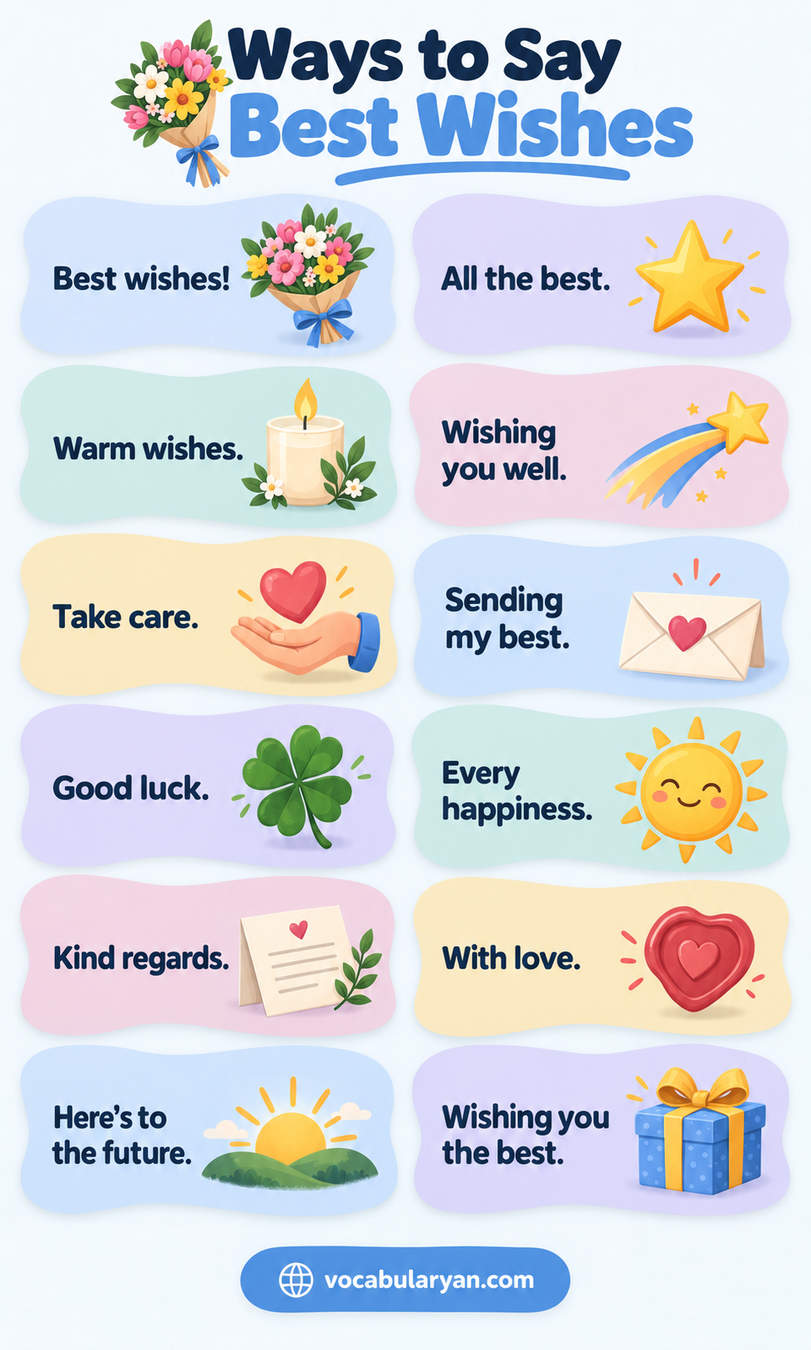
A card line is kept for years, so it is warmer and a little longer than an email sign-off.
All the best: the most common short wish in English, and it fits a card, a message, or speech.
- All the best for the move, Hana, send us a photo of the new kitchen.
- We’ll miss you at choir, all the best.
- All the best with the driving test, you’ve practised more than enough.
Wishing you all the best: the full form of "all the best", and the "wishing you" at the front makes it warmer.
- Wishing you all the best in your new home.
- Wishing you all the best, Grandad, from everyone at number twelve.
- Wishing you all the best for the year ahead, with love from the whole team.
Warm wishes: a soft, friendly card line, one step warmer than "best wishes". It fits a neighbour or a family friend.
- Warm wishes on your anniversary, Ruth and Paul.
- With warm wishes for a happy birthday, from Aunt Lena.
- Warm wishes to you both this Christmas.
Warmest wishes: "warm wishes" at full strength, written to someone you care about.
- Warmest wishes on your graduation, we are so proud of you.
- Warmest wishes, Dad, for a birthday as kind as you are.
- With our warmest wishes for the years ahead, the Okafor family.
With love: the closing for family and close friends, and it goes on the line before your name.
- With love on your wedding day, from Mum and Dad.
- Happy birthday, Ellie, with love from all of us.
- With love and every good wish, Jo.
Every good wish: a formal card line, common on cards from a club, a school, or an older relative.
- Every good wish for your retirement, from the staff at Hillside.
- With every good wish for the future, Margaret.
- Every good wish for the new school year, Class 4B.
Wishing you every happiness: a card line for a wedding, an engagement, or a new baby, and it means "I hope your life is happy".
- Wishing you every happiness in your married life.
- Wishing you every happiness with the new baby, she is beautiful.
- Wishing you every happiness, Sam and Priya, on your engagement.
A card line matches the occasion printed on the front, and the picture pairs each occasion with its line.
Write "all the best" on any card, and add "with love" only for family and close friends.
Ways to Say Best Wishes as an Email Sign-Off
An email sign-off goes on its own line before your name, and each one belongs to one level of politeness.
Best,: the shortest sign-off, and the most casual step on the ladder. It fits a colleague you write to every day.
- Speak soon. Best, Tom
- Thanks for the quick turnaround on the slides. Best, Ana
- See you at the meeting on Thursday. Best, Kwame
All the best,: one step warmer than "best", and it fits a colleague, a client you know, or a friend.
- Thanks again for your help with the audit. All the best, Leila
- Let me know how the interview goes. All the best, Dev
- All the best, and enjoy the long weekend. Marta
Best wishes,: the middle of the ladder, warm and polite at the same time. It fits a colleague or a client you have written to before.
- I hope the conference goes well. Best wishes, Hiro
- Best wishes, Sarah Cole, Head of Admissions
- Thank you for the update on the order. Best wishes, Omar
Warm regards,: friendly and professional at once, and the "warm" softens a formal email. It fits a client or a contact you met once.
- It was good to meet you at the fair. Warm regards, Chloe
- Warm regards, Daniel Ross
- Please pass my thanks to the team. Warm regards, Yusuf
Best regards,: the standard sign-off for business email, neutral and safe with anyone. It is the most common work sign-off in American English.
- Please find the invoice attached. Best regards, Mei Lin
- Best regards, James Okoro, Account Manager
- I look forward to your reply. Best regards, Nora
Kind regards,: the top of the ladder, polite and a little formal. It fits a stranger or a first email, and it is the most common work sign-off in British English.
- Thank you for your enquiry. Kind regards, Alex Byrne
- I have copied our finance team on this email. Kind regards, Fatima
- Kind regards, Reception, Bramley Dental
"Best wishes" sounds cheerful, so it is the wrong sign-off for a message about a death.
- I am so sorry to hear about your father. Best wishes, Karen ❌
A message of sympathy takes "with sympathy" or "with deepest sympathy", and the cheerful sign-offs stay out of it.
- I am so sorry to hear about your father. With sympathy, Karen ✅
"Kind wishes" is a mix of two sign-offs, and it reads as a mistake to most readers.
- Thank you for your email. Kind wishes, Ali ❌
"Kind" goes with "regards" and "best" goes with "wishes", and the two pairs do not swap.
- Thank you for your email. Kind regards, Ali ✅
The ladder runs from "best" at the casual end to "kind regards" at the formal end, and the picture lays the six sign-offs out in that order.
Sign a first email "kind regards", a working email "best regards", and a friendly one "best wishes" or "all the best".
Ways to Say Best Wishes in Person
A spoken wish is a full sentence, because the two-word card line sounds stiff out loud.
I wish you all the best: the spoken form of the card line, and it fits a goodbye at work, at a party, or at a front door.
- I wish you all the best in Canada, Sofia, write to us.
- Thank you for everything, and I wish you all the best.
- I wish you all the best with the new business, Mr Reid.
Have a great time: the wish for someone leaving for a holiday, a party, or a trip, and it fits anyone.
- Have a great time in Lisbon, and don’t check your email.
- Have a great time at the wedding, you two.
- Off you go, have a great time.
Look after yourself: a warm spoken wish at a goodbye, and it fits family, friends, and colleagues you like. The page on ways to say take care covers this family of lines.
- Look after yourself, love, and ring me when you land.
- It’s been great working with you, look after yourself.
- Look after yourself out there, Sam.
Say "I wish you all the best" at a goodbye, and add the reason so the wish sounds personal.
Formal Ways to Say Best Wishes at Work
A formal wish goes to a client, a senior colleague, or a whole company, in speech or in writing.
Please accept my best wishes: the most formal form, written in letters and on formal cards and said in speeches.
- Please accept my best wishes for a long and happy retirement.
- Please accept my best wishes on the opening of your new office.
- On behalf of the board, please accept my best wishes for the year ahead.
I wish you every success: the formal wish for a new job, a new business, or a new project, and it fits a reference letter or a farewell speech.
- I wish you every success in your new position at the ministry.
- I wish you every success with the launch next month.
- I wish you every success, and I hope our paths cross again.
With every good wish: a formal closing for a letter or a card, one step more formal than "best wishes".
- With every good wish for the coming term, Dr Helen Marsh, Principal.
- With every good wish, and thank you again for your generous gift.
- With every good wish for your future studies.
My very best wishes for the future: the line for a leaving speech or a reference, and it fits a colleague who is moving on.
- My very best wishes for the future, Rachel, you have been a credit to the department.
- Please pass on my very best wishes for the future to the whole team.
- My very best wishes for the future, and thank you for six good years.
Wishing you continued success: the formal wish for a person or a company already doing well, common on a business card or in a message to a partner firm.
- Wishing you continued success in the year ahead.
- Congratulations on the award, and wishing you continued success.
- Wishing you continued success, from all of us at Fenwick and Lowe.
On behalf of everyone at the company: the opening for a formal group wish, and the wish itself comes after it.
- On behalf of everyone at the company, best wishes for a happy retirement.
- On behalf of everyone at the company, I wish you every success in Singapore.
- On behalf of everyone at the company, warm wishes for the holidays.
A formal sentence keeps its "I" or "we", and the short form without one belongs in a text.
- Wish you all the best in your new role, Mr Tan. (in a formal letter) ❌
The "I" is missing, so the line reads as a note rather than a letter, and the full sentence fits the formal page.
- I wish you all the best in your new role, Mr Tan. ✅
Every wish on this page belongs to one of five levels.
| Level | Wishes | Who it fits |
|---|---|---|
| Slang | You’ve got this, go get ’em, sending good vibes | Close friends your own age |
| Casual | All the best, hope it all goes well, fingers crossed | Friends, family, relaxed colleagues |
| Neutral | Best wishes, warm wishes, wishing you all the best | Colleagues, neighbours, any card |
| Formal | Kind regards, best regards, I wish you every success | Clients, managers, strangers |
| Very formal | Please accept my best wishes, with every good wish | Letters, speeches, ceremonies |
Use "I wish you every success" in a speech or a reference, and "please accept my best wishes" in a formal letter.
Casual Ways to Say Best Wishes to Friends
A casual wish is short, spoken or texted, and it comes with a contraction and a friend’s name.
Hope it all goes well: the everyday wish before an event, and it fits a friend, a flatmate, or a colleague. "Hope" at the front means "I hope".
- Hope it all goes well tomorrow, let me know how it went.
- Hope it all goes well with the landlord.
- Big day, hope it all goes well!
You’ve got this: a wish and a push in one, said before an exam, a match, or a hard conversation.
- Don’t overthink the interview, you’ve got this.
- You’ve got this, Mia, you’ve run further in training.
- One more exam and you’re done, you’ve got this.
Go get ’em: American slang for "go and win", said with a grin before a game, a race, or an audition.
- Go get ’em, tiger.
- Right, go get ’em, and call me after.
- Go get ’em, Jay, the whole family’s rooting for you.
Fingers crossed: a wish for luck in a result that is out of the person’s hands, such as a test result or a job answer.
- Fingers crossed for the scan results, Mum.
- Fingers crossed they call you back today.
- Interview’s at ten? Fingers crossed!
Rooting for you: means "I want you to win", and it fits a friend before a big moment.
- Rooting for you on Saturday, run fast.
- We’re all rooting for you, Dad, go and show them.
- Rooting for you, always.
Sending good vibes: a light, friendly wish in a message, and it fits a friend before a hard week.
- Sending good vibes for the presentation.
- Sending good vibes your way for the audition.
- Hang in there, sending good vibes.
Say "hope it all goes well" to any friend, and keep "go get ’em" and "sending good vibes" for people your own age.
Ways to Say Best Wishes for a Birthday
A birthday wish looks ahead to the year the person is starting, and it comes after the greeting on the card.
"Happy birthday" is the greeting itself, and the page on ways to say happy birthday covers it. These four lines are the wish that follows it.
Many happy returns: the traditional British birthday wish, and it means "I hope this day comes back many times". It fits a card from an older relative.
- Many happy returns, Grandma, from all of us in Leeds.
- Many happy returns of the day, Mr Hale.
- Many happy returns! Eighty looks good on you.
Have a wonderful day: the wish for the day itself, and it goes after the greeting on a card or in a text.
- Happy birthday, Nina, have a wonderful day.
- Have a wonderful day, and save me some cake.
- Have a wonderful day, you deserve every minute of it.
Wishing you a great year ahead: the wish for the year rather than the day, and it fits a friend or a colleague you will see all year.
- Happy birthday, Raj, wishing you a great year ahead.
- Wishing you a great year ahead, full of good news.
- Thirty is going to be the best one yet, wishing you a great year ahead.
Write the greeting first, then one of these lines for the day or for the year.
Ways to Say Best Wishes for a Wedding
A wedding wish goes to two people at once, so the line names the couple or their future together.
The old etiquette rule gave "congratulations" to the groom and "best wishes" to the bride, because a bride was not to be congratulated on winning a husband. Today both lines go to both people, and the page on ways to say congratulations covers the first one.
Wishing you a lifetime of happiness: the standard wedding card line, and it fits a card from anyone, from a cousin to a boss.
- Wishing you a lifetime of happiness, Lucy and Tom.
- Wishing you a lifetime of happiness together, from the Grant family.
- Wishing you a lifetime of happiness and laughter.
Best wishes to you both: the plain wedding line for two people, and it fits a card from a colleague or a neighbour.
- Best wishes to you both on your wedding day.
- Best wishes to you both for a wonderful life together.
- Congratulations and best wishes to you both.
Here’s to the happy couple: the toast at a wedding, said with a raised glass, and it fits a speech or a card from a friend.
- Here’s to the happy couple, may they never run out of stories.
- Raise your glasses, here’s to the happy couple!
- Here’s to the happy couple, and to many years together.
May your love grow stronger every year: a card line with "may" at the front, the old form of a wish. It fits a card from a parent or a grandparent.
- May your love grow stronger every year, with love from Mum.
- May your love grow stronger every year, and may your home always be full.
- May your love grow stronger every year, Aisha and Karim.
Write "wishing you a lifetime of happiness" on a wedding card, and raise a glass with "here’s to the happy couple".
Ways to Say Best Wishes for a Retirement or a New Job
A leaving wish names the change, and it goes in a group card, a speech, or a last email.
Enjoy your retirement: the plain, warm wish for someone leaving work for good, and it fits a card, a speech, or a handshake.
- Enjoy your retirement, Bill, the garden is waiting.
- Enjoy your retirement, you’ve more than earned it.
- From everyone in payroll, enjoy your retirement.
Wishing you a long and happy retirement: the card and speech form, a little more formal, and it fits a message from a manager or a whole team.
- Wishing you a long and happy retirement, Mrs Osei.
- Wishing you a long and happy retirement after thirty years of service.
- Wishing you a long and happy retirement, with thanks for everything.
All the best in your new role: the wish for a colleague moving to another job, and it fits a card, a last email, or a chat in the corridor. The page on ways to say good luck covers "good luck in your new role".
- All the best in your new role, Priya, they’re lucky to have you.
- All the best in your new role at the hospital.
- We’ll miss you, all the best in your new role.
Best of luck in the next chapter: the wish for any big change, such as a move, a course, or a new business, and the "chapter" means the next part of life.
- Best of luck in the next chapter, Leo.
- Best of luck in the next chapter, and keep in touch.
- Best of luck in the next chapter, whatever it brings.
Farewell and best wishes: the formal line for a leaving card or a speech, and "farewell" is the formal word for "goodbye". The page on ways to say goodbye covers the goodbye itself.
- Farewell and best wishes, Dr Ahmed, from the whole practice.
- Farewell and best wishes to our longest-serving colleague.
- Farewell and best wishes for the road ahead.
Write "enjoy your retirement" for someone leaving work, and "all the best in your new role" for someone changing jobs.
Ways to Say Best Wishes for the New Year and the Holidays
A holiday wish goes on a card or into the last email of the year, and it names the season.
Happy New Year: the standard wish for the first days of January, spoken and written, at every level.
- Happy New Year, everyone, see you on the fifth.
- Happy New Year, Mrs Bennett, and thank you for a good year.
- Happy New Year! Any resolutions?
All the best for the new year: the wish for the year rather than the day, and it fits a card or a last email in December.
- All the best for the new year, from all of us at the clinic.
- All the best for the new year, Karim, and thanks for your help in the autumn.
- All the best for the new year, let’s catch up in January.
Season’s greetings: the neutral card line for December, and it fits people who do not celebrate Christmas.
- Season’s greetings from the team at Marlow Books.
- Season’s greetings and best wishes for a peaceful new year.
- Season’s greetings to you and your family.
Happy holidays: the American wish for the whole December break, and it covers Christmas, Hanukkah, and New Year at once.
- Happy holidays, Tara, enjoy the time off.
- Happy holidays from everyone at the front desk.
- Happy holidays! Safe travels home.
Wishing you health and happiness in the year ahead: the longer card line, and it fits a card from a business or a formal message from a manager.
- Wishing you health and happiness in the year ahead, Mr Ortega.
- Wishing you health and happiness in the year ahead, from the whole Ortega family.
- Thank you for your custom this year, and wishing you health and happiness in the year ahead.
Have a great break: the casual wish at the last meeting before a holiday, and it fits colleagues and classmates.
- Have a great break, everyone, and switch off your laptops.
- Have a great break, see you in the new year.
- Right, that’s the last class, have a great break.
Write "season’s greetings" to anyone whose holidays you do not know, and say "have a great break" to colleagues.
Ways to Say Best Wishes to Someone Who Is Ill
A wish to someone ill is about the recovery, and two or three lines cover almost every card.
Wishing you a speedy recovery: the card line for someone in hospital or off work, and it fits a colleague or a neighbour. "Get well soon" has a page of its own.
- Wishing you a speedy recovery, Mr Hall, from all of us on the third floor.
- Wishing you a speedy recovery, we’ll keep your desk warm.
- Wishing you a speedy recovery after the operation.
Hope you feel better soon: the spoken and texted wish for a cold, a flu, or a bad week, and it fits friends and family.
- Hope you feel better soon, Dad, rest up.
- Hope you feel better soon, don’t rush back in.
- Sorry you’re poorly, hope you feel better soon.
Thinking of you: the wish for a serious illness, when "get well" sounds too light. The page on ways to say thinking of you goes further.
- Thinking of you and your family this week.
- Thinking of you, Jo, call me any time, day or night.
- We’re all thinking of you, take all the time you need.
Write "wishing you a speedy recovery" for a short illness, and "thinking of you" for a serious one.
Ways to Say Best Wishes in a Text
A texted wish is one short line with an exclamation mark, sent on the morning of the event.
Big day today!: the text that names the event and works as the wish, and the wish itself follows in three or four words.
- Big day today! You’ll be brilliant.
- Big day today! Thinking of you at two.
- Big day today! Go and enjoy it.
Hope it goes well: the shortest texted wish, and it fits anyone from a friend to a manager. The reply is "thanks!"
- Hope it goes well this afternoon!
- Hope it goes well, tell me everything after.
- Interview at nine? Hope it goes well!
Crossing my fingers for you: the texted form of "fingers crossed", and it fits a result the person is waiting for.
- Crossing my fingers for you today!
- Crossing my fingers for you, the results are out at noon, right?
- Crossing my fingers for you and the whole team.
Have a lovely day: the soft morning text for a partner, a parent, or a close friend, and "lovely" is the British word for "very nice".
- Have a lovely day, see you tonight x
- Have a lovely day, Mum, happy birthday again!
- Off to work, have a lovely day!
Text one line, name the event, and add the exclamation mark, because a texted wish without one reads as flat.
Ways to Say Best Wishes to a Group
A group wish names everyone at once, and it goes in an email, a card, or a speech.
Best wishes to you all: the plain group wish, and it fits a card or the last line of an email to a team or a family.
- Best wishes to you all for the holidays.
- Best wishes to you all, and thank you for a great year.
- Best wishes to you all from the Hardy family.
All the best to the whole team: the group wish for a work project or a sports team, in speech or in a message.
- All the best to the whole team for the final on Saturday.
- All the best to the whole team with the launch.
- From our office to yours, all the best to the whole team.
Wishing everyone a great weekend: the Friday line in a group chat or a team email, and it fits any workplace.
- Wishing everyone a great weekend, see you Monday.
- Wishing everyone a great weekend, and well done on the numbers this week.
- Logging off now, wishing everyone a great weekend!
Warm wishes to you and your family: the card line for one person and the people at home, and it fits a colleague, a client, or a neighbour.
- Warm wishes to you and your family this Christmas.
- Warm wishes to you and your family, Mr Novak.
- Warm wishes to you and your family for the year ahead.
Write "best wishes to you all" at the end of a group email, and "to you and your family" on a card to one person.
Regional Ways to Say Best Wishes in English
Each English-speaking country has two or three wishes of its own.
British Ways to Say Best Wishes
Best of British: short for "best of British luck", said before something hard with a smile, and it fits friends and colleagues.
- Best of British with the exam, mate.
- You’re fixing the boiler yourself? Best of British.
- Best of British, lad, bring the trophy home.
Mind how you go: a British goodbye and a wish for a safe trip in one, common with older people and shopkeepers.
- Mind how you go, it’s icy out there.
- Bye, love, mind how you go.
- Mind how you go on those roads tonight.
American Ways to Say Best Wishes
Best of luck: the American form of "good luck" in a card or an email, and it fits a colleague or a friend.
- Best of luck with the bar exam, Jordan.
- Best of luck in Denver, keep in touch.
- Best of luck, we’ll miss you around here.
Knock ’em dead: American slang for "do brilliantly", said before a performance, a pitch, or an interview.
- Knock ’em dead tonight, the whole row is here for you.
- Big pitch at ten? Knock ’em dead.
- Knock ’em dead, kid.
Australian and Irish Ways to Say Best Wishes
Good on ya: the Australian line for "well done" and "good for you", and a wish for the next step comes after it.
- Good on ya, mate, all the best with the new place.
- Good on ya for signing up, go well.
- Good on ya, Shaz, you’ll be right.
Go well: an Australian and South African wish that means "all the best", said at a goodbye.
- Go well, mate, see you at Christmas.
- Go well in Perth.
- Safe drive, go well.
The best of luck to you: the Irish form of "good luck", with "to you" on the end, and it fits friends, neighbours, and strangers.
- The best of luck to you in Dublin, pet.
- The best of luck to you, lads, bring it home.
- The best of luck to you with the exams.
Mind yourself: the Irish "look after yourself", said at every goodbye, and it fits family and friends.
- Mind yourself, Sean, and text when you’re home.
- Bye now, mind yourself.
- Mind yourself on the bike, it’s dark.
The picture sets the four countries side by side with the wish each one uses most.
Say "best of British" in Britain, "knock ’em dead" in America, "go well" in Australia, and "mind yourself" in Ireland.
How Do You Reply When Someone Says Best Wishes?
The reply to a wish is a thank you, and after the thank you the wish goes back or the news follows.
Thank you, same to you: the reply when the wish fits both people, such as a holiday wish or a new year wish.
- Happy New Year! Thank you, same to you.
- All the best for the holidays. Thank you, same to you.
- Have a great weekend. Thanks, same to you.
Thanks, I’ll need it: the joking reply before something hard, and it fits friends and colleagues.
- Best of luck with the audit. Thanks, I’ll need it.
- Fingers crossed for tomorrow. Thanks, I’ll need it!
- You’ve got this. Thanks, I’ll need it, the panel is five people.
That’s very kind of you: the polite reply to a formal wish from a manager, a client, or an older person.
- I wish you every success in Berlin. That’s very kind of you, thank you.
- Please accept my best wishes. That’s very kind of you.
- Every good wish for the future. That’s very kind of you, Mrs Doyle.
Thanks, that means a lot: the warm reply to a personal wish from a friend or a family member.
- We’re all rooting for you. Thanks, that means a lot.
- Wishing you all the best in the new house. Thanks, that means a lot, come and see it soon.
- Look after yourself. Thanks, that means a lot, you too.
Thank you, I’ll let you know how it goes: the reply that promises news, and it fits a wish before an interview, an exam, or a result.
- Hope it all goes well tomorrow. Thank you, I’ll let you know how it goes.
- All the best with the test. Thanks, I’ll let you know how it goes.
- Crossing my fingers for you. Thank you, I’ll let you know how it goes at lunch.
A written "best wishes" at the end of an email takes no reply of its own. The picture pairs each wish with its reply.
Reply with "thank you" first, then return the wish when it fits both of you.
More Everyday English Phrases
- Other Ways to Say Get Well Soon
- Other Ways to Say Good Luck
- Other Ways to Say Congratulations
- Other Ways to Say Happy Birthday
FAQs
The count is open, because a wish can name any future event, and this page gives more than seventy that are in use today. The core set is small: "all the best", "best wishes", "warm wishes", "kind regards", and "I wish you every success" cover almost every card, email, and speech. The rest add an occasion, a country, or a level on top of those five.
"Kind regards" and "best regards" are the professional forms at the end of an email, and "I wish you every success" is the professional form in a letter or a speech. "Please accept my best wishes" is the most formal of all, and it fits a letter to a client or a card from a company. "Best wishes" itself is professional enough for a colleague you already know.
Yes, when the event is a change rather than a test, because "best wishes" is about a future and "good luck" is about a result. "Best wishes for the move" sounds natural, and "best wishes for the exam" sounds a little cold next to "good luck with the exam". For an exam, a match, or an interview, "all the best" works as the middle path.
No, because "congratulations" is for a result that has already happened, and "best wishes" is for what comes next. On a card for a new job, "congratulations" comes first and "best wishes in the new role" follows it. The one place the two swap is a wedding card, where "best wishes" on its own has always been correct.
The difference is warmth: "warm wishes" is one step more personal than "best wishes", and it fits a card more than an email. "Best wishes" is neutral, so it goes to a colleague, a client, or a neighbour without any risk. "Warm wishes" goes to someone you like, and "warmest wishes" goes to someone you love.
Write the wish as its own line before your name, and match it to the occasion on the front of the card. "All the best" fits any card, "wishing you every happiness" fits a wedding or a new baby, and "enjoy your retirement" fits a leaving card. Add "with love" before your name for family and close friends only.
Avoid "best wishes" in any message about a death, an illness that is serious, or bad news, because the phrase sounds cheerful. A message of sympathy ends with "with sympathy", and a message to someone very ill ends with "thinking of you". Avoid it too as the reply to a wish, because the reply is "thank you".
"Best wishes" is polite rather than formal, so it fits a colleague, a teacher, or a client you have written to before. A first email to a stranger or a customer takes "kind regards" in British English and "best regards" in American English. A formal letter takes "yours sincerely" after a name and "yours faithfully" after "Dear Sir or Madam".