
"Good luck" is said before an event, never after it, and it fits any person at any level. That is why the other ways to say good luck matter: each one adds warmth, confidence, or humour that the two plain words do not have. "Break a leg" belongs to the stage, "you’ve got this" belongs to a friend, and "I wish you every success" belongs to a formal email. The everyday wishes come first.
Common Ways to Say Good Luck in Everyday English
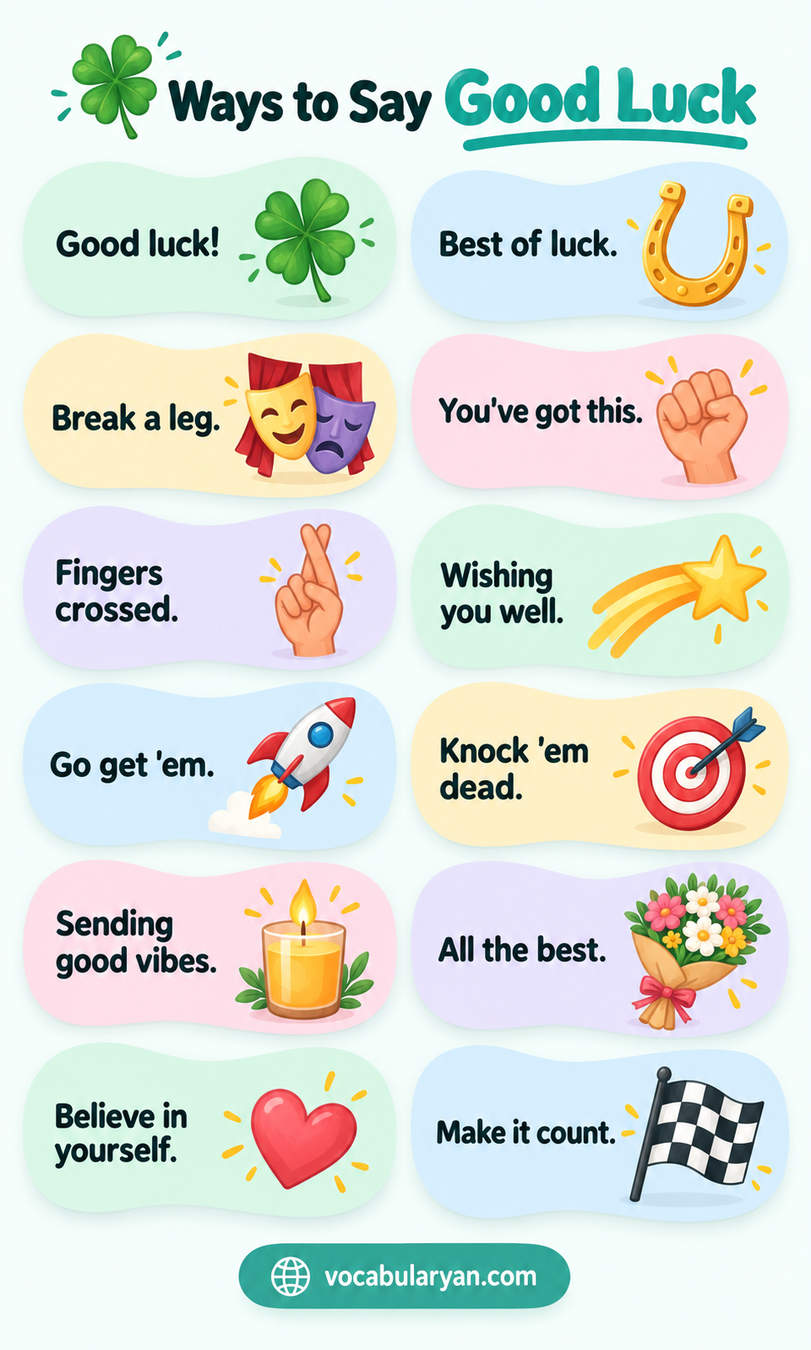
These six wishes fit a neighbour, a classmate, a colleague, or a stranger, and each one works in speech and in writing.
Good luck: the plain wish, said to anyone before a test, a match, a trip, or a hard day. It goes with "with" and a noun: "good luck with the move".
- Good luck with the presentation, Amir, you’ve practised enough.
- Good luck! Text me when you’re out.
- I heard about the audition on Friday, good luck.
Best of luck: a step warmer than "good luck", and it fits a colleague, a client, or a friend. It sounds fine in a card and in a quick chat by the door.
- Best of luck tomorrow, Dr Novak, the whole team is behind you.
- Best of luck with the surgery, I’ll come and see you afterwards.
- Right, best of luck, and don’t forget your passport.
All the best: a wish for the whole event or the whole future, and it fits a goodbye as well as a good luck. In an email it closes the message on its own line.
- All the best for the exam next week, Leo.
- All the best with the new flat, send me photos when you’re in.
- Well, all the best, and let us know how the interview goes.
Good luck with everything: the wish for a person whose next weeks are full: a move, a new job, a baby, or a course. It means "I hope every part goes well".
- Good luck with everything, Sara, you’ve got a busy month.
- It was lovely to see you, and good luck with everything.
- Good luck with everything back home, keep in touch.
I hope it goes well: a soft wish that names the event rather than luck, so it fits a person who does not believe in luck at all.
- I hope it goes well on Monday, Priya, you deserve that promotion.
- The dentist? Oh, I hope it goes well.
- I hope it goes well with the landlord tomorrow.
Fingers crossed: the wish that names the gesture, and it fits an event where the result is out of the person’s hands: a visa, a scan, a lottery, or a job reply.
- Fingers crossed the weather holds for the wedding.
- Fingers crossed for the interview, Dad.
- I applied this morning, so fingers crossed!
Say "good luck" when the person has work to do and "fingers crossed" when the result depends on someone else.
Casual Ways to Say Good Luck to Friends
Casual wishes are for close friends and family, and each one sounds like a push of confidence rather than a polite formula.
You’ve got this: the most common friendly wish today, and it means "you are ready, so go and do it". It fits a text, a hug at the door, or a call the night before.
- You’ve got this, Dan, you know the material better than anyone.
- Deep breath. You’ve got this.
- You’ve got this! Call me the second it’s over.
Go get ’em: short for "go get them", said to a friend about to face a crowd, a panel, or a rival team. It sounds American and playful.
- Go get ’em, Maya, show that panel who you are.
- Go get ’em, tiger!
- Big game tonight? Go get ’em.
Knock ’em dead: a wish for a performance, a speech, or an interview, and it means "impress them completely". It stays with friends and never goes in a formal email.
- Knock ’em dead at the open mic tonight.
- Knock ’em dead, Jess, that suit looks brilliant.
- Your first stand-up gig! Knock ’em dead.
Smash it: British slang that means "do it brilliantly", and it fits a friend before an exam, a race, or a pitch.
- Smash it tomorrow, Ollie!
- You’ll smash it, you always do.
- Go and smash it, and then we’re getting pizza.
I’m rooting for you: a wish that says "I am on your side", and it fits a friend who feels alone before a big day.
- I’m rooting for you, Kemi, every step of the way.
- Whatever happens on Friday, I’m rooting for you.
- I’m rooting for you, so make me proud.
Keep "smash it" and "knock ’em dead" for friends your own age, and say "you’ve got this" to anyone you are close to.
Formal Ways to Say Good Luck at Work
Formal wishes fit a manager, a client, a candidate, or a colleague you do not joke with, and each one names success rather than luck.
I wish you every success: the standard formal wish for a colleague who is leaving, a student who is graduating, or a client who is launching something new.
- I wish you every success in your new position, Ms Adeyemi.
- On behalf of the whole department, I wish you every success.
- I wish you every success with the expansion into Lisbon.
Best of luck with the presentation: "best of luck" plus the name of the event, and it is the most natural formal wish in an office.
- Best of luck with the presentation this afternoon, Tom.
- Best of luck with the audit next week, let me know if you need the figures.
- Best of luck with the pitch, the slides look excellent.
I wish you the best of luck: the full form, a little more polite than "best of luck", and it fits a spoken farewell to a candidate or a guest.
- I wish you the best of luck with the rest of the process, Mr Chen.
- Thank you for coming in today, and I wish you the best of luck.
- I wish you the best of luck in the final round.
Wishing you success: a short formal wish for a card, a speech, or the end of an email, and it goes with "in" or "with".
- Wishing you success in the exams, from all of us at Northfield.
- Wishing you success with the new clinic, Dr Okafor.
- Wishing you success and a smooth first quarter.
I’m confident you’ll do well: a wish that names your belief in the person, and it fits a manager speaking to a team member before a review or an exam.
- I’m confident you’ll do well, Nadia, your preparation has been thorough.
- I’m confident you’ll do well in the interview on Thursday.
- Relax, I’m confident you’ll do well tomorrow.
The one casual wish that reaches formal emails by mistake is "knock ’em dead".
- Knock ’em dead at the board meeting, Ms Adams. ❌
"Knock ’em dead" is slang for a stage or a pub, so a senior colleague gets "best of luck" with the name of the event.
- Best of luck at the board meeting, Ms Adams. ✅
A luck wish is spoken at one of five levels, and the table sorts the ones on this page.
| Level | Wishes (6) | Who it fits (11) |
|---|---|---|
| Slang | Smash it, go get ’em, knock ’em dead (36) | Close friends your own age (26) |
| Casual | You’ve got this, fingers crossed, I’m rooting for you (53) | Friends, family, relaxed colleagues (35) |
| Neutral | Good luck, best of luck, all the best, I hope it goes well (58) | Anyone you know by name (23) |
| Formal | Best of luck with the presentation, wishing you success (55) | Managers, clients, candidates (29) |
| Very formal | I wish you every success, I wish you the best of luck (53) | Speeches, references, leaving cards (35) |
Write "I wish you every success" for a leaving card or a reference, and "best of luck with" plus the event for everything else at work.
Ways to Say Good Luck in an Email
In an email the wish names the event, and it goes in the last line before the sign-off.
Good luck with the launch: the standard email wish for a colleague, and the noun after "with" changes with the event: the launch, the audit, the exam, the move.
- Good luck with the launch on Tuesday, the whole team has worked hard for it.
- Good luck with the exam, Ravi, and enjoy the break afterwards.
- Good luck with the move, we’ll miss you in the Leeds office.
Wishing you all the best with: a warmer email wish for a client or a colleague who is leaving, and the noun after "with" names what comes next.
- Wishing you all the best with the new venture, Elena.
- Wishing you all the best with the training course next month.
- Wishing you all the best with the house sale.
I hope everything goes smoothly: the email wish for a process rather than a test: a move, a visa, an operation, or a launch.
- I hope everything goes smoothly with the handover on Friday.
- I hope everything goes smoothly at the hospital next week.
- I hope everything goes smoothly, and please shout if you need anything from us.
Let me know how it goes: not a wish on its own, but the line that follows one, and it says that you want to hear the result.
- Good luck on Thursday, and let me know how it goes.
- Best of luck with the interview, let me know how it goes!
- Fingers crossed for the results, let me know how it goes.
Put "good luck with" plus the event in the last line of the email, and add "let me know how it goes" when you want a reply.
Ways to Say Good Luck in a Card
A card wish is kept and read again, so it is longer than a spoken wish and it names the future.
Wishing you the best of luck: the standard card wish, and it goes at the top of the message before the personal lines.
- Wishing you the best of luck in your exams, love from Gran.
- Wishing you the best of luck on the big day.
- Wishing you the best of luck at university, we’re so proud of you.
Good luck in your new adventure: a card wish for a big change: a move abroad, a year of travel, a new business, or retirement.
- Good luck in your new adventure, Sam, Canada is lucky to have you.
- Good luck in your new adventure, and send us a postcard from every city.
- Good luck in your new adventure as a full-time painter.
Best of luck with your future endeavours: the most formal card wish, common in a leaving card signed by a whole office. It sounds cold in a text to a friend.
- Best of luck with your future endeavours, from everyone in Finance.
- Best of luck with your future endeavours, Mr Petrov, it has been a pleasure.
- We wish you the best of luck with your future endeavours.
Here’s to your success: a toast in written form, and it fits a card for a new business, a graduation, or a first book.
- Here’s to your success, and to many more chapters.
- Here’s to your success with the bakery, Amal!
- Here’s to your success, you earned every bit of it.
"Best wishes" also fits a card, and it has a page of its own, so this page keeps to the luck wishes.
Write "wishing you the best of luck" at the top of a card and add one line about the person under it.
Ways to Say Good Luck in a Text
A text wish is short, and exclamation marks and capital letters do the work of your voice.
Good luck!!: the plain wish with two marks, and the extra mark makes it warm instead of flat. Three marks read as shouting with joy.
- Good luck!! You’re going to be brilliant.
- Good luck!! Text me after.
- Saw your post, good luck!!
GL: the two-letter form of "good luck", common in gaming chats and quick messages between friends. Keep it out of any message a teacher or a manager will read.
- GL on the boss fight, I’m off to bed.
- GL tomorrow, don’t stay up too late!
- gl, you’ll be fine.
You got this: the text form of "you’ve got this", with "have" dropped, and it is the most common encouraging text between friends.
- You got this 💪
- You got this, Ana. One more exam and you’re done.
- You got this! Ring me from the car park.
Sending good vibes: a text wish that means "I am thinking positive thoughts for you", and it fits close friends before a result they cannot control.
- Sending good vibes for the interview!
- Sending good vibes your way, Jo, ring me if you need to talk.
- Sending good vibes for the scan tomorrow x
Keep a text wish under six words, and let the exclamation mark do the warmth.
Ways to Say Good Luck Before an Exam
An exam wish names the test, and each one either wishes luck or asks for effort.
Good luck on your exam: the American form, and British English says "good luck in your exam". Both are correct, so match the person you are speaking to.
- Good luck on your exam tomorrow, Ethan, get some sleep.
- Good luck in your exam, Chloe, you’ve revised all month.
- Good luck on your exams this week, everyone.
Ace it: slang that means "get a top mark", and it fits a friend or a younger sibling who has studied hard.
- Ace it, Lily, then we’re going for ice cream.
- You’ll ace it, you always do.
- Go and ace it, and stop worrying.
Nail it: slang for "do it perfectly", used for an exam, a driving test, or a speech.
- Nail it tomorrow, Ben, you know this stuff.
- I know you’ll nail it.
- Nail it, and then sleep for a week.
Do your best: a wish that asks for effort rather than a top mark, and it fits a parent or a teacher who wants to take the pressure off.
- Do your best, Hana, that’s all anyone can ask.
- Just do your best and read every question twice.
- Do your best tomorrow, and we’ll talk about the rest later.
Say "good luck on your exam" in American English, "good luck in your exam" in British English, and "do your best" when the person is nervous.
Ways to Say Good Luck Before an Interview
An interview wish gives confidence, and it goes in a text the night before or a call in the morning.
Good luck with the interview: the neutral wish, and it fits a colleague, a friend, or a family member. "Good luck at the interview" is also correct.
- Good luck with the interview, Priya, they’d be lucky to have you.
- Good luck with the interview tomorrow, what time is it?
- Good luck at the interview, and remember to ask about the team.
Knock it out of the park: a baseball idiom that means "do it brilliantly", common in American offices and among friends.
- Knock it out of the park tomorrow, Jay.
- You’re going to knock it out of the park.
- Knock it out of the park, and then call me.
Show them what you’ve got: a wish that says "let them see your skills", and it fits a friend who is nervous about a panel.
- Show them what you’ve got, Aisha.
- Go in there and show them what you’ve got.
- Show them what you’ve got, and don’t undersell yourself.
You’ll do great: a soft, confident wish that fits anyone you know, and it is the most common spoken wish before an interview.
- You’ll do great, Sam, you’ve prepared for weeks.
- Don’t worry, you’ll do great.
- You’ll do great tomorrow, and I want to hear every detail.
Text "you’ll do great" the night before, and say "good luck with the interview" on the morning itself.
Ways to Say Good Luck Before a Performance
In a theatre "good luck" is bad luck, so a performer gets a wish that means the opposite.
Break a leg: the standard wish for an actor, a dancer, a musician, or a speaker, and it comes from a stage superstition that a direct wish brings bad luck. It fits friends and strangers backstage, and the reply is "thanks".
- Break a leg tonight, Mia, we’re in the third row.
- Break a leg, everyone, and enjoy the show.
- I can’t be there, but break a leg!
Have a great show: the plain wish for a performer, and it fits a parent, a friend, or a stage manager who prefers to skip the idiom.
- Have a great show, love, we’ll be at the stage door after.
- Have a great show, Tom, the house is full.
- Have a great show, and don’t forget your cue in the second act.
Toi toi toi: the wish that opera singers and classical musicians say instead of "good luck", said quickly three times. It stays backstage and sounds odd anywhere else.
- Toi toi toi, Elena, you sound wonderful in the second aria.
- Toi toi toi to the whole cast.
- Toi toi toi, and see you at the party afterwards.
Enjoy it out there: a wish that asks the performer to have fun rather than to be perfect, and it fits a nervous first-timer.
- Enjoy it out there, Ravi, the crowd is on your side.
- Forget the judges and enjoy it out there.
- Enjoy it out there, you’ve earned this.
A direct "good luck" to an actor is the one wish to avoid.
- Good luck tonight, Mia, we’re in the third row. (to an actor before the show) ❌
Actors treat "good luck" as a curse before a show, so the wish is "break a leg" or "have a great show".
- Break a leg tonight, Mia, we’re in the third row. ✅
Say "break a leg" to any performer, and keep "toi toi toi" for singers and orchestras.
Ways to Say Good Luck Before a Match or Race
A sports wish is short and loud, and it fits a player, a runner, or a whole team.
Play well: the plain wish for a footballer, a tennis player, or a chess player, and it fits a coach or a parent.
- Play well, Sofia, and keep your head up.
- Play well out there, lads.
- Play well today, and enjoy the final.
Bring it home: a wish that means "win it for us", and it fits a team in a final or a runner in the last leg of a relay.
- Bring it home, girls, the whole school is watching.
- One more set, bring it home!
- Bring it home tonight, Rovers.
Give it everything: a wish that asks for full effort, and it fits a race or a match where the result is uncertain.
- Give it everything today, Leo, and leave nothing on the track.
- Give it everything, and we’re proud of you whatever the score.
- Give it everything in the second half.
Say "play well" to one person, and "bring it home" to a team.
Ways to Say Good Luck Before a Trip or a Move
A travel wish names safety rather than luck, and a move wish names the new home.
Safe travels: the most common wish for a journey, and it fits a colleague flying to a conference, a friend going home, or a parent driving in the dark.
- Safe travels, Amir, and message me when you land.
- Safe travels back to Manchester.
- Safe travels tomorrow, the roads are icy.
Bon voyage: the French wish for a journey, used in English for a long trip by sea, by air, or by road, and it fits a card or a farewell party.
- Bon voyage, you two, enjoy every minute of the cruise.
- Bon voyage! Send us photos from Lisbon.
- Bon voyage, Dr Malik, and thank you for a wonderful year.
Good luck with the move: the wish for someone changing house, city, or country, and it fits a text, a card, or a goodbye by the van.
- Good luck with the move, Jess, and shout if you need boxes.
- Good luck with the move to Berlin, I’ll visit in the spring.
- Good luck with the move on Saturday, I hope it stays dry.
Godspeed: an old wish for a long or dangerous journey, and today it fits a soldier, a sailor, an astronaut, or a friend setting off on a big adventure. It sounds serious.
- Godspeed, Captain, and bring the crew home.
- Godspeed on the Atlantic crossing, Ella.
- Godspeed, my friend, and write when you can.
Say "safe travels" for any journey, "bon voyage" for a holiday, and "godspeed" for a journey with real risk.
Ways to Say Good Luck for a New Job
A new job wish names the job or the first day, and it fits a card, a text, or a handshake.
Good luck in your new job: the standard wish for a friend or a colleague who is starting somewhere new, and it fits speech and writing.
- Good luck in your new job, Nadia, they’ve made a great choice.
- Good luck in your new job on Monday!
- Good luck in your new job, and don’t forget your old friends.
Good luck on your first day: the wish for the morning itself, and it fits a text before eight o’clock.
- Good luck on your first day, Tom, wear the blue shirt.
- Good luck on your first day at the hospital.
- Good luck on your first day, you’ll know everyone’s name by lunch.
All the best in your new role: the formal wish for a colleague who is moving up or moving on, common in a leaving card or a farewell email.
- All the best in your new role, Ms Adams, the team will miss you.
- All the best in your new role as head of sales.
- All the best in your new role, and keep in touch.
Text "good luck on your first day" on the morning, and write "all the best in your new role" in the card.
Ways to Say Good Luck to a Group or Team
A group wish names everyone at once, and the level matches the room.
Good luck, everyone: the neutral wish for a class before an exam, a team before a match, or a group of colleagues before a launch.
- Good luck, everyone, and read the instructions on the front page first.
- Good luck, everyone, we’ve prepared for this all year.
- Good luck, everyone, see you on the other side.
Go, team!: a short cheer for a team, said with a raised fist, and it fits sport, a pub quiz, or an office competition.
- Go, team! Bring back that trophy.
- Go, team! Round three is ours.
- Go, team, you’ve got this!
Best of luck to you all: a warmer formal wish for a group, and it fits a manager, a teacher, or a coach speaking to the whole room.
- Best of luck to you all in the exams, and thank you for a wonderful year.
- Best of luck to you all today, whatever the result.
- Best of luck to you all, and I’ll see you at the finish.
Say "good luck, everyone" to a room, and "go, team!" to people you cheer for.
Regional Ways to Say Good Luck in English
English-speaking countries each keep a good luck wish of their own, and the right one in the right country wins a grin.
British Ways to Say Good Luck
Best of British: short for "best of British luck", a British wish said with a smile when the task is hard. It sounds warm between friends and colleagues.
- Best of British with the tax return, mate.
- Best of British tomorrow, you’ll need it against that team.
- Well, best of British, and give us a ring after.
You’ll smash it: the British form of "you’ll do brilliantly", and it fits friends before an exam, a race, or a first day.
- You’ll smash it, Charlie, stop worrying.
- You’ll smash it tomorrow, and then we’re celebrating.
- You’ll smash it, you always do.
Good luck, mate: "good luck" with "mate", the British and Australian word for a friend or any man you speak to casually.
- Good luck, mate, see you at the pub after.
- Good luck, mate, the driving test’s a piece of cake.
- Cheers for the lift, and good luck, mate.
American Ways to Say Good Luck
Go get ’em, tiger: an American wish with a nickname added, said to a friend or a child before a big day, and it sounds playful.
- Go get ’em, tiger, first day of school!
- Go get ’em, tiger, that promotion has your name on it.
- Go get ’em, tiger, and call me at lunch.
You’re gonna kill it: American slang that means "you will do brilliantly", and it fits friends before a pitch, a show, or a game.
- You’re gonna kill it tomorrow, Marcus.
- Don’t stress, you’re gonna kill it.
- You’re gonna kill it at the tryout.
Australian and Irish Ways to Say Good Luck
You’ll be right: the Australian wish that means "you will be fine", said to calm someone down before a test or a trip.
- You’ll be right, mate, the exam’s easier than last year’s.
- You’ll be right, just take your time on the hill start.
- Don’t panic, you’ll be right.
The best of luck to you: the Irish form of "best of luck", with "the" at the front, and it fits friends and strangers alike.
- The best of luck to you in the final, Sean.
- The best of luck to you, and safe home.
- The best of luck to you with the new shop, Niamh.
Say "best of British" in Britain, "go get ’em, tiger" in America, "you’ll be right" in Australia, and "the best of luck to you" in Ireland.
Funny Ways to Say Good Luck
Funny wishes are for friends who share your jokes, and each one plays on a film line or a mock threat.
May the Force be with you: a line from a space film, said as a joke wish before an exam or a match. It fits friends and family who know the film.
- May the Force be with you in the chemistry exam.
- May the Force be with you, young one.
- Big day? May the Force be with you.
May the odds be ever in your favour: a line from a book and film about a deadly contest. It works as a joke before a task with many rivals: an interview, a ticket sale, or a job lottery.
- Two hundred people applied? May the odds be ever in your favour.
- May the odds be ever in your favour in the seat lottery.
- May the odds be ever in your favour, and take snacks.
Don’t mess it up: a mock threat that means "good luck", said with a grin to a close friend or a sibling.
- Don’t mess it up, little brother, I’ve told everyone you’re a genius.
- Good luck, and don’t mess it up!
- Don’t mess it up, no pressure.
Good luck, you’ll need it: a tease that means "this is hard", and it fits friends who joke about each other. To a stranger it sounds unkind.
- Driving with Dad again? Good luck, you’ll need it.
- Good luck, you’ll need it, that professor never gives an A.
- You’re cooking for her parents? Good luck, you’ll need it.
"Good luck with that" is the trap among the funny wishes, because with a flat voice it means "that will never work".
- Good luck with that. (flat voice, to a friend who wants to pass the driving test) ❌
Said flatly, "good luck with that" is sarcasm, so a sincere wish takes a name and the event.
- Good luck with the test, Ben, you’ll pass this time. ✅
Save the joke wishes for people who will laugh, and say "good luck with the test" when you mean it.
How Do You Reply When Someone Says Good Luck?
The reply to a good luck wish thanks the speaker first, and then it adds one short line about the event or about the other person.
Thanks, I’ll need it: the most common reply, and it makes a small joke about the task being hard.
- Good luck with the exam! Thanks, I’ll need it.
- Best of luck tomorrow. Thanks, I’ll need it, the panel is huge.
- Good luck on your first day. Thanks, I’ll need it!
Thank you, fingers crossed: a reply that agrees the result is uncertain, and it fits a visa, a job reply, or a medical result.
- Good luck with the visa. Thank you, fingers crossed.
- I hope it goes well. Thank you, fingers crossed, we hear on Monday.
- Fingers crossed for you! Thank you, fingers crossed.
Cheers, I’ll let you know: a casual reply that promises news later, and it fits friends and colleagues.
- Good luck with the interview. Cheers, I’ll let you know.
- Best of luck, mate. Cheers, I’ll let you know how it goes.
- Smash it tomorrow. Cheers, I’ll let you know!
Thanks, you too: the reply when both of you face the same test, match, or first day. When the other person has no event, it sounds wrong.
- Good luck in the exam. Thanks, you too.
- Good luck today, we’re all nervous. Thanks, you too, see you after.
- Best of luck, everyone. Thanks, you too.
Thanks: the full reply to "break a leg", because a performer never returns the wish to someone in the audience.
- Break a leg tonight! Thanks, see you after.
- Break a leg, Mia. Thanks, I’m terrified.
- Toi toi toi. Thanks, you too (to another singer).
"You too" is the reply that goes wrong most.
- Good luck with the surgery tomorrow. (reply) You too. ❌
"You too" returns the wish, and the other person is not having surgery, so the reply is "thanks" plus a line.
- Good luck with the surgery tomorrow. (reply) Thanks, I’ll be glad when it’s over. ✅
Answer a good luck wish with "thanks" and one short line, and say "you too" only when the other person faces the same event.
More Everyday English Phrases
- Other Ways to Say Best Wishes
- Other Ways to Say Congratulations
- Other Ways to Say Get Well Soon
- Other Ways to Say Happy Birthday
FAQs
"I wish you every success" is the most formal wish, and "best of luck with" plus the name of the event is the most natural one in an office. "Wishing you success" and "all the best in your new role" fit a card or a farewell email. Slang such as "knock ’em dead" and "smash it" stays out of professional writing.
Yes, "good luck" is polite at every level, from a friend to a client, and it never sounds rude. The two exceptions are a theatre, where performers say "break a leg" instead, and a flat "good luck with that", which sounds sarcastic. Add a name or the event to keep the wish warm.
The idea comes from the theatre, where actors believe that a direct wish for luck brings the opposite result. The wish for a performer is "break a leg", and opera singers say "toi toi toi". Outside a theatre "good luck" is a normal, kind wish with no bad luck attached.
"Best of luck", "all the best", and "you’ve got this" are the three most common replacements, and "fingers crossed" fits a result the person cannot control. Before a performance the replacement is "break a leg", before a journey it is "safe travels", and in a formal email it is "I wish you every success".
"Good luck" and "all the best" mean the same as "best of luck", and "I wish you the best of luck" is the full formal form. "Wishing you the best of luck" is the version for a card. In a text between friends "you’ve got this" replaces all of them.
No, unless the professional setting is a stage, a concert hall, or a film set, where "break a leg" is the standard wish. In an office it sounds like a joke, so a colleague giving a presentation gets "best of luck with the presentation". Between friends who work together it passes as humour.
Say "good luck" before the event, never after it, and only when the person has something to do or to wait for: a test, an interview, a match, a trip, a move, or a result. After the event the line changes to "well done" or "congratulations" if it went well, and "bad luck" or "never mind" if it did not.
Say "thanks" first, then add a short line: "thanks, I’ll need it", "thank you, fingers crossed", or "cheers, I’ll let you know". "Thanks, you too" fits only when the other person faces the same event. A performer replies to "break a leg" with "thanks" and never with "you too".