
"Calm down" said to an angry or upset person makes most people angrier, because it says that their feeling is the problem. The ways to say calm down that work name the feeling first, or give the person one small action to take, such as "take a deep breath". Who you are speaking to decides the phrase, and the neutral phrases that replace "calm down" come first.
What to Say Instead of Calm Down
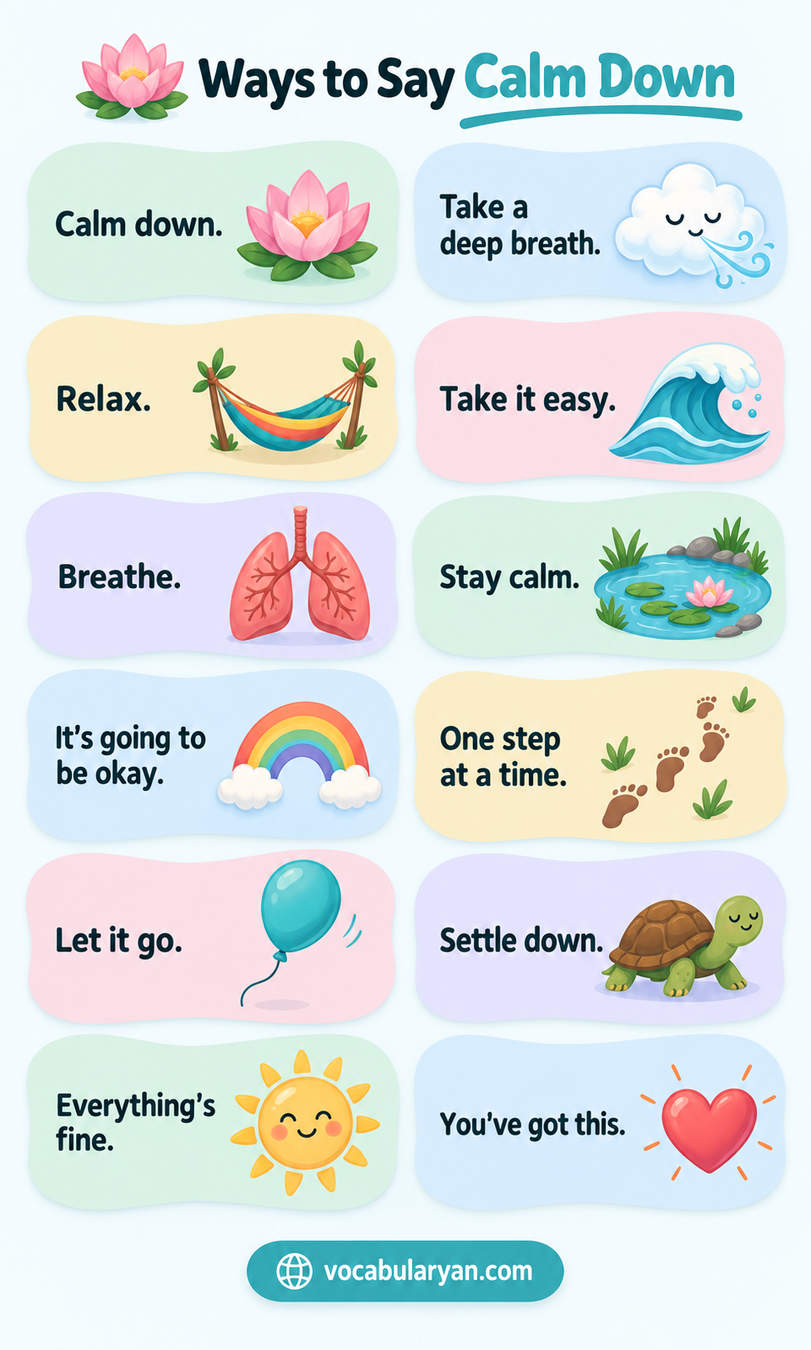
These five phrases replace "calm down" with almost anyone, because each one gives the person an action instead of a judgement.
Take a deep breath: the most common replacement, and it fits a friend, a child, a colleague, or yourself. It asks for one action, so the person has something to do with the feeling.
- Take a deep breath, then tell me what happened from the start.
- Right, take a deep breath, the train doesn’t leave for twenty minutes.
- I told him to take a deep breath before he opened the results.
Take a moment: neutral and polite, and it fits work as well as home. The person gets permission to stop for a few seconds.
- Take a moment, there’s no need to answer straight away.
- Why don’t you take a moment and get some water?
- She asked the room to take a moment before the vote.
Take your time: the phrase for someone who is rushing, stammering, or panicking about a deadline. It means "slow down" but sounds kinder.
- Take your time, the form isn’t due until Friday.
- Take your time, I’m in no hurry.
- The examiner told me to take my time, and the words came back.
Let’s pause for a moment: "let’s" puts you on the same side as the person, so the request sounds shared rather than ordered. It fits an argument or a tense call.
- Let’s pause for a moment and look at what we agree on.
- Let’s pause for a moment, I think we’re both tired.
- Before anyone says anything else, let’s pause for a moment.
It’s okay: the softest of the five, and it fits a child, a partner, or a friend who is crying. Said to an angry adult it sounds as if you are not listening.
- It’s okay, the cup was old anyway.
- It’s okay, take as long as you need.
- Hey, it’s okay, we’ll sort it out together.
Say "take a deep breath" or "take your time" first, and keep "calm down" itself out of the conversation.
Ways to Say Calm Down to a Friend Who Is Stressed
A stressed friend needs to hear that you are on their side, so these phrases offer help before they ask for calm.
I’m here: two words that say you are not leaving, and they fit a friend on the phone or on the sofa next to you. Nothing else needs to follow them.
- I’m here, talk when you’re ready.
- Whatever happens with the job, I’m here.
- I’m here, and I’ve got nowhere else to be tonight.
You’ve got this: the phrase for a friend who is stressed about something they still have to do. It says that you believe they can manage.
- You’ve got this, you’ve practised the speech ten times.
- Hey, you’ve got this, I’ll wait outside the whole time.
- Two more shifts and then a week off, you’ve got this.
Let’s figure this out together: an offer of help with the problem itself, and it fits money trouble, a broken plan, or a long to-do list.
- Let’s figure this out together, show me the letter.
- Don’t do it alone, let’s figure this out together over coffee.
- Let’s figure this out together, one bill at a time.
One thing at a time: the phrase for a friend who is trying to solve everything at once. The reply is a nod and a first task.
- One thing at a time, first the flight, then the hotel.
- Breathe, one thing at a time, and start with the email.
- We’ll get there, one thing at a time.
Don’t sweat it: casual, and it means "do not worry about it". It fits a small problem between friends and is wrong for a real crisis.
- Don’t sweat it, everyone forgets a birthday once.
- Late again? Don’t sweat it, I only just got here.
- Don’t sweat it, the stain will come out in the wash.
Offer "I’m here" or "let’s figure this out together" to a stressed friend, and save "don’t sweat it" for a small problem.
Ways to Say Calm Down to a Child
A child cannot calm down on command, so these phrases give the child a body action or a feeling word to hold on to.
Let’s take a breath together: the phrase for a child in tears or in a temper, and you breathe with the child so the child copies you.
- Let’s take a breath together, in through the nose, out through the mouth.
- Come here, let’s take a breath together and then find the shoe.
- Let’s take a breath together before we go back inside.
Use your calm voice: used by parents and teachers when a child is shouting. It asks for a change of volume, not a change of feeling.
- Use your calm voice, and I’ll listen to every word.
- I can’t hear you when you shout, so use your calm voice.
- Use your calm voice, please, your sister is asleep.
I can see you’re upset: a phrase that names the feeling, and it works because the child feels understood before anything else happens.
- I can see you’re upset, do you want to tell me why?
- I can see you’re upset about the game ending.
- I can see you’re upset, and that’s okay, I’m right here.
How about a big hug?: an offer, not an order, and a small child accepts it more readily than any instruction.
- How about a big hug and then we try the puzzle again?
- You fell over, didn’t you? How about a big hug?
- How about a big hug before school?
Count to ten: the classic instruction for an angry child, and it works for an angry adult too. Counting gives the brain a job.
- Count to ten with me, one, two, three.
- When you feel like hitting, count to ten first.
- She told the twins to count to ten and then talk.
Breathe with a small child, name the feeling for a bigger one, and keep "calm down" out of both.
Ways to Say Calm Down to an Angry Person
An angry person hears "calm down" as "you are wrong", so these phrases say that you have listened before you ask for anything.
I hear you: the shortest phrase that says "I have listened", and it fits an angry colleague, neighbour, or relative. It does not mean that you agree.
- I hear you, and I should have called before I changed the plan.
- I hear you, the noise has gone on too long.
- Okay, I hear you, let me answer each point.
I understand why you’re upset: a fuller form of "I hear you", and it fits a serious complaint. It names the feeling and gives it a reason.
- I understand why you’re upset, the delivery was three days late.
- I understand why you’re upset, and I would be too.
- I understand why you’re upset, so let’s talk about what happens next.
Let’s step back for a second: a request to stop and look at the problem from a distance, and it fits an argument that is going in circles.
- Let’s step back for a second, what do we both want here?
- Let’s step back for a second before we say something we regret.
- Okay, let’s step back for a second and look at the dates.
Can we pause this?: a question, so the other person keeps some control. It fits a family row or a call that has turned sharp.
- Can we pause this and pick it up after dinner?
- Can we pause this? I need five minutes.
- Can we pause this until we’ve both slept?
"Calm down" itself is the phrase that makes an angry person louder.
- Calm down, you’re overreacting. ❌
The line says that the anger is wrong, so the person defends the anger instead of dropping it.
- I understand why you’re upset, let’s fix it. ✅
Say "I hear you" before anything else to an angry person, and ask for a pause rather than ordering one.
Ways to Say Calm Down to a Customer
A customer who is angry wants a fix, so these phrases promise action and never mention the customer’s mood.
I understand your concern: the standard first line to an unhappy customer, in a shop, on a call, or in a reply. It fits every level of complaint.
- I understand your concern, and I’ll check the order now.
- I understand your concern about the charge, let me explain it.
- I understand your concern, Mrs Lee, this shouldn’t have happened.
I’m sorry this has happened: an apology for the situation, and it does not admit fault. It fits a late parcel, a wrong bill, or a cancelled booking.
- I’m sorry this has happened, let’s get it sorted today.
- I’m sorry this has happened, and I’ll make sure it’s noted.
- First of all, I’m sorry this has happened to you twice.
Let me look into this for you: the phrase that turns a complaint into a task, and it fits any customer who is waiting for an answer.
- Let me look into this for you, can I have the order number?
- Let me look into this for you and call you back within the hour.
- Bear with me, let me look into this for you right now.
Let’s see what we can do: an offer that promises effort without promising a result, and it fits a customer whose request is unusual.
- Let’s see what we can do about the refund.
- Let’s see what we can do, the manager is back at two.
- Let’s see what we can do to get you on the earlier flight.
Please bear with me for a moment: a polite request for patience while you check something, and it fits a call or a counter.
- Please bear with me for a moment while I find your booking.
- Please bear with me for a moment, the system is loading.
- Please bear with me for a moment, I’m checking with the kitchen.
Promise an action to an angry customer, and never say "calm down", "relax", or "there’s no need to shout".
Ways to Say Calm Down at Work in a Tense Meeting
A tense meeting needs a phrase that moves the talk back to the problem, and these four keep everyone’s dignity.
Let’s take a step back: the most common phrase for a meeting that has turned personal, and it fits a manager or anyone at the table.
- Let’s take a step back and look at the numbers again.
- Let’s take a step back, what is the actual decision today?
- Before we go on, let’s take a step back.
Let’s stick to the facts: the phrase for a meeting where opinions are getting loud, and it fits a chair or a project lead.
- Let’s stick to the facts, the deadline moved twice.
- Let’s stick to the facts and leave the blame for later.
- Okay, let’s stick to the facts, who signed the change?
Let’s revisit this later: the polite way to close a discussion that is going nowhere, and it promises a second look.
- Let’s revisit this later, once we have the client’s reply.
- Let’s revisit this later and move on to item three.
- I think let’s revisit this later, we’re out of time.
Please remain calm: very formal, and it fits an announcement, a safety drill, or a letter. Said to one colleague it sounds cold and official.
- Please remain calm and wait for further instructions.
- Please remain calm, the lift will be moving again shortly.
- The pilot asked everyone to please remain calm during the turbulence.
"Chill out" is the phrase to keep out of a meeting, however friendly the team.
- Chill out, Maria, it’s only a report. ❌
"Chill out" is slang for friends, so it sounds disrespectful to a colleague in front of others, and a shared request fits the same moment.
- Let’s take a step back, Maria, and look at the report together. ✅
Every phrase that replaces "calm down" belongs to one of five levels.
| Level | Phrases | Who it fits |
|---|---|---|
| Slang | Chill, chill out, take a chill pill, cool your jets | Close friends your own age |
| Casual | Don’t sweat it, no rush, easy tiger, keep your hair on | Friends, family, relaxed colleagues |
| Neutral | Take a deep breath, take your time, slow down, take a moment | Anyone you know by name |
| Formal | I understand your concern, let’s take a step back, let’s revisit this later | Managers, clients, customers |
| Very formal | Please remain calm, please remain composed | Announcements, letters, safety notices |
Use "let’s take a step back" in a meeting, and keep "please remain calm" for an announcement.
Ways to Say Calm Down to a Partner
A partner in a row hears every word twice, so these phrases stay warm and never sound like a parent.
Come here: two words and open arms, and they end more arguments than any sentence. They fit a partner who is upset rather than furious.
- Come here, I’m sorry, I didn’t mean it like that.
- Come here, you’ve had a horrible day.
- Just come here for a minute.
I’m not going anywhere: the phrase for a partner who is scared as well as angry, and it says that the argument will not end the relationship.
- I’m not going anywhere, we can be angry and still be us.
- Shout if you need to, I’m not going anywhere.
- I’m not going anywhere, so let’s take our time.
Let’s not do this while we’re upset: a request to stop the argument, not the relationship, and it fits late at night.
- Let’s not do this while we’re upset, we’ll talk in the morning.
- Let’s not do this while we’re upset, I love you, I’m going to make tea.
- Let’s not do this while we’re upset, it never ends well.
We’ll work it out: the phrase that says the problem is shared, and it fits money, family, or a decision about the future.
- We’ll work it out, we always do.
- I don’t have an answer tonight, but we’ll work it out.
- We’ll work it out together, okay?
Say "come here" or "we’ll work it out" to a partner, because "calm down" from the person you love sounds like a verdict.
Ways to Say Calm Down to Someone Anxious Before an Exam or a Flight
Anxiety before a fixed event needs a phrase about the event itself, so these four talk about the exam or the flight rather than the fear.
You’re going to be fine: the phrase for a nervous friend or relative in the last minutes, and it sounds confident rather than dismissive.
- You’re going to be fine, you know this paper inside out.
- You’re going to be fine, the flight is only two hours.
- Look at me, you’re going to be fine.
You’ve prepared for this: the phrase that reminds a student of the work already done, and it fits an exam, an interview, or a driving test.
- You’ve prepared for this for months, trust it.
- You’ve prepared for this, so walk in and read the first question slowly.
- Remember, you’ve prepared for this better than anyone.
Breathe in slowly: an instruction for a panic that is already starting, and it works on a plane, in an exam hall, or in a waiting room.
- Breathe in slowly, and out even slower.
- Breathe in slowly, count four, and let it go.
- Close your eyes, breathe in slowly, the plane is meant to shake a little.
Just focus on the next step: the phrase for someone who is thinking about the whole day at once. It cuts the task down to one action.
- Just focus on the next step, which is finding the gate.
- Just focus on the next step, read the question, then plan.
- Forget the result, just focus on the next step.
"Relax" is the one word an anxious person cannot act on.
- Relax, it’s not a big deal. ❌
The line says that the fear is silly, so the fear grows, and a phrase that names the work done fits instead.
- You’ve prepared for this, and you’re going to be fine. ✅
Remind an anxious person of the work they have done, and give one instruction they can follow at once.
Ways to Say Calm Down to a Group or Crowd
A group needs a phrase that reaches the back of the room, so these three are short, loud, and polite.
Everyone, please settle down: the phrase from a teacher, a chair, or a host when a room gets noisy, and it fits children and adults.
- Everyone, please settle down, we start in one minute.
- Everyone, please settle down and open your books.
- Right, everyone, please settle down, the speaker is here.
Let’s all take a breath: the group form of "take a deep breath", and it fits a team after bad news or a class after a fight.
- Let’s all take a breath and then go through the plan.
- Let’s all take a breath, nobody is in trouble.
- Let’s all take a breath before we answer the email.
Stay calm and stay where you are: the phrase for an emergency, from a guard, a steward, or a teacher during a drill.
- Stay calm and stay where you are, help is on the way.
- Stay calm and stay where you are, the doors will open shortly.
- Stay calm and stay where you are, this is only a test.
Use "everyone, please settle down" for noise and "stay calm and stay where you are" for an emergency.
Ways to Say Calm Down in a Text
A text has no voice to soften it, so the three calming phrases in a message are short and warm.
Breathe: one word, and it fits a friend who has sent a long panicked message. It reads as caring rather than bossy.
- Breathe. I’m on my way.
- Breathe, it’s only an interview.
- Breathe x we’ll sort it tonight.
You’re okay: the text form of "it’s okay", and it fits a partner or a close friend after a scare.
- You’re okay, you’re home, that’s all that matters.
- You’re okay, call me when you can talk.
- You’re okay, they said the scan was fine.
No rush: the phrase for a friend who is apologising for being slow, and it removes the pressure at once.
- No rush, reply whenever.
- No rush, I’m still in the queue.
- No rush on the money, honestly.
Keep a calming text to three words, and add a second message with a plan.
Ways to Say Calm Down in an Email
An email cannot tell a reader to calm down at all, so the phrases in writing calm the situation instead of the person.
There’s no need to worry: the standard written line after a mistake, and it fits a client, a colleague, or a student.
- There’s no need to worry about the invoice, it has been cancelled.
- There’s no need to worry, the file arrived in full.
- There’s no need to worry about the deadline, we have extended it to Monday.
Rest assured: formal, and it fits a reply to a complaint. The clause after it names what you will do.
- Rest assured that the order will leave today.
- Rest assured, your data has not been shared.
- Rest assured that we are treating this as a priority.
We can work through this step by step: the written form of "one thing at a time", and it fits a project that has gone wrong.
- We can work through this step by step, starting with the budget.
- We can work through this step by step on the call tomorrow.
- I know the list is long, but we can work through this step by step.
Write "there’s no need to worry" to a colleague and "rest assured" to a customer, and follow both with what happens next.
Ways to Say Calm Down to Yourself
Talking to yourself in a tense moment works when the phrase is short, so these four are the ones to say under your breath.
Deep breaths: the two-word instruction you give yourself before a speech, a phone call, or a hard conversation.
- Deep breaths, it’s only ten minutes on stage.
- Deep breaths, then knock on the door.
- Okay, deep breaths, the results are just numbers.
It is what it is: the phrase for a situation you cannot change, and it means "accept it and move on".
- The flight’s cancelled, it is what it is, let’s find a hotel.
- It is what it is, I’ll try again next year.
- I failed the first attempt, and it is what it is.
Let it go: the instruction for a grudge or a small annoyance, and it fits a comment you cannot stop thinking about.
- He was rude, but let it go, he’s leaving next week.
- Let it go, the parking ticket is paid.
- Just let it go and enjoy the weekend.
Pull yourself together: firmer, and you say it to yourself when you need to stop crying or shaking and act. Said to another person it sounds harsh.
- Right, pull yourself together, the children are watching.
- I had to pull myself together before the interview.
- Pull yourself together, you can cry in the car later.
Say "deep breaths" before the moment and "let it go" after it, and keep "pull yourself together" for yourself only.
Regional Ways to Say Calm Down in English
Each English-speaking country keeps a few calming phrases of its own, and the level of each one counts as much as the country.
British Ways to Say Calm Down
Keep your hair on: the everyday British phrase for a friend who is getting worked up over something small. It is casual and a little teasing.
- Keep your hair on, I only borrowed the charger.
- Alright, keep your hair on, the bus is two minutes away.
- Keep your hair on, Dad, it’s a scratch, not a dent.
Steady on: British and casual, said when someone goes too far in speech or action. It fits friends and relaxed colleagues, not a formal room.
- Steady on, that’s my sister you’re talking about.
- Steady on, mate, it’s only a game.
- Steady on, we haven’t heard her side yet.
Don’t get your knickers in a twist: British, funny, and only for friends and family. It means "you are worrying too much about something small".
- Don’t get your knickers in a twist, the tickets are in my bag.
- Don’t get your knickers in a twist, we’ll be there by seven.
- Oh, don’t get your knickers in a twist, I was joking.
American Ways to Say Calm Down
Cool your jets: American and casual, used with a friend or a child who is rushing or getting excited. It sounds playful rather than angry.
- Cool your jets, the pizza will be here in ten minutes.
- Cool your jets, kid, the pool opens at nine.
- Whoa, cool your jets, I haven’t said no yet.
Take a chill pill: American slang, and it fits a friend who is stressing about something small. To anyone else it sounds rude.
- Take a chill pill, it’s a group project, not a court case.
- Dude, take a chill pill, I’ll pay you back Friday.
- Take a chill pill, the movie doesn’t start for an hour.
Australian and Irish Ways to Say Calm Down
Settle down: used in Australia to a friend, a child, or a crowd, and it fits a teacher too. In Australian speech it is friendly rather than firm.
- Settle down, mate, the barbie isn’t going anywhere.
- Settle down, kids, Grandma’s on the phone.
- Settle down, it was one missed catch.
She’ll be right: the Australian phrase that means "it will all be fine", said to someone who is worrying about a plan or a problem.
- She’ll be right, the car’s got enough petrol.
- Stop stressing about the weather, she’ll be right.
- She’ll be right, the mechanic said it’s a small job.
Take it handy: Irish, and it means "go slowly and carefully". It fits a friend who is driving, drinking, or working too hard.
- Take it handy on that road, it’s wet.
- Take it handy, there’s no prize for finishing first.
- Take it handy tonight, you’ve work in the morning.
Use "keep your hair on" in Britain, "cool your jets" in America, "settle down" in Australia, and "take it handy" in Ireland, and only with people you know.
Slang Ways to Say Calm Down
Slang calming phrases are for friends your own age, and every one of them sounds rude from a stranger, a colleague, or a parent-in-law.
Chill: one word, and it fits a friend who is getting annoyed in a chat or a car. It is the most common slang form today.
- Chill, we’ll make the train.
- Just chill, I’ve got the tickets on my phone.
- Chill, man, she’s not even angry.
Chill out: "chill" with an extra word, and it sounds a little stronger. It fits friends and family, never a customer.
- Chill out, it’s only a scratch on the table.
- Can you chill out? The neighbours can hear you.
- Chill out, I’ll fix the wifi after dinner.
Easy tiger: a playful phrase for a friend who is getting too excited or too keen, and partners say it to each other with a smile.
- Easy tiger, the buffet isn’t going anywhere.
- Easy tiger, we’ve only had one date.
- Easy tiger, let the man finish his sentence.
Hold your horses: an old phrase that means "wait and slow down", and it fits a friend or a child who wants to rush ahead.
- Hold your horses, we haven’t paid yet.
- Hold your horses, the paint isn’t dry.
- Whoa, hold your horses, I want to read the contract first.
"Take it easy" belongs with these too, and it has a page of its own on this site, so use it here as the calm, friendly middle between "chill" and "take a deep breath".
Keep "chill", "chill out", and "easy tiger" for friends, and use "take a deep breath" with everyone else.
Funny Ways to Say Calm Down
A joke phrase can cool a small annoyance between close friends, and the same joke to an angry stranger starts a fight, so read the room first.
Somebody needs a nap: the joke for a friend who is grumpy for no big reason, and it treats the adult like a tired toddler.
- Somebody needs a nap, and it isn’t me.
- Ooh, somebody needs a nap before the party.
- Somebody needs a nap, look at that face.
Whoa there: a phrase said to a horse, used as a joke to a friend who is rushing or ranting.
- Whoa there, you’ve told me the same story twice.
- Whoa there, slow down, who said what?
- Whoa there, cowboy, it’s a bike lane.
Save the funny phrases for a friend who is a little grumpy, and never use one on a person who is really upset.
How Do You Reply When Someone Says Calm Down?
"Calm down" expects a reply, and the best one is short and level, because a shouted reply proves the other person’s point.
Calm down: the reply is "I am calm", said quietly, or a request not to be told what to feel.
- Calm down. I am calm, I just want an answer.
- Calm down. Please don’t tell me to calm down, tell me what happened.
- Calm down. I’ll calm down when the money is back in my account.
Take a deep breath: the reply accepts the instruction and does it.
- Take a deep breath. Okay. Okay, I’m breathing.
- Take a deep breath. You’re right, give me a second.
- Take a deep breath. Done. Now can I finish?
I hear you: the reply thanks the speaker and moves to the problem.
- I hear you. Thank you, so what can we do about it?
- I understand why you’re upset. Good, then you’ll understand why I want a refund.
- I hear you. Thanks, that’s all I wanted.
You’ve got this: the reply is thanks, with or without a joke.
- You’ve got this. Thanks, I needed to hear that.
- You’re going to be fine. I hope so, hold my bag.
- You’ve prepared for this. I know, I know, wish me luck.
Chill out: the reply between friends is the same level of slang, or a joke back.
- Chill out. Alright, alright, I’m chilling.
- Keep your hair on. I would if you’d stop losing my keys.
- Take a chill pill. Only if you drive.
Reply to "calm down" with "I am calm" in a quiet voice, and reply to a kind phrase with thanks and the next step.
More Everyday English Phrases
- Other Ways to Say Hurry Up
- Other Ways to Say Stop It
- Other Ways to Say Take Your Time
- Other Ways to Say Take It Easy
FAQs
Yes, in most situations, because "calm down" says that the other person’s feeling is the problem, and an upset person hears that as an insult. It is fine from a parent to a child or between close friends who are joking. To an angry adult, a customer, or a colleague, "I hear you" or "let’s take a moment" is the polite form.
The safest replacements are "take a deep breath", "take your time", "take a moment", and "I hear you". Each one gives the person an action or says that you have listened, and none of them judges the feeling. With a friend, "you’ve got this" and "I’m here" work well, and with a customer, "I understand your concern" is the standard first line.
Professionally, the phrases are "let’s take a step back", "let’s stick to the facts", "let’s revisit this later", and "I understand your concern". Each one moves the talk back to the problem without naming anyone’s mood. In writing, "there’s no need to worry" and "rest assured" do the same work, and "please remain calm" is for an announcement rather than a person.
The nice way names the feeling first, then offers help: "I can see you’re upset, let’s figure this out together". A softer instruction such as "take your time" or "let’s pause for a moment" also sounds kind, because "let’s" puts you on the same side. The word "please" in front of "calm down" does not make it nice, so use one of the other phrases instead.
No, not on a person who is already angry or frightened, because the order arrives as a judgement and the feeling gets stronger. It works only when the person is mildly excited and trusts you, such as a child before a party or a friend who is talking too fast. In every other case, an action phrase such as "take a deep breath" does the calming.
Say something about the event, not the fear: "you’ve prepared for this", "you’re going to be fine", or "just focus on the next step". Then give one action to do at once, such as "breathe in slowly". Avoid "relax" and "it’s not a big deal", because both say that the fear is silly.
Yes, to anyone except a close friend, because "chill out" is slang and it sounds dismissive from a colleague, a stranger, or a shop assistant. Between friends of the same age it is normal and even affectionate. At work or with a customer, "let’s take a moment" fits the same moment.
Yes, "somebody needs a nap", "whoa there", and the British "don’t get your knickers in a twist" are the common ones. Each one works only on a friend who is a little grumpy about something small. Said to a person who is really upset, the joke sounds like mockery, so check the size of the problem before you use one.