
"Get well soon" is said only to a person who is expected to recover, so it fits a cold, a broken arm, or an operation. The other ways to say get well soon each match one situation: "feel better soon" for a friend, "wishing you a speedy recovery" for a colleague, "I’m here for you" for a long illness. Most messages need nothing more than the everyday phrases, so start there.
Common Ways to Say Get Well Soon in Everyday English
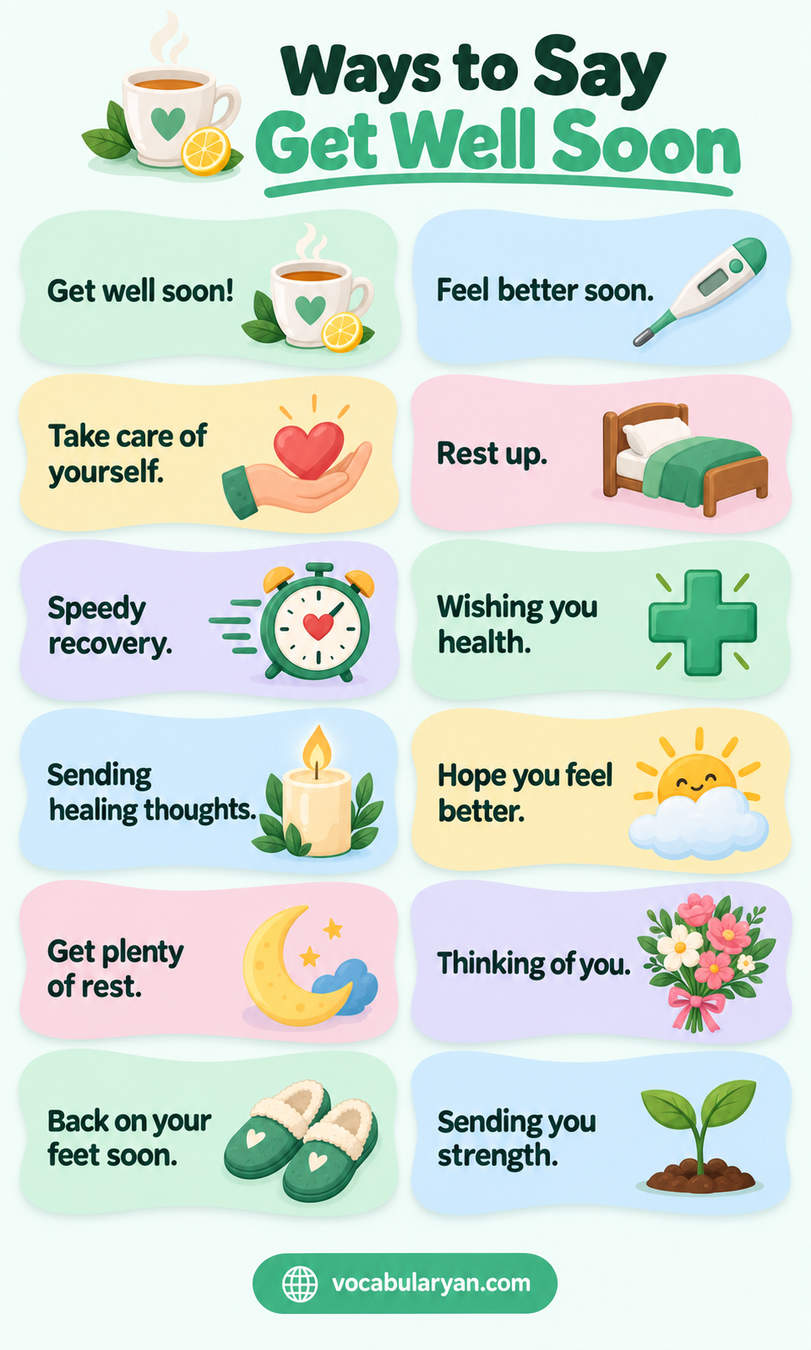
These four wishes fit almost anyone who is ill, from a classmate to a neighbour, and each one fits speech and writing.
Get well soon: the standard wish for an illness or an injury that will pass, and it fits every level at the start or the end of a message.
- Get well soon, Priya, the class isn’t the same without you.
- I heard you’ve been off with a chest infection, get well soon.
- Get well soon! We’ll save you a seat at the next rehearsal.
Feel better soon: softer than "get well soon", and the most common wish between friends and family. It fits a cold, a headache, or a low day as well as a real illness.
- Feel better soon, Tom, I’ll drop some soup round after work.
- Sorry you’re poorly, feel better soon.
- Feel better soon, and don’t even think about the report until Monday.
Hope you feel better soon: the full sentence form, and it sounds a little more caring because "hope" names your own feeling. It fits friends and colleagues alike.
- Hope you feel better soon, Grandma, I’ll ring you tonight.
- Just heard you’re home sick, hope you feel better soon.
- Hope you feel better soon, Mrs Ali, the whole street is asking after you.
Get better soon: the same meaning as "get well soon" with a plainer verb, and it sounds a touch more casual. It fits a child’s card and an adult’s text.
- Get better soon, Dad, the garden is waiting for you.
- Get better soon! Nobody else can fix the printer.
- I miss you at practice, get better soon.
Say "get well soon" to anyone with an illness that will pass, and "feel better soon" to someone you know well.
Casual Ways to Say Get Well Soon to Friends
Casual wishes are for friends and close colleagues, and each one sounds warm, quick, and a little playful.
Feel better!: the shortest wish of all, and the exclamation mark is part of it. It fits a text, a voice note, or a shout across the office.
- Feel better! Text me when you’re up to visitors.
- Ugh, flu again? Feel better!
- Feel better! I’ll cover your shift on Saturday.
Hope you’re back on your feet soon: "back on your feet" means "well enough to move around again", so this fits an injury or an illness that keeps someone in bed.
- Hope you’re back on your feet soon, Marco, football isn’t the same without you in goal.
- Heard about the ankle, hope you’re back on your feet soon.
- Hope you’re back on your feet soon, the dog misses his long walks.
Can’t wait to have you back: a wish that names the return rather than the illness, and it fits a teammate, a flatmate, or a colleague you like.
- Can’t wait to have you back, the office is too quiet.
- Get well soon, can’t wait to have you back on the pitch.
- Can’t wait to have you back, nobody else laughs at my jokes.
Get better, you: a fond, teasing wish for a close friend or a partner, with "you" added the way it is added to "hey, you".
- Get better, you, I need my running partner back.
- Stop answering emails from bed and get better, you.
- Get better, you! Movie night is on hold until then.
Write "feel better!" in a text and "hope you’re back on your feet soon" for an injury, and keep "get better, you" for a close friend.
Formal Ways to Say Get Well Soon at Work
Formal wishes fit a colleague you do not know well, a message from a manager, or a note to a client, and each one names recovery in full words.
Wishing you a speedy recovery: the standard formal wish for a team card, a client email, or a line from a manager, and it goes with a first name or a title and surname.
- Wishing you a speedy recovery, Ms Okafor, we look forward to seeing you back.
- Wishing you a speedy recovery, Daniel, please don’t worry about the audit.
- On behalf of the whole department, wishing you a speedy recovery.
I hope you make a full recovery: a formal wish for a serious but temporary illness, and "full" says that you expect the person to be completely well again.
- I hope you make a full recovery, Mr Hale, and please take the time you need.
- We were sorry to hear about the operation, and I hope you make a full recovery.
- I hope you make a full recovery and return to the project when you are ready.
I’m sorry to hear you’re unwell: the polite first line of a work message, and it comes before the wish itself. "Unwell" is the formal word for "sick".
- I’m sorry to hear you’re unwell, Sarah, the team will cover your meetings this week.
- I’m sorry to hear you’re unwell, please let me know if the deadline needs to move.
- Dear Mr Petrov, I’m sorry to hear you’re unwell, and I hope you are back with us soon.
Take the time you need to recover: the line a manager writes to a team member, because it gives permission to rest without guilt. Use it only when you can keep the promise.
- Take the time you need to recover, Amira, your projects are in safe hands.
- Please take the time you need to recover, the return date can wait.
- Take the time you need to recover, and we’ll talk about the handover when you’re back.
We look forward to having you back: a warm formal line for the end of a message, and it fits a card signed by a whole office.
- Get well soon, we look forward to having you back in October.
- We look forward to having you back, the new intern has a lot of questions for you.
- We look forward to having you back, Dr Lin, the clinic has missed you.
Best wishes for a speedy recovery: the most formal wish of the group, used for a client, a senior colleague, or a business partner you have met once or twice.
- Best wishes for a speedy recovery, Mrs Novak, from everyone at Northfield.
- Best wishes for a speedy recovery, and please pass on our regards to your family.
- The board sends its best wishes for a speedy recovery.
"Mate" and "get better" belong to friends, and in a note to a client the same wish takes the formal form.
- Get better soon, mate, don’t worry about the invoice. (to a client) ❌
"Get better soon, mate" sounds as if the client is a friend from the pub, and the formal wish keeps the same warmth without the slang.
- Wishing you a speedy recovery, Mr Hale, and please don’t worry about the invoice. ✅
The wishes on this page run from friend-only to formal-card, and the table sorts them.
| Level | Get-well wishes | Who it fits |
|---|---|---|
| Slang | Feel better!, get better, you, sending hugs | Close friends and partners |
| Casual | Feel better soon, get better soon, hope you’re back on your feet soon | Friends, family, relaxed colleagues |
| Neutral | Get well soon, hope you feel better soon | Anyone you know by name |
| Formal | Wishing you a speedy recovery, I hope you make a full recovery | Colleagues, managers, clients |
| Very formal | Best wishes for a speedy recovery, we look forward to having you back | Senior people, boards, business partners |
Use "wishing you a speedy recovery" with a colleague or a client, and add "take the time you need to recover" only when you are the manager.
Ways to Say Get Well Soon in an Email
A get-well email opens with the reason you are writing, gives the wish in the second line, and ends with an offer of help.
I was sorry to hear that you’re unwell: the standard opening line, and the past tense "was" says that someone told you the news.
- I was sorry to hear that you’re unwell, and I hope the rest is doing you good.
- Hi Jonas, I was sorry to hear that you’re unwell, please don’t rush back.
- Dear Ms Adams, I was sorry to hear that you’re unwell after the conference.
Please don’t worry about work: the line that takes the pressure off, and it fits a message from a manager or from the colleague who is covering.
- Please don’t worry about work, I’ve picked up the supplier calls.
- Please don’t worry about work while you’re recovering, everything is under control.
- Please don’t worry about work, Raj, your inbox will still be there in two weeks.
Let me know if there’s anything I can do: the offer at the end of a get-well email, and it stays polite because it lets the reader decide.
- Let me know if there’s anything I can do, even if it’s just forwarding the minutes.
- Get well soon, and let me know if there’s anything I can do from this end.
- Let me know if there’s anything I can do to make the return easier.
Wishing you a full and speedy recovery,: a closing line before your name, and it replaces "kind regards" in a get-well email.
- Wishing you a full and speedy recovery, Hannah
- Wishing you a full and speedy recovery, the Marketing team
- Wishing you a full and speedy recovery, and see you in the new year, Omar
Open with "I was sorry to hear that you’re unwell", give the wish on its own line, and close with an offer of help.
Ways to Say Get Well Soon in a Card
A card wish is longer than a spoken one, because the person will read it more than once, and the phrases name comfort, rest, and healing.
Sending healing thoughts your way: a gentle card line for someone in hospital or at home after an illness, and it fits both friends and colleagues.
- Sending healing thoughts your way, Nadia, and a big hug from the twins.
- Sending healing thoughts your way, we miss you at choir.
- Get well soon, sending healing thoughts your way every day.
Hoping each day brings you closer to full health: a wish for a longer recovery, and it fits a card for someone home from hospital.
- Hoping each day brings you closer to full health, Grandad.
- With love from all of us, hoping each day brings you closer to full health.
- Hoping each day brings you closer to full health, and to the golf course.
Wishing you comfort and rest: a calm card line for someone who is in pain or tired, and it asks for nothing quick.
- Wishing you comfort and rest while you get your strength back.
- Wishing you comfort and rest, Mrs Kaur, the flowers are from the whole floor.
- Wishing you comfort and rest, and a pile of good books.
Write "sending healing thoughts your way" for a short illness and "hoping each day brings you closer to full health" for a long one.
Ways to Say Get Well Soon in a Text
Text wishes are short, and the kisses, exclamation marks, and questions replace the hug you would give in person.
Feel better xx: the standard get-well text between friends in Britain, and the two kisses replace a longer wish.
- Feel better xx, call me when you’re up to it.
- Heard you’re ill, feel better xx
- Feel better xx soup is on the doorstep.
Get well soon x: the same wish with one kiss, and it fits a friend, a cousin, or a colleague you text outside work.
- Get well soon x don’t come in tomorrow if you’re still bad.
- Saw your status, get well soon x
- Get well soon x we’ll reschedule the cinema.
How are you feeling?: a text that checks on someone the day after the first wish, and the reply is one line of news.
- How are you feeling? Any better today?
- Morning! How are you feeling? Did you sleep?
- How are you feeling? Need me to pick anything up?
Need anything?: the two-word offer of help, and it fits a friend or a neighbour from the same street.
- Get well soon, need anything? I’m passing the pharmacy at five.
- Need anything? Milk, paracetamol, gossip?
- Need anything? I can drop it round in ten minutes.
Keep a get-well text to one line, add a kiss for a friend, and follow it the next day with "how are you feeling?".
Ways to Say Get Well Soon to a Child
A wish to a child is short and warm, names the part that hurts, and promises fun once the child is well again.
Get better soon, sweetheart: the wish a parent or grandparent says at the bedside, and "sweetheart" changes to "darling", "love", or the child’s nickname.
- Get better soon, sweetheart, the park will still be there next week.
- Get better soon, sweetheart, Grandma is coming to read to you.
- Drink your juice and get better soon, sweetheart.
Hope your tummy feels better soon: a wish that names the part that hurts, and children like it because it is about them. Swap "tummy" for "ear", "throat", or "knee".
- Hope your tummy feels better soon, Leo, no ice cream until then.
- Hope your tummy feels better soon, sweetie, Mum says you were very brave.
- Hope your tummy feels better soon so you can come to the party.
Get well soon, superstar: a cheerful wish for a child in hospital, and "superstar", "champ", or "brave girl" praises the child for coping.
- Get well soon, superstar, the nurses say you’re their best patient.
- Get well soon, superstar, the whole team signed your card.
- Get well soon, superstar, we’ve got a surprise waiting at home.
Name the sore part, add a fond word, and promise one treat for when the child is well.
Ways to Say Get Well Soon to a Family Member
A wish to family is plain and loving, and it comes with an offer of soup, a lift, or a visit rather than a formal line.
Get well soon, Mum: the family version, with the name of the person after the wish, and it fits a text, a call, or a note on the fridge.
- Get well soon, Mum, I’ll do the shopping this week.
- Get well soon, Mum, and stop doing the ironing from the sofa.
- Get well soon, Mum, the kids made you a card.
Love you, get better soon: the wish that closes a call to a parent, a sibling, or a grandparent, and "love you" comes first.
- Love you, get better soon, I’ll see you Sunday.
- Love you, get better soon, and let Dad make the tea for once.
- Love you, get better soon, Nan, the garden misses you.
You just concentrate on getting better: the line for a relative who worries about everyone else, because it takes the jobs away from them.
- You just concentrate on getting better, we’ve sorted the dog.
- You just concentrate on getting better, Auntie, the bills are paid.
- You just concentrate on getting better, and leave the rest to us.
Say "get well soon" plus the person’s name to family, and follow it with one thing you will do for them.
Ways to Say Get Well Soon After Surgery
A wish after an operation names healing and rest rather than speed, because the person will be sore for a while.
Hope the operation went well: the first line to send once the person is out of surgery, and it asks for news without asking for a long reply.
- Hope the operation went well, Ben, thinking of you and Clara.
- Hope the operation went well, message me when you’re awake enough.
- Hope the operation went well, Mr Diaz, the whole office sends its best.
Wishing you a smooth recovery: the standard wish after surgery, and "smooth" means "without problems", so it fits any operation from a knee to a heart.
- Wishing you a smooth recovery, Aunt Jo, and no lifting anything heavier than a cup of tea.
- Wishing you a smooth recovery from everyone in the choir.
- Wishing you a smooth recovery, Dr Reyes, we’ll see you in the new term.
Take it one day at a time: the wish for someone who is impatient to be well again, and it gives permission to heal slowly.
- Take it one day at a time, Grandad, the physio said six weeks for a reason.
- Take it one day at a time, and let the nurses spoil you.
- You’ll get there, take it one day at a time.
Send "hope the operation went well" first, and "wishing you a smooth recovery" once the person is home.
Ways to Say Get Well Soon for a Cold or Flu
A wish for a cold or flu is light and a little jokey, because everyone knows the illness will pass in a week.
Hope you shake it off soon: "shake off" means "get rid of", so this wish fits a cold, a cough, or a bug that everyone in the office has had.
- Hope you shake it off soon, half the team has had it this month.
- Sounds like a nasty cold, hope you shake it off soon.
- Hope you shake it off soon, Ana, the flu is going round the school.
Hope you’re over the worst of it: the wish for day three or four, when the fever has passed but the person is still tired.
- Hope you’re over the worst of it, Dan, did the fever break?
- Hope you’re over the worst of it, take the rest of the week if you need it.
- Morning, Grandma, hope you’re over the worst of it now.
Drink plenty of fluids and get well soon: the wish with the standard advice built in, and it fits a text from a friend who has been through the same cold.
- Drink plenty of fluids and get well soon, honey and lemon works for me.
- Drink plenty of fluids and get well soon, the flu is horrible this year.
- Drink plenty of fluids and get well soon, and no, coffee doesn’t count.
Keep a cold wish light, and save "full recovery" for an illness that needs a hospital.
What to Say Instead of Get Well Soon for a Long or Serious Illness
"Get well soon" asks for a recovery, so for a chronic condition, a long treatment, or a terminal illness the message names support instead.
I’m so sorry you’re going through this: the first line to a friend or a colleague after bad news, and it names the illness without promising a cure.
- I’m so sorry you’re going through this, Maya, I’m here for whatever you need.
- I’m so sorry you’re going through this, and I’d love to visit when you’re up to it.
- I’m so sorry you’re going through this, please let me take the school run for a while.
I’m here whenever you need me: the offer that fits every stage of a long illness, and it works in a card, a text, or at the bedside.
- I’m here whenever you need me, day or night.
- I’m here whenever you need me, Dad, even just to sit with you.
- You don’t have to reply, I’m here whenever you need me.
Take each day as it comes: a calm wish for a person facing months of treatment, and it asks for nothing beyond today.
- Take each day as it comes, and let us carry the rest.
- Take each day as it comes, Ruth, the good days will come round.
- Take each day as it comes, and call me on the bad ones.
Wishing you strength and comfort: the formal card line for a serious illness, and it replaces "speedy recovery" when speed is not possible.
- Wishing you strength and comfort in the weeks ahead, Mrs Ali.
- Wishing you strength and comfort, from all of us in the team.
- Wishing you strength and comfort, and please know that we are thinking of you.
I hope today is a good day: a wish for someone with a long-term condition who has good days and bad days, and it fits a text every week or two.
- I hope today is a good day, Grandma, the sun is out at last.
- I hope today is a good day, and if it isn’t, I’m only a call away.
- I hope today is a good day, Jamal, thinking of you.
"Thinking of you" fits here too, and a page of its own covers the full set of ways to say it.
- Get well soon, Aunt Ruth. (to someone with an illness that will not go away) ❌
"Get well soon" names a full recovery, so when a full recovery is not expected the wish sounds as if you do not understand the illness, and a line of support fits instead.
- I’m thinking of you, Aunt Ruth, and I’m here whenever you need me. ✅
"Speedy" is the same trap in formal words.
- Wishing you a speedy recovery. (to a colleague starting months of treatment) ❌
"Speedy" promises a short illness, so for a long treatment the wish names strength, comfort, or good days.
- Wishing you strength for the months ahead, and we’re all behind you. ✅
Say "I’m so sorry you’re going through this" and "I’m here whenever you need me" when a full recovery is not expected, and leave "get well soon" out.
Ways to Say Get Well Soon to a Group or a Colleague’s Family
A group wish is signed by everyone, and a wish for a colleague’s relative goes through the colleague, so the phrases name "we" and "your".
Get well soon from all of us: the standard card line signed by a team, a class, or a family, and it goes right before the names.
- Get well soon from all of us in the sales team.
- Get well soon from all of us, the office is far too tidy without you.
- Get well soon from all of us at number nine, we’ve fed the cat.
Wishing your mother a full recovery: the wish for a colleague’s relative, and "your" plus the relative names the person who is ill.
- Wishing your mother a full recovery, Chen, take whatever time you need.
- Wishing your mother a full recovery, and please don’t worry about the rota.
- Wishing your mother a full recovery, we’re all thinking of your family.
Please pass on our best wishes: the polite line when you do not know the relative, and it asks the colleague to deliver the wish for you.
- Please pass on our best wishes to your wife, and we hope she’s home soon.
- Please pass on our best wishes, and let us know if the team can do anything.
- Please pass on our best wishes to your dad from everyone at the clinic.
Sign a group card "get well soon from all of us", and send a wish for a relative with "please pass on our best wishes".
Regional Ways to Say Get Well Soon in English
Each English-speaking country keeps a few get-well phrases of its own, and the right one wins a smile from a local.
British Ways to Say Get Well Soon
Hope you’re on the mend: "on the mend" means "getting better", and it is the everyday British way to ask about a recovery.
- Hope you’re on the mend, Claire, the kettle’s on whenever you’re ready.
- Hope you’re on the mend, is the cough any better?
- Morning, Pete, hope you’re on the mend after that fall.
Get well soon, love: "love" is the friendly British word for a friend, a customer, or a child, and it fits a card from a neighbour or a text from a friend.
- Get well soon, love, I’ve left a lasagne on the step.
- Get well soon, love, don’t rush back to the shop.
- Get well soon, love, we all miss you at bingo.
American Ways to Say Get Well Soon
Hope you’re back to 100 percent soon: the American wish that treats health as a score, and it fits sports, work, and friends.
- Hope you’re back to 100 percent soon, coach, the team needs you Friday.
- Hope you’re back to 100 percent soon, take the week if you need it.
- Hope you’re back to 100 percent soon, buddy, rest that shoulder.
Australian and Irish Ways to Say Get Well Soon
Hope you’re back on deck soon: the Australian wish for a colleague, because "back on deck" means "back at work".
- Hope you’re back on deck soon, mate, the site’s a mess without you.
- Hope you’re back on deck soon, we’ve kept your desk clear.
- Hope you’re back on deck soon, Liam, the boss is doing your job badly.
Hope you’re grand again soon: the Irish wish, because "grand" means "fine" in Ireland, and it fits friends, family, and the corner shop.
- Hope you’re grand again soon, Niamh, mind that chest.
- Hope you’re grand again soon, the lads were asking after you.
- Hope you’re grand again soon, the whole parish has had that bug.
Say "on the mend" in Britain, "back to 100 percent" in America, "back on deck" in Australia, and "grand again" in Ireland.
Funny Ways to Say Get Well Soon
A funny wish is for a close friend with a minor illness, and the joke is that you are more upset about your own inconvenience than their health.
Get well soon, the coffee machine misses you: a joke card line for a colleague, and the joke changes to whatever the person is known for at work.
- Get well soon, the coffee machine misses you, and so does the person who fixes it.
- Get well soon, the coffee machine misses you, nobody else knows how to descale it.
- Get well soon, the coffee machine misses you, from the second floor.
I’d say get well soon, but I’m enjoying the quiet: a teasing wish for a talkative friend, and it works only with someone who teases you back.
- I’d say get well soon, but I’m enjoying the quiet in the office.
- I’d say get well soon, but I’m enjoying the quiet, take an extra week.
- I’d say get well soon, but I’m enjoying the quiet, love from your favourite brother.
Get well soon, or else: a mock threat that says "I miss you", and it fits a text to a sibling or a best friend.
- Get well soon, or else I’m eating your share of the birthday cake.
- Get well soon, or else I’ll come round and sing to you.
- Get well soon, or else, love from the whole flat.
Save a funny wish for a friend with a cold, and never send one to a person in hospital.
How Do You Reply When Someone Says Get Well Soon?
The reply to a get-well wish is "thank you" plus one line about how you feel, and the line changes with how well you are.
Thanks, I’m on the mend: the reply when you are getting better, and it saves the other person from asking a second question.
- Get well soon, Priya. Thanks, I’m on the mend, back at work on Monday.
- Hope you feel better soon. Thanks, I’m on the mend, just tired.
- Feel better! Thanks, I’m on the mend, the fever’s gone.
Thank you, that’s kind of you: the formal reply to a colleague or a client, and it fits an email or a card.
- Wishing you a speedy recovery, Mr Hale. Thank you, that’s kind of you, and thank you for moving the deadline.
- Best wishes for a speedy recovery. Thank you, that’s kind of you, I’ll be back in a fortnight.
- We look forward to having you back. Thank you, that’s kind of you, I look forward to it too.
Thanks, I’ll be back before you know it: the cheerful reply for a friend or a teammate, and it says that the illness is not serious.
- Can’t wait to have you back. Thanks, I’ll be back before you know it.
- Get well soon, we miss you. Thanks, I’ll be back before you know it, save me a seat.
- Hope you’re back on your feet soon. Thanks, I’ll be back before you know it, the ankle’s nearly there.
Thank you, it’s been a rough week: the honest reply when you are not better yet, and it fits a friend or a family member who will want the truth.
- Feel better soon, love. Thank you, it’s been a rough week, the cough won’t go.
- Hope the operation went well. Thank you, it’s been a rough week, but the doctors are pleased.
- Sending hugs. Thank you, it’s been a rough week, hugs are exactly what I need.
Reply with "thank you" and one line of news, and choose "I’m on the mend" when you are better and "it’s been a rough week" when you are not.
More Everyday English Phrases
- Other Ways to Say Best Wishes
- Other Ways to Say Good Luck
- Other Ways to Say Congratulations
- Other Ways to Say Happy Birthday
- Other Ways to Say Thinking of You
FAQs
"Feel better soon", "hope you feel better soon", and "get better soon" are the everyday choices, and "wishing you a speedy recovery" is the formal one. For a friend with a cold, "hope you shake it off soon" is lighter. For someone with a long or serious illness, "I’m here whenever you need me" fits where "get well soon" does not.
"Wishing you a speedy recovery" is the professional form, and "I hope you make a full recovery" fits a serious illness. Open the message with "I’m sorry to hear you’re unwell", give the wish, and close with "please don’t worry about work" or "let me know if there’s anything I can do". A manager adds "take the time you need to recover".
Yes, when the person is expected to recover, so it fits a cold, an injury, or an operation. It is wrong for a chronic or terminal illness, because it asks for a recovery that will not come. In that case the message names support, with "I’m so sorry you’re going through this" or "I’m here whenever you need me".
No, because "get well soon" promises a quick and full recovery, and a serious illness does not work that way. Say "wishing you strength and comfort" in a card, "take each day as it comes" to a friend, or "I hope today is a good day" in a text. The person hears that you understand the illness rather than wishing it away.
The wish goes at the start or the end of the sentence, with the person’s name and one offer or piece of news. In speech: "Get well soon, Priya, the class isn’t the same without you." In a card the wish takes its own line, and in a text it takes a kiss: "Get well soon x."
Yes, a short wish is normal, and "feel better!" or "get well soon x" is a complete message between friends. A card or a work email takes two or three lines: the wish, one offer of help, and a sign-off. A name in the message adds more warmth than extra length does.
"Feel better!", "get better soon", and "get better, you" are the informal forms, and a text adds "xx" or an exclamation mark. Between close friends the wish turns into a joke, with "get well soon, or else" or "I’d say get well soon, but I’m enjoying the quiet". Keep the jokes for a cold, not for hospital.
Yes, "get well soon" is the standard card title, and the longer lines go under it. Write "sending healing thoughts your way" for a short illness and "hoping each day brings you closer to full health" for a long one. A group card ends with "get well soon from all of us" before the names. For a serious illness the card title changes to "thinking of you".