
Before noon the standard greeting is "good morning", and it is correct with a boss, a stranger, and a child. The other ways to say good morning are set by the person in front of you: "morning" for a colleague, "rise and shine" for a child in bed, "good morning, Ms Tan" for a client. The short everyday forms are where the day starts.
Other Ways to Say Good Morning in Everyday English
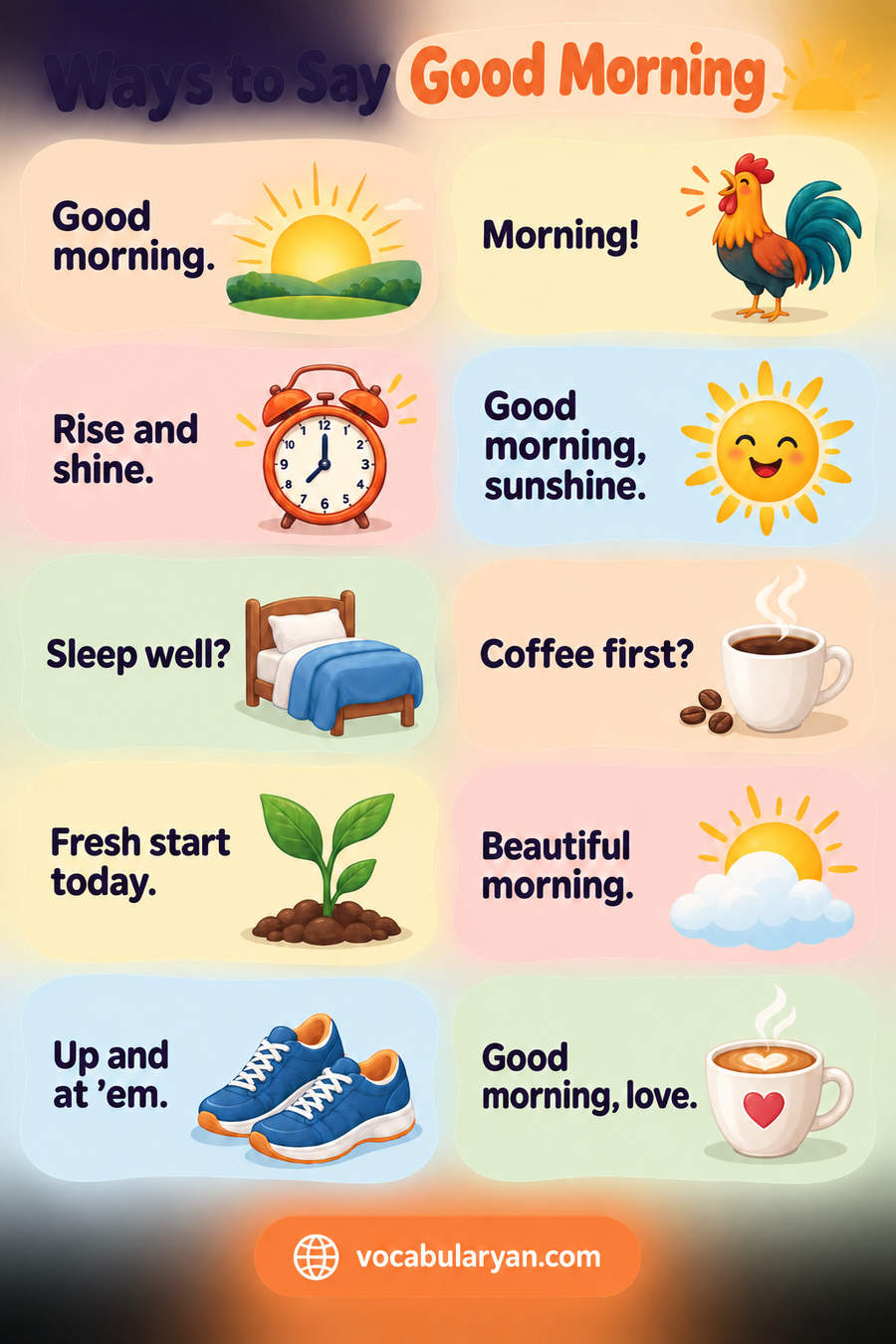
These greetings fit almost everyone before noon, from the bus driver to your manager, and each one is a form of the same two words.
Good morning: the full greeting, polite and warm at the same time. It fits a stranger, a colleague, and a family member, and it is the safest choice when you are unsure.
- Good morning, Mr Osei, the meeting room is ready for you.
- Good morning! Is the bakery open yet?
- Good morning, Dad, you’re up before me for once.
Morning: the short form, said with a nod or a smile between people who see each other every day. It is neutral, so it works with a colleague and with a neighbour.
- Morning, Hana, how was the drive in?
- Morning! Cold one today.
- Morning, Mr Reid, your paper’s on the step.
Mornin’: "morning" with the last sound dropped, common in relaxed speech and in texts between friends. Write it with the apostrophe.
- Mornin’, Jake, you look half asleep.
- Mornin’! Any coffee left in the pot?
- Mornin’, all, who wants a lift to the station?
Good morning to you: a friendly reply form, and it sounds a little old-fashioned when it opens a conversation. It fits an older neighbour, a shopkeeper, or a cheerful colleague.
- Good morning to you, Mrs Byrne, the roses look lovely.
- And a very good morning to you, young man.
- Good morning to you too, Sam, did the baby sleep?
Hello, good morning: "hello" plus the greeting, used when you walk into a room or answer the door and want to sound friendly and polite at once.
- Hello, good morning, I’m here to read the gas meter.
- Hello, good morning, is Dr Patel in yet?
- Hello, good morning, everyone, sorry to interrupt.
Good morning, everyone: the greeting for a group of any size, and it fits a class, a meeting, or a family breakfast.
- Good morning, everyone, phones away, please.
- Good morning, everyone, we have a full agenda today.
- Good morning, everyone! Who’s making the toast?
Morning, all: the short group greeting, common in offices and in group messages between colleagues who know each other.
- Morning, all, the lift is out again, so take the stairs.
- Morning, all! Cake in the kitchen, courtesy of Priya.
- Morning, all, quick reminder about the fire drill at ten.
Say "good morning" to anyone before noon, and drop to "morning" once the person greets you the same way.
Casual Ways to Say Good Morning to Friends
Casual morning greetings are for friends, flatmates, and family, and each one sounds sleepy, quick, or a little teasing.
Hey, morning: "hey" plus the short greeting, and it fits a friend or a flatmate you bump into in the kitchen.
- Hey, morning, did you finish the milk?
- Hey, morning! I didn’t hear you come in last night.
- Hey, morning, Tariq, you’re early for a Saturday.
Morning, you: a fond greeting for a close friend or a partner, and the "you" makes it warm.
- Morning, you, I saved you the last croissant.
- Morning, you! Sleep well?
- Well, morning, you, look who finally surfaced.
How’s your morning going?: a greeting and a question in one, and it fits a friend or a colleague you see mid-morning rather than at the door.
- How’s your morning going? Mine started with a flat tyre.
- Hi, Lena, how’s your morning going?
- How’s your morning going, mate? Busy?
Up early?: a teasing greeting for a friend who is not a morning person, and the reply is a joke or a groan.
- Up early? It’s only half past six.
- Up early, Jess? Big day?
- Up early? I thought you’d sleep till noon.
Happy Friday: a morning greeting that names the day, and it fits colleagues and friends on the last day of the working week. "Happy Monday" is the same greeting said as a joke.
- Happy Friday, Omar, any plans for the weekend?
- Happy Friday! Doughnuts are on me.
- Happy Friday, team, let’s finish strong.
Coffee’s on: a greeting between flatmates, partners, or family, and the words mean "good morning, come and sit down".
- Coffee’s on, Dan, grab a mug.
- Morning, coffee’s on, and there’s toast if you want it.
- Coffee’s on! Hurry before Ana drinks it all.
What a morning: a greeting that comments on the weather or the mood, and it fits a walk with a neighbour or the first line of a call.
- What a morning! Look at that sky.
- What a morning, Sofia, the train broke down twice.
- What a morning for a run, want to join me?
Keep "up early?" and "morning, you" for friends, and use "morning" with everyone else.
Formal Ways to Say Good Morning at Work
Formal morning greetings fit a manager, a client, a patient, or an interview, and they pair with a title and a surname or with a full sentence.
Good morning, Ms Tan: the greeting plus a title and surname, and it is the standard formal opening in an office, a clinic, or a bank. Keep the title until the person offers a first name.
- Good morning, Ms Tan, thank you for making time today.
- Good morning, Dr Haddad, the results came back this morning.
- Good morning, Mr Novak, I have your file here.
Good morning, sir: the greeting for a customer, a guest, or a senior person whose name you do not know. "Madam" is the form for a woman, and "ma’am" is the spoken American form.
- Good morning, sir, do you have a reservation?
- Good morning, madam, the fitting rooms are on your left.
- Good morning, ma’am, welcome to the clinic.
Good morning, how are you?: the greeting plus the polite question, and the reply is short and positive: "Very well, thank you, and you?"
- Good morning, how are you? Please come through.
- Good morning, Mrs Ali, how are you today?
- Good morning, how are you? I hope the traffic wasn’t bad.
A very good morning to you: a warm formal greeting from a host, a speaker, or a receptionist, and it sounds polished rather than stiff.
- A very good morning to you all, and welcome to the conference.
- A very good morning to you, Professor Grant.
- A very good morning to you, and thank you for calling Hartley and Sons.
Good morning, and thank you for coming: the greeting that opens an interview, a meeting, or a presentation, with thanks in the same breath.
- Good morning, and thank you for coming in at such short notice.
- Good morning, and thank you for coming, please take a seat.
- Good morning, and thank you for coming to our open day.
It’s good to see you this morning: a warm formal greeting for a client or a colleague you have met before, and it fits the start of a meeting.
- It’s good to see you this morning, Mr Chen, how was the flight?
- It’s good to see you this morning, everyone, let’s begin.
- It’s good to see you this morning, Fatima, welcome back.
I trust you had a good morning: a very formal opening for a speech or a letter, and it sounds right from a chairperson or a head teacher.
- I trust you had a good morning, and I will keep this short.
- I trust you had a good morning, ladies and gentlemen.
- I trust you had a good morning, Mr Ambassador, and a safe journey.
"Good morning" belongs to the hours before noon, and after noon it sounds like a mistake, even in a formal room.
- Good morning, Ms Tan, thank you for joining us. (at three in the afternoon) ❌
The clock decides the greeting, so from noon the formal greeting is "good afternoon" with the same title and surname.
- Good afternoon, Ms Tan, thank you for joining us. ✅
Every morning greeting on this page belongs to one of five levels.
| Level | Greetings | Who it fits |
|---|---|---|
| Slang | Gm, mornin’, rise and grind | Close friends your own age, texts |
| Casual | Morning, hey morning, up early | Friends, family, flatmates, relaxed colleagues |
| Neutral | Good morning, morning all, good morning everyone | Anyone you know by name |
| Formal | Good morning with a title, good morning sir, good morning how are you | Managers, clients, patients, strangers |
| Very formal | A very good morning to you, I trust you had a good morning | Speeches, ceremonies, interviews |
Use "good morning" with a title and surname on the first day, and say "good afternoon" the moment the clock passes twelve.
Ways to Say Good Morning in an Email
A morning greeting works in an email when the reader will open it before noon, and the name after it changes with the relationship.
Good morning, Ms Tan,: the formal email opening for a client, a customer, or anyone senior, with a title and surname. "Dear" is a step more formal and fits a first email.
- Good morning, Ms Tan, please find the revised quote attached.
- Good morning, Dr Haddad, I am writing to confirm Thursday’s appointment.
- Good morning, Mr Novak, thank you for your call yesterday.
Good morning, Ben,: the everyday email opening for a colleague or a client you know by first name, and it sounds warmer than "hi".
- Good morning, Ben, the numbers from last week are in.
- Good morning, Ben, could you sign off the draft by noon?
- Good morning, Ben, hope the move went well.
Good morning all,: the opening for an email to a group of colleagues, and it works for a team, a class, or a project.
- Good morning all, the agenda for today’s call is attached.
- Good morning all, a quick note on the new parking rules.
- Good morning all, thanks for the fast replies yesterday.
Good morning, team,: the warm opening for a group you lead, and it fits a daily update or a reminder.
- Good morning, team, three days to launch, so let’s check the list.
- Good morning, team, great work on the pitch, the client said yes.
- Good morning, team, the office closes early on Friday.
I hope your week is off to a good start: the first line after a greeting on a Monday or Tuesday, and it softens a request that follows.
- Good morning, Ben, I hope your week is off to a good start. Could you send the invoice?
- Hi Sara, I hope your week is off to a good start. Two quick questions.
- Dear Ms Tan, I hope your week is off to a good start. I am writing to follow up.
Good morning from London: the opening for a team in different time zones, and the city name gives the reader the time where you are.
- Good morning from London, and good evening to those of you in Sydney.
- Good morning from London! The slides are ready for the afternoon call.
- Good morning from London, Ana, I’ll be online until six your time.
"Good morning" is two separate words, and the one-word form is a spelling mistake that a reader notices at once.
- Goodmorning Ms Tan, please see the attached report. ❌
"Good" is an adjective and "morning" is a noun, so a space stays between them in every kind of writing, and a comma follows the name.
- Good morning, Ms Tan, please see the attached report. ✅
Write "good morning" plus a title and surname for a client, and "good morning" plus a first name for a colleague.
Ways to Say Good Morning Over Text
Text greetings are short, and an exclamation mark or a question replaces the smile.
Morning!: the default first text of the day to a friend, a partner, or a flatmate, and the exclamation mark makes it warm.
- Morning! Bus is late again, save me a seat.
- Morning! Are we still on for brunch?
- Morning! Just saw your message from last night.
Gm: the two-letter text form of "good morning", used by younger speakers with close friends. Keep it out of a message to a teacher or a manager.
- Gm, you awake?
- Gm! Train’s at nine, don’t be late.
- Gm, sorry I fell asleep mid-chat.
Morning, how’d you sleep?: a soft opener for a partner or a close friend, and the reply is a short chat rather than one word.
- Morning, how’d you sleep? I was out cold by ten.
- Morning, how’d you sleep? Is your back any better?
- Morning, how’d you sleep, sleepyhead?
You up?: a greeting and a question in one, sent early to check whether a friend is awake before you call.
- You up? I need a favour before work.
- You up? Look outside, it’s snowing.
- Morning, you up? Call me when you can.
Good morning, happy Tuesday: a cheerful text greeting that names the day, and it fits a friend, a partner, or a family group chat.
- Good morning, happy Tuesday! Two days till the trip.
- Good morning, happy Tuesday, Grandma, how’s the hip?
- Good morning, happy Tuesday, everyone, who’s driving tonight?
Have a good one: a morning text that wishes the person a good day, and it fits a partner leaving the house or a friend starting a shift.
- Morning! Have a good one, and text me after the interview.
- Have a good one, Ali, back at six.
- Have a good one at the new job!
Morning, any plans today?: the greeting that opens a plan, sent to a friend or a partner on a day off.
- Morning, any plans today? I’m free after twelve.
- Morning, any plans today? Fancy the beach?
- Morning, any plans today, or is it a pyjama day?
Keep a morning text to two or three words, and add a question if you want a reply.
Ways to Say Good Morning to Your Partner
Morning greetings for a partner add a pet name or a wish, and each one sounds warmer than the plain greeting.
Good morning, beautiful: the classic greeting for a partner, said in person or in the first text of the day. "Good morning, handsome" is the form for a man.
- Good morning, beautiful, coffee’s on the table.
- Good morning, beautiful! Sorry I left before you woke up.
- Good morning, handsome, your shirt’s ironed.
Morning, love: the everyday greeting between partners, and it is common across Britain in speech and in texts. In the north of England "love" is also said to strangers by shopkeepers and bus drivers.
- Morning, love, did the alarm wake you?
- Morning, love! I’ll pick up the kids tonight.
- Morning, love, tea’s by the bed.
Morning, sunshine: a cheerful greeting for a partner or a child, and it is also said as a joke to someone in a bad mood.
- Morning, sunshine, it’s a beautiful day out there.
- Morning, sunshine! You slept through two alarms.
- Well, morning, sunshine, somebody’s grumpy.
Good morning, sweetheart: a tender greeting for a partner, and it is also used by parents and grandparents with a child.
- Good morning, sweetheart, how’s your head after last night?
- Good morning, sweetheart, I made your favourite.
- Good morning, sweetheart, Nana’s here for breakfast.
Morning, gorgeous: a playful, flirty greeting, and it fits a partner or a very close friend who enjoys the joke.
- Morning, gorgeous, you look great in that.
- Morning, gorgeous! Ready for the big day?
- Morning, gorgeous, I’ll be home by seven.
Hope you slept well: a gentle greeting for a partner, a guest, or an ill relative, said in person or by text.
- Morning, hope you slept well, the bed’s a bit hard in that room.
- Hope you slept well, love, I tried not to wake you.
- Hope you slept well! Breakfast in ten.
Good morning, my love: the most tender of the set, and it fits a long-distance text or a first morning back together.
- Good morning, my love, only four more days till I’m home.
- Good morning, my love, I missed you last night.
- Good morning, my love, happy anniversary.
Say "morning, love" every day and keep "good morning, my love" for a birthday or a first morning back together.
Ways to Say Good Morning to Kids and Family
These greetings are said to someone still in bed, and each one asks the person to wake up and get moving.
Rise and shine: the classic wake-up greeting for a child, a partner, or a guest, said with the curtains opening.
- Rise and shine, Ellie, school in forty minutes!
- Rise and shine! The sun’s out and so is the tent.
- Rise and shine, sleepyhead, the pancakes won’t wait.
Wakey, wakey: a playful British wake-up call for a child or a sleepy partner, said in a sing-song voice.
- Wakey, wakey, Max, Grandpa’s downstairs.
- Wakey, wakey! Your bus goes in twenty minutes.
- Wakey, wakey, love, you asked me to get you up at six.
Wake up, sleepyhead: a fond greeting for someone who sleeps late, and "sleepyhead" is a soft name, not an insult.
- Wake up, sleepyhead, it’s nearly ten.
- Wake up, sleepyhead! We’re leaving in five.
- Wake up, sleepyhead, the dog needs a walk.
Up and at ’em: an old army phrase that means "get up and get to work", and it fits a parent hurrying children or a coach on a trip.
- Up and at ’em, boys, the coach leaves at seven.
- Up and at ’em! Beds made before breakfast.
- Morning, up and at ’em, we’ve got a garden to dig.
Morning, kiddo: a warm greeting from a parent, an uncle, or a grandparent to a child or a teenager.
- Morning, kiddo, cereal’s on the table.
- Morning, kiddo! Big test today, you’ll be fine.
- Morning, kiddo, want a lift or are you cycling?
Time to get up: the plain wake-up line, said by a parent or a partner when the gentle greetings have not worked.
- Time to get up, Leo, I mean it this time.
- Morning, time to get up, your taxi’s at eight.
- Time to get up! The plumber’s here in ten minutes.
Wake up, buttercup: a playful rhyme for a child, and it goes with a tickle or a pillow thrown across the room.
- Wake up, buttercup, Nana’s making waffles.
- Wake up, buttercup! It’s your birthday.
- Wake up, buttercup, we’re going to the zoo.
Use "rise and shine" and "wakey, wakey" on someone in bed, and never on a colleague at a desk.
Ways to Say Good Morning in a Meeting or on the Phone
A morning greeting to a room or on a call names the listeners and says who is speaking, because the greeting starts the business of the day.
Good morning, ladies and gentlemen: the formal opening for a speech, a ceremony, or an announcement, and it fits a host, a pilot, or a chairperson.
- Good morning, ladies and gentlemen, and welcome aboard.
- Good morning, ladies and gentlemen, please take your seats.
- Good morning, ladies and gentlemen, the show will begin in five minutes.
Good morning, class: the greeting a teacher says at the start of a lesson, and the reply is "good morning" back, said all together.
- Good morning, class, books open at page twelve.
- Good morning, class, we have a visitor today.
- Good morning, class! Who did the reading?
Morning, folks: a relaxed greeting for a room of colleagues or customers, and it is common in American offices and shops.
- Morning, folks, the shop opens in five, so grab a coffee.
- Morning, folks! Let’s get this meeting done by nine.
- Morning, folks, the road’s closed, so use the back entrance.
Good morning, and welcome: the greeting that opens an event, a course, or a tour, with the welcome in the same sentence.
- Good morning, and welcome to the first day of the course.
- Good morning, and welcome to Riverside Museum.
- Good morning, and welcome back, everyone, after the holiday.
Good morning, this is Ana from Riverside Dental: the formal opening for a work call, with your name and your company in the first line.
- Good morning, this is Ana from Riverside Dental, I’m calling about your check-up.
- Good morning, this is Ana from Riverside Dental, could I speak to Mr Reid?
- Good morning, this is Ana from Riverside Dental, returning your call.
Good morning, you’re through to Dev: the way to answer a work phone before noon, with your name so the caller knows who is listening.
- Good morning, you’re through to Dev, how can I help?
- Good morning, you’re through to Dev in accounts.
- Good morning, you’re through to Dev, please hold for one moment.
Open a meeting with "good morning, everyone" and a call with "good morning" plus your name, because a room and a phone line both need to know who is speaking.
Funny Ways to Say Good Morning
Funny morning greetings are for close friends and family who enjoy a joke before coffee, and each one plays on an old or unusual form.
Top of the morning to you: a mock-Irish greeting from old films, and it is a joke, not a real Irish greeting. The comic reply is "and the rest of the day to yourself".
- Top of the morning to you, Captain, is the tea ready?
- Top of the morning to you! What’s the plan?
- Top of the morning to you, Dad, in your best film voice.
Good morrow: the greeting from old plays, said with a bow for a laugh between friends.
- Good morrow, my lord, your porridge awaits.
- Good morrow, fair travellers, the coach departs at nine.
- Good morrow! Who stole my socks?
Morning, campers: a greeting from holiday camps, said by a parent, a coach, or a flatmate to a sleepy group.
- Morning, campers, breakfast is served!
- Morning, campers! Who’s ready for the hike?
- Morning, campers, the showers are cold today, sorry.
Wake up and smell the coffee: a joke greeting that also means "face the truth", so it fits a friend who is asleep or a friend who is dreaming.
- Wake up and smell the coffee, Jay, it’s nearly noon.
- Wake up and smell the coffee! I made a whole pot.
- Morning, wake up and smell the coffee, the exam is tomorrow.
Look who’s up: a teasing greeting for a friend or a teenager who comes downstairs late in the morning.
- Look who’s up! Did the sun come round twice?
- Well, look who’s up, it’s only half past eleven.
- Look who’s up, we’d nearly eaten your breakfast.
Rise and grind: a joke on "rise and shine" for a friend who trains or works early, and it fits a gym text or a group chat.
- Rise and grind, Marco, the gym opens at six.
- Rise and grind! Deadline day.
- Rise and grind, team, coffee’s on the counter.
Save the funny greetings for people who will laugh, because "good morrow" to a client reads as a mistake.
When Do You Say Good Morning?
"Good morning" covers the hours from waking until twelve noon, and the greeting changes when the clock does.
Good afternoon: the greeting from noon until about six in the evening, and it fits a shop, a clinic, or a meeting.
- Good afternoon, I have a booking under Lopez at one.
- Good afternoon, class, let’s continue from yesterday.
- Good afternoon, Dr Haddad, I’m a little early.
Good evening: the greeting after about six, and it sounds a little more formal than the other two.
- Good evening, and thank you all for coming out tonight.
- Good evening, Mr Novak, your table is ready.
- Good evening, is the kitchen still open?
Good day: a greeting for any hour, and it sounds old-fashioned in Britain and America. In Australia it survives as "g’day".
- Good day, madam, how can I assist you?
- Good day to you, sir.
- Good day, is this the office for permits?
"Good night" is the one time-of-day phrase that is not a greeting.
- Good night, Mrs Byrne, lovely to see you here. (on arrival at eight in the evening) ❌
"Good night" is a farewell said when someone leaves or goes to bed, so the greeting on arrival is "good evening".
- Good evening, Mrs Byrne, lovely to see you here. ✅
Say "good morning" until twelve, "good afternoon" until six, and "good evening" after that.
Regional Ways to Say Good Morning in English
English-speaking countries each keep a few morning greetings of their own, and the right one in the right country wins a smile.
British Ways to Say Good Morning
Morning, mate: the short greeting plus "mate", the friendly British word for a friend or any man you speak to casually.
- Morning, mate, is this seat free?
- Morning, mate! Cheers for the lift yesterday.
- Morning, mate, kettle’s just boiled.
Lovely morning, isn’t it?: a greeting that talks about the weather, and it fits a neighbour, a dog walker, or a shopkeeper. The reply agrees with the weather.
- Lovely morning, isn’t it? First sun in a week.
- Lovely morning, isn’t it, Mrs Kaur?
- Lovely morning, isn’t it? Shame I’m stuck inside.
Alright, morning: "alright?" plus the greeting, and it is the everyday British hello before noon. The reply is "alright, morning" back.
- Alright, morning, Dave, you’re in early.
- Alright, morning! Busy shift?
- Alright, morning, lads, who’s on the till?
American Ways to Say Good Morning
Good morning, y’all: the greeting plus "you all", the Southern American form for a group of friends, family, or customers.
- Good morning, y’all, breakfast is on the porch.
- Good morning, y’all! Store opens at eight.
- Good morning, y’all, thanks for coming out so early.
Howdy, mornin’: "howdy" from the American South and West plus the short greeting, said to neighbours and strangers on a trail.
- Howdy, mornin’, need a hand with that gate?
- Howdy, mornin’! Fine day for a ride.
- Howdy, mornin’, folks, welcome to the ranch.
Morning, neighbor: a friendly American greeting over a fence or in a driveway, and it fits someone whose name you do not know.
- Morning, neighbor, your paper landed in my yard.
- Morning, neighbor! Nice truck.
- Morning, neighbor, the trash goes out today, right?
Australian and Irish Ways to Say Good Morning
G’day: the Australian "good day", said at any hour and to anyone, and it replaces "good morning" before noon.
- G’day, is the bakery open yet?
- G’day, mate, surf’s up early today.
- G’day, everyone, coffee is on me this morning.
Morning, how ya going?: the Australian form of "morning, how are you?", and the reply is "good, thanks".
- Morning, how ya going? Find the place alright?
- Morning, how ya going, Liam?
- Morning, how ya going? Big night?
Morning, lads: the Irish greeting for a group of friends or workmates, and "lads" covers women too in Ireland.
- Morning, lads, who’s making the tea?
- Morning, lads! Grand day for it.
- Morning, lads, the van’s out front.
Grand morning: the Irish greeting that comments on the weather, and "grand" means "fine" or "lovely".
- Grand morning, Niamh, the sun’s out at last.
- Grand morning! Off to the match?
- Grand morning for a walk, isn’t it?
Use "alright, morning" in Britain, "good morning, y’all" in the American South, "g’day" in Australia, and "morning, lads" in Ireland.
How Do You Reply When Someone Says Good Morning?
The reply to a morning greeting matches the greeting: a "good morning" gets one back, and a question-shaped greeting gets a short answer and the same question returned.
Good morning or morning: reply with the same words, or the shorter form, plus the person’s name.
- Good morning, Priya. Good morning, Tom, how’s the new desk?
- Morning, Dev. Morning, Hana.
- Good morning, everyone. Morning, sir.
Good morning, how are you?: the reply is short and positive, then the question goes back.
- Good morning, how are you? Very well, thank you, and you?
- Morning, how’s your morning going? Not bad, you?
- Good morning, how are you today? Fine, thanks, a bit tired.
Rise and shine or wakey, wakey: the reply is a groan, a joke, or a request for five more minutes.
- Rise and shine! Five more minutes, please.
- Wakey, wakey, love. Is it really seven already?
- Wake up, sleepyhead. I’m up, I’m up.
Lovely morning, isn’t it? or grand morning: the reply agrees about the weather and adds one line.
- Lovely morning, isn’t it? It is, first dry day all week.
- Grand morning! It is, makes a change.
- What a morning! Isn’t it? I walked in.
Good morning, and welcome: the reply thanks the speaker.
- Good morning, and welcome to the team. Thank you, I’m glad to be here.
- Good morning, and thank you for coming. Thank you for having me.
- Good morning, you’re through to Dev. Good morning, Dev, it’s Ana from Riverside Dental.
Return the greeting at the same level, and answer a question-shaped greeting in three words or fewer before you ask it back.
More Everyday English Phrases
- Other Ways to Say Good Afternoon
- Other Ways to Say Hello
- Other Ways to Say Good Evening
- Other Ways to Say What’s Up
FAQs
The most common other ways to say good morning are "morning", "mornin’", "good morning, everyone", and "morning, all", and each one fits work and home. For a partner the greeting becomes "morning, love" or "good morning, beautiful", and for a child in bed it becomes "rise and shine" or "wakey, wakey". A client or a manager gets "good morning" plus a title and surname.
"Good morning" covers the hours from waking until twelve noon, and "good afternoon" starts at noon and runs until about six. After six the greeting is "good evening". "Good night" is not a greeting at all, because it is said when someone leaves or goes to bed.
"Good morning" is two words, always, in a text, an email, and a letter. "Good" is an adjective and "morning" is a noun, and the two never join. "Goodnight" as one word does appear in casual writing, and that is the reason "goodmorning" looks right to some writers, but it is a spelling mistake.
No, not as a real greeting, because "top of the morning to you" comes from old films and songs about Ireland, and nobody in Ireland says it today. It works as a joke between friends who know it is a joke. In Ireland the real morning greetings are "morning", "morning, lads", and "grand morning".
Yes, "greetings" works as a hello at any hour, but it sounds very formal or a little playful, so it is rare in speech. It fits a formal letter, the first line of a speech, or a joke between friends. In a normal morning conversation "good morning" or "morning" is the natural choice.
Add the person’s name and one warm line, because "good morning, Ben, how was the weekend?" sounds friendly and still professional. With a client or a senior person keep the title and surname, and add "how are you?" or "thank you for coming". The stiff forms, "I trust you had a good morning" and "a very good morning to you", belong to speeches, not to a desk.
The cute forms are "morning, sunshine", "morning, you", "good morning, beautiful", and "morning, how’d you sleep?", and each one fits a partner or a very close friend. A question at the end, such as "any plans today?", turns the greeting into a chat. Keep the text short and let the pet name add the warmth.
Say good morning in an email when the reader will open it before noon in their own time zone. When the reader is in another time zone, or when the email will sit unread until the afternoon, "hi" or "hello" with the name is the safer opening. "Good morning from London" solves the problem for a team spread across the world, because it names where you are.