
"Good night" is a farewell and a bedtime wish, and it is never a greeting when you arrive. Who is going to sleep decides the phrase. The ways to say good night in English split by person: "sweet dreams" for a partner, "night night" for a child, "have a good night" for a colleague leaving late. The everyday phrases come first.
Common Ways to Say Good Night in English
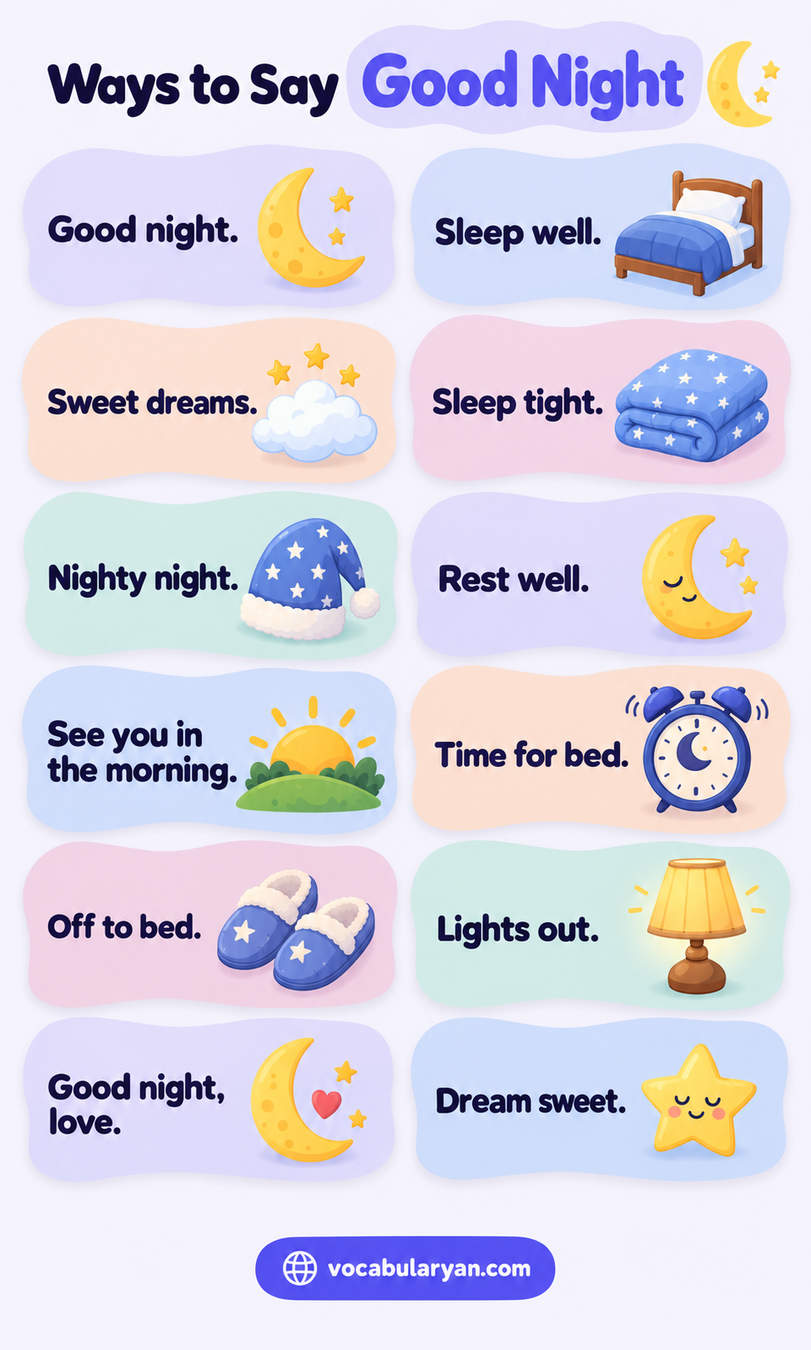
These seven farewells fit almost everyone at bedtime or at the end of an evening, from a partner to a neighbour on the stairs.
Good night: the standard form, correct with family, friends, colleagues, and strangers. It goes with a name and works in speech and in writing.
- Good night, Priya, and thanks for dinner.
- Good night, everyone, the lights go off in ten minutes.
- Right, I’m off to bed, good night.
Night: the short form, and it fits friends, family, and flatmates. With a stranger or a client it sounds too quick, so use the full form there.
- Night, Tom, see you at breakfast.
- Night! Don’t forget to lock the back door.
- Okay, I’m done, night, all.
Sleep well: a wish rather than a plain goodbye, and it fits anyone you care about. It sounds kind after a hard day.
- Sleep well, Grandad, I’ll bring your tea at eight.
- You’ve had a long week, so sleep well.
- Good night, Ana, sleep well and text me when you land tomorrow.
Sleep tight: a warm, slightly old-fashioned wish that means "sleep deeply". It fits children, partners, and close friends.
- Sleep tight, little one, the nightlight stays on.
- Good night, love, sleep tight.
- Sleep tight, and don’t worry about the exam, you’re ready.
Sweet dreams: a soft wish for a partner, a child, or a close friend, said at the bedroom door or at the end of a call.
- Sweet dreams, Maya, see you in the morning.
- Night, darling, sweet dreams.
- I’m turning my phone off now, sweet dreams.
See you in the morning: the farewell for someone who sleeps in the same house or the same hotel, and it names the next meeting.
- Good night, Mum, see you in the morning.
- I’ve set the alarm for six, see you in the morning.
- See you in the morning, Raj, breakfast is in the lobby.
Have a good night: the polite farewell for someone who leaves before you, at a shop, an office, or a restaurant. It is a wish for the whole evening, and sleep is one part of it.
- Have a good night, and thank you for shopping with us.
- Have a good night, Mr Chen, the taxi is outside.
- That’s everything from me, have a good night.
Say "good night" when you are unsure, and add "sleep well" for anyone who is going straight to bed.
Cute Ways to Say Good Night to a Partner
These wishes are for a boyfriend, a girlfriend, a husband, or a wife, and each one says that the person is on your mind at the end of the day.
Good night, my love: the plain romantic form, and it fits a partner at any stage of a relationship.
- Good night, my love, drive safe in the morning.
- Good night, my love, I’ll dream about the beach.
- Sleep well and good night, my love.
Dream of me: a playful wish that asks the partner to think of you while they sleep. It fits a couple who live apart or a couple at the end of a call.
- Dream of me, I’ll be back on Friday.
- Night, Sam, dream of me.
- Dream of me and I’ll dream of you, deal?
I’ll be dreaming of you: the same wish from the other side, and it sounds warm in a text or a whisper.
- Sleep tight, I’ll be dreaming of you.
- I’ll be dreaming of you all the way to Lisbon.
- Good night, Leo, I’ll be dreaming of you, as always.
Can’t wait to see you tomorrow: a good night for a partner you will meet the next day, and it puts the joy on the morning rather than the night.
- Night, can’t wait to see you tomorrow.
- Can’t wait to see you tomorrow, wear the blue jacket.
- Sleep well, can’t wait to see you tomorrow at the station.
Wish I was there to tuck you in: a long-distance wish for a partner who is away, said in a message or on the phone.
- Wish I was there to tuck you in, sleep well.
- Night, Kemi, wish I was there to tuck you in.
- Wish I was there to tuck you in, only two more nights.
Sleep well, beautiful: a compliment and a wish in one, with "handsome" for a man. It fits a couple, and it sounds strange from anyone else.
- Sleep well, beautiful, I’ll call at eight.
- Sleep well, handsome, big day tomorrow.
- Good night, sleep well, beautiful, I love you.
Keep "dream of me" and "sleep well, beautiful" for a partner, and say "good night, my love" when you want the plain warm form.
Sweet Ways to Say Good Night to Children
Bedtime phrases for children are short, gentle, and full of rhyme, and a child hears the same one every night.
Night night: the standard bedtime farewell for a small child, and it is the first good night most children learn. Between parents it is a joke too.
- Night night, Ellie, sleep tight.
- Night night, teddy is right here next to you.
- Say night night to Grandma, then it’s straight upstairs.
Nighty night: a softer form of "night night", used with babies and toddlers, and with a partner as a joke.
- Nighty night, sweetheart, Mummy loves you.
- Nighty night, little man, no more stories tonight.
- Time to sleep, nighty night.
Sleep tight, don’t let the bed bugs bite: a rhyme said at the bedroom door, and the bugs are a joke rather than a warning.
- Good night, sleep tight, don’t let the bed bugs bite.
- Sleep tight, don’t let the bed bugs bite, Noah, and no reading under the covers.
- Right, lights off, sleep tight, don’t let the bed bugs bite.
Lights out: the moment the bedroom light goes off, and it is a good night and an order in one. Older children hear it at camp and at boarding school.
- Lights out, boys, it’s nine o’clock.
- Lights out in five minutes, finish the page.
- Okay, lights out, sweet dreams.
Off to dreamland: a gentle way to say that a child is falling asleep or needs to fall asleep now.
- Come on, off to dreamland, it’s late.
- She was off to dreamland before the story ended.
- Off to dreamland, little one, I’ll see you in the morning.
Snug as a bug in a rug: a rhyme said when you tuck a child in, and it means warm and comfortable under the blanket.
- There, snug as a bug in a rug, good night.
- You’re all wrapped up, snug as a bug in a rug.
- Snug as a bug in a rug, and the door stays open a crack.
Time for bed, sleepyhead: a rhyming order for a child who is yawning, and "sleepyhead" is a fond name for a tired person.
- Time for bed, sleepyhead, teeth first.
- You can’t keep your eyes open, so it’s time for bed, sleepyhead.
- Time for bed, sleepyhead, school tomorrow.
Say "night night" to a small child every night, and add one rhyme, because a child sleeps better with the same words.
Casual Ways to Say Good Night to Friends
Casual farewells at night are for friends, flatmates, and classmates, and most of them say that you are going to bed rather than wishing sleep on the other person.
I’m off to bed: the plain way to leave a room or a chat at night, and it fits friends and family alike.
- I’m off to bed, night, all.
- Long day, so I’m off to bed, see you tomorrow.
- I’m off to bed, turn the telly off when you’re done.
I’m going to hit the hay: American slang for "go to bed", and it fits friends and relaxed colleagues. It is a joke about sleeping on hay in a barn.
- It’s past midnight, so I’m going to hit the hay.
- I’m going to hit the hay, we’ve got an early start.
- Night, guys, I’m going to hit the hay.
Time to catch some Zs: slang for "get some sleep", because "zzz" is the sound of sleep in a cartoon. Keep it for friends.
- Time to catch some Zs, I’m done.
- The match is over, so it’s time to catch some Zs.
- Time to catch some Zs, night, Jay.
I’m calling it a night: the phrase for ending an evening out or a work session, and it fits friends and colleagues.
- I’m calling it a night, my feet hurt.
- That’s the last slide, so I’m calling it a night.
- I’m calling it a night, thanks for the drinks.
Catch you tomorrow: a casual goodbye at night to a friend you will see the next day.
- Night, Ben, catch you tomorrow at the gym.
- Catch you tomorrow, don’t be late.
- I’m heading up, catch you tomorrow.
Sleep well, mate: the British and Australian form of "sleep well" between friends, and "mate" fits a man or a woman you know well.
- Sleep well, mate, and cheers for the lift.
- Night, sleep well, mate, big game tomorrow.
- Sleep well, mate, you’ve earned it.
Say "I’m off to bed" when you leave, and keep "hit the hay" and "catch some Zs" for friends your own age.
Ways to Say Good Night to Family
Family good nights are the warmest of all, and most of them go with a name, a kiss, or a small instruction for the morning.
Good night, Mum: the plain form with a family name, and it is the good night heard in most homes every night.
- Good night, Mum, thanks for the soup.
- Good night, Dad, I’ll wake you before I leave.
- Good night, Nan, sleep well.
Love you, night: the shortest way to say good night and "I love you" at once, and it fits a parent, a child, or a sibling.
- Love you, night, see you at breakfast.
- Love you, night, Mum.
- Okay, love you, night, don’t wait up.
Don’t stay up too late: a good night from a parent to a teenager, or between partners, and it is care in the form of an order.
- Night, Ava, don’t stay up too late.
- Don’t stay up too late, you’ve got school.
- I’m going up now, don’t stay up too late with that game.
Sleep well, love: "love" is a British family name for a partner, a child, or a parent, and the phrase fits anyone at home.
- Sleep well, love, the heating is on.
- Night, sleep well, love, I’ll be up early.
- Sleep well, love, and shout if you need anything.
See you at breakfast: the family form of "see you in the morning", and it names the first meeting of the next day.
- Good night, Grandad, see you at breakfast.
- See you at breakfast, I’m making pancakes.
- Night, kids, see you at breakfast, no phones upstairs.
Say "good night" with a family name, and add "love you" or "don’t stay up too late" because those two lines are what family sounds like at night.
Ways to Say Good Night Over Text
Text good nights are short, and letters, punctuation, and a kiss mark do the work of your voice.
Night x: the standard British text good night to a partner, a friend, or a family member, and the "x" is a kiss.
- Night x
- Night x, talk tomorrow.
- Off to sleep, night x
Gn: the two-letter short form of "good night", used by younger speakers with close friends. It reads cold from anyone else, so keep it for a group chat.
- Gn, guys, early shift.
- Gn, message me when you’re up.
- Okay, I’m out, gn.
Nightttt: "night" with extra letters, and the more letters you add, the sleepier and warmer it reads.
- Nightttt, I’m so tired.
- Nightttt, love you.
- Fine, you win, nightttt.
Sleep well, talk tomorrow: a full text good night for a partner or a friend, and it promises the next message.
- Sleep well, talk tomorrow, and good luck at the interview.
- Sleep well, talk tomorrow, I’ll send the photos.
- Night, sleep well, talk tomorrow x
Going to sleep, night: the text that ends a chat, and it fits anyone you message at night.
- Going to sleep, night, thanks for the help.
- Going to sleep, night, you should too.
- Right, going to sleep, night, all.
Sweet dreams x: the romantic text good night, and the kiss mark makes it read as a partner’s message.
- Sweet dreams x
- Sweet dreams x, miss you already.
- Night, Dan, sweet dreams x
Keep a text good night to three words or fewer, and add an "x" or extra letters for warmth.
Formal Ways to Say Good Night
Formal good nights fit a manager, a client, a guest of honour, or a stranger, and they go with a title and a surname or a full polite sentence.
Good night, Mr Lewis: "good night" with a title and surname is the standard formal farewell at the end of an evening event, a late meeting, or a hotel shift.
- Good night, Mr Lewis, your car is at the front door.
- Good night, Dr Okafor, thank you for staying so late.
- Good night, Mrs Kaur, the porter will bring your bags up.
Have a good night: the polite farewell for anyone who leaves before you, and it fits a receptionist, a waiter, or a colleague.
- Have a good night, sir, and thank you for dining with us.
- Have a good night, Ms Adams, see you at the conference tomorrow.
- I’ll close the office, have a good night.
Have a restful night: a formal wish for sleep, and it fits a guest, a patient, or a senior colleague who looks tired.
- Have a restful night, Mr Petrov, breakfast starts at seven.
- The results are fine, so have a restful night.
- Have a restful night, Professor, we’ll continue in the morning.
I hope you sleep well: the polite full-sentence form of "sleep well", and it fits a client at a hotel or a guest in your home.
- I hope you sleep well, the room is quiet at the back.
- Good night, Mrs Novak, I hope you sleep well.
- I hope you sleep well after such a long flight.
Rest well: a short formal wish, a little warmer than "have a restful night", and it fits a nurse, a host, or a manager.
- Rest well, Mr Diaz, the doctor will see you at nine.
- Good night and rest well, you’ve done enough for today.
- Rest well, everyone, tomorrow is the final day.
Good night and thank you for coming: the farewell from a host at the end of a dinner, a wedding, or a work event.
- Good night and thank you for coming, the coats are by the door.
- Good night and thank you for coming, we’ll send the photos next week.
- From all of us, good night and thank you for coming.
The one mistake that happens most is "good night" as a greeting, because "good morning" and "good afternoon" work on arrival and "good night" looks like the fourth in the set.
- Good night, Mr Lewis, do you have a reservation? (at 8 p.m., on arrival) ❌
"Good night" is a farewell, so it ends a conversation, and the greeting on arrival after six is "good evening".
- Good evening, Mr Lewis, do you have a reservation? ✅
Every good night on this page belongs to one of five levels.
| Level | Good nights | Who it fits |
|---|---|---|
| Slang | Gn, hit the hay, catch some Zs | Close friends your own age |
| Casual | Night, night night, I’m off to bed, catch you tomorrow | Friends, family, flatmates |
| Neutral | Good night, sleep well, see you in the morning | Anyone you know by name |
| Formal | Have a good night, good night with a title, rest well | Managers, clients, customers, older people |
| Very formal | Have a restful night, I hope you sleep well, good night and thank you for coming | Guests of honour, patients, hosts at an event |
Say "good night" with a title and surname to a senior person, and "have a good night" to anyone who leaves before you.
Ways to Say Good Night to Colleagues Leaving Late
A colleague who leaves the office at night gets a farewell about the evening or the journey home, not a wish about sleep.
Have a good evening: the standard office farewell from five o’clock onwards, and it works with a manager, a teammate, or a client.
- Have a good evening, Sara, and well done on the pitch.
- Have a good evening, I’ll finish the report tomorrow.
- Bye, have a good evening, everyone.
Don’t stay too late: a kind farewell to a colleague who is still at a desk when you leave, and it fits a teammate or a junior.
- Night, Marco, don’t stay too late.
- Don’t stay too late, the deadline is Friday, not tomorrow.
- I’m off, don’t stay too late, it’s nearly nine.
Get some rest: the farewell for a colleague who has worked a long day or a long week, and it sounds warm without sounding too personal.
- Get some rest, you’ve been here since seven.
- Good night, Fatima, get some rest, the launch went well.
- Get some rest this weekend, we start again on Monday.
Get home safe: the farewell for a colleague who leaves late, in the dark, or in bad weather.
- Get home safe, the roads are icy.
- Night, Joel, get home safe.
- Get home safe, and text the group when you’re in.
See you tomorrow: the plain office good night, and it names the next working day.
- See you tomorrow, the meeting moved to ten.
- Night, all, see you tomorrow.
- See you tomorrow, Ruth, thanks for staying.
A bedtime wish to a manager sounds too close, because "sweet dreams" and "nighty night" belong to a partner or a child.
- Sweet dreams, Ms Adams, see you at the board meeting. ❌
At work the farewell is about the evening or the journey, so the same moment takes "have a good evening" or "get home safe".
- Have a good evening, Ms Adams, see you at the board meeting. ✅
Say "have a good evening" or "get home safe" to a colleague who leaves late, and keep every wish about dreams for home.
Ways to Say Good Night to Guests
A guest gets good night in one of two ways: at the front door when they leave, or at the spare-room door when they stay.
I’ll be right here in the morning: a host’s good night to a guest who is staying over, and it means "you are not alone in a strange house".
- Sleep well, I’ll be right here in the morning.
- I’ll be right here in the morning, so knock if you need anything.
- Good night, Elena, I’ll be right here in the morning, coffee at eight.
If you need anything, you know where I am: the same care in a longer form, and it goes with a wave towards your own bedroom door.
- Night, Omar, if you need anything, you know where I am.
- If you need anything, you know where I am, the towels are on the chair.
- Sleep well, and if you need anything, you know where I am.
Breakfast is at eight: a good night with a plan for the morning, and it fits a guest in a home or a hotel.
- Good night, breakfast is at eight, no rush.
- Breakfast is at eight, sleep well.
- I’ll say good night now, breakfast is at eight in the kitchen.
Safe trip home: the good night for a guest who leaves your house at night by car, bus, or on foot.
- Safe trip home, thanks for coming.
- Night, both, safe trip home.
- Safe trip home, text me when you’re in.
Thanks for a lovely evening: the guest’s good night to the host at the door, and it goes with "safe trip home" from the host.
- Thanks for a lovely evening, the food was wonderful.
- Good night, and thanks for a lovely evening, Ruth.
- Thanks for a lovely evening, we must do it again soon.
Say "I’ll be right here in the morning" to a guest who stays, and "safe trip home" to a guest who leaves.
Funny Ways to Say Good Night
Funny good nights are for friends and family who share your humour, and each one plays with an old or odd picture of sleep.
I’m going to hit the sack: "sack" is an old word for a bed made of cloth, and the phrase means "go to bed". It fits friends and family.
- I’m going to hit the sack, my eyes are closing.
- Right, I’m going to hit the sack, night, all.
- I’m going to hit the sack before I fall asleep on the sofa.
Off to the land of Nod: the land of Nod is a joke name for sleep, and the phrase fits a parent, a grandparent, or an old friend.
- I’m off to the land of Nod, good night.
- He’s off to the land of Nod already, look at him.
- Off to the land of Nod, wake me if the cat comes in.
Time to count sheep: counting sheep is the joke cure for a night without sleep, so the phrase means "time to try to sleep".
- Time to count sheep, night, Dan.
- The film is over, so it’s time to count sheep.
- Time to count sheep, I’ve got an exam at nine.
See you on the other side: a joke farewell before a long sleep, and it fits a friend after a late night or a long trip.
- See you on the other side, I plan to sleep for twelve hours.
- Night, see you on the other side of this hangover.
- See you on the other side, don’t wake me before noon.
I’m going to sleep like a log: a promise that you will sleep deeply and hear nothing, and it fits a friend or a partner after a tiring day.
- After that hike, I’m going to sleep like a log.
- I’m going to sleep like a log, so use the spare key.
- Night, I’m going to sleep like a log tonight.
Save the funny good nights for people who laugh with you, because "hit the sack" to a client reads as a mistake.
Regional Ways to Say Good Night in English
English-speaking countries each keep a few good nights of their own, and each one fits a friend or a family member in that country.
British Ways to Say Good Night
Night, love: the everyday British good night at home, and "love" fits a partner, a child, a parent, and even a customer in a corner shop.
- Night, love, I’ve locked up.
- Night, love, sleep well.
- Go on up, night, love.
Night night: used by British adults with each other as a fond or joking good night, and with children too.
- Night night, Dave, mind the stairs.
- Night night, see you at eight.
- Okay, night night, don’t snore.
Sleep well, pet: "pet" is a fond name in the north-east of England, and the phrase fits family and close friends there.
- Sleep well, pet, the kettle’s ready for the morning.
- Night, sleep well, pet.
- Sleep well, pet, you’ve had a long day.
Ta-ra, then, night: "ta-ra" is a northern and Midlands British goodbye, and with "night" it becomes a bedtime farewell between friends.
- Ta-ra, then, night, see you Saturday.
- Ta-ra, then, night, thanks for the tea.
- Right, ta-ra, then, night, all.
American Ways to Say Good Night
Have a good one: the American farewell for any time of day, and at night it means "have a good night".
- Have a good one, Marcus, see you at practice.
- Night, have a good one.
- Have a good one, and drive safe.
Night, y’all: "y’all" is "you all" in the American South, and the phrase fits a group of friends or family at bedtime.
- Night, y’all, breakfast at seven.
- Night, y’all, thanks for a great evening.
- I’m beat, night, y’all.
Catch you in the AM: American slang for "see you in the morning", and it fits friends and flatmates.
- Catch you in the AM, I’m done.
- Night, catch you in the AM for the run.
- Catch you in the AM, don’t forget the tickets.
Australian and Irish Ways to Say Good Night
Night, mate: the Australian good night between friends, and "mate" fits almost anyone you know.
- Night, mate, good game today.
- Night, mate, see you at the beach.
- I’m off, night, mate.
Hooroo: an older Australian goodbye, said with a wave at any hour, and at night it works as a good night between friends and family.
- Hooroo, I’m heading to bed.
- Hooroo, everyone, thanks for tea.
- Night, hooroo, see you tomorrow.
Safe home: the Irish farewell to anyone who leaves your house or the pub at night, and it means "get home safely".
- Safe home, Niamh, mind the road.
- Safe home, and thanks for coming.
- Night, lads, safe home.
Good night, God bless: an older Irish good night from a parent or a grandparent, still heard in many homes.
- Good night, God bless, Sean.
- Good night, God bless, see you in the morning.
- Off you go, good night, God bless.
Say "night, love" in Britain, "have a good one" in America, "night, mate" in Australia, and "safe home" in Ireland, and say "good night" everywhere else.
How Do You Reply When Someone Says Good Night?
The reply to a good night matches the good night: a farewell gets the same farewell back, and a wish for sleep gets a thank you and the wish returned.
Good night or night: reply with the same word, or add a name.
- Good night, Priya. Good night, Tom.
- Night! Night, sleep well.
- Good night, Mr Chen. Good night, Ms Adams, safe journey.
Sleep well or sweet dreams: the reply is "you too", or "thanks, you too".
- Sleep well. You too, night.
- Sweet dreams. Thanks, you too, love.
- Sleep tight. You too, see you at breakfast.
Have a good night or have a good evening: the reply is "you too" or "thanks, same to you".
- Have a good night. You too, thanks.
- Have a good evening, Sara. Thanks, same to you.
- Have a good one. You too, man.
Don’t stay up too late or get some rest: the reply is a promise, real or joking.
- Don’t stay up too late. I won’t, night.
- Get some rest. I will, thanks for today.
- Don’t let the bed bugs bite. I won’t, night night.
Dream of me: the reply agrees, or teases, because the phrase is a game between partners.
- Dream of me. Always, night x
- Dream of me. Only if you dream of me first.
- I’ll be dreaming of you. Me too, sleep well.
Safe home or get home safe: the reply thanks the speaker and ends the evening.
- Get home safe. Will do, night.
- Safe home. Thanks, night, all.
- Safe trip home. Thanks for having us, good night.
"Good evening" as a reply to "good night" is the same mix-up in the other direction.
- Good night, Tom. (reply) Good evening. ❌
The reply to a farewell is a farewell, and "good evening" is a greeting, so the reply is "good night" back.
- Good night, Tom. (reply) Good night, Priya. ✅
Return a good night at the same level, and answer a wish for sleep with "you too" before you add anything else.
More Everyday English Phrases
- Other Ways to Say Sweet Dreams
- Other Ways to Say Take Care
- Other Ways to Say Have a Nice Day
- Other Ways to Say See You Later
FAQs
Both forms are correct, and the two words are the standard form in British and American dictionaries. "Goodnight" as one word is common in texts and in fiction, and it is never wrong in a message to a friend. In a formal email or a card, write "good night" as two words.
No, because "good night" is a farewell and a bedtime wish, and it ends a conversation rather than starting one. The greeting on arrival after about six o’clock is "good evening". "Good night" from a waiter at the door as you arrive is the wrong one.
The difference is the direction of the moment: "good evening" is for arriving, and "good night" is for leaving or going to bed. At a restaurant you hear "good evening" when you sit down and "good night" when you pay and leave. If you are unsure, ask yourself whether the conversation is starting or ending.
Say "good night" back, or "night", and add the person’s name if you know it. A wish such as "sleep well" or "sweet dreams" gets "you too" or "thanks, you too". A farewell such as "get home safe" gets "will do" or "thanks".
"Have a good evening" and "have a good night" are the professional forms, and both fit a manager, a client, or a customer who leaves before you. "Good night" with a title and surname fits the end of a late meeting or an evening event. Wishes about dreams and rhymes belong at home, so leave "sweet dreams" and "nighty night" out of every work message.
"A good night’s sleep" is the correct form, with the apostrophe and the "s", because the sleep belongs to the night. "Have a good night’s sleep" is a wish, and "I had a good night’s sleep" is a report the next morning. "Good night sleep" without the apostrophe is a mistake in writing and sounds wrong in speech.
"Night x", "sweet dreams x", and "sleep well, talk tomorrow" are the most common cute good nights in a text, and the "x" is a kiss. "Nightttt" with extra letters reads sleepy and warm, and "dream of me" fits a partner. Keep the message to a few words, because a short good night reads as fond and a long one reads as a speech.