
"Hurry up" is an order, and an order sounds sharp to anyone who is not a close friend or a child. The ways to say hurry up in English change with the listener: a friend hears "get a move on", a colleague hears "can we move this along?", and a customer hears "whenever you’re ready". The everyday phrases come first, because most days need one of them.
Common Ways to Say Hurry Up in Everyday English
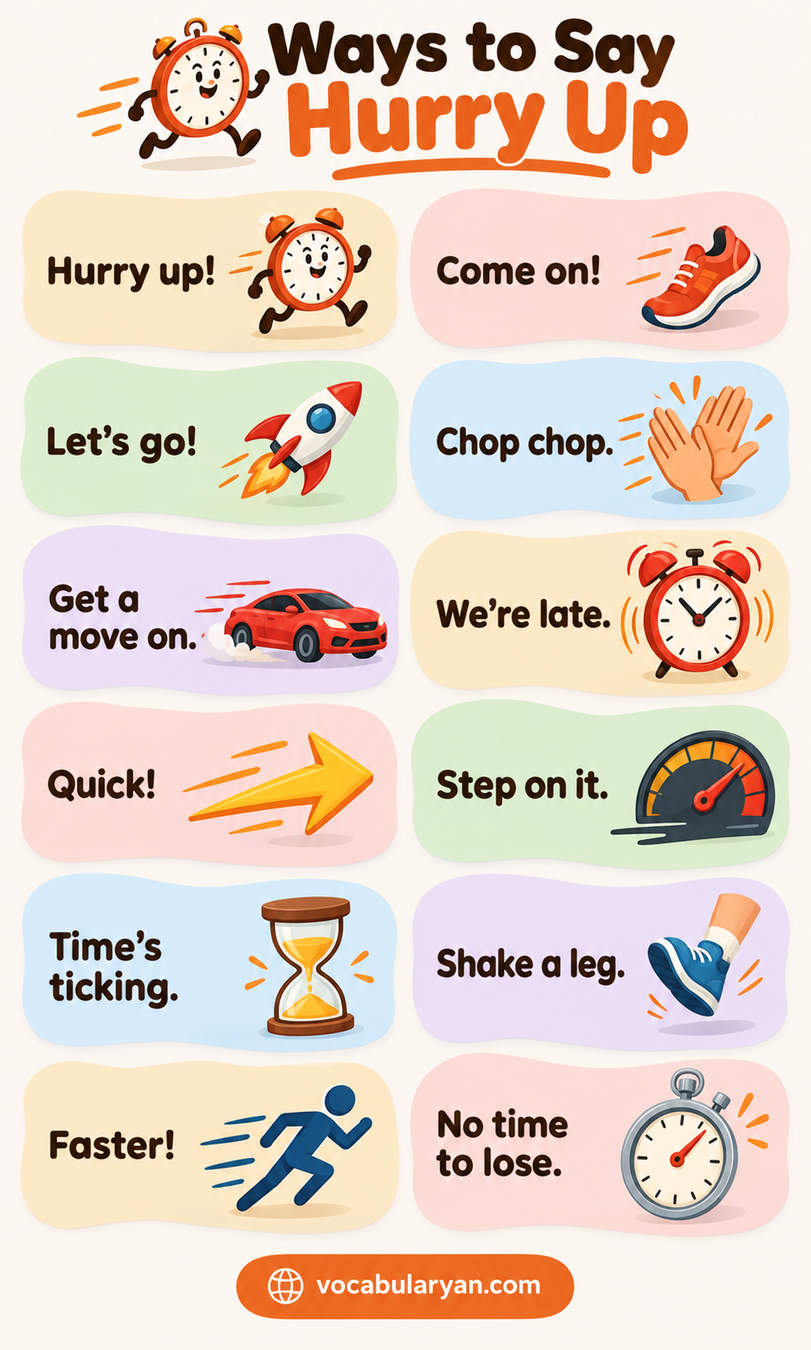
These five phrases are the everyday ones, said at home and between friends when someone is slow.
Hurry up: the direct order, and it fits family, friends, and children. Said to anyone else it sounds like a complaint, so the softer forms come next.
- Hurry up, Ben, the bus leaves in four minutes.
- Can you hurry up in there? I need the bathroom.
- Hurry up and eat, we’re going to be late for school.
Come on: a push rather than an order, and it works with a smile. Most parents say it twenty times a morning.
- Come on, the film starts at eight.
- Come on, Dad, everyone’s waiting in the car.
- Oh, come on, you’ve had an hour to get ready.
Let’s go: the phrase for the moment of leaving, and it moves a whole group at once.
- Let’s go, the taxi’s here.
- Right, coats on, let’s go.
- Let’s go, people, the doors close at nine.
Quick: one word, said when there is no time for a sentence. It fits a friend, a child, or a partner, and it sounds urgent rather than rude.
- Quick, the train’s pulling in!
- Grab your bag, quick, they’re calling our names.
- Quick, hide the cake, she’s coming up the stairs.
We need to leave now: a plain statement of fact, and it fits any listener because it gives a reason rather than an order.
- We need to leave now or we’ll miss the check-in.
- Sorry to interrupt, but we need to leave now.
- Kids, we need to leave now, not in five minutes.
Say "come on" at home, "let’s go" to a group, and "we need to leave now" to anyone who needs a reason.
Casual Ways to Say Hurry Up to Friends
Casual phrases are for people who will not take offence, and each one sounds relaxed even when the time is short.
Move it: blunt and playful between friends, and it fits a doorway, a queue, or a game.
- Move it, Jay, the taxi meter’s running.
- Come on, move it, we’re up next.
- Move it or lose it, I’m taking the front seat.
Let’s get moving: the friendly form of "let’s go", and it fits a group of friends who have stopped to chat.
- Let’s get moving, the pub shuts at eleven.
- Okay, photos done, let’s get moving.
- Let’s get moving before the car park fills up.
Pick up the pace: a request to go faster at a task already started: walking, working, or packing.
- Pick up the pace, we’re the last ones on the trail.
- If we pick up the pace we’ll finish by lunch.
- Come on, pick up the pace, you two, the tide’s coming in.
We haven’t got all day: a tease that says the other person is slow, and it fits friends and family only.
- We haven’t got all day, choose a flavour.
- Are you done? We haven’t got all day.
- Come on, mate, we haven’t got all day.
Let’s not be late: softer than the rest, and it puts the blame on the clock instead of the person.
- Let’s not be late again, her mum already thinks we’re rude.
- Grab your keys, let’s not be late.
- Let’s not be late on the first day.
Use "move it" and "we haven’t got all day" only with friends who joke back, and keep "let’s not be late" for everyone else.
Ways to Say Hurry Up to a Child
A child hears "hurry up" many times a day, so these phrases turn the order into a game or a plan.
Shoes on, let’s go: an instruction plus a phrase, and it works because the child knows what to do first.
- Shoes on, let’s go, the school gate shuts at nine.
- Right, Mia, shoes on, let’s go.
- Shoes on, let’s go, Grandma’s waiting at the park.
Quick, quick: the doubled word sounds like a game, and it fits toddlers and small children.
- Quick, quick, into the car before it rains!
- Quick, quick, brush your teeth and I’ll read a story.
- Pyjamas on, quick, quick, lights out in five minutes.
Let’s see how fast you can be: a challenge instead of an order, and most children answer it by running.
- Let’s see how fast you can be getting dressed.
- Toys in the box, let’s see how fast you can be.
- Let’s see how fast you can be, I’ll count.
I’m counting to three: a warning that the time is almost up, and it fits a parent or a teacher.
- I’m counting to three, and then the tablet goes away.
- Coat on now, I’m counting to three.
- I’m counting to three, one, two…
Last one to the car is a rotten egg: the old playground race, and it gets a slow child to the door faster than any order.
- Last one to the car is a rotten egg!
- Right, last one to the car is a rotten egg, go!
- She shouted "last one to the car is a rotten egg" and both boys ran.
Turn "hurry up" into a race or a count for a child, and keep the order for the moments that are dangerous.
Polite Ways to Say Hurry Up at Work
A colleague hears a question, not an order, and each of these asks for speed without a complaint.
Could you speed this up a little?: the standard polite form, and "a little" softens it further. The reply is a time: "I’ll have it by three."
- Could you speed this up a little? The client is waiting on the numbers.
- Sorry to push, but could you speed this up a little?
- Could you speed this up a little, Dan? The van leaves at two.
Can we move this along?: the phrase for a meeting or a task that has slowed down, and it blames nobody.
- Can we move this along? We still have three things on the agenda.
- We’re over time, so can we move this along?
- Can we move this along, please? Half the room has another call.
We’re short on time: a fact about the schedule, not the person, so nobody feels blamed.
- We’re short on time, so let’s skip the slides.
- We’re short on time today, can you send me the draft as it is?
- Let’s decide now, we’re short on time.
Is there any way to have it sooner?: the gentlest way to ask for a faster date, and it leaves the answer open.
- Is there any way to have it sooner? Friday is cutting it fine.
- I know you’re busy, but is there any way to have it sooner?
- Is there any way to have it sooner, even a rough version?
When you get a chance, could you prioritise this?: the phrase for a message to a colleague, and "when you get a chance" keeps it polite even though the meaning is "now".
- When you get a chance, could you prioritise this? Legal needs it today.
- Hi Tom, when you get a chance, could you prioritise this?
- When you get a chance, could you prioritise this over the survey work?
"Hurry up" to a boss is the mistake that costs the most, because an order from a junior to a senior sounds like disrespect.
- Hurry up with the sign-off, Ms Adams, I need it today. ❌
An order is wrong from a junior, so the same request takes a question and a reason.
- Could you speed this up a little, Ms Adams? The printer needs it by noon. ✅
The table places every phrase on this page at one of five levels.
| Level | Phrases (7) | Who it fits (11) |
|---|---|---|
| Slang | Pronto, stat, move your butt (28) | Close friends, teammates (24) |
| Casual | Come on, move it, get a move on (31) | Friends, family, children (25) |
| Neutral | Let’s go, be quick, we need to leave now (40) | Anyone you know by name (23) |
| Formal | Could you speed this up, we’re short on time (44) | Colleagues, managers, clients (29) |
| Very formal | At your earliest convenience, I would be grateful for a reply by (64) | Senior contacts, strangers in writing (37) |
Ask a colleague with "could you" and a reason, and never give an order to anyone senior to you.
Ways to Say Hurry Up in an Email
An email asks for a quick reply or names a deadline, and a date sounds more polite than any order.
As soon as possible: the standard urgent request in writing, and it fits colleagues. The short form "ASAP" is casual and belongs in a message to a teammate, not to a client.
- Please send the signed form back as soon as possible.
- Could you confirm the numbers as soon as possible? The board meets tomorrow.
- I’d appreciate a reply as soon as possible, as the venue needs a headcount.
At your earliest convenience: the formal form of "as soon as possible", and it fits a senior contact or a stranger. It sounds patient, and it means "soon".
- Please review the attached contract at your earliest convenience.
- Could you call me back at your earliest convenience?
- I would be grateful for your reply at your earliest convenience.
By Friday: a date instead of a request for speed, and it is the most polite way to hurry anyone in writing.
- Could you have the draft to me by Friday?
- The forms need to reach the office by Friday at five.
- By Friday would be ideal, but Monday still works.
A quick reply would be much appreciated: the polite closing line when you need an answer today, and it thanks the reader before they act.
- A quick reply would be much appreciated, as the printer is waiting on the final page.
- A quick reply would be much appreciated so I can book the room.
- Sorry to chase, but a quick reply would be much appreciated.
Please treat this as urgent: the strongest line that stays polite, and it fits a colleague or a supplier when a deadline is at risk.
- Please treat this as urgent: the shipment leaves at noon.
- Hi all, please treat this as urgent and reply by end of day.
- Please treat this as urgent, the client has asked for it twice.
Just following up: the phrase for the second email, and it asks for speed without saying so.
- Just following up on my message from Monday, is there any news?
- Just following up: do you need anything else from me before you sign?
- Hi Lena, just following up on the invoice.
An order in writing is worse than an order in speech, because the reader sees it again every time the email opens.
- Hurry up and send the deposit, or you lose the room. ❌
The polite form gives the date and the reason, and the reader keeps the choice.
- To hold the room, we need the deposit by Thursday. ✅
These lines run from casual to very formal, and the image places each one at its level.
Write a date and a reason in an email, and save "as soon as possible" for a colleague you know.
Ways to Say Hurry Up to a Customer or Client
A customer never hears "hurry up", so each phrase here makes the speed sound like a favour to them.
Whenever you’re ready: the opposite of an order, and it works because most customers hear it and speed up on their own.
- Whenever you’re ready, I can take your order.
- No rush, whenever you’re ready we’ll start the fitting.
- Whenever you’re ready, sir, the card machine is just here.
To hold your place, we’d need a reply by Monday: a deadline with a benefit, and the benefit is the reason the customer moves.
- To hold your place, we’d need a reply by Monday.
- To hold your place, we’d need a reply by Monday, as the class is nearly full.
- To hold your place, we’d need a reply by Monday at the latest.
Just so you don’t miss out: a warning about a loss, said as a kindness.
- Just so you don’t miss out, the early price ends tonight.
- Just so you don’t miss out, the last two seats are still on hold for you.
- I’m mentioning it just so you don’t miss out.
I don’t want to hold you up: a way to close a slow conversation, and it makes the customer the busy one.
- I don’t want to hold you up, so shall I email the rest?
- I don’t want to hold you up, are you happy to sign now?
- I don’t want to hold you up any longer, let’s book that in.
A customer who hears an order walks out, so the level trap here costs money.
- Hurry up and decide, there are people behind you. ❌
The same moment takes a choice and a reason, and the customer feels served rather than pushed.
- Whenever you’re ready, there’s no rush, I’ll serve the next person while you look. ✅
Offer a customer a benefit or a date, and say "whenever you’re ready" instead of any order.
Ways to Say Hurry Up to a Group
A group phrase reaches everyone at once, and it names the time left rather than one slow person.
Two minutes, everyone: a time instead of an order, and it fits a class, a team, or a family on holiday.
- Two minutes, everyone, then we’re back on the bus.
- Two minutes, everyone, finish your sentence and save the file.
- Right, two minutes, everyone, last drinks.
Let’s wrap this up: the phrase for the end of a meeting or a task, and it fits a manager or a host.
- Let’s wrap this up, we’ve covered everything on the list.
- Okay, let’s wrap this up and get some lunch.
- Let’s wrap this up, the next group needs the room.
Let’s crack on: British, and it means "start or continue with energy". It fits a work group or friends on a job.
- Let’s crack on, the light goes at four.
- Tea’s finished, let’s crack on.
- Let’s crack on with the painting while it’s dry.
Last call: the phrase from a bar or an airport, and it means "this is the final chance".
- Last call for boarding at gate twelve.
- Last call for anyone who wants a coffee before we leave.
- This is the last call, hand your forms in now.
Give a group a time or a "last call", because an order to a room reaches nobody in particular.
Ways to Say Hurry Up When You Are Late
These phrases name the problem, so the other person hurries without being told to.
We’re running late: the plainest statement, and it fits anyone from a partner to a taxi driver.
- We’re running late, can you skip the second coat?
- We’re running late already, so leave the dishes.
- Sorry, we’re running late, is the meter on?
We’re going to miss it: a warning about the result, and it fits a train, a film, or an appointment.
- We’re going to miss it if you don’t find your keys now.
- Come on, we’re going to miss it!
- We’re going to miss it, the last bus is at eleven.
We should have left ten minutes ago: a complaint about the clock, not the person, and it fits family and friends.
- We should have left ten minutes ago, where’s your coat?
- Honestly, we should have left ten minutes ago.
- We should have left ten minutes ago, I told you the traffic would be bad.
We’re cutting it fine: British, and it means "there is almost no spare time". It sounds calm rather than cross.
- We’re cutting it fine, the doors close at half past.
- If we stop for petrol we’re cutting it fine.
- We’re cutting it fine, but we’ll make it if the lights are green.
"Hurry up" to a stranger is the third trap, and it happens most in a queue or at a ticket machine.
- Hurry up, some of us have trains to catch. ❌
A stranger owes you nothing, so the polite form asks for help with your problem.
- Sorry, I’m running late for a train, would you mind if I went first? ✅
Name the clock, not the person, when you are late, and say "we’re going to miss it" instead of "hurry up".
Ways to Say Hurry Up in a Text
A text hurries someone in three words or fewer, and a question mark keeps it friendly.
Where are you?: the most common hurry-up text, and it means "you are late" without saying it.
- Where are you? We ordered without you.
- Where are you? The film starts in five.
- Hey, where are you? I’m outside.
Almost ready?: a soft check, and it fits a partner, a flatmate, or a friend you are waiting for.
- Almost ready? Taxi’s on its way.
- Almost ready? No rush, just checking.
- Almost ready? I’m parked round the corner.
ETA?: short for "estimated time of arrival", and it fits friends and colleagues in a message.
- ETA? We’re at the back table.
- ETA? They won’t hold the booking past eight.
- Quick one, ETA?
Hurry pls: the casual text form, and the short spelling makes it friendly rather than cross.
- Hurry pls, it’s freezing out here.
- Hurry pls, the queue is moving fast.
- Hurry pls x
Need this asap: the work text, and it fits a colleague you message all day. In an email to a client it is too short.
- Need this asap, the client’s on the phone.
- Need this asap pls, sorry!
- Hi, need this asap if you can, the deck goes out at three.
Text "where are you?" or "ETA?" to a friend, and save "need this asap" for a colleague you message all day.
Ways to Say Hurry Up to a Driver or in Traffic
A driver hears a request about speed, and each phrase names the road, the time, or the pedal.
Put your foot down: British, and it means "press the accelerator harder". It fits a friend or a family member who is driving.
- Put your foot down, the ferry leaves at ten.
- Dad, put your foot down, we’re going to miss the start.
- She put her foot down and we made it with a minute to spare.
Can you go a bit faster?: the polite request to a taxi driver, and "a bit" keeps it from sounding like panic.
- Can you go a bit faster? My flight boards in forty minutes.
- Sorry, can you go a bit faster? I’m late for an interview.
- Can you go a bit faster, please? The meeting started already.
Is there a quicker way?: a question about the route instead of the speed, and it never offends a driver.
- Is there a quicker way? This road is jammed.
- Is there a quicker way round the roadworks?
- Excuse me, is there a quicker way to the station?
Floor it: slang for "drive at full speed", and it fits a friend at the wheel, never a taxi driver.
- Floor it, the lights are green!
- Just floor it, there’s nobody behind us.
- He said "floor it" and I told him to put his seatbelt on first.
Ask a taxi driver "can you go a bit faster?" and keep "floor it" for a friend’s car.
Urgent Ways to Say Hurry Up in an Emergency
In an emergency the phrase is one or two words, shouted, and politeness stops for the moment.
Now!: the single word, and it fits a fire, a fall, or a child near a road.
- Out of the water, now!
- Call an ambulance, now!
- Everybody out, now!
Move!: the order to get out of the way, and it is the right word to shout when someone is in danger.
- Move! The shelf’s coming down!
- Move, move, let the medic through!
- Get back, move!
Go, go, go!: the triple order from sport and the army, and it fits a race, a fire drill, or a rush to a gate.
- Go, go, go! The gate closes in two minutes!
- The coach shouted "go, go, go" and the team ran.
- Doors open, go, go, go!
There’s no time to lose: a full sentence for a serious moment, and it fits a doctor, a rescue, or a deadline that cannot move.
- There’s no time to lose, get the car.
- There’s no time to lose, she needs a hospital.
- We leave tonight, there’s no time to lose.
Shout "now" or "move" in a real emergency, and keep the polite forms for everything else.
Regional Ways to Say Hurry Up in English
Each English-speaking country keeps a few hurry-up phrases of its own, and most of them are jokes between friends.
British Ways to Say Hurry Up
Get a move on: the everyday British phrase for "hurry up", and it fits friends, family, and children. Americans understand it and say it too, but less.
- Get a move on, the bus is at the end of the road.
- Come on, get a move on, you’ll miss breakfast.
- We’d better get a move on if we want a seat.
Chop chop: a playful two-word push, from Cantonese through the speech of sailors, and most common in Britain. It fits friends and children, and from a boss it sounds rude.
- Chop chop, the taxi’s outside.
- Right, chop chop, coats on.
- Chop chop, we’ve got a train to catch.
Put your skates on: British, and it means "go faster", with the picture of someone on roller skates. It sounds friendly.
- Put your skates on, the shop shuts at five.
- You’d better put your skates on, the taxi’s here.
- Put your skates on, love, we’re late.
American Ways to Say Hurry Up
Step on it: American in origin, from the car accelerator, and now said in every English-speaking country. It fits a taxi driver in a film, and in real life it fits a friend.
- Step on it, we’ve got twenty minutes to get to the airport.
- Come on, step on it, the game’s already started.
- She told the driver to step on it and he laughed.
Shake a leg: American in origin and now international, and it fits a friend or a child who is slow to get up.
- Shake a leg, breakfast is on the table.
- Come on, shake a leg, the bus leaves in ten.
- I told him to shake a leg and he rolled over.
Make it snappy: American, and it means "do it fast", said with a smile to a friend or a child. From a customer to a waiter it sounds rude.
- Two coffees, and make it snappy, I’ve got a train.
- Get your coat, and make it snappy.
- Make it snappy, the film’s starting.
Australian and Irish Ways to Say Hurry Up
Get a wriggle on: the Australian form of "get a wiggle on", and it fits friends and family. It sounds warm.
- Get a wriggle on, the surf’s up.
- Come on, get a wriggle on, mate, the barbie’s lit.
- We’d better get a wriggle on if we want to beat the traffic.
Rattle your dags: Australian and New Zealand slang for "hurry up", from sheep farming, and it is a joke between friends.
- Rattle your dags, we’re leaving in five.
- Come on, rattle your dags, the footy starts at two.
- He told the kids to rattle their dags and they laughed.
Hurry on: the Irish form of "hurry up", and it fits friends and family. "Will you hurry on" is the fuller form.
- Hurry on, the bus is coming down the road.
- Will you hurry on, we’ll miss the start.
- Hurry on, lads, the match is about to kick off.
The image places each of these phrases in its home country.
Say "get a move on" in Britain, "step on it" in America, "get a wriggle on" in Australia, and "hurry on" in Ireland.
Slang Ways to Say Hurry Up
Slang phrases are for close friends and teammates, and each one is wrong in front of anyone senior.
Pronto: from Spanish and Italian, and it means "right now". It fits friends and sounds a little jokey.
- Get over here, pronto.
- I need that report, pronto.
- Coats on, pronto, the taxi’s waiting.
Stat: from hospital speech, short for the Latin "statim", and it means "immediately". It fits friends and colleagues who joke.
- I need coffee, stat.
- Send me the file, stat.
- Get the manager here, stat.
Move your butt: American slang, blunt and playful, and it fits a sibling, a flatmate, or a close friend only.
- Move your butt, the pizza guy’s downstairs.
- Come on, move your butt, we’re late.
- He told me to move my butt and I threw a cushion at him.
Giddy up: the word for a horse, used as a joke to a slow friend or a child on your shoulders.
- Giddy up, we’re going to be late for the party.
- Come on, giddy up, the bus won’t wait.
- Giddy up, Dad, the ice cream van’s leaving.
Keep "pronto", "stat", and "move your butt" for friends, and never type them to a manager.
Funny Ways to Say Hurry Up
Funny phrases work on a friend who is slow, and each one makes the wait into the joke.
I’m growing old here: a complaint that the wait is taking years, said with a grin.
- I’m growing old here, pick a film.
- Any time you like, I’m growing old here.
- I’m growing old here, Sam, is the sandwich ready?
Sometime this century: sarcasm about a long wait, and it fits friends who tease each other.
- Can we leave sometime this century?
- Sometime this century would be nice.
- Are you going to order sometime this century?
While we’re young: sarcasm from the golf course, said to someone who takes too long to decide or to act.
- Choose a colour, while we’re young.
- Take the shot, while we’re young.
- Are you going to park while we’re young?
Today, please: two polite words said in a flat voice, and the joke is the contrast between the words and the voice.
- Keys, today, please.
- Can we go, today, please?
- Today, please, the film won’t wait.
Save the jokes for a friend who laughs back, because "sometime this century" to a stranger is an insult.
How Do You Reply When Someone Says Hurry Up?
The reply to "hurry up" is a time, a promise, or a push back, and silence is the one answer that makes it worse.
Coming!: the shortest reply, shouted from another room, and it means "I have heard you".
- Hurry up, the taxi’s here! Coming!
- Come on, we’re late! Coming, one second!
- Let’s go! Coming, I can’t find my shoes.
I’m going as fast as I can: the reply when the pushing is unfair, and it fits family and friends.
- Chop chop! I’m going as fast as I can.
- Can you speed this up? I’m going as fast as I can, the system’s slow today.
- Hurry up! I’m going as fast as I can, there’s a queue.
Hold your horses: the push back, and it means "be patient". It fits friends and family, and it sounds rude to a customer.
- Hurry up! Hold your horses, the shop doesn’t open till nine.
- Come on, come on! Hold your horses, I’m looking for my card.
- Where are you? Hold your horses, I’m parking.
I’ll have it to you by three: the work reply, and it gives a time so the other person stops asking.
- Could you speed this up? I’ll have it to you by three.
- Is there any way to have it sooner? I’ll have it to you by three, if the numbers arrive.
- Please treat this as urgent. Understood, I’ll have it to you by three.
The image pairs each hurry-up line with the reply that fits it.
Reply with a time or "coming", and keep "hold your horses" for people who hurry you as a joke.
More Everyday English Phrases
FAQs
"Come on" is the most common one in speech, and "let’s go" is second. At work the question "could you speed this up a little?" replaces the order, and in an email a date such as "by Friday" replaces it. For a friend, "get a move on" and "chop chop" are both fine.
The nice way names the clock instead of the person: "we’re running late", "we’re short on time", or "we’re going to miss it". A question also sounds kind: "almost ready?" or "is there any way to have it sooner?". Each one gives the listener a reason, and a reason is what turns an order into a request.
The professional forms are questions and dates. "Could you speed this up a little?", "can we move this along?", and "is there any way to have it sooner?" all fit a colleague. In an email, "by Friday" or "at your earliest convenience" fits the same need. "Please treat this as urgent" is the strongest line that stays polite.
No, not between friends, family, and children, where it is the normal phrase. Yes, to a boss, a customer, or a stranger, because it is an order, and an order from a junior or from a shop assistant sounds like disrespect. With those three, a question and a reason ask for the same speed without the offence.
It depends on the speaker. From a parent to a child or between friends it is a joke, and nobody minds. From a manager, a customer, or a stranger it sounds like an order to a servant, so it is rude in those three cases.
"Pronto", "stat", "move your butt", and "giddy up" are the slang forms, along with "make it snappy" in American English and "get a wriggle on" in Australia. All of them belong to friends and teammates, and none of them belong in a message to anyone senior.
"I’m growing old here", "sometime this century", "any day now", and "while we’re young" are all jokes about a wait that feels too long. They work on a friend who is slow to choose or to leave, and the joke is the exaggeration. To a stranger, each one is an insult.
"Come on", "move it", "get a move on", and "let’s get moving" are the casual forms, and "we haven’t got all day" is the casual tease. They fit friends, family, and flatmates, and they sound relaxed even when the time is short.