
"I agree" is a full sentence on its own, and in speech it sounds short and a little cold. The many ways to say I agree in English each add one thing to it: warmth for a friend, weight for a meeting, or a limit for an opinion you accept only in part. You pick the phrase by the person and the strength of your agreement, and the everyday phrases come first.
Common Ways to Say I Agree in Everyday English
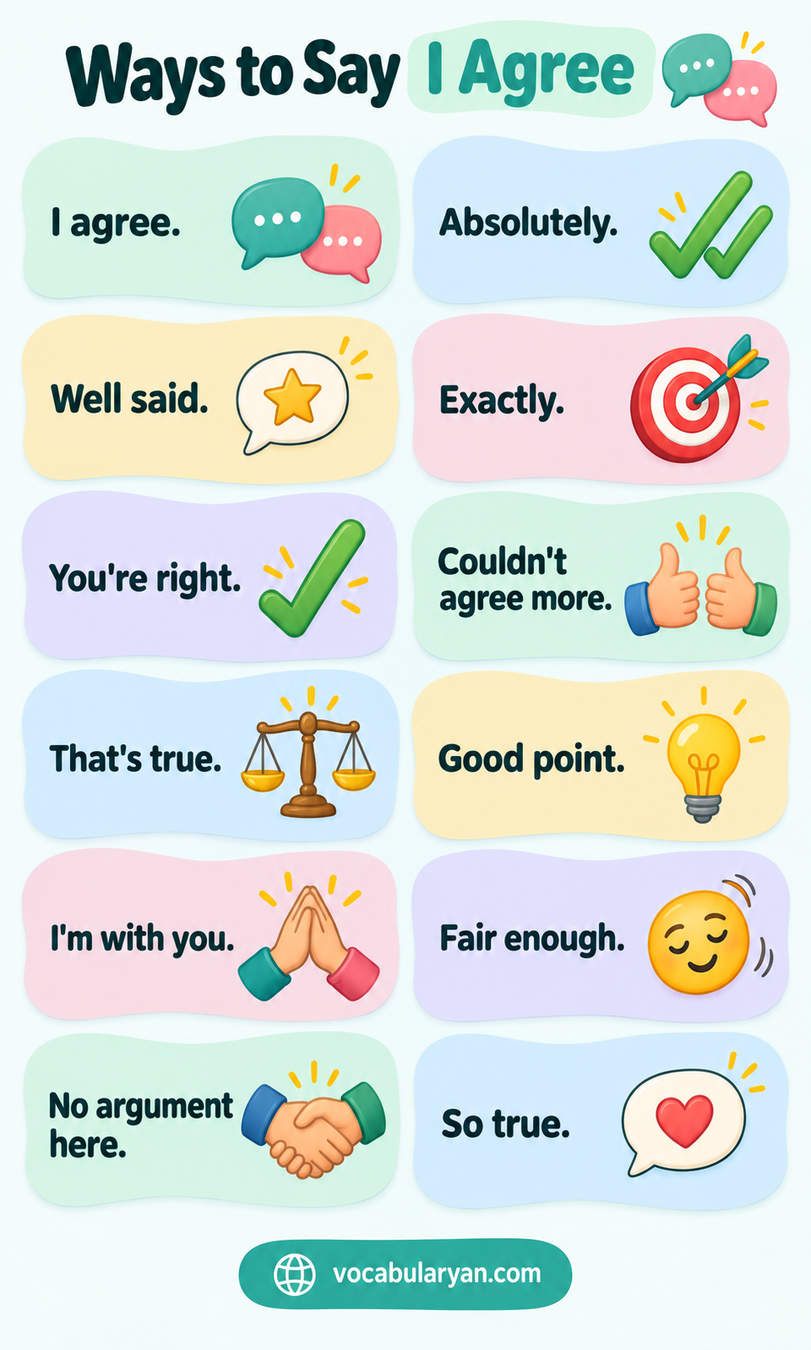
These phrases fit any person and any moment, and each one replaces "I agree" without changing the level.
Yes: the plainest agreement, and it fits every person from a child to a judge. On its own it sounds short, so a reason or a name goes after it.
- Yes, the blue one looks better with the curtains.
- Yes, Dad, you were right about the traffic.
- Yes, that’s the date we discussed, so I’ll book the room.
Agreed: one word that closes a small decision, and it fits colleagues, friends, and family alike. It sounds firm rather than warm.
- Agreed, we’ll leave at seven and eat on the way.
- Agreed, the price is too high for a used bike.
- That sounds fair. Agreed.
Of course: agreement that treats the other person’s words as obvious in a friendly way. It fits a request as well as an opinion.
- Of course the kids should come, it’s a family lunch.
- Of course, take the afternoon off, you’ve earned it.
- Of course it’s cheaper by train, the bus takes twice as long.
Definitely: a warm, confident yes that fits speech and messages with almost anyone. It sounds sure without sounding loud.
- Definitely, the earlier flight is the better choice.
- Is the new café worth a visit? Definitely.
- Definitely, I’ve had the same problem with that printer.
That’s right: agreement with a fact or a memory, and it fits a colleague, a teacher, or a friend who has just said something true.
- That’s right, the meeting moved to Thursday.
- That’s right, we met at Lena’s wedding two years ago.
- That’s right, the shop closes early on Sundays.
Say "yes" with a reason after it, because a bare "yes" ends the conversation as fast as it starts.
Casual Ways to Say I Agree to Friends
Casual agreement is for people who know you well, and each phrase sounds quick, warm, and a little emotional.
Totally: the most common casual yes, and it fits a friend’s opinion about anything from a film to a boss. It sounds too relaxed for a formal meeting.
- Totally, that ending made no sense at all.
- Totally, we should have booked the earlier train.
- Oh, totally, she’s the best cook in the family.
For sure: a confident casual yes that fits speech and texts between friends. In American English it is everywhere; in British English it sounds a little younger.
- For sure, the sequel is better than the first one.
- For sure, I’ll be there by eight.
- Should we bring dessert? For sure.
Tell me about it: agreement with a complaint, and it means "I have the same problem". It is never a request for the full story.
- The buses are hopeless this week. Tell me about it, I waited forty minutes.
- Tell me about it, my rent went up too.
- The exam was brutal. Tell me about it.
I know, right?: a casual phrase that agrees and asks for more agreement at the same time. It fits friends your own age and sounds strange from anyone senior.
- That new bakery is amazing. I know, right?
- I know, right? I couldn’t believe he said that.
- The tickets are so cheap this year. I know, right?
Same here: agreement that means "I feel the same" or "I want the same", and it fits opinions, orders, and moods.
- I’m exhausted after that walk. Same here.
- I’d pick the window seat every time. Same here.
- Same here, I’ve never liked that song.
Keep "totally", "for sure", and "I know, right?" for friends, and switch to "yes" or "that’s right" with anyone senior.
Formal Ways to Say I Agree at Work and in Meetings
Formal agreement fits a manager, a client, or a meeting with people you do not know well, and each phrase names what you agree with.
I’m in agreement: the standard formal yes in a meeting, and it goes with "with you" or "with that". It sounds calm and measured.
- I’m in agreement with Priya on the timeline.
- I’m in agreement, the budget needs a second review.
- On the hiring plan, I’m in agreement with the committee.
I second that: a phrase from formal meetings, where a second person must support a proposal before a vote. In everyday work it means "I support what was just said".
- I second that, the launch should wait until the tests pass.
- Marco has proposed a smaller team, and I second that.
- I second that, Mrs Okafor, the site visit is the right first step.
I support that: agreement with a plan or a proposal, and it fits a manager speaking to a team or a colleague speaking in a meeting.
- I support that, and I can free up two people to help.
- I support that approach, though we’ll need legal to check the contract.
- I support that fully, let’s put it to the board.
That’s a fair assessment: agreement with someone’s judgement of a situation, and it fits reviews, reports, and difficult conversations.
- That’s a fair assessment, the first quarter was weaker than planned.
- That’s a fair assessment of the risks, thank you, Dr Malik.
- I think that’s a fair assessment, and the numbers back it up.
I have no objection: a formal way to agree by saying you will not block a decision. It sounds neutral rather than enthusiastic.
- I have no objection to the new supplier.
- I have no objection, provided the deadline stays the same.
- If the client is happy, I have no objection.
Every agreement phrase on this page belongs to one of five levels.
| Level | Phrases | Who it fits |
|---|---|---|
| Slang | Word, facts, hard agree, say less | Close friends your own age |
| Casual | Totally, for sure, same here, I know right | Friends, family, relaxed colleagues |
| Neutral | Yes, agreed, that’s right, you’re right | Anyone at all |
| Formal | I’m in agreement, I support that, I second that | Managers, clients, meetings |
| Very formal | I concur, I have no objection, I share this position | Boards, courts, essays, ceremonies |
The verb "agree" takes no "am" before it, and this is the most common mistake with the phrase.
- I am agree with the new schedule. ❌
"Agree" is a verb, not an adjective, so it works like "I think" and "I know" with no "am" before it.
- I agree with the new schedule. ✅
The preposition changes with what you agree with.
- I agree to you about the venue. ❌
"Agree with" goes with a person or an opinion, and "agree to" goes with a plan, a request, or a condition.
- I agree with you about the venue. ✅
Use "I’m in agreement" or "I support that" in a meeting, and keep "totally" for the corridor afterwards.
Ways to Say I Agree in an Email
Written agreement is short, and in an email the phrase confirms a decision so the other person can act on it.
Sounds good: the standard reply to a suggested time, place, or plan, and it fits colleagues and clients you know. It is the most common written agreement in English.
- Sounds good, I’ll send the draft over on Friday.
- Thursday at ten? Sounds good.
- Sounds good, thanks for arranging it so quickly.
That works for me: agreement with a time or an arrangement, and it fits any level from a friend to a client.
- That works for me, see you at the north entrance.
- The new deadline is 12 May. That works for me.
- That works for me, and I’ve updated the calendar invite.
Happy to go ahead: agreement that gives permission to start, and it fits a manager, a client, or a customer writing to a supplier.
- Happy to go ahead with the quote as sent.
- Happy to go ahead, please book the venue.
- We’ve reviewed the design and we’re happy to go ahead.
I’m on board with that: agreement with a plan or a change, and it sounds warm and modern in a work email.
- I’m on board with that, let’s start the trial next week.
- I’m on board with that as long as the team has the training first.
- Thanks for the explanation, I’m on board with that now.
Noted and agreed: the shortest formal written agreement, and it fits a reply to a list of actions or terms.
- Noted and agreed, I’ll have the figures ready by Monday.
- Noted and agreed on both counts.
- Noted and agreed, thank you for the clarification.
Write "sounds good" to a colleague and "happy to go ahead" to a supplier, and always name the thing you agree to.
Ways to Say I Agree in a Debate or an Essay
Academic agreement names the claim, gives the reason, and leaves out the word "I" wherever the essay style asks for it.
I concur: the most formal spoken agreement, and it fits a debate, a panel, a court, or a formal essay. In a café it sounds like a joke.
- I concur with the previous speaker on the cost of the scheme.
- I concur, the data do not support the second claim.
- On this reading of the evidence, I concur with Professor Grant.
The evidence supports this claim: agreement that rests on proof, and it is the standard form in a science or history essay.
- The evidence supports this claim, as the 2019 census figures make plain.
- On the question of rainfall, the evidence supports this claim.
- The evidence supports this claim far more strongly than the earlier theory.
I share this position: formal agreement with a stated argument, and it fits an opinion essay where "I" is allowed.
- I share this position, though for a different reason.
- I share this position and would extend it to rural schools too.
- Having read both sides, I share this position.
It is hard to argue with: agreement that admits the other side has the stronger case, and it fits a debate reply.
- It is hard to argue with the figures on youth employment.
- It is hard to argue with that logic, so the motion should pass.
- It is hard to argue with a study of that size.
I accept the premise: agreement with the starting idea of an argument, and it is the phrase for agreeing with one part before you answer the rest.
- I accept the premise that cities need more housing.
- I accept the premise, but not the figure of ten thousand homes.
- I accept the premise and move to the second question.
In an essay, agree with the claim and the evidence by name, and let "I concur" stay in the debate room.
Strong Ways to Say I Agree
Strong agreement means "completely, with no doubt", and each phrase sounds warmer and louder than a plain yes.
I couldn’t agree more: the strongest fixed phrase for agreement, and it fits every level from friends to a boardroom. It means "my agreement cannot be any bigger".
- I couldn’t agree more, the team deserves a bonus.
- I couldn’t agree more with what Ana just said.
- I couldn’t agree more, that was the best film of the year.
Absolutely: a strong yes in one word, and it fits speech at every level. As a reply to a question it means "yes, completely".
- Absolutely, safety comes before the deadline.
- Will you come to the launch? Absolutely.
- Absolutely, and I’d go further than that.
You’re absolutely right: strong agreement that gives the credit to the other person, and it fits a colleague, a friend, or a parent.
- You’re absolutely right, I should have called first.
- You’re absolutely right, the old road is faster after six.
- You’re absolutely right, Mrs Ali, the contract needs a date.
Exactly: agreement that means "that is precisely what I think", and it is said with force. It fits any person and any level.
- Exactly, that’s the problem with the new timetable.
- Exactly! I’ve been saying that for weeks.
- Exactly, so we start with the smaller order.
One hundred percent: a strong casual yes that has moved into work speech, and it fits friends and relaxed colleagues.
- One hundred percent, the second candidate was stronger.
- Do you back the plan? One hundred percent.
- One hundred percent, the beach was the right call.
The word "less" turns the strongest agreement into its opposite, and the two phrases sound almost the same.
- I couldn’t agree less, the plan is excellent. ❌
"I couldn’t agree less" means "I completely disagree", so the strong agreement needs "more".
- I couldn’t agree more, the plan is excellent. ✅
Save "I couldn’t agree more" for the opinion you really share, because it loses its force when it follows every remark.
Partial Ways to Say I Agree
Partial agreement accepts one part of an opinion and keeps a doubt about the rest, and "but" or "although" follows it.
I agree up to a point: the standard partial agreement, and it means "with the first part, not with all of it".
- I agree up to a point, but the cost is higher than you think.
- I agree up to a point, the design is good, though the colours are wrong.
- I agree up to a point, Sam, and then we part ways on the timing.
I agree in principle: agreement with the idea but not yet with the way of doing it, and it fits meetings and negotiations.
- I agree in principle, but the dates need to move.
- I agree in principle, so let’s see the full budget.
- I agree in principle with a longer trial, as long as the client pays for it.
You have a point: partial agreement that admits one good argument, and it fits friends, family, and colleagues.
- You have a point, the flat is closer to work.
- You have a point, but I still think the price is too high.
- Okay, you have a point about the noise.
I see where you’re coming from: agreement with the reason behind an opinion, said before a "but". It sounds kind rather than cold.
- I see where you’re coming from, but I can’t sign this today.
- I see where you’re coming from, and part of me agrees.
- I see where you’re coming from on the schedule, though the client won’t.
I take your point: British partial agreement that accepts an argument without a full yes, and it fits meetings and debates.
- I take your point, and I’ll rewrite that line.
- I take your point about the risk, so we’ll insure it.
- I take your point, Dr Chen, though the trial still needs a control group.
Put "but" straight after "I agree up to a point", because the other person is waiting for the part you do not accept.
Ways to Say I Agree With a Plan
Agreement with a plan is a promise to join in, and each phrase means "yes, do it" or "yes, I’m coming".
Count me in: casual agreement with a plan that needs people, and it means "I’ll join". It fits friends, family, and relaxed colleagues.
- A beach day on Saturday? Count me in.
- Count me in for the quiz, I know all the sport questions.
- If you’re ordering pizza, count me in.
Let’s do it: enthusiastic agreement that also gives the signal to start, and it fits any group from friends to a project team.
- Forty kilometres before lunch? Let’s do it.
- Let’s do it, book the tickets now before the price rises.
- Let’s do it, and we’ll fix the small problems as they appear.
Fine by me: relaxed agreement with a choice someone else has made, and it means "I have no problem with that".
- Meet at the station instead? Fine by me.
- Fine by me if Dan drives.
- Chinese or Thai? Either is fine by me.
Sounds like a plan: friendly agreement that closes the arrangement, and it fits friends, family, and colleagues you know well.
- Coffee first, then the museum. Sounds like a plan.
- Sounds like a plan, I’ll bring the map.
- Sounds like a plan, see you at nine.
Go ahead: agreement that gives permission, and it fits a manager, a parent, or a host answering a request.
- Can I send the email now? Go ahead.
- Go ahead, use my desk while I’m out.
- Go ahead and order for both of us, you know what I like.
Answer a plan with "count me in" or "let’s do it", because "I agree" to an invitation sounds like a contract.
Ways to Say I Agree With an Opinion
Agreement with an opinion means the other person’s view is also yours, and the phrase names the view, the person, or the feeling.
You’re right: the most used agreement with an opinion, and it fits every level. It gives the credit to the speaker.
- You’re right, the smaller venue would feel warmer.
- You’re right, I should ask before I borrow the car.
- You’re right, Tom, the report needs a shorter first page.
That makes sense: agreement with the reasoning, and it fits a colleague who has just explained a choice.
- That makes sense, the older machine breaks down more.
- That makes sense, so the survey goes out first.
- Okay, that makes sense, thanks for explaining.
I feel the same way: agreement with a feeling or a personal opinion, and it fits friends, partners, and family.
- I feel the same way about crowded beaches.
- I feel the same way, the city has changed too fast.
- Honestly, I feel the same way about the new manager.
My thoughts exactly: agreement that means "you said what I was thinking", and it fits friends and relaxed colleagues.
- My thoughts exactly, the second act was far too long.
- My thoughts exactly, we need one more tester.
- My thoughts exactly, Grandma, the pie needs more apple.
I’m with you on that: agreement with one opinion out of several, and it fits a friendly argument at work or at home.
- I’m with you on that, the trains beat the motorway.
- I’m with you on that, but not on the colour of the walls.
- I’m with you on that one, Kemi.
"Me too" agrees with a positive sentence, and the negative sentence takes a different phrase.
- I don’t like the new logo. Me too. ❌
After a negative statement the agreement is "me neither", because "too" belongs to positive sentences.
- I don’t like the new logo. Me neither. ✅
Agree with the opinion by naming it, and keep "you’re right" for a person who has changed your mind.
Ways to Say I Agree in a Text
Texted agreement is one or two words, and letters, punctuation, and numbers do the work of your voice.
Yep: the everyday text yes between friends and family, and it sounds friendly and quick.
- Yep, the eight o’clock one is fine.
- Yep, same place as last time.
- Yep, you were right about the rain.
Yesss: "yes" with extra letters, and the extra letters mean excitement. It fits close friends and a partner.
- Yesss, finally a free weekend!
- Yesss, the Thai place, book it.
- Yesss, I’ve been waiting for someone to say that.
100: the number replaces "one hundred percent", and it fits a group chat with friends.
- Best goal of the season? 100.
- 100, she should get the job.
- 100, I’m never going back to that gym.
Def: short for "definitely", used in texts between younger friends. It looks odd in a work message.
- Def, count me in for Friday.
- Def the green one, the other is too dark.
- Def, you should text him back.
Ikr: the text form of "I know, right?", and it agrees with a strong reaction. Keep it for friends your own age.
- That exam was awful. Ikr.
- Ikr, the ending was so sad.
- The new season is amazing. Ikr!
Keep a text agreement to one word, and add an exclamation mark when the plan is good news.
Ways to Say I Agree to a Group
Group agreement gathers everyone’s yes into one line, and it fits the person leading a meeting or a family decision.
We’re all agreed, then: the phrase that closes a group decision, and it fits a meeting, a committee, or a kitchen table.
- We’re all agreed, then, the trip is in June.
- We’re all agreed, then, and I’ll write it up tonight.
- So we’re all agreed, then? The red logo stays.
I think we’re on the same page: agreement that the whole group now understands the plan the same way, and it fits work groups.
- I think we’re on the same page about the budget.
- I think we’re on the same page now, thanks, everyone.
- Good, I think we’re on the same page on the deadline at least.
All in favour: the formal call for a group vote, and the reply is "aye" or a raised hand.
- All in favour of the new opening hours?
- All in favour, please raise your hand.
- All in favour? Then the motion passes.
That’s settled: agreement that a group decision is final, and it fits family, friends, and meetings alike.
- That’s settled, Mum’s house for Christmas.
- That’s settled, then, we go with the cheaper printer.
- Right, that’s settled, no more changes after today.
Close a group decision with "we’re all agreed, then", because the question mark at the end gives anyone a last chance to speak.
Regional Ways to Say I Agree in English
Each English-speaking country keeps a few agreement phrases of its own, and using the local one sounds warm and natural.
British Ways to Say I Agree
Spot on: British agreement that means "exactly right", and it fits friends and colleagues in speech and messages.
- Spot on, that’s the road we took last year.
- Spot on, Dave, the invoice was wrong.
- Your guess was spot on.
Fair enough: British agreement that accepts a reason or a decision, and it means "I understand and I accept it". It sounds a little unwilling.
- You can’t come because of work? Fair enough.
- Fair enough, we’ll try the other supplier.
- Fair enough, that’s a better price than mine.
Hear, hear: the phrase from the British parliament, said aloud to support a speaker. Between friends it is half a joke.
- More holidays for everyone! Hear, hear.
- Hear, hear, well said, Mr Chairman.
- She said the coffee needs replacing. Hear, hear.
American Ways to Say I Agree
You bet: friendly American agreement with a plan or a request, and it means "yes, certainly".
- Can you cover my shift? You bet.
- You bet, we’ll be at the game.
- You bet the price will go up before summer.
I hear you: American agreement with a feeling or a complaint, and it means "I understand and I feel the same".
- I hear you, the rent in this city is crazy.
- I hear you, I was up all night with the baby too.
- I hear you, and I’ll talk to the landlord.
You got that right: strong casual American agreement with a remark, and it fits friends and family.
- The best pizza in town. You got that right.
- You got that right, that meeting was a waste of time.
- You got that right, he never returns a call.
Australian and Irish Ways to Say I Agree
Too right: Australian strong agreement, and it means "absolutely". It fits friends, family, and relaxed workplaces.
- Cold enough for you? Too right.
- Too right, mate, the surf was huge this morning.
- Too right we’re staying another week.
You’re not wrong: Irish and Australian agreement with a remark, and it means "you’re right", said with a smile.
- Traffic is mad today. You’re not wrong.
- You’re not wrong, that was the best pint in the county.
- You’re not wrong there, Niamh.
Grand, so: Irish agreement with a plan, and it means "fine, then". The "so" at the end is the Irish part.
- We’ll meet at the bridge at six. Grand, so.
- Grand, so, I’ll bring the car.
- Grand, so, see you Saturday.
Say "spot on" in Britain, "you bet" in the United States, "too right" in Australia, and "grand, so" in Ireland, and use "you’re right" everywhere else.
Slang Ways to Say I Agree
Slang agreement belongs to close friends your own age, and each phrase changes fast, so listen before you use it.
Word: American slang for "I agree", said flat, and it fits close friends. To anyone older it sounds like a mistake.
- That was the worst game all year. Word.
- Word, he owes us dinner.
- Word, we leave at ten.
Facts: slang that means "that is completely true", used in speech and group chats by younger speakers.
- She’s the best player on the team. Facts.
- Facts, the first film was better.
- Facts, nobody reads the group rules.
Hard agree: internet slang for strong agreement, and it fits messages and online comments between friends.
- Hard agree, the new update is worse.
- Hard agree on the pizza place.
- Hard agree, she deserved the award.
Say less: slang that means "you’ve convinced me, no more talking needed", and it fits a plan between close friends.
- Free tickets tonight? Say less.
- Say less, I’m on my way.
- Say less, I’ll bring the speaker.
Keep "word", "facts", and "say less" for friends your own age, and never write them to a teacher or a manager.
Funny Ways to Say I Agree
Funny agreement plays with an old, religious, or over-formal phrase, and it fits friends who share your sense of humour.
Amen to that: agreement borrowed from church, and it fits a strong remark about food, work, or the weather.
- Nobody should work on a Sunday. Amen to that.
- Amen to that, pass the cake.
- More sleep and less email. Amen to that.
Preach: a one-word joke from the same source, said when a friend complains about something you also hate.
- Meetings that should have been an email! Preach.
- Preach, the queue at the post office is a crime.
- Pineapple never belongs on pizza. Preach.
Great minds think alike: a playful line for the moment two friends have the same idea at the same time.
- Coffee before the film? Great minds think alike, I was about to say that.
- Great minds think alike, we both bought the same gift.
- You picked the blue one too? Great minds think alike.
What she said: joke agreement that names the last speaker, and it fits a group of friends when one person has said it all.
- What she said, I’ve got nothing to add.
- Priya wants the window seat, and what she said goes for me too.
- What he said, the plan is perfect.
Save the funny agreement for people who laugh at the same jokes, because "amen to that" from a stranger reads as odd.
Agreement That Sounds Hollow
A few phrases look like agreement and mean "I am not convinced", and native speakers hear the doubt at once.
I guess: weak agreement that means "I do not fully agree but I will not argue". It sounds unwilling and a little bored.
- Should we take the early train? I guess.
- I guess the red one is fine.
- I guess so, if everyone else wants to.
If you say so: agreement with the words and not with the idea, and it means you still disagree.
- The new office is better? If you say so.
- If you say so, but I liked the old menu.
- If you say so, I’ll stop asking.
Fine, whatever: agreement given to end an argument, and it sounds rude to anyone but a close friend or a sibling.
- Fine, whatever, we’ll watch your film.
- Fine, whatever, take the car, I’ll walk.
- Fine, whatever you want.
I suppose so: the British version of "I guess", polite on the surface and doubtful underneath.
- Is the price fair? I suppose so.
- I suppose so, though I’d have picked the other one.
- I suppose so, if the landlord agrees.
Say "you’re right" when you mean it, and say "I’m not sure" when you do not, because "if you say so" gives the doubt away anyway.
More Everyday English Phrases
- Other Ways to Say I Disagree
- Other Ways to Say Sounds Good
- Other Ways to Say I Think So
- Other Ways to Say Okay
FAQs
The professional forms of "I agree" are "I’m in agreement", "I support that", "I second that", and "that’s a fair assessment", and each one names what you agree with. In writing, "sounds good", "that works for me", and "happy to go ahead" confirm a plan in one line. "I concur" is stronger still and belongs to a board, a court, or a formal panel.
Answer with the fact, the person, or the plan instead of the verb. "You’re right" and "that makes sense" agree with an opinion, and "count me in" and "let’s do it" agree with a plan. Strong agreement takes "absolutely" or "exactly", and casual agreement takes "totally" or "same here". Each one replaces "I agree" completely, so the two never go together in one sentence.
"You’re right", "I’m with you on that", "I feel the same way", and "my thoughts exactly" all replace "I agree with you" and give the credit to the other person. "You’re absolutely right" and "I couldn’t agree more" make it stronger. With a manager or a client, "I’m in agreement with you" keeps the same meaning at a formal level.
Yes, "I agree with you" is correct and polite at every level, and the preposition is always "with" for a person. "I agree to" goes with a plan, a request, or a condition, so "I agree to the terms" is right and "I agree to you" is wrong. The one form to avoid is "I am agree", because "agree" is a verb and takes no "am".
Reply in one line that names the decision: "sounds good, I’ll send it Friday", "that works for me", or "happy to go ahead with the quote". A formal reply to a list of terms is "noted and agreed", and a reply to a proposal is "I support this approach". Add the next action after the agreement so the sender knows what happens now.
The casual forms are "totally", "for sure", "same here", and "I know, right?", and they fit friends and family. The slang forms are "word", "facts", "hard agree", and "say less", and they belong to close friends your own age. Regional casual forms such as "spot on", "you bet", and "too right" work in the country they come from.
Yes, "I agree" is polite in every setting, and the only problem with it is that it sounds short. A reason after it, such as "I agree, the earlier date is safer", makes it warm. In a meeting the fuller "I’m in agreement" or "I second that" sounds more natural than the two-word form.
Say "I agree" when the agreement needs to be on record, such as in a meeting minute, a contract, or a written reply to a proposal. A short phrase such as "yes" or "sure" fits a plan between friends, and "you’re right" fits an opinion. The difference between "I agree" and "I think so" is certainty: "I agree" states a firm position, and "I think so" gives an opinion with some doubt.