
"I understand" is used in two ways: it confirms that you followed an explanation, and it says that you share a feeling. The listener decides which one you meant, and a wrong guess makes the phrase sound cold. The ways to say I understand in English split along that line, so a reply for a fact and a reply for a feeling are never the same words. The everyday replies for a fact come first.
Common Ways to Say I Understand in Everyday English
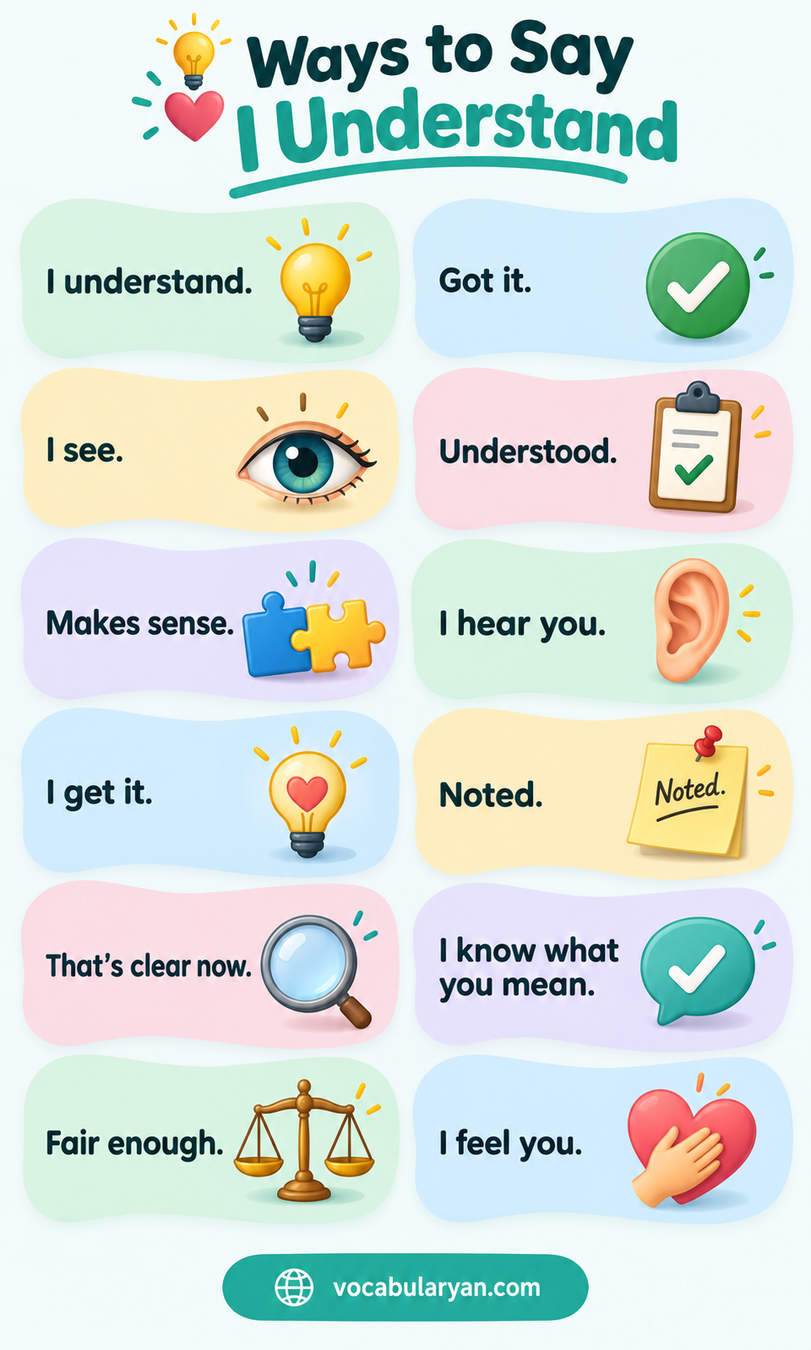
These six replies fit any listener, and each one confirms that you followed what was just said.
I see: the shortest neutral reply, and it fits a fact, a story, or a piece of news. On its own it sounds a little flat, so a question after it keeps the talk going.
- I see, so the train leaves from platform four, not platform two.
- Oh, I see! That’s why the lights kept going off.
- I see, and how long has your knee been hurting like that?
I get it: casual and warm, and it means the explanation has worked at last. It fits a friend, a classmate, or a colleague you know well.
- I get it now, the red wire goes to the top screw.
- Okay, I get it, you don’t want to talk about it tonight.
- I get it, thanks, that diagram made all the difference.
That makes sense: the reply after a long explanation, and it says the reason is good as well as understood. It fits every level from a text to a meeting.
- That makes sense, the shop closes early on Sundays.
- Ah, that makes sense, I wondered why the invoice was late.
- That makes sense, Dr Rao, I’ll take the tablets with food from now on.
I know what you mean: a reply that says you have felt or seen the same thing. It goes with agreement more than with new facts.
- I know what you mean, the mornings are getting dark already.
- Yeah, I know what you mean, that shop is always too loud.
- I know what you mean about the new timetable, nobody can find their room.
I follow you: a reply in the middle of an explanation, and it asks the speaker to carry on. "I’m following" means the same in speech.
- I follow you so far, what happens after the form is signed?
- Go on, I follow you.
- I follow you, but where does the second payment come from?
I see what you mean: the reply when someone gives an opinion and you now agree with it. It sounds a little more thoughtful than "I see".
- I see what you mean, the blue looks better in daylight.
- Now that I’ve read it twice, I see what you mean about the ending.
- I see what you mean, Jonah, the price is too high for students.
Say "I see" after a short fact and "that makes sense" after a long explanation.
Casual Ways to Say I Understand to Friends
Casual replies are short, and each one says that you followed the story and want your friend to go on.
Got you: the friendly form of "I understand", written "gotcha" in texts. The reply after a plan, a favour, or a quick piece of news.
- Got you, I’ll wait by the side entrance.
- Ah, got you, you meant next Saturday, not this one.
- Got you, no onions on yours.
I’m with you: a reply that says you are keeping up, and it fits a long story or a plan with many steps.
- I’m with you so far, but why did she leave the party?
- Keep going, I’m with you.
- I’m with you, the cheaper flight is worth the early start.
I get the picture: a reply that stops a story before the end, because the rest is already obvious. It sounds a little impatient, so keep it for friends.
- Okay, I get the picture, he never paid you back.
- I get the picture, the flat is small and the landlord is rude.
- You don’t have to go on, I get the picture.
I catch your drift: an older casual phrase that means you understood the hidden meaning. It fits a friend who is hinting rather than saying.
- I catch your drift, you want me to leave before your parents arrive.
- Oh, I catch your drift, we’re not telling Sam about the surprise.
- I catch your drift, mate, I’ll pay for the taxi this time.
Fair enough: a reply that accepts a reason even when you did not like the answer. It closes the argument without a fight.
- Fair enough, you’ve had a long week, we’ll go next time.
- Fair enough, I hadn’t thought about the cost.
- You’d rather stay in? Fair enough.
Say no more: a playful reply that means you understood at once and will act. It fits a favour or a plan between close friends.
- Pizza and a film tonight? Say no more.
- Say no more, I’ll pick your brother up from the station.
- You need a lift at six? Say no more, I’m on my way.
Reply with "got you" or "fair enough" to a friend, and save "I get the picture" for a story that has gone on too long.
Formal Ways to Say I Understand at Work
Formal replies name what you understood, and they fit a manager, a client, or a meeting with people you do not know.
Understood: the standard one-word reply at work, and it fits an instruction, a deadline, or a change of plan. It sounds calm and sure, and nobody hears it as rude.
- Understood, the report goes to the finance team first.
- Understood, Ms Okoro, I’ll change the date on the contract.
- Understood, we won’t contact the client until you say so.
I take your point: the reply when a colleague disagrees with you and you accept the reason. It fits a discussion more than an instruction.
- I take your point, the deadline is too tight for a full test.
- I take your point about the budget, so let’s cut the travel first.
- I take your point, Mr Fischer, and we’ll change the wording tomorrow.
Point taken: the shorter form of "I take your point", and it admits that the other person is right. It sounds a little sharper, so say it with a friendly voice.
- Point taken, I should have called before I changed the order.
- Point taken, we’ll start the meetings on time from now on.
- Okay, point taken, the logo is too small.
I see your point: softer than "point taken", because it accepts the reason without saying you agree with the plan.
- I see your point, but the client still wants the blue version.
- I see your point about the parking, and we’re looking at options.
- I see your point, Lena, let’s raise it with the board.
That’s clear: the reply after a manager explains a process, and it says the explanation worked. "That’s clear, thank you" is the warmer form.
- That’s clear, thank you, I’ll follow the new steps from Monday.
- That’s clear, so the second signature comes from legal.
- Yes, that’s clear now, I had the two forms mixed up.
I appreciate your point: a very polite reply in a disagreement, and it fits a client or a senior colleague. It accepts the point without a promise to change.
- I appreciate your point, and we’ll review the pricing before the next quarter.
- I appreciate your point, Dr Hale, though the study still needs a control group.
- I appreciate your point about the timing, so let’s move the launch.
I’m aware of that: a formal reply that says the fact was already known to you. Said in a flat voice it sounds annoyed, so add a next step.
- I’m aware of that, and the fix is going out this afternoon.
- I’m aware of that, thank you, the supplier has already been told.
- Yes, I’m aware of that, which is why the order was placed early.
"Gotcha" belongs to friends, and in a first meeting with a manager it sounds as if you are not taking the task seriously.
- Gotcha, Mr Lee, I’ll fix the numbers. ❌
The same reply at work is "understood", because it sounds calm and respectful in front of anyone.
- Understood, Mr Lee, I’ll fix the numbers. ✅
Each way of saying you understood is spoken at one of five levels, and the table sorts them.
| Level | Replies | Who it fits |
|---|---|---|
| Slang | Gotcha, I feel you, say less, bet | Close friends your own age |
| Casual | Got it, got you, I get it, fair enough | Friends, family, relaxed colleagues |
| Neutral | I see, that makes sense, I follow you | Anyone, in speech or in writing |
| Formal | Understood, I take your point, noted with thanks | Managers, clients, customers |
| Very formal | I appreciate your point, I acknowledge that, duly noted | Senior people, official letters, disputes |
Say "understood" for an instruction and "I take your point" for a disagreement, and keep "gotcha" out of the office until your manager uses it first.
Ways to Say I Understand in an Email
An email reply confirms what you read, and the shortest replies need a thank-you to sound warm.
Noted: one word that says you read the message and will remember it. On its own it sounds cold, so it goes with "thank you" or a next step.
- Noted, thank you, I’ll move the call to three o’clock.
- Noted, the new address is on the file now.
- Noted, thanks, Priya, and I’ll copy you on the reply.
Noted with thanks: the polite form of "noted", common in offices across Asia and in formal replies to a client.
- Noted with thanks, and the invoice will follow on Friday.
- Noted with thanks, Mr Tan, we will keep the original delivery date.
- Noted with thanks, I have passed your request to the design team.
Duly noted: very formal, and it means the message has been recorded in the proper way. Between friends it sounds like a joke, so keep it for official mail.
- Duly noted, and the committee will discuss it at the March meeting.
- Your objection is duly noted, and a written reply will follow.
- Duly noted, Councillor, the plans will be amended.
Thank you for clarifying: the reply after someone answers your question, and it sounds polite and a little formal.
- Thank you for clarifying, I’ll use the second template.
- Thank you for clarifying the dates, the booking is confirmed for the 12th.
- Thank you for clarifying, Dr Osei, that answers my question.
Thanks for explaining: the warmer, less formal form of "thank you for clarifying", and it fits a colleague you email every day.
- Thanks for explaining, that makes the process a lot easier.
- Thanks for explaining, Ben, I had the two accounts mixed up.
- Thanks for explaining the login steps, it worked first time.
That’s clear now, thank you: the reply after a second or third explanation, and it says that the reader does not need to write again.
- That’s clear now, thank you, I’ll submit the form tonight.
- That’s clear now, thank you for your patience.
- That’s clear now, thank you, and sorry for the extra emails.
A bare "Noted." with a full stop is the most common cold reply in English email.
- Noted. ❌
The word alone sounds as if you want no more contact, and a thank-you with a next step turns it into a normal reply.
- Noted, thank you, I’ll update the schedule today. ✅
Write "noted, thank you" plus one action for a colleague, and "duly noted" only in an official reply.
Ways to Say I Understand to a Customer
A customer needs to hear the problem in your words before any fix, and these phrases are for that moment.
I understand the problem: the plain reply after a customer describes what went wrong, and it works best when the problem follows in your own words.
- I understand the problem, the parcel was marked delivered but never arrived.
- I understand the problem, Mrs Silva, the card was charged twice on the same day.
- I understand the problem, and I’m sorry you had to call about it twice.
I can see why that’s frustrating: a reply that names the feeling as well as the fact, and it calms an angry customer faster than an apology alone.
- I can see why that’s frustrating, two weeks without internet is far too long.
- I can see why that’s frustrating, and I’ll stay on the line until it’s fixed.
- I can see why that’s frustrating, sir, let me check what happened to the refund.
I understand your concern: the formal reply to a worry rather than a fault, and it fits a bank, a clinic, or a school.
- I understand your concern, and the data is stored in the UK only.
- I understand your concern about the side effects, so let’s go through them.
- I understand your concern, Mr Byrne, and the school will reply in writing.
So, if I’ve understood you correctly: a check that repeats the problem back, and it stops a wrong fix before it starts.
- So, if I’ve understood you correctly, the screen freezes only after an update.
- So, if I’ve understood you correctly, you want the delivery moved to the office.
- So, if I’ve understood you correctly, the charge appeared before you cancelled.
Thank you for explaining that: a reply that thanks the customer for their time, and it fits a long or confusing story.
- Thank you for explaining that, I now have the full picture of what happened.
- Thank you for explaining that, Ms Dube, and I’ve added a note to your account.
- Thank you for explaining that so patiently, it helps me find the right fix.
Repeat the customer’s problem in your own words first, and say "I can see why that’s frustrating" before the fix.
Ways to Say I Understand When You Receive Instructions
A reply to an instruction says that you will act, so most of these phrases name the next action.
Got it: the everyday reply to a task from a colleague or a friend, and it means both "understood" and "I’ll do it".
- Got it, two copies for you and one for the file.
- Got it, I’ll lock the back door on my way out.
- Got it, thanks, the meeting room is on the third floor.
Will do: a reply that promises the action, and it fits a small favour or a task you are happy to take.
- Can you email the client? Will do.
- Will do, I’ll water the plants while you’re away.
- Will do, boss, the van will be back by five.
Roger that: from radio language, and it means "message received". Between colleagues it sounds friendly and a little playful.
- Roger that, the delivery goes to the side gate.
- Roger that, I’ll turn the heating down.
- Roger that, see you at the second checkpoint.
Copy that: the American radio reply, and it means the same as "roger that". It fits a team chat or a busy kitchen.
- Copy that, table nine wants the bill.
- Copy that, I’ll take the second shift.
- Copy that, moving the boxes to the loading bay now.
On it: the shortest reply that says you have already started, and it fits a text or a busy office.
- Printer’s jammed again. On it.
- On it, the file will be with you in ten minutes.
- On it, I’ll call the supplier before lunch.
Consider it done: a confident reply that promises a finished task, and it fits a friend or a manager who trusts you.
- Consider it done, the slides will be ready by nine.
- You need the car washed before the wedding? Consider it done.
- Consider it done, Grandma, I’ll fix the shelf on Saturday.
Loud and clear: a reply to a warning or a repeated instruction, and it says the message has arrived with no doubt at all.
- Loud and clear, no phones in the exam room.
- Message received, loud and clear, I’ll be home by midnight.
- Loud and clear, coach, no more late tackles.
Reply "got it" or "will do" to a colleague, and "understood" to a manager who has just given you a deadline.
Ways to Say I Understand to Show Sympathy
Sympathy phrases answer a feeling rather than a fact, and each one puts the other person first.
I understand how you feel: the standard sympathy reply, and it fits a friend who is worried, tired, or sad. It works best when you have been in the same place yourself.
- I understand how you feel, I was nervous for weeks before my first exam too.
- I understand how you feel, moving house is exhausting.
- I understand how you feel, and you’re allowed to be angry about it.
I know how you feel: a warmer version of "I understand how you feel", and it means you have lived through the same thing. Never say it about a loss you have not had.
- I know how you feel, my flight was cancelled twice last summer.
- I know how you feel, the first week at a new school is the hardest.
- I know how you feel, I failed my driving test the first time too.
I can imagine: the safe sympathy reply when you have never been in the same situation. It admits the limit and still sounds warm.
- I can imagine, a night in hospital with a baby is no fun at all.
- I can imagine, you must be worn out after that drive.
- That sounds scary, I can imagine how worried you were.
That must be hard: a reply that names the difficulty and asks for nothing back, and it fits a colleague or a neighbour as well as a friend.
- That must be hard, caring for your mum and working full time.
- That must be hard, I’m sorry you’re going through it.
- That must be hard for the children too.
I can relate: a casual sympathy reply that means you have had a similar problem. It fits a friend or a classmate.
- I can relate, my landlord ignores emails for weeks as well.
- I can relate, honestly, my brother was the same at that age.
- I can relate to that, deadlines make me forget to eat.
I would feel the same: a reply that agrees with the feeling, and it fits an argument, a disappointment, or bad news from work.
- I would feel the same if my manager cancelled my leave at the last minute.
- I would feel the same, that was a rude thing to say to you.
- Don’t apologise, I would feel the same in your place.
I don’t blame you: a reply that says the person’s reaction is fair, and it fits someone who is angry or has walked away from something.
- I don’t blame you for leaving early, the music was far too loud.
- I don’t blame you, I’d have quit that job months ago.
- I don’t blame you for being upset, he promised to call.
"I know exactly how you feel" fails when the other person has lost something you have never lost.
- I know exactly how you feel, my cat died last year. (to a friend whose father has died) ❌
The loss is not the same, so the reply sounds as if you are talking about yourself. "I can’t imagine" admits the difference and keeps the focus on the friend.
- I can’t imagine how hard this is, I’m here whenever you need me. ✅
Say "I know how you feel" only after the same experience, and "I can imagine" or "that must be hard" every other time.
Ways to Say I Understand in a Text
A text reply is one to three words, and each one either closes the message or asks for more.
Ok: the shortest reply, and it means "understood" with no feeling attached. A full stop after it reads cold, so leave the stop off or add a word.
- Ok, see you at seven
- Ok cool, I’ll bring the charger
- Ok, no problem, I’ll tell Dad
Ah ok: "ok" with a small surprise, and it means the message answered something you had wondered about.
- Ah ok, so you’re not coming until Sunday
- Ah ok, that’s why the bus didn’t stop
- Ah ok, makes sense now
Gotcha: the text spelling of "got you", and it fits a friend, a sibling, or a colleague in a group chat.
- Gotcha, back door it is
- Gotcha, I’ll grab milk on the way
- Gotcha, thanks for letting me know
Makes sense: "that makes sense" without the "that", and it fits a text after a friend explains a change of plan.
- Makes sense, the park will be full on a bank holiday
- Makes sense, let’s do Tuesday instead
- Ah, makes sense, I forgot she works nights
Ohh I see: the extra "h" adds the sound of a slow realisation, and it fits a friend who has just explained a misunderstanding.
- Ohh I see, you meant the other Emma
- Ohh I see, sorry, I read your message wrong
- Ohh I see, so the tickets are for next week
Keep a text reply to two or three words, and drop the full stop after "ok" so it does not read as annoyed.
Ways to Say I Understand to a Group
A group reply speaks for everyone in the room, so it names "we" and checks that the others agree.
We’re all on the same page: a reply that says the whole team now understands the same plan, and it fits the end of a briefing.
- We’re all on the same page, the launch moves to the fifth.
- Good, we’re all on the same page, so let’s split the tasks.
- We’re all on the same page about the budget, I think.
We get it: the casual group reply, and it fits friends or classmates answering a teacher, a coach, or a parent.
- We get it, Dad, no music after ten.
- Okay, we get it, the deadline is real this time.
- We get it, coach, pass early and keep moving.
I think we all follow: a polite reply in a meeting that speaks for the group and lets the speaker move on.
- I think we all follow, so shall we look at the costs?
- I think we all follow the first part, but the timeline needs another look.
- I think we all follow, thank you, Martin, that was very thorough.
Understood, everyone?: the reply a team leader uses to pass an instruction on and check that the group heard it.
- Two-minute breaks only. Understood, everyone?
- Understood, everyone? Bags stay in the lockers.
- Names on every sheet, understood, everyone?
Say "we’re all on the same page" to close a briefing, and "we get it" only with people who will smile at it.
Regional Ways to Say I Understand in English
Each English-speaking country keeps a few replies of its own, and the right one in the right place sounds warm at once.
British Ways to Say I Understand
Right you are: a cheerful British reply to an instruction, and it fits a shopkeeper, a builder, or a bus driver.
- Right you are, two sugars and no milk.
- Right you are, love, I’ll drop it round tomorrow.
- Right you are, the ladder goes back in the shed.
Righto: the short British reply to a plan, and it sounds friendly and a little old-fashioned. It is common in Australia as well.
- Righto, see you at the pub at eight.
- Righto, I’ll put the kettle on.
- Righto, the keys are under the mat, then.
American Ways to Say I Understand
I hear ya: the spoken American form of "I hear you", and it means "I understand and I feel the same". It fits a friend complaining.
- I hear ya, rent in this town is crazy.
- I hear ya, my commute is an hour each way too.
- I hear ya, nobody wants a Monday meeting.
Ten-four: American radio code for "message received", and it fits a joke reply between friends or workmates.
- Ten-four, picking up the pizza now.
- Ten-four, I’ll meet you at the gate.
- Ten-four, boss, the truck is loaded.
Sure thing: a warm American reply to a request, and it means "understood, happy to do it".
- Can you close up tonight? Sure thing.
- Sure thing, I’ll email the address.
- Sure thing, ma’am, the table is by the window.
Australian and Irish Ways to Say I Understand
No worries: the Australian reply to an instruction or an apology, and it means "understood, it’s no trouble".
- No worries, I’ll grab the car from the airport.
- No worries, mate, the invoice can wait till Monday.
- No worries, the bins go out on Thursday.
Too easy: an Australian reply that means the task is understood and small, and it fits shops, cafés, and tradespeople.
- Flat white to go? Too easy.
- Too easy, I’ll have the fence done by lunch.
- Too easy, drop the keys at the front desk.
Grand: the Irish reply that means "fine, understood", and it fits almost any plan or instruction between friends.
- Grand, I’ll see you outside the church at ten.
- Grand, so, the bus is at half past.
- Grand, no bother, I’ll bring the cake.
Sound: an Irish and northern British reply that means "understood, that’s good with me", used between friends.
- Meet at Dave’s first? Sound.
- Sound, I’ll text you when I’m outside.
- Sound, thanks for the lift.
Say "right you are" in Britain, "sure thing" in America, "no worries" in Australia, and "grand" in Ireland, and say "got it" everywhere else.
Slang Ways to Say I Understand
Slang replies belong to close friends your own age, and each one dates fast, so listen before you use one.
I feel you: American slang for "I understand how you feel", and it fits a friend who is venting.
- I feel you, exams in June are the worst.
- I feel you, man, I’d be angry too.
- I feel you, that group chat is out of control.
Say less: newer slang that means "I understand, no need to explain", and it fits a plan a friend has just started to describe.
- Rooftop at nine? Say less.
- Say less, I’m already getting my shoes on.
- Say less, I’ll sort the music.
Bet: one-word slang that means "understood, agreed", and it fits a text or a quick spoken reply.
- I’ll pay you back Friday. Bet.
- Bet, see you at the courts.
- Bet, I’ll tell Marcus.
I’m picking up what you’re putting down: a long playful phrase that means you understood the hint. It sounds American and a little dated, so use it as a joke.
- I’m picking up what you’re putting down, you want me to leave you two alone.
- Oh, I’m picking up what you’re putting down, we’re skipping the meeting.
- I’m picking up what you’re putting down, dinner is on me tonight.
Keep "bet" and "say less" for friends your own age, and use "got it" with everyone else.
Funny Ways to Say I Understand
Funny replies act out a soldier, a pilot, or a sailor, and they fit friends who like a joke.
Aye aye, captain: the sailor’s reply to an order, and it makes a friend’s instruction sound like a command on a ship.
- Aye aye, captain, the dishes will be done by the time you’re back.
- Set the alarm for six? Aye aye, captain.
- Aye aye, captain, no more snacks before dinner.
Roger, Roger: a doubled radio reply, and it turns a plain instruction into a joke between friends or workmates.
- Roger, Roger, the car is parked at the back.
- Roger, Roger, I’ll bring the extra chairs.
- Roger, Roger, quiet in the library.
Crystal: the last word of "crystal clear" on its own, and it works as a joke reply to a warning or a stern instruction.
- No phones at the table, is that understood? Crystal.
- Crystal, I’ll be back before eleven.
- Crystal, boss, the meeting starts at nine sharp.
Message received: a mock-serious reply that treats a friend’s hint as an official message, and it fits a joke about being told off.
- Message received, I’ll stop humming.
- Message received, no more jokes about your haircut.
- Message received, the kitchen is your kitchen.
Save the funny replies for people who laugh with you, because "aye aye, captain" to a real manager sounds like a mock.
When I Understand Sounds Dismissive
"I understand" fails when the other person wanted to be heard, not answered, and the fix is a longer reply.
The phrase goes wrong in three places. The first is a complaint, where "I understand, but" makes the "but" the real reply. The second is an interruption, where "I understand" said before the person has finished is a request to stop. The third is a flat voice, where the words are right and the sound says you have stopped listening.
The fix in each case is the same: name the problem or the feeling in your own words, and put any "but" in a new sentence.
- I understand, but the policy is the policy. ❌
The "but" cancels the "understand", and the customer hears only the refusal. A reply that names the feeling first and then gives the reason sounds like a person rather than a rule.
I can see why that’s frustrating. The refund window closed on the 30th, and I’m sorry about that. ✅
I understand. (in a flat voice, after a friend describes a bad day) ❌
The flat reply closes the conversation before the friend has finished. A reply that names one detail from the story says that you listened.
- That sounds like a long day. What happened after the meeting? ✅
Name the feeling or the problem in your own words, and never put "but" in the same sentence as "I understand".
More Everyday English Phrases
- Other Ways to Say I Don’t Think So
- Other Ways to Say I Think So
- Other Ways to Say I Disagree
- Other Ways to Say I Agree
FAQs
The three most common replies are "I see", "got it", and "that makes sense". "I see" fits any listener, "got it" fits a task from a friend or a colleague, and "that makes sense" fits a long explanation. For a feeling rather than a fact, the reply is "I understand how you feel" or "that must be hard".
No, "I understand" is polite in itself, and it becomes rude only when a "but" follows it or when you say it before the other person has finished. In those cases the listener hears "stop talking". The fix is to repeat the problem in your own words and put any disagreement in a new sentence.
Say "I understand" in the present, because the understanding is happening now, at the moment you reply. "I understood" is past tense. It fits a report about an earlier moment: "I understood the rules, but I forgot them." A one-word "understood" at work is short for "that is understood", and it is present in meaning.
The best reply is one that names the feeling, such as "that must be hard" or "I can see why you’re upset". "I know how you feel" is stronger, and it works only after you have been through the same thing. When you have not, "I can imagine" is honest and still warm.
Yes, "understood" is the standard reply to an instruction at work, and "I take your point" is the reply in a disagreement. In an email, "noted, thank you" and "thank you for clarifying" fit a colleague or a client. "Duly noted" is for official letters, and "I acknowledge that" fits a formal dispute.
Change the reply with the situation instead of the word. A fact gets "I see", a task gets "got it", a long explanation gets "that makes sense", and a feeling gets "that must be hard". A second way is to repeat one detail from what the person said, because that proves the understanding without the phrase at all.
Say "I understand" when someone has explained a fact, a rule, or a problem and you want to confirm that the explanation worked. Say "I understand how you feel" only when the person has described a feeling and you have felt the same one. In every other case, name the feeling instead, because the bare phrase sounds like the end of the conversation.