
"I’m proud of you" is praise for the person, not for the result, and that is why it means more than "congratulations". The ways to say I’m proud of you change with the listener. A child needs praise for effort, a partner needs warmth, and a manager needs a line about the work rather than the person. Each group on this page names who the phrase fits, and the everyday forms come first.
Other Ways to Say I’m Proud of You in Everyday English
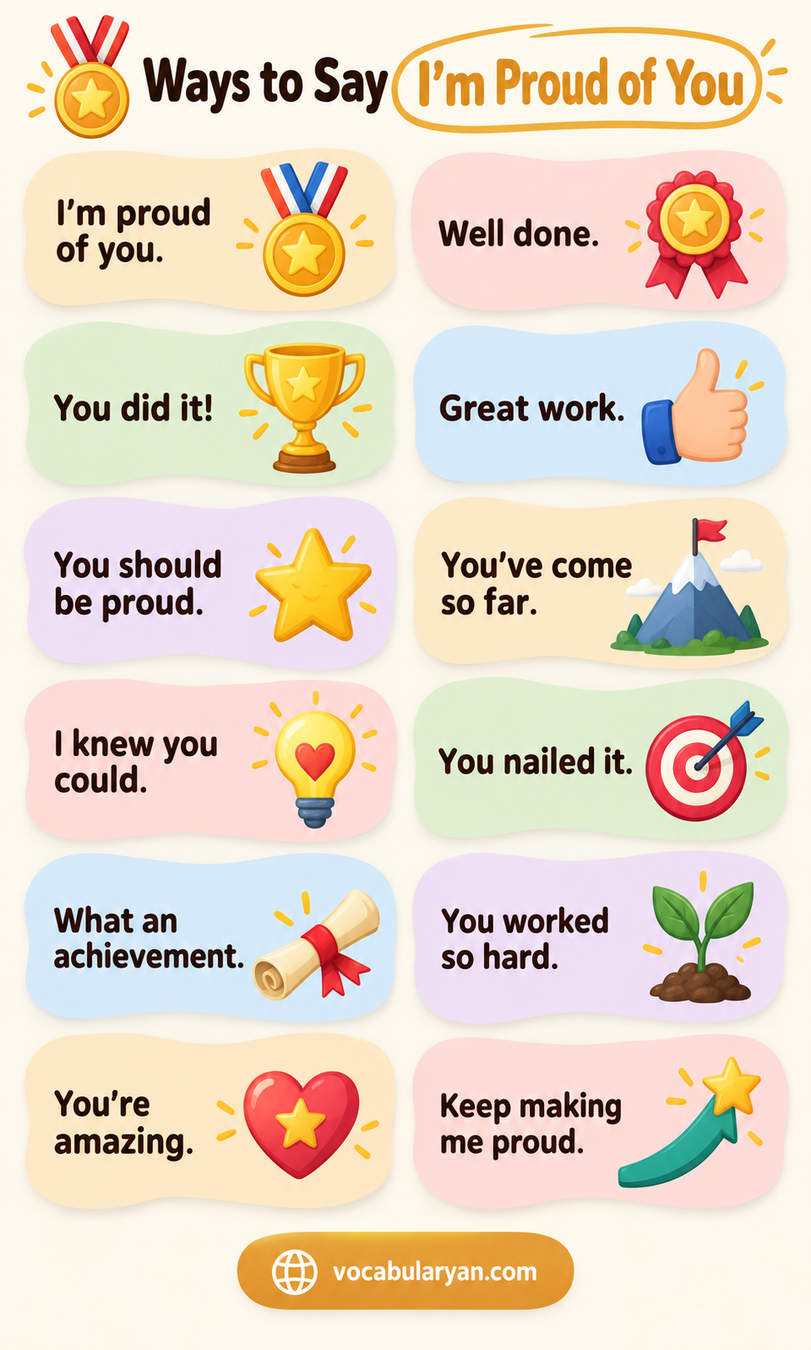
These five phrases fit almost anyone you care about, and each one names the person’s effort or growth rather than the prize.
I’m so proud of you: the warmest everyday form, and "so" doubles the feeling. It fits family, close friends, and anyone who has just finished something hard.
- I’m so proud of you, Leila, your first solo drive and not a scratch.
- Dad rang to say he’s so proud of you.
- I’m so proud of you for finishing the course while working full time.
You did it: the shortest praise for a completed goal, and it fits every age and every level. The stress falls on "did".
- You did it! Ten kilometres without stopping.
- Look at that certificate, Sam, you did it.
- After three tries at the exam, you did it, and nobody is surprised.
You should be proud of yourself: praise that hands the pride back to the person, so it fits a friend, a student, or an adult child. It sounds warm without sounding like a parent.
- You should be proud of yourself, that presentation was the best in the room.
- Two months without a cigarette, Ravi, you should be proud of yourself.
- You should be proud of yourself for speaking up in that meeting.
Look how far you’ve come: praise for a long journey rather than one win, and it fits someone who started from a low point.
- Look how far you’ve come since your first lesson in January.
- A year ago you were afraid to order coffee in English, and look how far you’ve come.
- Look how far you’ve come, Nan, walking to the shops again after the operation.
You’ve outdone yourself: praise for a result better than the person’s own best, and it fits a cook, an artist, a student, or a colleague.
- You’ve outdone yourself with this cake, Maria.
- Honestly, Tom, you’ve outdone yourself on the garden this year.
- The report is superb, you’ve outdone yourself again.
The preposition after "proud" is "of", and "for" is a common slip.
- I’m proud for you, Leila. ❌
"Proud for" is not standard English, and the feeling of gladness on someone’s behalf takes "happy for you" instead.
- I’m proud of you, Leila. ✅
Say "you did it" at the moment of the win, and "look how far you’ve come" when the win took months.
Ways to Say I’m Proud of You to a Child
Praise for a child names the effort and the choice, because praise for talent alone teaches a child to fear failure.
You worked so hard on that: the standard effort praise for a child, and it fits homework, a drawing, or a sports match, win or lose.
- You worked so hard on that puzzle, and you didn’t give up once.
- I saw you practising every night, you worked so hard on that song.
- You worked so hard on that, sweetheart, let’s put it on the fridge.
I love how you kept trying: praise for persistence, and it fits a child who failed a few times before the result came.
- I love how you kept trying even after the tower fell down twice.
- I love how you kept trying with your reading tonight, Ben.
- You fell off the bike three times, and I love how you kept trying.
That was brave of you: praise for courage, and it fits a child who did something scary: a first day, an injection, a speech in class.
- That was brave of you to tell the teacher what happened.
- That was brave of you, going down the big slide on your own.
- The doctor said that was brave of you, and I agree.
You did that all by yourself: praise for independence, and it fits a small first: shoes tied, a bed made, a sum solved.
- You did that all by yourself? Wow, look at those laces.
- You did that all by yourself while I was on the phone, well, well.
- Your bed is made, and you did that all by yourself.
You made a good choice: praise for behaviour rather than a result, and it fits sharing, waiting, or walking away from a fight.
- You made a good choice when you let your sister go first.
- I know you were angry, and you made a good choice to walk away.
- You made a good choice to save your pocket money, Priya.
Praise for a fixed quality sounds nice and does less good than praise for effort.
- You’re so smart, Ben. (after a hard sum) ❌
"You’re so smart" praises a quality the child cannot control, so a wrong answer next time feels like a loss of the label, and effort praise avoids that.
- You worked so hard on that sum, Ben. ✅
Tell a child "you worked so hard on that" and "I love how you kept trying", and leave "you’re so smart" out.
Ways to Say I’m Proud of You to a Student
A teacher or a tutor praises progress and method, so these phrases point to the work that produced the grade.
Your hard work paid off: praise that links the result to the effort, and it fits a student who has just seen a good grade.
- Your hard work paid off, Aisha, a B plus is a huge jump from December.
- All those extra practice tests, and your hard work paid off.
- Your hard work paid off in the speaking exam, I could hear the difference.
You’ve improved so much: praise for progress over time, and it fits a student who started weak and is now strong.
- You’ve improved so much in your writing since September.
- Listen to yourself, Diego, you’ve improved so much.
- You’ve improved so much that I’m moving you up a group.
That’s excellent work: the standard classroom praise for a piece of work, written on an essay or said across a desk.
- That’s excellent work, and your argument in the second paragraph is the strongest in the class.
- That’s excellent work on the lab report, Fatima.
- Neat, complete, and on time, that’s excellent work.
You’ve come a long way this term: praise for the whole term, and it fits a report card or a final lesson.
- You’ve come a long way this term, and your confidence is the biggest change.
- Ms Okafor wrote that you’ve come a long way this term.
- You’ve come a long way this term, Marek, from silent to first to answer.
Write "that’s excellent work" on the page, and say "you’ve come a long way this term" to the student’s face.
Ways to Say I’m Proud of You to a Partner
Praise between partners is about the person as much as the result, so these phrases are warm and personal.
I’m proud to be with you: praise that names the relationship, and it fits a partner after a public moment: a speech, an award, a hard conversation handled well.
- I’m proud to be with you, and I mean that every single day.
- Watching you up there tonight, I’m proud to be with you.
- I’m proud to be with you, whatever the interview result is.
You amaze me: praise for the person’s strength, and it fits a partner who has done something the speaker finds remarkable.
- You amaze me, Jonah, a full-time job and a degree in the same year.
- Every time you handle a crisis like that, you amaze me.
- You amaze me, you know that?
I admire you: the calm form of pride between adults, and it fits a partner who has shown patience, courage, or kindness.
- I admire you for the way you looked after your mum this year.
- I admire you, and I’m lucky to have a front-row seat.
- The way you stood up for your team today, I admire you for that.
Say "I’m proud to be with you" after the big public moment, and "you make me proud every day" on the ordinary ones.
Ways to Say I’m Proud of You to a Friend
Pride between friends sounds like excitement, so these phrases are loud, short, and full of contractions.
You crushed it: casual praise for a performance: an interview, a match, a gig, an exam. It is American in origin and now common everywhere.
- You crushed it in that interview, when do you start?
- Saw the video, you crushed it on stage!
- You crushed it, mate, three goals!
I’m so happy for you: praise mixed with joy, and it fits a friend’s good news: a job, a baby, a house, a visa.
- I’m so happy for you, Dana, the flat is perfect.
- I’m so happy for you both, congratulations on the little one.
- You got the visa? I’m so happy for you!
You deserve this: praise that says the win was earned, and it fits a friend who waited a long time for it.
- You deserve this, Ola, nobody worked harder for that promotion.
- After the year you’ve had, you deserve this holiday.
- You deserve this award and every bit of the applause.
Look at you!: playful praise for a friend who has changed or achieved something visible, said with a big smile.
- Look at you! A suit, a briefcase, a proper grown-up.
- Look at you, running a marathon after all that moaning about the gym.
- Look at you! Published author.
I always knew you had it in you: praise for a talent the speaker saw before the friend did, and it fits a late success.
- I always knew you had it in you, even when you were sleeping through lectures.
- I always knew you had it in you, Sara, and now everyone else knows too.
- Your own bakery! I always knew you had it in you.
Text "you crushed it" the minute the news arrives, and save "you deserve this" for when you meet.
Ways to Say I’m Proud of You to a Colleague or Employee
At work, praise goes to the work rather than the person, because "I’m proud of you" from a peer or a junior sounds like a parent to a child.
Excellent work on the report: the standard workplace praise, with the piece of work named after "on". It fits a manager to a team member or one peer to another.
- Excellent work on the report, Hannah, the board asked who wrote it.
- Excellent work on the pitch, you answered every question.
- Excellent work on the migration, and thank you for the weekend hours.
Your effort has not gone unnoticed: formal praise from a manager, and it says that the work was seen even if no reward has come yet.
- Your effort has not gone unnoticed, and I have raised it with the director.
- Late nights all month, Chen, your effort has not gone unnoticed.
- Your effort has not gone unnoticed by the client either.
You exceeded expectations: formal praise for a result beyond the target, and it fits a review, a reference, or a project close.
- You exceeded expectations in every area of the review this year.
- The launch date moved forward a month because you exceeded expectations on testing.
- You exceeded expectations, and the bonus reflects that.
I commend you on your work: very formal praise, and it fits a written note, a speech, or a senior person addressing a junior.
- I commend you on your work with the new starters this quarter.
- I commend you on your work under a very tight deadline.
- On behalf of the committee, I commend you on your work.
Your dedication is impressive: praise for the attitude behind the work, and it fits an employee who kept going through a hard project.
- Your dedication is impressive, and it set the standard for the team.
- Six months on one client, and your dedication is impressive.
- Your dedication is impressive, Mr Oyelaran, the board agrees.
Outstanding work: two-word praise with the force of a full sentence, and it fits an email title line, a message, or a handshake.
- Outstanding work, everyone, the numbers speak for themselves.
- Outstanding work on the audit, Zara.
- That was outstanding work under pressure.
"Good job" and "well done" also belong at work, and each one has its own page. Praise upward takes a line about the result, not about the person.
- I’m proud of you, Ms Adams, that was a great presentation. (to your manager) ❌
"I’m proud of you" from a junior to a senior sounds as if the junior is judging the senior, so praise upward names the result.
- Congratulations on the presentation, Ms Adams, the client loved it. ✅
Praise is spoken at one of five levels, and the table sorts the ones on this page.
| Level | Phrases | Who it fits |
|---|---|---|
| Slang | You crushed it, you smashed it, go you | Close friends your own age |
| Casual | You did it, look at you, so proud of you | Friends, family, partners |
| Neutral | I’m proud of you, you should be proud of yourself, your hard work paid off | Anyone you know well |
| Formal | Excellent work on the report, you exceeded expectations, your effort has not gone unnoticed | Colleagues, employees, students |
| Very formal | I commend you on your work, please accept my congratulations | Speeches, references, official letters |
Name the work with "excellent work on the report", and keep "I’m proud of you" for family and friends.
Ways to Say I’m Proud of You in an Email
Email praise is a full sentence with the achievement named, because the reader cannot hear your voice.
I wanted to say how proud I am of your work: the warm form for an email from a manager, a mentor, or a parent, and "wanted to say" softens the opening.
- I wanted to say how proud I am of your work on the community project this spring.
- Before the weekend, I wanted to say how proud I am of your work this quarter.
- I wanted to say how proud I am of your work, and so is the whole department.
Congratulations on completing the project: formal email praise with the achievement named after "on", and it fits a client, a colleague, or a student.
- Congratulations on completing the project two weeks ahead of schedule.
- Congratulations on completing the course, your certificate is attached.
- Congratulations on completing the audit, please pass my thanks to the team.
This is a real achievement: neutral email praise for a result that took effort, and it fits any reader.
- This is a real achievement, and the numbers prove it.
- Fifty new members in a month, this is a real achievement for a small club.
- This is a real achievement, Priya, and one to put on your CV.
Please accept my congratulations: the very formal form, and it fits a letter or an email to someone senior or someone you do not know well.
- Please accept my congratulations on your appointment as Head of Faculty.
- Please accept my congratulations on the award, it is richly deserved.
- On behalf of the trustees, please accept my congratulations.
Open with "I wanted to say how proud I am of your work" to someone you mentor, and with "congratulations on completing the project" to anyone else.
Ways to Say I’m Proud of You in a Card
A card takes a short line before the signature, and the shorter the line, the more it sounds like a hug.
So proud of you: the standard card line, with "I’m" dropped, and it fits a graduation, a new job, or a first home.
- So proud of you, Ella. Love, Mum and Dad.
- So proud of you today and every day.
- So proud of you, little brother, go and change the world.
We’re all so proud of you: the card line from a family, a class, or an office, and "all" makes the praise a chorus.
- We’re all so proud of you, from everyone at Northfield Primary.
- We’re all so proud of you, and Grandad says he always knew.
- We’re all so proud of you, Doctor Mensah!
What an achievement: a card line that names the size of the win without naming the win, so it fits any card.
- What an achievement, congratulations on your degree.
- Twenty-five years at the firm, what an achievement.
- What an achievement, and what a year.
Write "so proud of you" from one person and "we’re all so proud of you" from a group.
Ways to Say I’m Proud of You in a Text
Text praise is two or three words, and the punctuation marks the excitement.
Proud of you!: the default text form, sent within a minute of the news, and the exclamation mark is part of the phrase.
- Proud of you! Call me when you’re out.
- Saw the results, proud of you!
- Proud of you! Dinner’s on me tonight.
You did that!: casual praise that puts the credit on the person, popular with younger speakers in messages.
- You did that! First place!
- You did that, and you did it on your own.
- Passed? You did that! I’m screaming.
Knew you’d do it: a text that says the belief was there all along, with the "I" dropped.
- Knew you’d do it, never doubted you.
- Knew you’d do it! Told you the practice tests would pay off.
- Knew you’d do it, you always do.
Go you!: playful two-word praise, British and Australian in flavour, and it fits a friend or a sibling.
- Go you! A whole book in a month.
- Go you, first in the class!
- Promotion? Go you!
Send "proud of you!" the second the news lands, and say the longer lines when you see the person.
Ways to Say I’m Proud of You After a Big Achievement
A big win asks for a big line, so these phrases name the size of the moment.
Congratulations, you’ve earned it: praise that joins the win to the work, and it fits a promotion, a degree, or a medal.
- Congratulations, you’ve earned it, every late night went into that.
- Congratulations, you’ve earned it, Dr Ali.
- Congratulations, you’ve earned it ten times over.
You made it happen: praise that gives the person the credit for a plan that came true, and it fits a long project.
- You made it happen, the whole festival, from one idea in a kitchen.
- Nobody believed in the shop, and you made it happen.
- You made it happen, Amir, and on time.
Hats off to you: praise that admits the speaker is impressed, and it fits a colleague, a rival, or a friend.
- Hats off to you, that was the best speech of the night.
- Hats off to you for running the whole event alone.
- Hats off to you, Grace, a full marathon at sixty.
Say "congratulations, you’ve earned it" to anyone, and "this is huge" to the people who will hug you back.
Ways to Say I’m Proud of You After Effort Without Success
Pride after a loss is the hardest praise to give and the most needed, so these phrases name the effort and leave the result alone.
I’m proud of you for trying: the standard line after a loss, and "for trying" makes the reason plain.
- I’m proud of you for trying, and next year is another chance.
- You didn’t get the part, and I’m proud of you for trying out at all.
- I’m proud of you for trying, Mo, most people never even apply.
You gave it everything: praise for total effort, and it fits a match, an exam, or a job interview that went the wrong way.
- You gave it everything, and the score does not change that.
- You gave it everything out there, the whole team saw it.
- You gave it everything, Lucy, and that is all anyone can ask.
It took courage to try: praise for the risk, and it fits a person who did something scary and did not win.
- It took courage to try, and most people never do.
- It took courage to try for a job like that, and the next one is yours.
- It took courage to try, and I’m proud of that part.
The result doesn’t change how proud I am: praise that puts the feeling before the outcome, and it fits a parent or a partner.
- The result doesn’t change how proud I am of you.
- You came fourth, and the result doesn’t change how proud I am.
- The result doesn’t change how proud I am, so stop apologising.
You’ll get there: praise and hope in one, and it fits a person who plans to try again.
- You’ll get there, and you’re closer than you think.
- You’ll get there, Eli, two marks is nothing.
- I know it hurts today, and you’ll get there.
Say "I’m proud of you for trying" first, and leave "you’ll get there" until the person is ready to hear it.
Ways to Say I’m Proud of You to a Group or Team
Group praise names everyone at once, and it fits a meeting, a message, or a speech at the end of a project.
I’m proud of this team: the standard line from a manager, a coach, or a teacher, and "this team" replaces "you" so nobody is left out.
- I’m proud of this team, and I’d choose every one of you again.
- I’m proud of this team for what happened in the second half.
- Whatever the judges say, I’m proud of this team.
You should all be proud: group praise that hands the pride to the group, and it fits a class, a choir, or a department.
- You should all be proud, that was the best concert this school has given.
- You should all be proud of the way you handled the complaints this week.
- You should all be proud, and the client agrees.
Fantastic work, everyone: short group praise for an email, a chat, or the close of a meeting.
- Fantastic work, everyone, the site is live.
- Fantastic work, everyone, go home early today.
- Fantastic work, everyone, and a special thank you to the night shift.
Every one of you made this happen: praise that credits each member, and it fits a speech after a long project.
- Every one of you made this happen, and the plaque has all your names on it.
- Every one of you made this happen, from the first sketch to tonight.
- Every one of you made this happen, so take the afternoon off.
Open a meeting with "fantastic work, everyone", and close a project with "I’m proud of this team".
Ways to Say I’m Proud of Yourself
Praise for yourself sounds odd to many learners, and it is normal in English after a real effort.
I’m proud of myself: the plain form, and it fits a diary, a friend, or a therapist. It sounds strong rather than boastful when a real effort comes before it.
- I’m proud of myself for finishing the whole course.
- Honestly, I’m proud of myself today, I didn’t lose my temper once.
- I’m proud of myself, and I don’t say that very often.
I did that: short self-praise with the stress on "I", common in messages and speech among younger adults.
- Three interviews in a week and an offer, I did that.
- I did that on my own, no help, no shortcuts.
- Look at the finished room. I did that.
I’ve come a long way: self-praise for progress, and it fits a person who is comparing now with a hard past.
- I’ve come a long way since my first day in this country.
- Two years sober, I’ve come a long way.
- I’ve come a long way, and I’m not done yet.
Say "I’m proud of myself" out loud after a hard week, because nobody else knows what it cost.
Regional Ways to Say I’m Proud of You
English-speaking countries each keep a few praise phrases of their own, and using one in the right country wins a grin at once.
British Ways to Say I’m Proud of You
You smashed it: the British form of "you crushed it", and it fits an exam, a match, or a performance between friends.
- You smashed it, Jack, first-class degree!
- Heard about the interview, you smashed it.
- You smashed it tonight, the crowd loved you.
I’m chuffed for you: warm British praise, and "chuffed" means very pleased. It fits friends, family, and relaxed colleagues.
- I’m chuffed for you, the new job sounds perfect.
- I’m chuffed for you, honestly, nobody deserves it more.
- Your mum says she’s chuffed for you and wants a photo.
Good on you: British and Australian praise for a good decision or a kind act, and it fits any age.
- Good on you for helping the neighbours move.
- Quit the job you hated? Good on you.
- Good on you, love, that took guts.
American Ways to Say I’m Proud of You
Way to go: the classic American praise line, and it fits a child, a friend, or a teammate.
- Way to go, Lily, first goal of the season!
- You aced the test? Way to go!
- Way to go, team, that was a big win.
You killed it: American slang for a great performance, and it fits close friends and relaxed colleagues.
- You killed it on stage tonight.
- The demo was perfect, you killed it.
- You killed it at the interview, I can tell.
Australian and Irish Ways to Say I’m Proud of You
Good on ya: the Australian form of "good on you", said to friends and strangers alike.
- Good on ya, mate, the whole fence in a day.
- Ran the City to Surf? Good on ya.
- Good on ya, Jess, you told them straight.
You’re a legend: Australian praise for anyone who did something impressive or kind, and "legend" is a big compliment said lightly.
- You’re a legend, Dave, the barbecue was perfect.
- Fixed the car in the rain? You’re a legend.
- You’re a legend for driving three hours to be here.
Fair play to you: the Irish praise line, and it means "you did well and I respect it". It fits friends, family, and colleagues.
- Fair play to you, Sean, the exam and the wedding in one week.
- Fair play to you for finishing the race in that weather.
- Fair play to you, I’d have given up in the first hour.
Good man yourself: Irish praise for a man who did something well, with "good woman yourself" for a woman, said warmly between friends.
- Good man yourself, Paddy, three tries in one match.
- Good woman yourself, Niamh, the whole house painted.
- Good man yourself, you got the lot done before the rain.
Use "you smashed it" in Britain, "way to go" in America, "good on ya" in Australia, and "fair play to you" in Ireland.
Funny Ways to Say I’m Proud of You
Funny praise is for friends who know the joke is love, and each line makes the achievement sound bigger than life.
Who are you and what have you done with my friend?: a joke line for a friend who did something out of character: ran a marathon, cooked a dinner, got up early.
- A five-kilometre run before work? Who are you and what have you done with my friend?
- Who are you and what have you done with my friend? You cleaned the kitchen.
- Reading a whole book in a weekend, who are you and what have you done with my friend?
Somebody call the newspapers: mock-serious praise that treats a small win as front-page news.
- Ahmed passed his driving test, somebody call the newspapers.
- Somebody call the newspapers, my brother made his own bed.
- You were on time? Somebody call the newspapers.
I’m not crying, you’re crying: a joke line for a proud moment that made the speaker emotional, common in messages and at graduations.
- I’m not crying, you’re crying. Congratulations, graduate.
- Watched the video of your speech, I’m not crying, you’re crying.
- I’m not crying, you’re crying, and Mum is definitely crying.
Save the funny lines for people who laugh at your jokes already, and add a real "I’m proud of you" afterwards.
How Do You Reply When Someone Says I’m Proud of You?
Praise expects a thank you, and the reply that fits best accepts the praise and gives a little of it back.
Thank you, that means a lot: the standard reply at every level, and it fits a parent, a teacher, or a manager.
- I’m proud of you. Thank you, that means a lot.
- Excellent work on the report. Thank you, that means a lot coming from you.
- We’re all so proud of you. Thank you, that means a lot to me.
I couldn’t have done it without you: the reply that shares the credit, and it fits a coach, a partner, or a parent who helped.
- You did it! I couldn’t have done it without you.
- Look how far you’ve come. I couldn’t have done it without you pushing me.
- I’m proud of you for trying. I couldn’t have done it without you in the front row.
Thanks, I worked hard for it: a reply that accepts the praise and owns the effort, and it sounds confident rather than boastful.
- You crushed it. Thanks, I worked hard for it.
- Your hard work paid off. Thanks, I worked hard for it, and it feels great.
- You should be proud of yourself. Thanks, I worked hard for it, and I am.
Aw, thanks: the casual reply between friends, and "aw" says the praise touched you.
- Proud of you! Aw, thanks, that made my day.
- Look at you! Aw, thanks, I scrubbed up okay.
- Go you! Aw, thanks, I’m still shaking.
Thank you, I’m proud of myself too: a reply that agrees with the praise, and it fits a person who felt every hour of the effort.
- I’m so proud of you. Thank you, I’m proud of myself too.
- You’ve come a long way this term. Thank you, I’m proud of myself too, it was a hard year.
- You gave it everything. Thank you, I’m proud of myself too, even without the medal.
That means the world coming from you: the warmest reply, and it fits praise from someone you admire.
- I admire you. That means the world coming from you.
- I commend you on your work. That means the world coming from you, Professor.
- Hats off to you. That means the world coming from you, you taught me everything.
A denial of the praise sounds like a rejection of the person who gave it.
- I’m proud of you. Oh, it was nothing, anyone could have done it. ❌
A denial says that the speaker’s feeling was wrong, so the reply accepts the praise first and shares the credit second.
- I’m proud of you. Thank you, that means a lot, and I had a lot of help. ✅
Accept the praise with "thank you, that means a lot", and share the credit in the next sentence if you want to.
More Everyday English Phrases
- Other Ways to Say Keep It Up
- Other Ways to Say Well Done
- Other Ways to Say Good Job
- Other Ways to Say Congratulations
FAQs
Professionally, the praise names the work instead of the person: "excellent work on the report", "you exceeded expectations", or "your effort has not gone unnoticed". "I’m proud of you" from a manager to a long-term team member is warm and acceptable, and from a junior to a senior it sounds like a parent. In writing, "please accept my congratulations" is the most formal choice.
The closest everyday replacements are "you should be proud of yourself", "you did it", "look how far you’ve come", and "your hard work paid off". Each one praises the effort rather than the prize, which is the reason "I’m proud of you" feels different from "congratulations". For a text, "proud of you!" on its own is enough.
Yes, when the colleague is a peer you know well and the moment is personal, such as a degree finished at night or a first public talk. Between colleagues who are not close, "great result" or "excellent work on the pitch" fits better, because "proud of you" from an equal sounds like a judge. Upward, to a manager, it is out of place.
Yes, and the email form takes a full sentence with the achievement named: "I wanted to say how proud I am of your work on the launch". A mentor, a teacher, or a manager writing to a team member can use it without any trouble. To a client or a senior person, "congratulations on completing the project" or "please accept my congratulations" replaces it.
Say it after a real effort, and say it whether or not the effort won. The moment after a result is the obvious one, and the moment after a loss is the one people remember, so "I’m proud of you for trying" belongs in your set. Everyday small wins count too: a hard phone call made, a bad habit broken, a child sharing without being asked.
The fix is to name the effort or the choice, not the person’s ability. "You worked so hard on that" and "that took courage" praise something the person did, while "you’re so clever" hands down a verdict. Between adults, "I admire you" and "hats off to you" put the speaker level with the listener instead of over them. Say it once, and mean it.
No, between family, friends, partners, teachers, and managers it is one of the warmest sentences in English. It turns rude only when the speaker has no standing to judge, as with a junior praising a senior, or a stranger praising an adult. In those cases "congratulations" or "that’s a real achievement" says the same thing without the hint of a parent.
Yes, "I’m proud of myself" is normal English after a real effort, and it sounds confident rather than boastful when the effort is named: "I’m proud of myself for finishing the course". The casual forms are "I did that" and "I’ve come a long way". Leave the phrase out of a work email, where "I’m pleased with the result" fits the same feeling.