
"I care about you" is softer than "I love you" and stronger than "I like you", which is why it fits so many people at once. Most of the ways to say I care about you in English name one of three feelings: you are on my mind, I am on your side, or I want you to be safe. Start with the phrases that work for almost everyone.
How to Say I Care About You to Someone
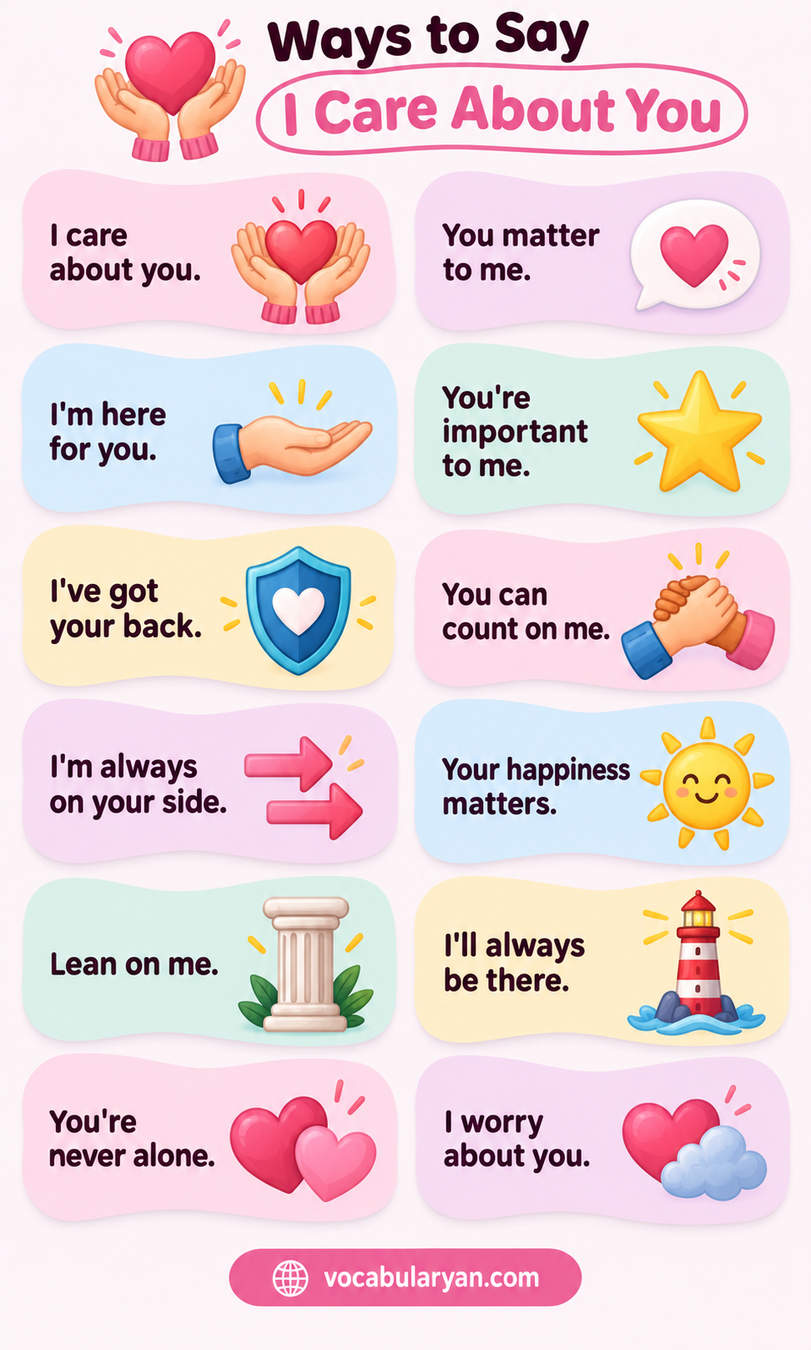
These five phrases fit almost any person in your life, and each one names a different part of caring.
I’m here for you: the most common way to say it, and it fits a friend, a partner, a parent, or a colleague. It means "you can come to me".
- I’m here for you, whatever the doctor says tomorrow.
- I know the exam didn’t go well, but I’m here for you, okay?
- Call me at any hour, I’m here for you.
You matter to me: a direct phrase for someone who feels forgotten or small. It fits a partner, a close friend, or a teenager.
- You matter to me, so stop saying you’re a bother.
- I cancelled the trip because you matter to me more than a beach does.
- Listen, you matter to me, and that hasn’t changed.
I’m thinking of you: a phrase for someone who is far away or going through a hard time, and it fits a card, a text, or a call. The reply is "thank you".
- I’m thinking of you today, I know it’s the anniversary.
- Just a note to say I’m thinking of you before the surgery.
- I’m thinking of you, Nan, the weather here is grey without you.
I’ve got your back: casual and strong, and it means "I will defend you and support you". It fits a friend, a sibling, or a teammate.
- Say what you need to say in the meeting, I’ve got your back.
- Don’t worry about the rent this month, I’ve got your back.
- I’ve got your back, mate, always have.
I want the best for you: a phrase for a moment when you disagree with someone’s choice but still care. It fits a parent, an older friend, or a mentor.
- I want the best for you, and that’s why I’m asking you to wait.
- You know I want the best for you, even if it doesn’t feel like it today.
- I want the best for you, so tell me what the best looks like.
Say "I’m here for you" to anyone having a hard time, and keep "I’ve got your back" for friends and teammates.
Ways to Say I Care About You to a Partner
A partner hears these phrases as a promise, so each one says more than the words in it.
You mean the world to me: the warmest phrase for a partner, and it fits a hard conversation or an ordinary night. It is one step down from "I love you" and works before those words are ready.
- You mean the world to me, you know that, don’t you?
- I’m sorry about tonight, you mean the world to me and I forgot to show it.
- Ten years on and you mean the world to me still.
I love having you in my life: a phrase about the everyday, and it fits a partner you live with or see every day.
- I love having you in my life, even on the days you steal the duvet.
- Honestly, I love having you in my life, thank you for staying.
- I love having you in my life, and I don’t say it enough.
I want to take care of you: a phrase for a partner who is ill, tired, or stressed, and it comes with an offer: soup, a lift, a night off.
- Sit down, I want to take care of you for once.
- I want to take care of you this week, so leave the shopping to me.
- You’ve looked after everyone else all year, and I want to take care of you now.
I love seeing you happy: a phrase for a good day, and it fits a partner after news, a win, or a laugh.
- I love seeing you happy like this, you should dance more.
- I love seeing you happy, so yes, book the course.
- You got the job? I love seeing you happy, come here.
The page on ways to say I love you covers the bigger phrases, and these four fit the days when those words are too much.
Say "you mean the world to me" for a serious moment and "I love seeing you happy" for a good one.
Ways to Say I Care About You to a Friend
Phrases for a friend sound warm and a little casual, and none of these five can be mistaken for a romantic line.
I’m always rooting for you: a phrase for a friend with a goal: an exam, an interview, a race. It means "I want you to win".
- I’m always rooting for you, so go and get that promotion.
- Whatever happens on Saturday, I’m always rooting for you.
- I’m always rooting for you, even from the other side of the world.
I’m glad you’re in my life: a full-sentence phrase for a birthday, a goodbye, or a long night talking.
- I’m glad you’re in my life, Jo, happy birthday.
- I don’t say it much, but I’m glad you’re in my life.
- I’m glad you’re in my life, thanks for tonight.
You can always talk to me: an offer to a friend who has gone quiet, and it fits a text as well as speech.
- You can always talk to me, about anything, any time.
- I noticed you’ve been off lately, you can always talk to me.
- You can always talk to me, no judgement, I promise.
I’m proud of you: a phrase for a friend who has done something hard, from finishing a course to leaving a bad job.
- I’m proud of you for walking away from that place.
- I’m proud of you, you know, three months without a cigarette.
- Look at you, a whole marathon, I’m proud of you.
You’re one of my favourite people: playful and honest at the same time, and it fits a friend you see all the time or one you miss.
- You’re one of my favourite people, so don’t move to Canada.
- Have I told you you’re one of my favourite people?
- You’re one of my favourite people, come and visit soon.
Tell a friend "I’m proud of you" after the hard thing, and "I’m always rooting for you" before it.
Ways to Say I Care About You to Family
Family phrases fit across ages, and most of them say "I worry" or "I’m glad" rather than "I care".
I’m lucky to have you: a phrase for a parent, a sibling, or a grandparent, and it fits a card as well as a hug at the door.
- I’m lucky to have you, Mum, I know that now.
- I’m lucky to have you as a brother, even when you borrow my car.
- I don’t say it enough, but I’m lucky to have you.
You can always come home: a parent’s phrase for a child who has moved away, and it means "there is a place for you here whatever happens".
- Whatever happens with the flat, you can always come home.
- You can always come home, your room is still your room.
- You know you can always come home, love, even at two in the morning.
I worry about you: a phrase that sounds like a complaint and is really care, and it fits a parent or a grandparent.
- I worry about you on that motorbike, that’s all.
- Of course I worry about you, you’re my daughter.
- I worry about you working those hours, please eat something.
Call me when you get there: the everyday family phrase, and it fits any journey longer than an hour.
- Call me when you get there, even if it’s late.
- Drive safely and call me when you get there.
- Call me when you get there, your dad won’t sleep otherwise.
Say "I’m lucky to have you" out loud once a year, and "call me when you get there" every single time.
Ways to Say I Care About You to a Child
A child needs short phrases and the same ones again and again, so pick two or three and repeat them.
I’m so proud of you: the phrase a child remembers, and it fits a small win as well as a big one.
- I’m so proud of you for trying the deep end today.
- You shared your toys with Lily, I’m so proud of you.
- I’m so proud of you, even though the team lost.
You’re safe with me: a phrase for a scared or upset child, said slowly, with a hand on the shoulder.
- It’s just thunder, you’re safe with me.
- You’re safe with me, nobody is cross with you.
- Hold my hand, you’re safe with me in the crowd.
I love spending time with you: a phrase for a normal afternoon, and it says the child is fun, not a job.
- I love spending time with you, shall we do this again next Saturday?
- I love spending time with you, even when we’re only doing homework.
- You know, I love spending time with you, you’re good company.
I’ll always be here: a promise for a child who is worried about change, from a new school to a divorce.
- Things are different now, but I’ll always be here.
- I’ll always be here, whatever happens at school.
- I’ll always be here at the gate at half past three.
Repeat "I’m so proud of you" and "you’re safe with me" until the child can say them back.
Ways to Say I Care About You to Someone Who Is Struggling
When someone is grieving, ill, or low, the phrase that works is short and makes no demand on them.
You don’t have to go through this alone: the phrase for the first hard day, and it fits a friend, a partner, or a family member.
- You don’t have to go through this alone, I’m coming over.
- I know you’re private, but you don’t have to go through this alone.
- You don’t have to go through this alone, let me drive you to the hospital.
I’m not going anywhere: a promise to stay, and it fits someone who is afraid of being a burden.
- Cry if you need to, I’m not going anywhere.
- I’m not going anywhere, take all the time you need.
- You can push me away, but I’m not going anywhere.
What can I do to help?: a real question with a real answer expected, and it fits a colleague or a neighbour as well as a friend.
- What can I do to help? I can take the kids on Thursday.
- I’m so sorry about your dad, what can I do to help?
- What can I do to help this week? Meals, lifts, anything.
I know this is hard: a phrase that names the pain instead of fixing it, and it fits any relationship.
- I know this is hard, and I’m here.
- I know this is hard, you don’t need to be brave with me.
- I know this is hard right now, one day at a time.
You can lean on me: a warm phrase for a friend or a partner who deals with a lot alone.
- You can lean on me for a while, you’ve carried enough.
- You can lean on me, that’s what I’m for.
- Stop apologising, you can lean on me.
I’m here to listen: an offer with no advice attached, and it fits someone who is tired of being told what to do.
- I won’t tell you what to do, I’m here to listen.
- I’m here to listen whenever you’re ready to talk.
- I’m here to listen, and I’ve got all evening.
The phrase to avoid with someone who is grieving is "cheer up", because it asks them to feel better on your schedule.
- Cheer up, it could be worse. ❌
"Cheer up" says the person’s feeling is wrong, so the phrase to use names the hard thing and stays with it.
- I know this is hard, and I’m not going anywhere. ✅
Ask "what can I do to help?" and then do the thing they name, because that is the whole phrase.
Ways to Say I Care About You in a Text
A caring text is short and asks nothing back, so the other person can read it and put the phone down.
Just checking in: the standard opening for a text to someone you have not heard from in a few days.
- Just checking in, how did the scan go?
- Hey, just checking in, no need to reply if you’re busy.
- Just checking in on you after yesterday.
Thinking of you today: a text for an anniversary, an exam, or a hard date. The word "today" says you remembered the day.
- Thinking of you today, I know it’s a year since Grandpa.
- Thinking of you today, good luck in there.
- Thinking of you today and every day, love you loads.
Hope you’re doing okay: softer than "how are you?", and it fits someone who is not ready to talk.
- Hope you’re doing okay, I’m around all weekend.
- Hope you’re doing okay after the news, sending a hug.
- Saw the rain from your window on the news, hope you’re doing okay.
I’m only a message away: a phrase for someone far away, and it fits a friend abroad or a child at university.
- Miss you already, I’m only a message away.
- I’m only a message away if the first week is rough.
- Remember, I’m only a message away, day or night.
No need to reply: a phrase to add to any caring text, and it takes the pressure off the reader.
- Thinking of you, no need to reply, just wanted you to know.
- No need to reply, I know today is full, but you’ve got this.
- Sending love, no need to reply, rest.
"Care" is a state, not an action, so it never takes the "-ing" form when it means affection.
- I’m caring about you so much right now. ❌
"Care about" describes a feeling that stays, so the verb takes the present tense, the same as "I know" or "I want".
- I care about you so much right now. ✅
Open with "just checking in", close with "no need to reply", and keep the whole text under twenty words.
Ways to Say I Care About You in a Card
A card phrase is written once and read many times, so it sounds a little more polished than speech.
You’re in my thoughts: the standard card phrase for illness, loss, or a hard time, and it fits a neighbour as well as a close friend.
- You’re in my thoughts as you recover, get well soon.
- You’re in my thoughts, and I’m so sorry for your loss.
- You’re in my thoughts this week, call any time.
Wishing you all the best: a phrase for a new job, a move, or a retirement, and it fits a colleague or a distant relative.
- Wishing you all the best in Manchester, we’ll miss you here.
- Wishing you all the best for the new chapter, you’ve earned it.
- Wishing you all the best, from everyone in the office.
I’m grateful to have you in my life: a phrase for a birthday or a thank-you card, and it fits a close friend or a family member.
- I’m grateful to have you in my life, happy sixtieth, Aunt Maria.
- I’m grateful to have you in my life, thank you for this year.
- Every day I’m grateful to have you in my life.
You mean a lot to me: a line for a card to a friend or a mentor, and it fits when "I love you" is too much and "thanks" is too little.
- You mean a lot to me, thank you for everything this year.
- Just so you know, you mean a lot to me, and so does your family.
- You mean a lot to me, Coach, congratulations on retiring.
Write "you’re in my thoughts" for a hard time and "you mean a lot to me" for a happy one.
Ways to Say I Care About You in a New Relationship
In the first weeks these phrases say "this is real for me" without the weight of "I love you".
I really like you: the honest first phrase, and it fits the third or fourth date, said plainly.
- I really like you, and I wanted to say it before you go.
- I really like you, you know, this isn’t casual for me.
- I don’t do this often, but I really like you.
I like spending time with you: a safe phrase for the first month, and it names the fact without naming a feeling.
- I like spending time with you, can we do Sunday too?
- I like spending time with you, even in a launderette.
- Honestly, I like spending time with you more than anyone.
I care about you a lot: the phrase for when "I like you" is too small, and it comes a few weeks before "I love you".
- I care about you a lot, more than I expected to.
- I’m not ready for the big words, but I care about you a lot.
- I care about you a lot, so please text when you land.
I’m really into you: casual and American, and it fits a couple who joke around.
- I’m really into you, in case that wasn’t obvious.
- Okay, confession, I’m really into you.
- I’m really into you, so yes, meet my friends.
The most common learner mistake with this phrase mixes "care about" with "take care of".
- I take care about you. ❌
"Take care of" means look after someone, and "care about" means have feelings for them, so the two never combine.
- I care about you. ✅
Say "I really like you" in the first weeks and "I care about you a lot" when that feels too small.
Professional Ways to Say I Care About You at Work
At work a caring phrase names the person’s well-being or offers support, and never names feelings.
I hope you’re doing well: the standard opening line of an email to a colleague who has been away, ill, or under pressure.
- I hope you’re doing well after last week, no rush on the figures.
- Hi Priya, I hope you’re doing well, welcome back.
- I hope you’re doing well, the team asked me to send their best.
Please let me know how I can support you: the formal phrase for a manager or a colleague, and it fits an email or a one-to-one meeting.
- Please let me know how I can support you during the treatment.
- Please let me know how I can support you, we can move the deadline.
- I’ve read your message, please let me know how I can support you.
Your well-being comes first: a manager’s phrase when someone is choosing between work and health, and it gives permission to stop.
- Your well-being comes first, hand the project to Omar.
- Your well-being comes first, so please take the full week.
- I mean it, your well-being comes first, the client can wait.
Take all the time you need: a phrase for bereavement or illness, and it fits a manager or a close colleague.
- Take all the time you need, we’ll cover the shifts.
- Take all the time you need, and call me when you’re ready.
- I’m so sorry, take all the time you need.
I appreciate you: a warm phrase for a colleague who has helped, and it fits speech, chat, or a card.
- I appreciate you, thank you for stepping in yesterday.
- I appreciate you more than the monthly report says.
- I appreciate you, Dan, honestly, the whole team does.
The one phrase to avoid in a work email is "I care about you" on its own, because it reads as personal.
- Hi Priya, I care about you, so take Friday off. ❌
"I care about you" belongs to family and friends, so at work the same care goes into a phrase about health or support.
- Hi Priya, your well-being comes first, so take Friday off. ✅
Five levels sort the phrases on this page, from slang to very formal.
| Level | Phrases (7) | Who it fits (11) |
|---|---|---|
| Slang | I’ve got you, you’re my person, I’m really into you (51) | Close friends, partners, teammates (34) |
| Casual | I’ve got your back, you’re stuck with me, did you eat? (54) | Friends, siblings, partners (27) |
| Neutral | I’m here for you, I’m thinking of you, you matter to me (55) | Almost anyone you know well (27) |
| Formal | I hope you’re doing well, take all the time you need (52) | Colleagues, clients, older relatives (36) |
| Very formal | Please let me know how I can support you, your well-being comes first (69) | Managers, staff, formal emails (30) |
Write "I hope you’re doing well" to a colleague, and "please let me know how I can support you" to anyone you manage.
Ways to Say I Care About You Without Saying It
Most care in English is said through a small practical question, and none of these five phrases has a feeling word in it.
Did you eat?: the everyday question that means "I care", and it fits a parent, a partner, or a flatmate.
- Did you eat? There’s pasta in the fridge.
- It’s nine o’clock, did you eat today?
- Did you eat, or did you work through lunch again?
Text me when you get home: the phrase for the end of a night out, and it fits friends of any age.
- Text me when you get home, the roads are icy.
- Have fun, and text me when you get home.
- Text me when you get home, even if it’s three a.m.
Get some rest: a phrase for someone who looks tired, and it fits a colleague, a partner, or a parent.
- You’ve been up since five, get some rest.
- Get some rest, we’ll finish this tomorrow.
- Get some rest, love, I’ll take the dog out.
Here, have mine: the phrase when someone has no coat, no umbrella, or no seat, and the action is the whole message.
- You’re shivering, here, have mine.
- No chair? Here, have mine, I’m standing anyway.
- Here, have mine, I’ve already had two.
Drive safely: the family phrase at the door, and it fits any journey by car.
- Drive safely, it’s foggy on the motorway.
- Drive safely and don’t rush back for us.
- Bye, love, drive safely.
Ask "did you eat?" and say "text me when you get home", because both mean "I care about you".
Regional Ways to Say I Care About You in English
Each English-speaking country keeps a few caring phrases of its own, and most of them are said at the door on the way out.
British Ways to Say I Care About You
Look after yourself: the standard British goodbye between people who care, and it fits a friend, a colleague, or a relative.
- Look after yourself, and give my love to Jean.
- Look after yourself, you’re no use to anyone ill.
- Right, I’m off, look after yourself.
Mind how you go: a warm British farewell, common in London and the south, and it means "be careful on your way".
- Mind how you go, it’s dark out there.
- Cheers for the tea, mind how you go.
- Mind how you go, love, those pavements are slippery.
You alright, love?: a British question from an older person or a shopkeeper, and it means "I noticed you and I care".
- You alright, love? You look done in.
- You alright, love? Sit down, I’ll get you some water.
- Oh, you alright, love? Did you miss the bus?
American Ways to Say I Care About You
I’ve got you: the American short form of "I’ve got your back", and it fits friends, partners, and teammates.
- Don’t worry about the bill, I’ve got you.
- I’ve got you, take a breath, we’ll figure it out.
- I’ve got you, man, always.
You’re my person: American, from television, and it means "you are the one I call first". It fits a best friend or a partner.
- You’re my person, you know that, right?
- When it all fell apart, I called you, because you’re my person.
- You’re my person, so of course I’m coming to the appointment.
Australian and Irish Ways to Say I Care About You
Take it easy, mate: the Australian goodbye that says "look after yourself", and it fits friends and colleagues.
- Take it easy, mate, don’t work the whole weekend.
- Cheers for the lift, take it easy, mate.
- Take it easy, mate, see you at training.
You’re a legend: Australian praise that means "you’re a good person and I’m grateful", and it fits a friend who has helped.
- You’re a legend for picking up the kids, thank you.
- You’re a legend, mate, I owe you a beer.
- Honestly, you’re a legend, I’d have missed the flight.
Mind yourself: the Irish farewell that means "take care", and it fits family, friends, and neighbours.
- Mind yourself on those roads, it’s lashing rain.
- Bye, Mam, mind yourself.
- Mind yourself now, and ring me tomorrow.
Safe home: the Irish phrase said as someone leaves, and it means "get home safely". It fits any visitor.
- Safe home, and thanks for coming out.
- Safe home, text me from the door.
- Right, safe home, the both of you.
Say "look after yourself" in Britain, "I’ve got you" in America, "take it easy, mate" in Australia, and "mind yourself" in Ireland.
Funny Ways to Say I Care About You
A funny caring phrase says the feeling as a joke, and it fits close friends and partners who tease each other.
I’d share my fries with you: a playful phrase that means "you are in a very small group", because fries are not shared with everyone.
- I’d share my fries with you, and I don’t say that lightly.
- You’re the only one I’d share my fries with, so sit down.
- I’d share my fries with you, that’s how serious this is.
You’re stuck with me: a phrase for a partner or a best friend that means "I’m not leaving", said with a grin.
- Bad news, you’re stuck with me for another year.
- You’re stuck with me, so you can stop apologising.
- I’m afraid you’re stuck with me, contract’s signed.
You’re my favourite human: a light phrase for a friend or a partner, and it fits a text or a birthday message.
- Happy birthday, you’re my favourite human.
- You’re my favourite human, and the cat is a close second.
- Thanks for today, you’re my favourite human.
Keep the jokes for friends who will laugh, and switch to "I’m here for you" the moment the talk turns serious.
How Do You Reply When Someone Says I Care About You?
"I care about you" asks for a short, warm answer, and the reply returns the care, thanks the speaker, or says what the words meant to you.
I care about you too: the most common reply, and it fits a partner, a friend, or a family member.
- I care about you. I care about you too, you know that.
- I care about you a lot. I care about you too, more than I say.
- Hey, I care about you. And I care about you too, always.
That means a lot: the reply when you are not ready to say it back, and it sounds honest rather than cold.
- I care about you. That means a lot, thank you.
- I’ve got your back. That means a lot, especially this week.
- You matter to me. That means a lot, I needed to hear it.
Thank you for saying that: a warm reply for a colleague or a new friend, and it fits speech and email.
- I hope you’re doing well. Thank you for saying that, I’m getting there.
- I’m here if you need me. Thank you for saying that, I’ll take you up on it.
- You’re in my thoughts. Thank you for saying that, it helps.
I know, and I’m grateful: a reply for a parent or an old friend, and it says the care was already felt.
- I worry about you. I know, and I’m grateful, Mum.
- I want the best for you. I know, and I’m grateful, honestly.
- We’re all rooting for you. I know, and I’m grateful, tell everyone thanks.
You too: the two-word reply for a text or a doorstep goodbye, and it fits "look after yourself", "take it easy", and "mind yourself".
- Look after yourself. You too, see you Sunday.
- Take it easy, mate. You too, cheers.
- Mind yourself on the roads. You too, safe home.
Reply with "I care about you too" if you mean it, and "that means a lot" if you are not there yet.
More Everyday English Phrases
- Other Ways to Say I’m Proud of You
- Other Ways to Say Thinking of You
- Other Ways to Say I Miss You
- Other Ways to Say I Love You
FAQs
The closest phrases are "I’m here for you", "you matter to me", and "you mean a lot to me". "I’m here for you" fits a hard moment, "you matter to me" fits a partner or a close friend, and "you mean a lot to me" fits a card. For a colleague the phrase becomes "I hope you’re doing well".
Ask a practical question or give an instruction: "did you eat?", "text me when you get home", "get some rest", or "here, have mine". Each one names a small act of looking after someone, and the feeling is understood. An action works the same way: a saved plate of food or a lift to the station says the phrase without words.
Yes, in almost every relationship, because the phrase is warm without being romantic. It fits a friend, a parent, a partner, and a person you have dated for a few weeks. The one place it sounds wrong is a work email, where "your well-being comes first" says the same thing at the right level.
Say "I care about you too" if you feel the same, or "that means a lot" if you are not ready to say it back. Both replies stay short, and both sound warm. "Thank you for saying that" fits a colleague or a new friend.
Use "I’ve got your back", "I’m always rooting for you", or "you’re one of my favourite people", because none of them sounds romantic. "I’m proud of you" fits after a friend has done something hard. "You’re stuck with me" fits a friend who hates serious talk.
Text "just checking in", "thinking of you today", or "hope you’re doing okay", and add "no need to reply" at the end. A caring text stays under twenty words and asks for nothing back. "I’m only a message away" fits someone far from home.
Say "I care about you a lot" as it is, because the two extra words make it stronger without making it "I love you". "You mean the world to me" and "you matter to me more than you know" say the same thing with more feeling. In a new relationship "I care about you a lot" is the step that comes before the bigger words.
The romantic forms are "you mean the world to me", "I love having you in my life", and "I want to take care of you". Each one fits a partner and sounds serious rather than sweet. The page on ways to say I love you covers the rest.